
Architect AI agents the way you architect organizations: new models of firms.
Move beyond prompt engineering and single-agent chains. This is the framework — roles, hierarchies, governance, and blueprints — that lets senior leaders design, orchestrate, and scale multi-agent AI systems with the same rigor they'd apply to any high-stakes organizational design problem.

"The leaders who will define the AI era aren't the ones who can prompt the best — they're the ones who can design the best agent organizations."
— Val (Valdas) Samonis
What you'll learn
What you'll be able to do
- Design multi-agent systems using organizational structures — roles, divisions, and reporting hierarchies — rather than single-shot agent chains
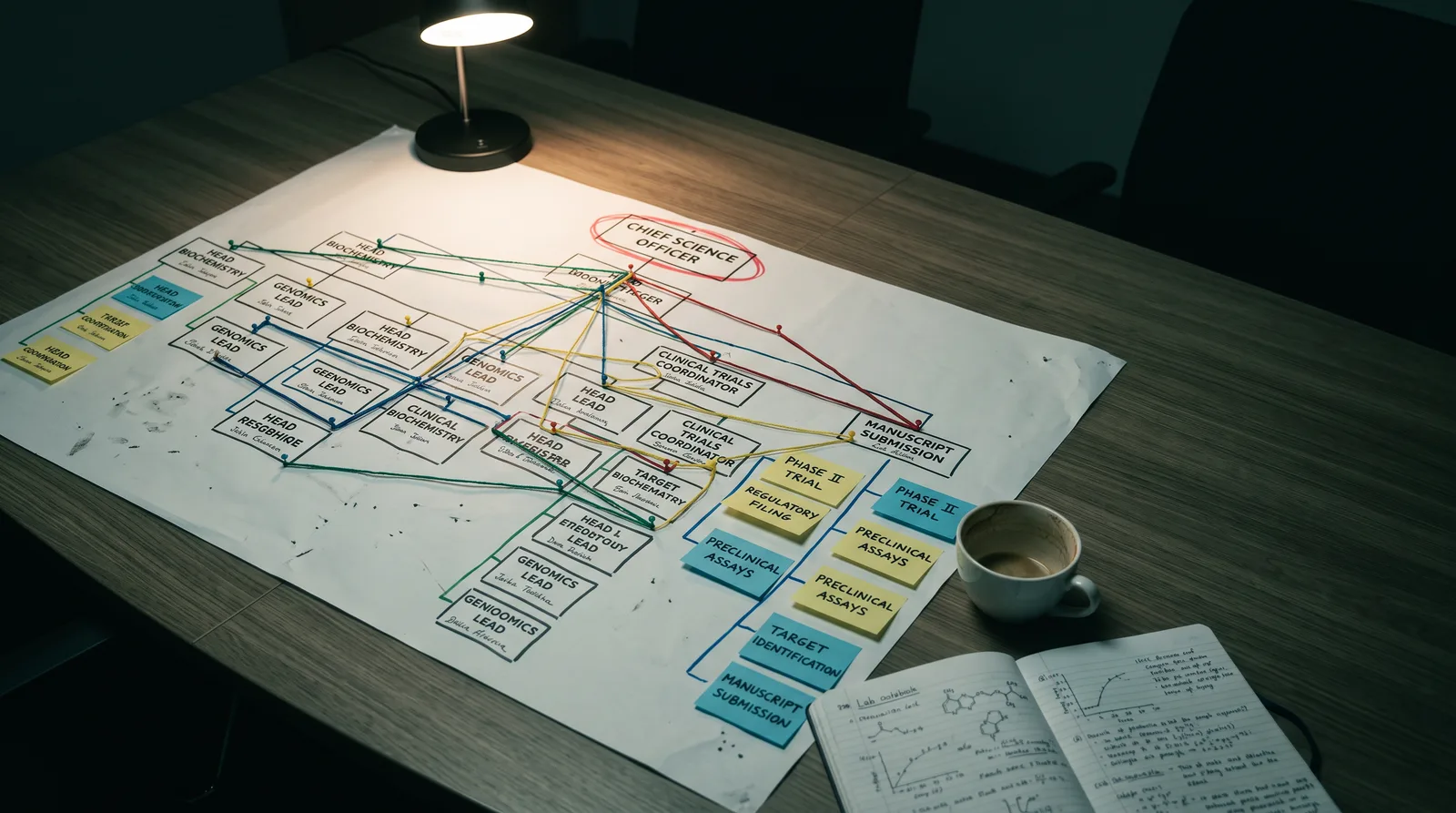
- Apply the Stanford virtual-biotech architecture as a reference model for structuring parallel agent pipelines in your own domain
- Define clear agent role taxonomies (executive, specialist, validator) and wire them into coherent workflows
- Identify the governance and coordination failure modes that emerge at scale — and build the checkpoints that prevent them
- Evaluate when agentic population management outperforms monolithic LLM approaches and articulate the business case to stakeholders
- Ship a working multi-agent system blueprint for a real organizational problem, ready for engineering handoff
How it works
A school that adapts to you
This isn't a set of static videos. Every lesson is generated live and tuned to where you actually are.
We learn your level
A quick placement check tailors your starting point so you're never bored or lost.
Lessons adapt as you go
Each lesson is written for your pace and your goal, adjusting as your skills grow.
Your AI coach keeps you moving
Checkpoints, feedback, and gentle nudges turn progress into a real result.
The curriculum
What's inside your school
0 modules · 0 lessons

The Organizational Turn in Agentic AI
Establishes why the shift from single agents to agent populations changes the fundamental design problem — from prompt engineering to org design.
- 1.1From Chain-of-Thought to Chain-of-CommandIncluded
- 1.2The Stanford Virtual Biotech as a Reference ModelIncluded
- 1.3Agent Design Is Organization DesignIncluded
- 1.4When Agentic Populations Beat Monolithic LLMsIncluded
Agent Role Taxonomy and Team Structures
Teaches how to define, classify, and compose agent roles — executive, specialist, and validator — into coherent team units.
- 2.1The Three-Layer Role Stack: Executive, Specialist, ValidatorIncluded
- 2.2Writing Agent Role SpecificationsIncluded
- 2.3Composing Teams: Pods, Divisions, and Cross-Functional UnitsIncluded
- 2.4Parallel Pipelines vs. Sequential HandoffsIncluded
Orchestration Architecture and Workflow Design
Covers the technical and structural patterns for wiring agent teams into end-to-end workflows that are observable and controllable.
- 3.1Orchestration Patterns: Conductor, Peer Mesh, and HybridIncluded
- 3.2Designing the Chief Agent: Authority, Scope, and LimitsIncluded
- 3.3State Management and Memory Across Agent PopulationsIncluded
- 3.4Handoff Protocols and Inter-Agent ContractsIncluded
- 3.5Observability: Logging, Tracing, and Audit Trails at ScaleIncluded
Governance, Failure Modes, and Coordination Risk
Identifies the systemic failure modes that emerge only at agent-population scale and builds the governance checkpoints that prevent them.
- 4.1The Taxonomy of Multi-Agent Failure ModesIncluded
- 4.2Designing Checkpoints and Human-in-the-Loop GatesIncluded
- 4.3Trust, Permissions, and Agent Authorization ModelsIncluded
- 4.4Conflict Resolution Between Competing Agent OutputsIncluded
- 4.5Responsible Scaling: Bias, Accountability, and AuditabilityIncluded
The Business Case and Stakeholder Strategy
Equips leaders to evaluate, prioritize, and communicate the organizational value of multi-agent systems to technical and non-technical stakeholders.
- 5.1Sizing the Opportunity: Where Agent Populations Create Asymmetric ValueIncluded
- 5.2Total Cost of Orchestration: Beyond API SpendIncluded
- 5.3Pitching Multi-Agent Architecture to Skeptical ExecutivesIncluded
- 5.4Build, Buy, or Partner: Evaluating Orchestration PlatformsIncluded
Blueprint Sprint: Designing Your Multi-Agent System
A structured capstone in which participants apply every prior module to produce a real, engineering-ready multi-agent system blueprint for their own domain.
- 6.1Selecting and Scoping Your Organizational ProblemIncluded
- 6.2Drafting Your Agent Org ChartIncluded
- 6.3Mapping Workflows, Handoffs, and CheckpointsIncluded
- 6.4Stress-Testing: Failure Modes and Mitigation PlansIncluded
- 6.5Presenting Your Blueprint for Engineering HandoffIncluded
Who it's for
Is this you?

VP of Engineering
Leading teams already running AI experiments and needs a principled architecture before the sprawl becomes ungovernable.

AI Product Lead
Owns the roadmap for an agent-powered product and needs to move the design conversation from features to system architecture.

Technical Founder
Building a company whose core infrastructure is agentic and needs the governance and orchestration framework to scale it responsibly.

Enterprise Architect
Responsible for the technical strategy of a large organization and needs to evaluate and design multi-agent systems that integrate with existing structure.

Innovation Executive
Charged with driving AI transformation at the organizational level and needs the business case and blueprint language to lead that mandate.

Senior AI/ML Engineer
Has built agent pipelines but keeps hitting coordination and governance ceilings that pure engineering approaches can't solve alone.
Questions
Frequently asked
Your teacher
A note from your teacher

Val (Valdas) Samonis
If you're reading this, you've probably already moved past the 'AI is coming' phase. You're in the thick of it — evaluating orchestration frameworks, arguing about agent memory architectures in design reviews, trying to explain to your board why 'just using GPT-4' isn't the answer to the problem you're actually solving. I know that position well, because it's the problem that drove me to build this curriculum.
The honest gap I kept running into — in my own work and in conversations with other senior practitioners — wasn't a lack of capability. The tools have gotten remarkably good. The gap was conceptual. We had no principled framework for thinking about what happens when you're not designing a single agent, but an organization of agents. And the people who had solved hard coordination problems at scale — organizational theorists, systems engineers, operations researchers — weren't talking to the AI practitioners building these systems. This school is my attempt to close that gap.
What you'll find here is not a survey of AI trends or a beginner's guide to prompt engineering. It's a rigorous, strategy-first framework built on the insight that multi-agent architecture is, at its core, an organizational design problem. We take that seriously: role taxonomies, authority structures, coordination protocols, governance models, failure mode analysis — all of it borrowed from disciplines that have been solving human-organization problems for decades and applied to the specific constraints of AI agent populations.
The Stanford virtual-biotech simulation is our north star because it validates the approach at a scale most of us won't reach — and forces every design principle to prove itself under extreme conditions. If a coordination mechanism works for 37,000 agents, understanding why it works tells you something durable and transferable. That's the level of intellectual seriousness I've tried to bring to every module.
My ask of you is simply this: come with a real problem. The Blueprint Sprint at the end of this course is not a toy exercise — it's designed to produce something you can hand to an engineering team on Monday morning. The frameworks only become valuable when they're grounded in the actual constraints of your organization. Bring those constraints, and we'll build something worth shipping.
— Val (Valdas) Samonis
Start your journey today
Get instant access — learn at your own pace with an AI coach in your corner.
$100/mo
Recurring billing · cancel anytime
Secure checkout · Instant access
- 6 modules, 27 lessons
- AI-adaptive lessons tuned to your level
- Quizzes & checkpoints to lock in progress
- Your own AI learning coach
- Learn on any device, at your pace
- Full access for as long as you're subscribed