
Master H1 Chemistry. Walk into the A-Levels ready.
A complete, syllabus-mapped journey through every H1 topic — from atomic structure to organic polymers — with exam-focused lessons, worked A-Level questions, and full mock papers designed specifically for Singapore JC students.

"Every H1 Chemistry concept has a moment where it clicks — my job is to get you there before the exam does."
— Tuition on Demand Academy
What you'll learn
What you'll be able to do
- Explain atomic structure, electronic configurations, and isotopes accurately using correct chemical notation and terminology
- Predict and justify bonding type, molecular geometry, and intermolecular forces for a wide range of substances
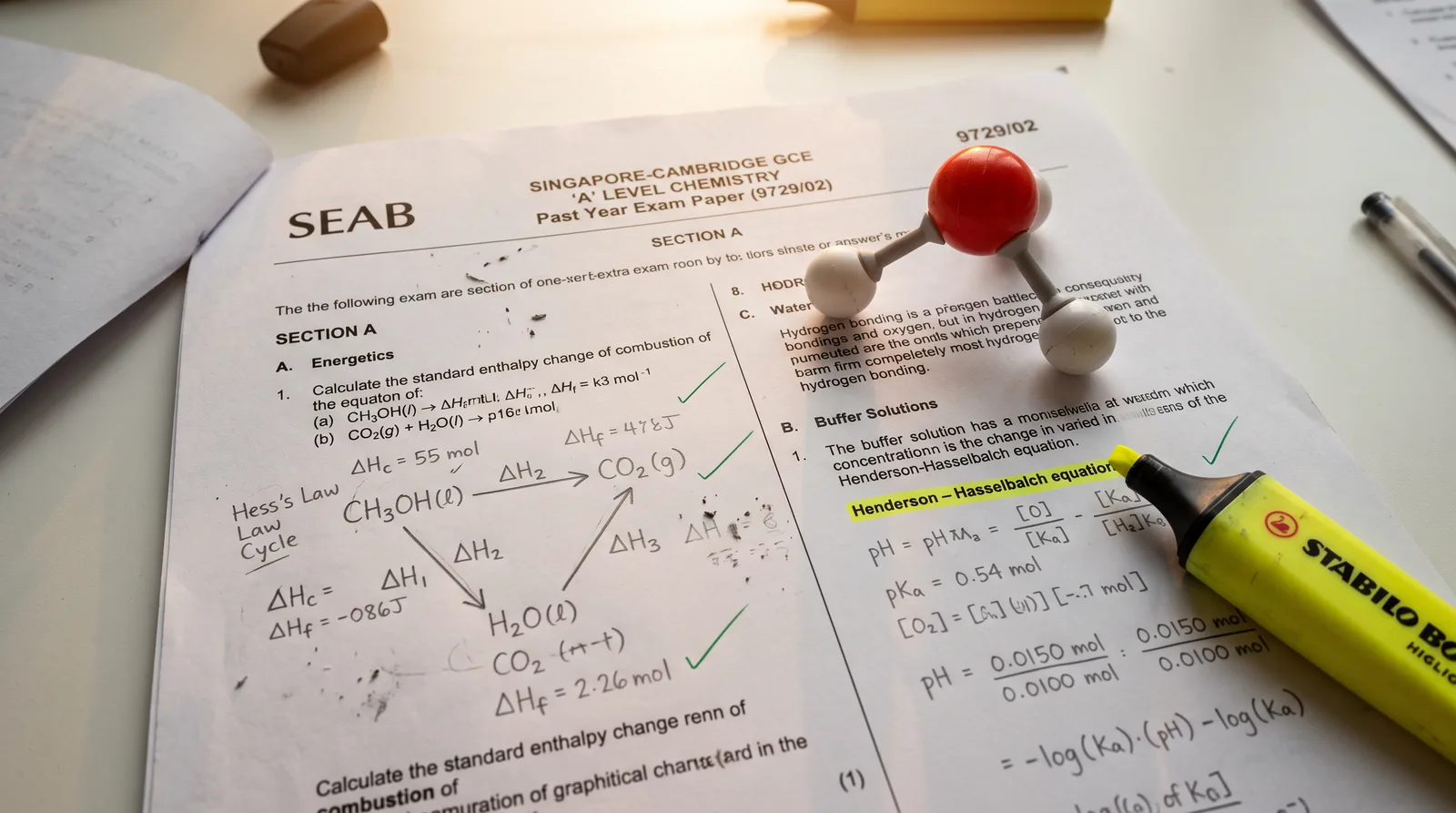
- Perform confident pH and buffer calculations using the Brønsted-Lowry acid-base framework
- Apply Hess's Law, bond energy data, and enthalpy cycle diagrams to solve Chemical Energetics problems
- Analyse reaction kinetics and chemical equilibria — including Kc expressions and Le Chatelier's principle — in the context of real industrial processes
- Attempt and self-assess full MOE H1 A-Level mock papers with detailed worked solutions and examiner-style feedback
How it works
A school that adapts to you
This isn't a set of static videos. Every lesson is generated live and tuned to where you actually are.
We learn your level
A quick placement check tailors your starting point so you're never bored or lost.
Lessons adapt as you go
Each lesson is written for your pace and your goal, adjusting as your skills grow.
Your AI coach keeps you moving
Checkpoints, feedback, and gentle nudges turn progress into a real result.
The curriculum
What's inside your school
11 modules · 68 lessons

Atomic Structure
Build a confident, exam-ready foundation in subatomic particles, isotopes, and electronic configurations using visual models and real A-Level question practice.
- 1.1Meet the Atom: Subatomic Particles & Nuclear StructureIncluded
- 1.2Isotopes: Same Element, Different MassIncluded
- 1.3Electronic Configuration Part 1: Shells & SubshellsIncluded
- 1.4Electronic Configuration Part 2: Orbital Diagrams & ExceptionsIncluded
- 1.5Mass Spectrometry: Interpreting Spectra & Isotope PatternsIncluded
- 1.6Atomic Structure: Exam Skills CheckpointIncluded
Chemical Bonding & Molecular Shapes
Explore ionic, covalent, and metallic bonding, master VSEPR theory for molecular geometry, and understand how intermolecular forces explain physical properties.
- 2.1Ionic Bonding: Crystals, Charges & PropertiesIncluded
- 2.2Covalent Bonding: Sharing is CaringIncluded
- 2.3Metallic Bonding & Comparing Bond TypesIncluded
- 2.4Molecular Shapes with VSEPR TheoryIncluded
- 2.5Intermolecular Forces: van der Waals, Dipole & Hydrogen BondsIncluded
- 2.6Electronegativity, Polarity & Bond PropertiesIncluded
- 2.7Chemical Bonding: Exam Skills CheckpointIncluded
The Mole Concept & Stoichiometry
Develop fluency in mole calculations, equation balancing, and volumetric analysis — the essential quantitative toolkit for every A-Level chemistry topic.
- 3.1The Mole: Counting Atoms in BulkIncluded
- 3.2Molar Mass, Empirical & Molecular FormulaeIncluded
- 3.3Balancing Equations & Reacting QuantitiesIncluded
- 3.4Solutions, Concentration & Titration CalculationsIncluded
- 3.5Limiting Reagents, Yield & Atom EconomyIncluded
- 3.6Stoichiometry: Exam Skills CheckpointIncluded
The Periodic Table & Periodicity
Investigate the periodic trends in physical and chemical properties across Period 3 and connect them to underlying atomic structure — a favourite A-Level essay topic.
- 4.1The Periodic Table: Structure, Trends & Why They MatterIncluded
- 4.2Period 3 Elements: Physical Properties & BondingIncluded
- 4.3Period 3 Oxides: Reactions & Acid-Base CharacterIncluded
- 4.4Period 3 Chlorides & Periodicity PatternsIncluded
- 4.5Periodicity: Exam Skills CheckpointIncluded
Theories of Acids & Bases
Master the Brønsted-Lowry acid-base framework, confidently perform pH and Ka calculations, and design buffer solutions — all tied to exam question styles.
- 5.1Brønsted-Lowry Theory: Proton Donors & AcceptorsIncluded
- 5.2Strong & Weak Acids: Dissociation & KaIncluded
- 5.3pH Calculations for Acids & BasesIncluded
- 5.4Buffer Solutions: How They Work & Why They MatterIncluded
- 5.5Acid-Base Titrations & IndicatorsIncluded
- 5.6Acids & Bases: Exam Skills CheckpointIncluded
Chemical Energetics
Confidently apply Hess's Law, enthalpy cycle diagrams, and bond energy data to solve the full range of A-Level Chemical Energetics problems.
- 6.1Enthalpy Changes: Exothermic, Endothermic & Standard ConditionsIncluded
- 6.2Measuring Enthalpy: Calorimetry CalculationsIncluded
- 6.3Hess's Law & Enthalpy Cycle DiagramsIncluded
- 6.4Bond Energies: Breaking & Making BondsIncluded
- 6.5Chemical Energetics: Exam Skills CheckpointIncluded
Reaction Kinetics
Understand and explain the factors controlling reaction rate, activation energy, and catalysis — and apply them to exam questions set in industrial contexts.
- 7.1Collision Theory & Factors Affecting RateIncluded
- 7.2Activation Energy & Maxwell-Boltzmann DistributionsIncluded
- 7.3Catalysts: Homogeneous, Heterogeneous & EnzymesIncluded
- 7.4Kinetics in Industry: Real-World Exam ContextsIncluded
- 7.5Reaction Kinetics: Exam Skills CheckpointIncluded
Chemical Equilibria
Master dynamic equilibrium, Kc expressions, and Le Chatelier's principle — applying them confidently to industrial and exam contexts.
- 8.1Reversible Reactions & Dynamic EquilibriumIncluded
- 8.2The Equilibrium Constant Kc: Writing & Interpreting ExpressionsIncluded
- 8.3Kc Calculations: Concentrations & ICE TablesIncluded
- 8.4Le Chatelier's Principle: Shifting EquilibriumIncluded
- 8.5Equilibrium in Industry: Haber Process & BeyondIncluded
- 8.6Chemical Equilibria: Exam Skills CheckpointIncluded
Organic Chemistry & Polymers
Introduce key functional groups, isomerism, and addition and condensation polymerisation — building the organic chemistry literacy needed for A-Level extension questions.
- 9.1Introduction to Organic Chemistry: Functional Groups & NomenclatureIncluded
- 9.2Structural Isomerism: Same Formula, Different StructuresIncluded
- 9.3Stereoisomerism: Geometric & Optical IsomersIncluded
- 9.4Alkanes: Free Radical SubstitutionIncluded
- 9.5Alkenes: Electrophilic Addition ReactionsIncluded
- 9.6Halogenoalkanes: Nucleophilic Substitution & EliminationIncluded
- 9.7Alcohols: Oxidation, Esterification & DehydrationIncluded
- 9.8Carbonyl Compounds & Carboxylic Acids: Reactions & TestsIncluded
- 9.9Amines: Structure, Basicity & ReactionsIncluded
- 9.10Addition Polymers: Alkenes to PlasticsIncluded
- 9.11Condensation Polymers: Polyesters & PolyamidesIncluded
- 9.12Organic Chemistry: Exam Skills CheckpointIncluded
Full Mock Examinations & Exam Mastery
Consolidate every topic through two full H1 A-Level mock papers, detailed worked solutions, and targeted revision strategies — so you walk into the real exam feeling ready and confident.
- 10.1Mock Exam 1: Paper Attempt (Full H1 A-Level Format)Included
- 10.2Mock Exam 1: Worked Solutions & Examiner CommentaryIncluded
- 10.3Identifying Your Gaps: Targeted Revision PlanningIncluded
- 10.4Mock Exam 2: Paper Attempt (Full H1 A-Level Format)Included
- 10.5Mock Exam 2: Worked Solutions & Final Examiner FeedbackIncluded
Electrochemistry & Redox
Covers oxidation states, redox reactions, standard electrode potentials, the electrochemical series, and predicting cell feasibility — all heavily examined H1 topics currently missing from the school.
- 11.1Oxidation States & Redox ReactionsIncluded
- 11.2Standard Electrode Potentials & the Electrochemical SeriesIncluded
- 11.3Electrochemical Cells: Calculating E°cell & Predicting FeasibilityIncluded
- 11.4Electrolytic Cells: Electrolysis of Molten & Aqueous SystemsIncluded
- 11.5Electrochemistry: Exam Skills CheckpointIncluded
Who it's for
Is this you?

The JC1 Fresh Starter
Just entered Junior College and wants to build a rock-solid H1 Chemistry foundation from day one, before bad habits set in.

The JC2 Exam Rusher
A-Levels are months away and the syllabus feels only half-consolidated — needs a fast, structured way to fill gaps and attempt full mock papers.

The Calculation-Phobe
Comfortable with theory but freezes on stoichiometry, pH, and Kc calculations — needs step-by-step worked examples that demystify the numbers.

The Self-Study Student
Prefers learning independently over crowded tuition centres, and wants a complete, syllabus-mapped resource she can work through at her own pace.

The Science Stream Balancer
Taking H1 Chemistry alongside heavier H2 subjects and needs focused, efficient lessons that don't eat into time reserved for other papers.

The Confidence Builder
Struggled with secondary school chemistry and enters JC feeling behind — needs clear explanations, encouragement, and proof that the A-Level is genuinely achievable.
Questions
Frequently asked
Your teacher
A note from your teacher
Tuition on Demand Academy
Hey — I see you.
You're juggling lectures, tutorials, common tests, maybe a CCA or two, and somewhere in the middle of all that, you're supposed to become fluent in H1 Chemistry. It can feel like everyone around you either gets it effortlessly or has already given up. If you're somewhere in between — trying hard but not yet confident — I built this school for you.
Here's what I know after teaching JC Chemistry: the students who struggle aren't lacking ability. They're lacking a clear map. The syllabus is broad, the questions are specific, and most resources either go too deep into H2 territory (confusing you with content you don't need) or stay too shallow (leaving you stranded when the actual A-Level question looks nothing like your textbook). What you need is someone who knows exactly where the marks are, explains the concepts so they actually make sense, and then shows you — repeatedly — how to translate that understanding into the answers examiners reward.
That's the promise of this school. We move through every H1 topic in a logical, unhurried sequence. Atomic structure before bonding. Bonding before periodicity. Energetics before kinetics. Each unit builds on the last, and each one ends with an Exam Skills Checkpoint that mimics the real exam — so consolidation happens naturally, not in a panicked rush the week before the papers. By the time you reach the full mock exams, you'll have seen the question types so many times in context that they'll feel familiar, not frightening.
I won't pretend chemistry is always easy. Buffer calculations, enthalpy cycles, Kc expressions, stereoisomerism — some of this genuinely takes effort to internalise. But I also know that every single one of these topics has a moment where it clicks. My job — in every lesson — is to get you to that moment as efficiently and enjoyably as possible. Clear analogies, precise language, real worked examples, and always the honest answer when something is tricky.
You have two years, roughly two hours a week, and a very achievable goal. Let's make every one of those hours count. I'll be right here with you, from the first subatomic particle to the last mark on Mock Exam 2. Let's get to work.
— Tuition on Demand Academy
Start your journey today
Get instant access — learn at your own pace with an AI coach in your corner.
$35/mo
Recurring billing · cancel anytime
Secure checkout · Instant access
- 11 modules, 68 lessons
- AI-adaptive lessons tuned to your level
- Quizzes & checkpoints to lock in progress
- Your own AI learning coach
- Learn on any device, at your pace
- Full access for as long as you're subscribed