
Master H2 Chemistry. Score with confidence.
A complete, syllabus-exact journey through every MOE H2 Chemistry topic — from atomic orbitals to organic synthesis — built for Singapore JC students who want deep understanding, not just memorised facts. 30-minute sessions, real exam questions, and mock papers included.
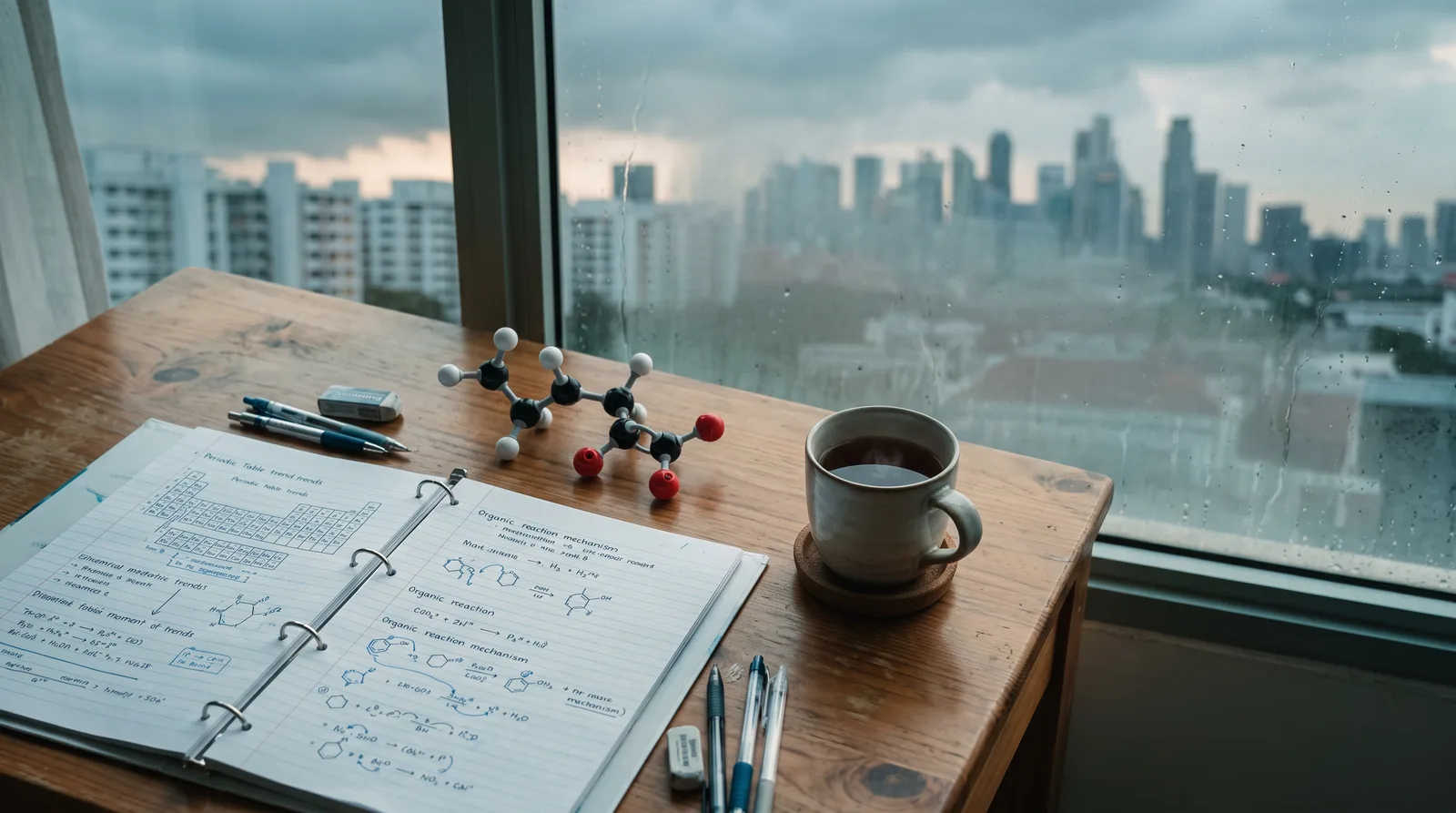
Once you see the logic behind the chemistry, every exam question becomes a puzzle you already know how to solve.
— Tuition on Demand Academy
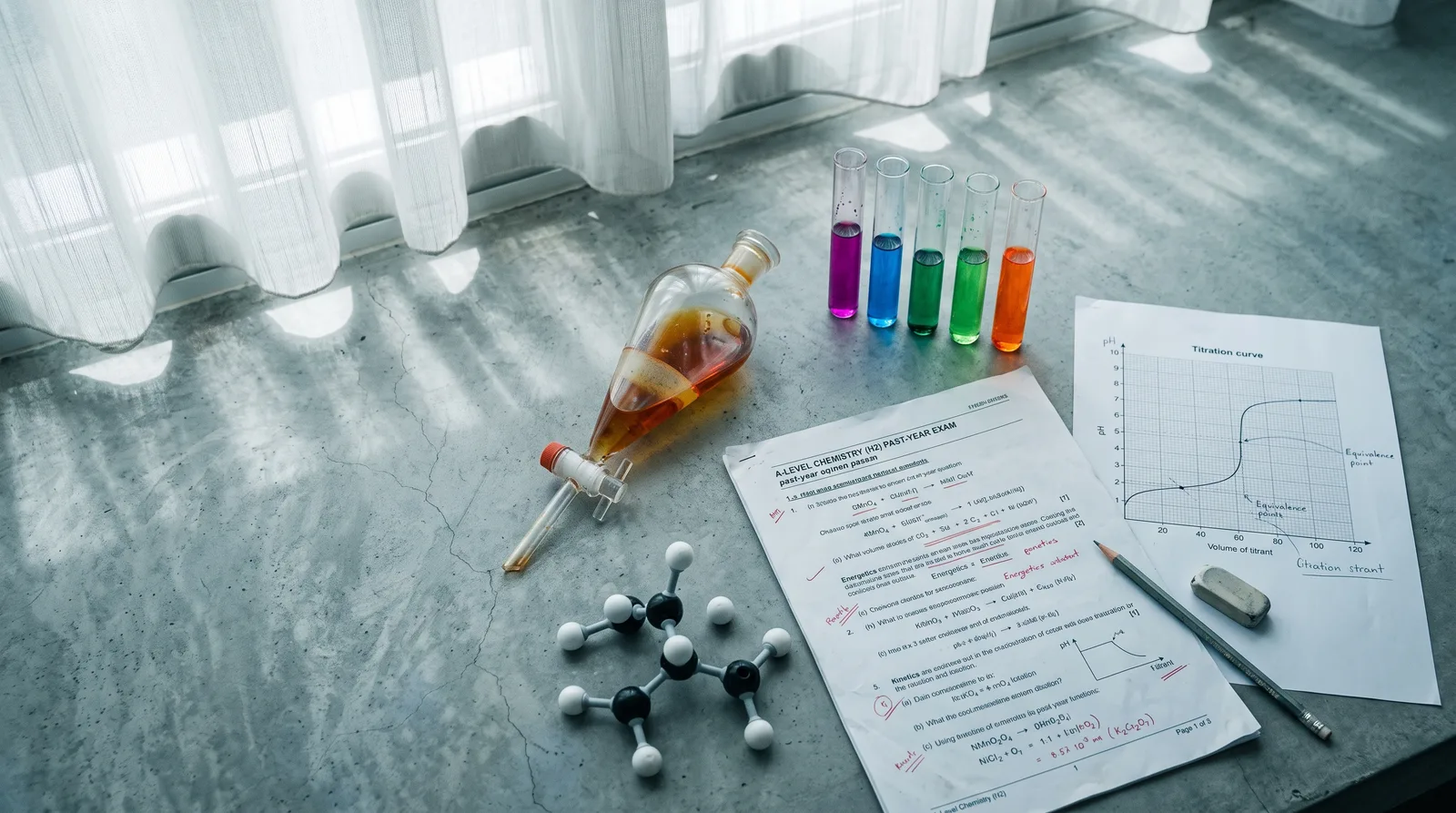
What you'll learn
What you'll be able to do
- Confidently explain and apply atomic structure, orbital theory, molecular shapes, and all major bonding and intermolecular force concepts to unseen exam questions.
- Perform accurate calculations and conceptual reasoning across Energetics (ΔH, ΔS, ΔG, Born-Haber cycles), Kinetics (rate equations, Ea, Boltzmann distributions), and Equilibria (Kc, Kp, Ksp, Le Chatelier's principle).
- Master Acids & Bases and Electrochemistry — including pH and buffer calculations, titration curve interpretation, standard electrode potentials, cell diagrams, and Faraday's electrolysis laws.
- Analyse and predict the physical and chemical behaviour of Period 3 elements, Group 2 metals, Group 17 halogens, and d-block transition metals including complex ion formation and colour.
- Draw mechanisms, name compounds correctly, identify all isomer types, and map the full H2 organic functional-group pathway from alkanes through to amino acids and polymers.
- Tackle full-length H2 Chemistry mock examinations under timed conditions, self-mark against model answers, and apply examiner feedback to close specific knowledge and technique gaps.
How it works
A school that adapts to you
This isn't a set of static videos. Every lesson is generated live and tuned to where you actually are.
We learn your level
A quick placement check tailors your starting point so you're never bored or lost.
Lessons adapt as you go
Each lesson is written for your pace and your goal, adjusting as your skills grow.
Your AI coach keeps you moving
Checkpoints, feedback, and gentle nudges turn progress into a real result.
The curriculum
What's inside your school
7 modules · 55 lessons

Atomic Structure & Chemical Bonding
Builds the foundational picture of atomic orbitals, molecular shapes, and all bonding types that underpin every topic that follows.
- 1.1Inside the Atom: Sub-atomic Particles & Electronic ConfigurationIncluded
- 1.2Atomic Orbitals Up Close: s, p, and d ShapesIncluded
- 1.3Ionic & Covalent Bonding: Sharing vs Transferring ElectronsIncluded
- 1.4Shapes of Molecules: VSEPR Theory in ActionIncluded
- 1.5Intermolecular Forces: van der Waals, Dipole–Dipole & Hydrogen BondingIncluded
- 1.6Bonding & Properties: Giant Structures vs Simple MoleculesIncluded
- 1.7Mass Spectrometry: Interpreting Spectra and Identifying MoleculesIncluded
- 1.8Exam Workshop — Atomic Structure & BondingIncluded
Energetics
Develops rigorous thermochemical reasoning from enthalpy cycles through to Gibbs free energy and spontaneity.
- 2.1Enthalpy Changes: What Is ΔH and Why Does It Matter?Included
- 2.2Hess's Law & Energy Cycles: Building the RoadmapIncluded
- 2.3Born-Haber Cycles: Ionic Lattice Energies Step by StepIncluded
- 2.4Entropy (ΔS): Disorder, Probability, and Chemical ChangeIncluded
- 2.5Gibbs Free Energy (ΔG): Predicting SpontaneityIncluded
- 2.6Exam Workshop — EnergeticsIncluded
Kinetics & Equilibria
Covers reaction rates, rate equations, and both homogeneous and heterogeneous equilibrium systems, woven together as two sides of dynamic chemistry.
- 3.1Collision Theory & the Boltzmann DistributionIncluded
- 3.2Activation Energy & Arrhenius: Putting Numbers to RateIncluded
- 3.3Rate Equations & Orders of ReactionIncluded
- 3.4Reaction Mechanisms & the Rate-Determining StepIncluded
- 3.5Chemical Equilibrium: Kc, Kp, and What They Tell YouIncluded
- 3.6Le Chatelier's Principle & Manipulating EquilibriumIncluded
- 3.7Solubility Product (Ksp) & Precipitation ReactionsIncluded
- 3.8Exam Workshop — Kinetics & EquilibriaIncluded
Acids, Bases & Electrochemistry
Unifies proton-transfer acid-base chemistry and electron-transfer electrochemical systems, both rich with A-Level quantitative questions.
- 4.1Brønsted-Lowry Theory: Acids, Bases & Conjugate PairsIncluded
- 4.2pH Calculations: Strong, Weak, and Mixed SolutionsIncluded
- 4.3Buffer Solutions: How They Work and How to Calculate ThemIncluded
- 4.4Acid-Base Titration Curves: Reading and Interpreting Every ShapeIncluded
- 4.5Standard Electrode Potentials & Electrochemical CellsIncluded
- 4.6Electrolysis: Selective Discharge and Faraday's LawsIncluded
- 4.7Exam Workshop — Acids, Bases & ElectrochemistryIncluded
Inorganic Chemistry: Periodic Trends, Group 2, Group 17 & Transition Elements
Surveys the physical and chemical behaviour of key elements and groups across the Periodic Table, with a strong focus on explaining trends and reactions mechanistically.
- 5.1Period 3 Physical Trends: Structure, Bonding & PropertiesIncluded
- 5.2Period 3 Chemical Trends: Oxides, Chlorides & HydroxidesIncluded
- 5.3Group 2 Alkaline Earth Metals: Trends & Key ReactionsIncluded
- 5.4Group 17 Halogens: Oxidising Power, Displacement & DisproportionationIncluded
- 5.5Transition Elements: Characteristics, Oxidation States & ColourIncluded
- 5.6Complex Ions: Shapes, Ligands & Colour ExplainedIncluded
- 5.7Exam Workshop — Inorganic ChemistryIncluded
Organic Chemistry: Foundations, Mechanisms & Functional Groups
Builds the complete H2 organic chemistry pathway from naming and isomerism through every key mechanism to polymers and amino acids.
- 6.1Naming & Functional Groups: The Language of Organic ChemistryIncluded
- 6.2Structural & Stereo-Isomerism: Spotting Every TypeIncluded
- 6.3Alkanes & Free-Radical Substitution MechanismIncluded
- 6.4Alkenes: Electrophilic Addition & Markovnikov's RuleIncluded
- 6.5Arenes: Electrophilic Substitution & Aromatic StabilityIncluded
- 6.6Halogenoalkanes: SN1, SN2, and EliminationIncluded
- 6.7Hydroxy & Carbonyl Compounds: Reactions and Distinguishing TestsIncluded
- 6.8Carboxylic Acids & Nitrogen Compounds: Amines, Amides & Amino AcidsIncluded
- 6.9Polymers: Addition & Condensation, Properties & Environmental ImpactIncluded
- 6.10Identifying Organic Compounds: Functional Group Tests & AnalysisIncluded
- 6.11Organic Synthesis & Functional-Group Pathway MasteryIncluded
Exam Preparation & Mock Examinations
Consolidates every topic through timed mock papers, self-marking, and targeted examiner-feedback sessions to build peak exam confidence.
- 7.1How the H2 Chemistry Exam Works: Paper 1, 2, 3 DecodedIncluded
- 7.2Command Words & Exam Technique: Writing Answers That ScoreIncluded
- 7.3Experimental Planning & Evaluation: Designing, Executing, and Critiquing InvestigationsIncluded
- 7.4Mock Exam — Paper 1 (MCQ): Full Timed SittingIncluded
- 7.5Mock Exam — Paper 2 (Structured): Full Timed SittingIncluded
- 7.6Mock Exam — Paper 3 (Free Response): Full Timed SittingIncluded
- 7.7Targeted Revision: Closing Your Personal Knowledge GapsIncluded
- 7.8Final Confidence Builder: Mixed-Topic Rapid-Fire RevisionIncluded
Who it's for
Is this you?

JC1 foundation builder
Just starting H2 Chemistry and wants to build genuine understanding from atomic structure upward before bad habits set in.

JC2 revision sprinter
Facing A-Levels in months and needs a structured, exam-aligned way to consolidate every topic and close knowledge gaps fast.

Organic Chemistry struggler
Finds mechanisms confusing and wants a step-by-step, reasoning-first approach that makes SN1, SN2, and electrophilic addition finally click.

Calculations-focused student
Wants to master the quantitative side — Born-Haber cycles, rate equations, pH buffers, and Faraday's laws — with worked examples they can actually reproduce.

Private tutor or educator
Seeking a rigorous, syllabus-exact resource to supplement tutoring sessions with exam-quality worked examples and mock paper material.

Self-studying school leaver
Retaking or self-preparing for the A-Level examination and needs a complete, self-contained H2 Chemistry resource they can work through independently.
Questions
Frequently asked
Your teacher
A note from your teacher
Tuition on Demand Academy
If you've ever stared at an H2 Chemistry question — the kind that asks you to predict a product, justify a trend, or construct an energy cycle from scratch — and felt that sinking feeling of I revised this, so why can't I answer it? — I want you to know that feeling is not a sign that chemistry isn't for you. It's a sign that you haven't yet been shown the underlying logic that makes everything connect. That's what I'm here to fix.
H2 Chemistry is genuinely one of the most concept-rich subjects in the Singapore A-Level curriculum. There's a lot to learn — no point pretending otherwise. But here's what I've come to believe after years of working through this syllabus with students: the difference between a student who scrapes a pass and a student who scores isn't raw intelligence. It's whether they understand the story behind the chemistry, or whether they're just trying to hold disconnected facts in their head long enough to regurgitate them. Memorisation has a ceiling. Understanding doesn't.
That's the philosophy behind every lesson in this school. When we study Energetics, we're not just practising Born-Haber cycles as a procedure — we're building intuition about why ionic lattices form and what that tells us about physical properties. When we move into Organic Chemistry, we treat each mechanism as a piece of detective reasoning: electrons move for reasons, and once you know the reasons, you can predict reactions you've never seen before. Every Exam Workshop lesson takes that understanding and sharpens it against real exam questions, so that the translation from knowing to scoring becomes second nature.
I've designed the lessons to fit the reality of JC life. You have lectures, tutorials, common tests, CCA, and probably about seventeen other things demanding your attention. Thirty minutes per session is the discipline I've built in — enough time to genuinely cover a concept and work through an example, short enough that you can actually fit it in. Progress compounds quickly when you're consistent, even in small doses.
Whether you're a JC1 student meeting orbital theory for the first time, a JC2 student in full revision mode trying to pull everything together, or a school leaver or tutor who wants a rigorous, exam-aligned resource to rely on — this school is built for you. Come with your questions, your confusion, and your curiosity. I promise the chemistry will start making sense. Let's get to work.
— Tuition on Demand Academy
Start your journey today
Get instant access — learn at your own pace with an AI coach in your corner.
$35/mo
Recurring billing · cancel anytime
Secure checkout · Instant access
- 7 modules, 55 lessons
- AI-adaptive lessons tuned to your level
- Quizzes & checkpoints to lock in progress
- Your own AI learning coach
- Learn on any device, at your pace
- Full access for as long as you're subscribed