
Ace H2 Geography at the A-Levels
Structured 30-minute lessons guide you through every MOE H2 Geography cluster — from TNCs and ENSO to climate governance and fieldwork — so you walk into the exam hall knowing exactly what examiners want to see.

Geography explains the world — my job is to make sure you can explain it back to an examiner, brilliantly.
— Tuition on Demand Academy
What you'll learn
What you'll be able to do
- Analyse the causes and consequences of uneven global development, including the roles of TNCs and global production networks, using real A-Level case studies and exam-style responses.
- Explain tropical atmospheric and oceanic systems — including ENSO, tropical cyclones, and drainage basin dynamics — and evaluate strategies for managing tropical hazards.
- Assess the uncertainties, evidence, and contrasting responses surrounding climate change, linking scientific understanding to policy debate at local and global scales.
- Apply sustainable development frameworks to urban growth and resource management challenges, constructing well-structured geographical arguments for essay and data-response questions.
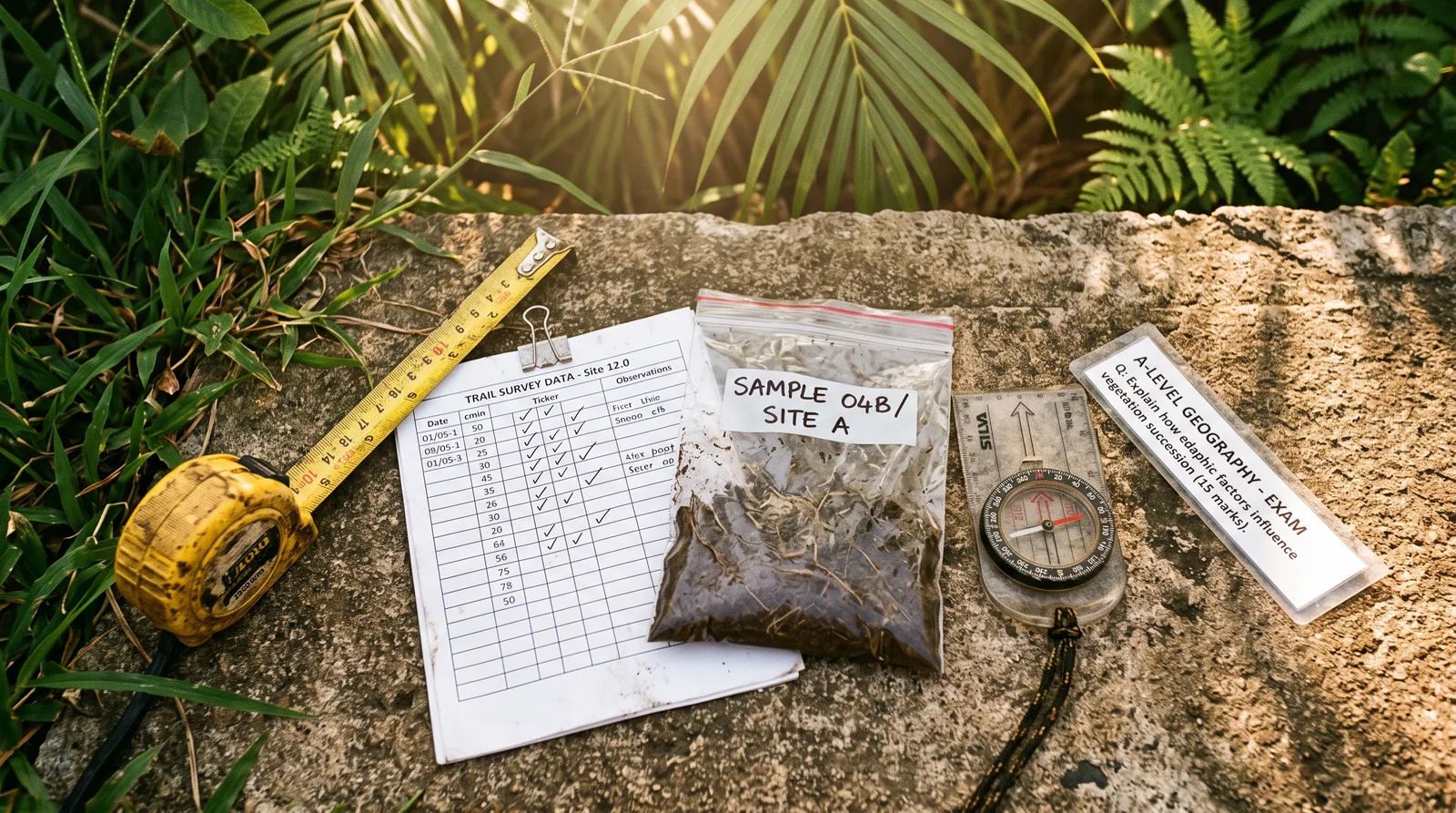
- Design and carry out a geographical investigation: formulate hypotheses, collect primary field data, apply spatial analysis techniques, and write up findings to examination standard.
- Tackle timed mock examinations and past A-Level questions with confidence, using examiner-approved essay structures, command-word strategies, and self-assessment checklists.
How it works
A school that adapts to you
This isn't a set of static videos. Every lesson is generated live and tuned to where you actually are.
We learn your level
A quick placement check tailors your starting point so you're never bored or lost.
Lessons adapt as you go
Each lesson is written for your pace and your goal, adjusting as your skills grow.
Your AI coach keeps you moving
Checkpoints, feedback, and gentle nudges turn progress into a real result.
The curriculum
What's inside your school
9 modules · 63 lessons

Foundations: Thinking Like a Geographer
Builds the conceptual toolkit — Space, Place, Scale, and Environment/Interconnectedness — and introduces A-Level exam skills and command-word strategies.
- 1.1Welcome to H2 GeographyIncluded
- 1.2The Four Big Concepts: Space, Place, Scale & InterconnectednessIncluded
- 1.3Cracking A-Level Command WordsIncluded
- 1.4Building a Geographical ArgumentIncluded
- 1.5Data-Response Skills: Graphs, Maps & StatisticsIncluded
Cluster 1 — Development, Economy and Environment: Global Patterns
Examines the causes and spatial patterns of uneven global development using indicators, theories, and real A-Level case studies.
- 2.1Measuring Development: Indicators Old and NewIncluded
- 2.2Why Development is Uneven: Theories and PerspectivesIncluded
- 2.3Global Trade and the Changing Economic LandscapeIncluded
- 2.4Global Financial Systems: Banks, Debt and the IMFIncluded
- 2.5The Digital Divide and Knowledge EconomiesIncluded
- 2.6Exam Clinic: Uneven Development Essay and Data QuestionsIncluded
Cluster 1 — TNCs, Global Production Networks and the Environment
Analyses how transnational corporations and global production networks drive economic growth while creating environmental and social consequences.
- 3.1What Are TNCs and Why Do They Matter?Included
- 3.2Global Production Networks: How Goods Are MadeIncluded
- 3.3Winners and Losers: Development Impacts of TNCsIncluded
- 3.4Environmental Costs of Economic RestructuringIncluded
- 3.5Corporate Responsibility and Sustainable BusinessIncluded
- 3.6Exam Clinic: TNCs and GPNs Past-Paper PracticeIncluded
Cluster 2 — Tropical Climates, Oceans and Atmospheric Systems
Explores the dynamics of tropical atmospheres and oceans — including the ITCZ, monsoons, ENSO, and tropical cyclones — through videos, diagrams, and exam questions.
- 4.1The Tropical Climate Zone: Characteristics and ControlsIncluded
- 4.2Atmospheric Circulation: ITCZ and MonsoonsIncluded
- 4.3ENSO: El Niño, La Niña and Their Global ImpactsIncluded
- 4.4Indian Ocean Dipole: Ocean–Atmosphere Interactions Beyond ENSOIncluded
- 4.5Tropical Cyclones: Formation, Structure and TracksIncluded
- 4.6Tropical Cyclone Impacts and Case StudiesIncluded
- 4.7Managing Tropical Hazards: Prediction, Preparation and ResponseIncluded
- 4.8Exam Clinic: Tropical Atmospheric Systems QuestionsIncluded
Cluster 2 — Drainage Basin Systems and Tropical Landforms
Investigates the drainage basin as a system, covering fluvial processes, tropical landforms, and integrated hazard management strategies.
- 5.1The Drainage Basin as a SystemIncluded
- 5.2Fluvial Processes: Erosion, Transport and DepositionIncluded
- 5.3Tropical Landforms: Floodplains, Deltas and KarstIncluded
- 5.4Flooding in the Tropics: Causes, Patterns and ImpactsIncluded
- 5.5Integrated Drainage Basin ManagementIncluded
- 5.6Exam Clinic: Drainage Basins and Tropical LandformsIncluded
Cluster 3 — Climate Change: Evidence, Uncertainty and Global Responses
Investigates the scientific evidence for climate change, the debates around uncertainty, and the spectrum of mitigation and adaptation responses at all scales.
- 6.1The Science of Climate Change: Evidence and MechanismsIncluded
- 6.2Uncertainty in Climate Science: Models and ProjectionsIncluded
- 6.3Impacts of Climate Change: Ecosystems, Coasts and PeopleIncluded
- 6.4Ecosystem Services and Biodiversity LossIncluded
- 6.5Mitigation Strategies: Reducing Greenhouse Gas EmissionsIncluded
- 6.6Adaptation Strategies: Living with Climate ChangeIncluded
- 6.7Global Climate Governance: From Kyoto to Paris and BeyondIncluded
- 6.8Singapore's Climate Story: Local Responses at Global ScaleIncluded
- 6.9Exam Clinic: Climate Change Essays and Data QuestionsIncluded
Cluster 3 — Sustainable Urban Development and Resource Management
Applies sustainable development frameworks to the challenges of rapid urbanisation, smart city planning, water, energy, and food resource management.
- 7.1What Is Sustainable Development? Frameworks and DebatesIncluded
- 7.2Urban Growth Patterns and ChallengesIncluded
- 7.3Planning Sustainable Cities: Concepts and Case StudiesIncluded
- 7.4Water Resource Management: Scarcity, Access and SolutionsIncluded
- 7.5Energy Resource Management: Transition to RenewablesIncluded
- 7.6Food Security: Global Patterns and Local SolutionsIncluded
- 7.7Land and Soil as a Resource: Degradation, Desertification and ManagementIncluded
- 7.8Exam Clinic: Sustainable Development and ResourcesIncluded
Cluster 4 — Geographical Investigation and Fieldwork Skills
Guides students through every stage of a geographical investigation — from hypothesis design to spatial analysis and examination-standard write-up.
- 8.1Introduction to Geographical InvestigationIncluded
- 8.2Formulating Research Questions and HypothesesIncluded
- 8.3Planning Primary Data CollectionIncluded
- 8.4Fieldwork Methods: Surveys, Counts and Environmental MeasurementsIncluded
- 8.5Spatial Analysis Techniques: Maps, GIS and StatisticsIncluded
- 8.6Writing Up Findings to Examination StandardIncluded
- 8.7Peer Review and Improving Your InvestigationIncluded
- 8.8Evaluating Secondary Data: Reliability, Validity and LimitationsIncluded
Exam Preparation and Mock Examinations
Consolidates all four clusters through timed mock exams, self-assessment, and targeted revision so students enter the A-Level examination with confidence.
- 9.1Revision Strategy and Study PlanningIncluded
- 9.2Mock Exam 1: Development, Economy and EnvironmentIncluded
- 9.3Mock Exam 2: Tropical EnvironmentsIncluded
- 9.4Mock Exam 3: Sustainable Future and Climate ChangeIncluded
- 9.5Mock Exam 4: Full A-Level SimulationIncluded
- 9.6Examiner Feedback and Common MistakesIncluded
- 9.7Final Boost: Confident, Exam-Ready YouIncluded
Who it's for
Is this you?

The JC1 Early Starter
She's chosen H2 Geography and wants to build strong foundations from Cluster 1 before school lessons race ahead.

The JC2 Revision Sprinter
He knows the content broadly but needs structured exam practice, Exam Clinics, and mock papers to convert knowledge into A-grade answers.

The Essay Technique Seeker
She understands the geography but keeps losing marks on essay structure and command-word responses — and wants a systematic fix.

The GI Stressor
His school fieldwork is coming up and he needs a clear, step-by-step guide to hypotheses, data collection, spatial analysis, and exam-standard write-ups.

The Self-Directed Learner
She prefers learning at her own pace outside the classroom and wants a complete, syllabus-aligned course she can trust to cover everything.

The Content Gap Filler
He's solid in some clusters but has real gaps in tropical systems or climate change, and needs targeted, clear lessons to catch up fast.
Questions
Frequently asked
Your teacher
A note from your teacher
Tuition on Demand Academy
If you're here, there's a good chance you've sat down with your H2 Geography notes at some point and thought: there is so much to know, and I'm not entirely sure what the examiner actually wants from me. That feeling is real — and it's exactly what I built this school to fix.
H2 Geography covers genuinely big ideas. Global inequality. The invisible networks that drive the world economy. The science of a warming planet. The fury of a tropical cyclone and the quiet complexity of a drainage basin. These aren't dry syllabus points — they're the forces shaping the world you're growing up in. I want you to feel that excitement, because students who find the geography interesting consistently write better essays. Curiosity, it turns out, is excellent exam technique.
But curiosity alone doesn't get you an A. What gets you an A is knowing how to take a rich, complex geographical idea and turn it into a focused, well-structured argument that directly answers the question in front of you. That means understanding what assess really demands versus what explain demands. It means knowing which case study to deploy and why. It means building your answer at the right scale — local, national, global — and linking ideas together the way a geographer does. Every lesson in this school is designed around that translation: from understanding the world to writing about it in the way examiners reward.
I've structured the school to match the rhythm of JC life. Lessons run around 30 minutes — long enough to go deep, short enough to fit between tutorials, CCA, and the rest of what you're juggling. Every cluster builds systematically, from foundations to application to exam practice. By the time you hit the mock examination block — four full simulations covering every cluster — you won't be guessing at the format. You'll be performing in it.
One more thing I want to say honestly: this school is a companion, not a shortcut. Doing well at H2 Geography takes genuine engagement with the ideas. But if you show up consistently — working through the lessons, attempting the exam questions, using the checklists to reflect on your own writing — the progress will come. I've seen it happen. I'm here for the whole journey, and I'm genuinely glad you've made a start.
Welcome aboard. Let's do this geography together.
— Tuition on Demand Academy
Start your journey today
Get instant access — learn at your own pace with an AI coach in your corner.
$35/mo
Recurring billing · cancel anytime
Secure checkout · Instant access
- 9 modules, 63 lessons
- AI-adaptive lessons tuned to your level
- Quizzes & checkpoints to lock in progress
- Your own AI learning coach
- Learn on any device, at your pace
- Full access for as long as you're subscribed