
Master H2 History. Walk into the A-Level exam ready.
A complete online school built around Singapore's MOE H2 History Syllabus 9174 — covering every Cold War turning point, every Southeast Asia topic, and every SBCS skill, in clear 30-minute lessons designed to turn confusion into confidence before your Paper 1 and Paper 2.
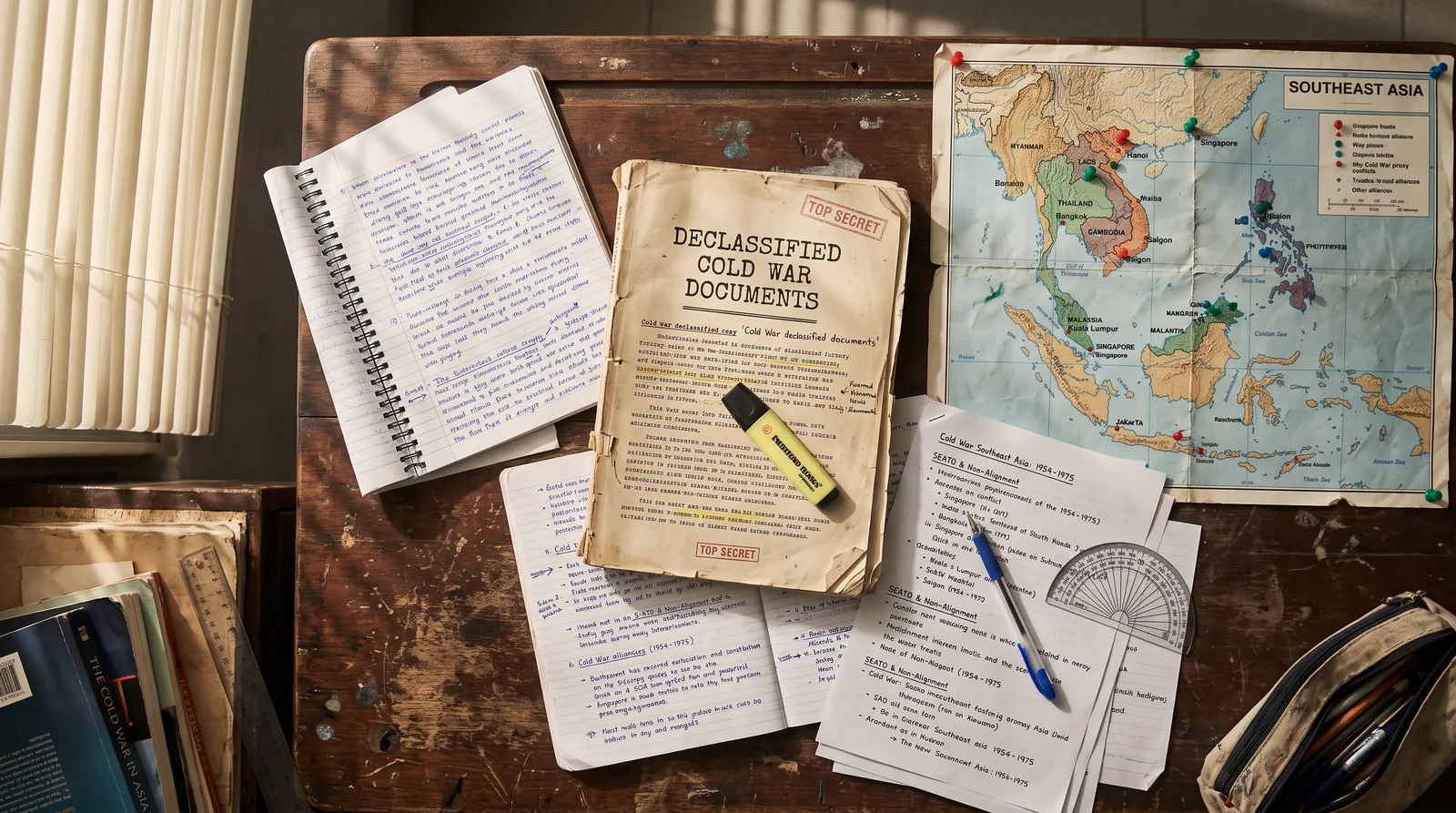
"I built this school because the gap between knowing history and performing it in an exam is a gap every student can close — with the right skills, the right practice, and someone in their corner."
— Tuition on Demand Academy
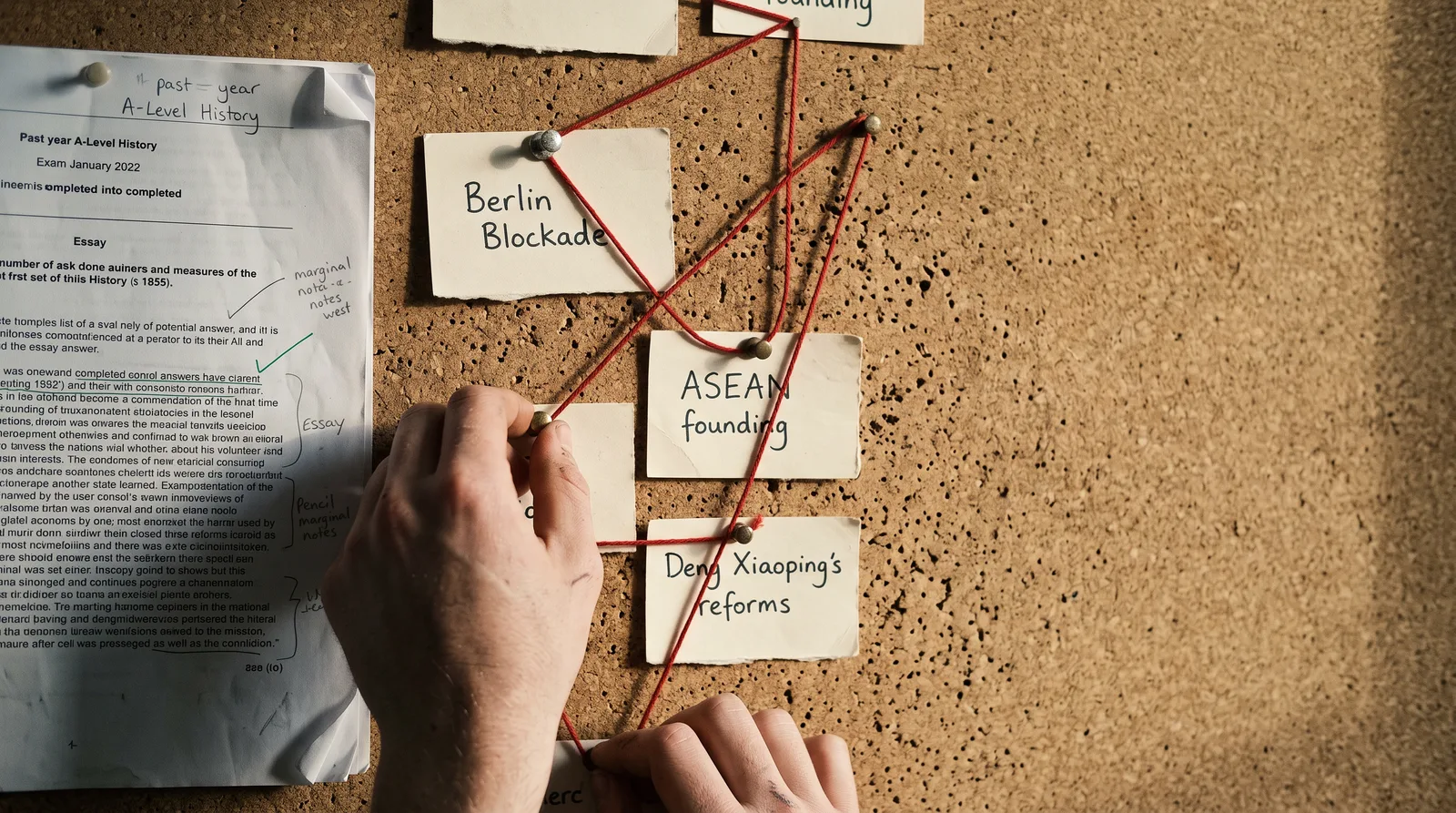
What you'll learn
What you'll be able to do
- Analyse and evaluate primary sources using the full SBCS toolkit — sourcing (purpose and provenance), contextualisation, and corroboration — to score confidently on Paper 1 and Paper 2 source questions.
- Construct well-structured, evidence-rich essays on the Cold War, Global Economy, Conflict and Cooperation, Nation-State formation, and Economic Change in Southeast Asia, matched to A-Level marking criteria.
- Explain and connect the key turning points of the Cold War (1945–1991), from the Truman Doctrine and Korean War to détente, the arms race, and the Soviet collapse.
- Trace the economic and political development of Southeast Asian nations from independence to 2000, including ASEAN's formation, regional conflicts, and economic transformation.
- Tackle real A-Level exam questions with confidence by practising timed mock papers, annotated model answers, and examiner-tip breakdowns for both Paper 1 and Paper 2.
- Apply the broad-hypothesis question strategy for SBCS Part (b), integrating the full source set with background knowledge to build a persuasive, balanced argument under exam conditions.
How it works
A school that adapts to you
This isn't a set of static videos. Every lesson is generated live and tuned to where you actually are.
We learn your level
A quick placement check tailors your starting point so you're never bored or lost.
Lessons adapt as you go
Each lesson is written for your pace and your goal, adjusting as your skills grow.
Your AI coach keeps you moving
Checkpoints, feedback, and gentle nudges turn progress into a real result.
The curriculum
What's inside your school
11 modules · 91 lessons

Welcome to H2 History: Skills, Mindset & the Big Picture
Orients students to the 9174 syllabus structure, assessment format, and the historical thinking habits that underpin every mark they will earn.
- 1.1Your H2 History RoadmapIncluded
- 1.2How Historians ThinkIncluded
- 1.3Reading the Past: Working With Historical SourcesIncluded
- 1.4The SBCS Toolkit OverviewIncluded
- 1.5Writing That Scores: A First Look at H2 EssaysIncluded
Source-Based Case Study Mastery: Paper 1 Skills
Builds every SBCS skill — sourcing, contextualisation, corroboration, and the broad-hypothesis Part (b) — through guided practice with real-style Cold War sources.
- 2.1Sourcing: Who Wrote It and Why Does That Matter?Included
- 2.2Sourcing in Action: Cold War Sources PracticeIncluded
- 2.3Contextualisation: Placing Sources in Their WorldIncluded
- 2.4Contextualisation Practice: From Knowledge to MarksIncluded
- 2.5Corroboration: Comparing Sources Like an ExaminerIncluded
- 2.6Corroboration Workshop: Building a Multi-Source ArgumentIncluded
- 2.7The Broad-Hypothesis Question (Part b): Strategy MasterclassIncluded
- 2.8Part (b) Full Practice: Timed Source Set ChallengeIncluded
- 2.9SBCS Common Mistakes and Examiner TipsIncluded
- 2.10SBCS Mock: Full Paper 1 Source QuestionIncluded
The Cold War (1945–1991): Foundations and Early Confrontations
Traces the ideological split between the superpowers, the key doctrines and crises of the early Cold War, and the global order they created.
- 3.1Why Did the Cold War Begin? Ideologies in ConflictIncluded
- 3.2The Truman Doctrine and Marshall PlanIncluded
- 3.3The Soviet Response: Cominform, Comecon, and the Iron CurtainIncluded
- 3.4Berlin in Crisis: The Blockade and NATO's BirthIncluded
- 3.5The Korean War: Cold War Goes HotIncluded
- 3.6Nuclear Fear: The Arms Race and MADIncluded
- 3.7Crisis Points: Cuba 1962 and the Brink of WarIncluded
- 3.8Essay Skills Workshop: Cold War Causation QuestionsIncluded
- 3.9China as a Cold War Actor: Revolution, Split, and RapprochementIncluded
The Cold War (1945–1991): Détente, Escalation, and Collapse
Covers the shifting dynamics of the Cold War from the 1960s to the Soviet collapse in 1991, including détente, proxy wars, and the end-game.
- 4.1Vietnam and the Limits of Superpower PowerIncluded
- 4.2Détente: Superpowers Step Back from the BrinkIncluded
- 4.3The Second Cold War: Afghanistan and Reagan's ChallengeIncluded
- 4.4Gorbachev, Glasnost, and PerestroikaIncluded
- 4.5The Fall of the Wall and the Soviet Collapse (1989–1991)Included
- 4.6Why Did the Cold War End? Debating the HistoriansIncluded
- 4.7Essay Skills Workshop: Cold War Turning Points and ChangeIncluded
- 4.8Cold War Mock Essay: Timed Full-Length PracticeIncluded
- 4.9The Non-Aligned Movement: Third World Agency in the Cold WarIncluded
The Global Economy (1945–2000): Growth, Institutions, and Crises
Traces the construction of the post-war economic order, the rise of globalisation, and the major crises and transformations that reshaped wealth and trade worldwide.
- 5.1Rebuilding the World: Bretton Woods and the Post-War OrderIncluded
- 5.2The Golden Age of Capitalism (1950s–1970s)Included
- 5.3Oil Shocks and the End of the Golden AgeIncluded
- 5.4The Rise of Neoliberalism: Thatcher, Reagan, and Free MarketsIncluded
- 5.5Globalisation and the New World Economy (1980s–2000)Included
- 5.6Debt, Development, and the Global SouthIncluded
- 5.7The Asian Economic Miracle and the 1997 Financial CrisisIncluded
- 5.8Essay Skills Workshop: Global Economy QuestionsIncluded
- 5.9From GATT to WTO: Trade Liberalisation and Its DiscontentsIncluded
Conflict and Cooperation (1945–2000): The International Stage
Examines the causes, conduct, and outcomes of major international conflicts and the institutions built to manage them, with a focus on essay-relevant debates.
- 6.1The United Nations: Promise and RealityIncluded
- 6.2Decolonisation and the Birth of a Multipolar WorldIncluded
- 6.3The Arab-Israeli Conflict: Wars, Diplomacy, and DeadlockIncluded
- 6.4Regional Conflicts: From Korea to the GulfIncluded
- 6.5Nuclear Non-Proliferation and Arms Control TreatiesIncluded
- 6.6Economic Cooperation: The EEC, OPEC, and BeyondIncluded
- 6.7Essay Skills Workshop: Conflict and Cooperation ArgumentsIncluded
- 6.8Paper 1 Full Mock ExamIncluded
- 6.9The UN in the 1990s: Rwanda, Somalia, and the Limits of PeacekeepingIncluded
Southeast Asia: Independence and Nation-Building
Explores how Southeast Asian nations gained independence, confronted the challenges of nation-state formation, and built political legitimacy in the post-colonial era.
- 7.1The End of Empire in Southeast AsiaIncluded
- 7.2Paths to Independence: Revolution, Negotiation, and WarIncluded
- 7.3The Challenge of Nation-Building: Unity from DiversityIncluded
- 7.4Constitutions, Governments, and Political LegitimacyIncluded
- 7.5The Cold War in Southeast Asia: Ideology and InstabilityIncluded
- 7.6Singapore and Malaysia: Separation and Nation-MakingIncluded
- 7.7The Philippines, Indonesia, and the Strongman StateIncluded
- 7.8Essay Skills Workshop: Nation-State Formation ArgumentsIncluded
Regional Conflicts and Cooperation in Southeast Asia
Covers the Paper 2 SBCS theme, examining the region's major conflicts and the institutions — especially ASEAN — built to manage rivalry and foster cooperation.
- 8.1Sources of Regional Tension: Territorial and Ethnic ConflictsIncluded
- 8.2Konfrontasi: Indonesia, Malaysia, and the Limits of ConfrontationIncluded
- 8.3The Vietnam War and Its Regional Ripple EffectsIncluded
- 8.4Cambodia, the Khmer Rouge, and Regional InterventionIncluded
- 8.5ASEAN's Birth: Why Cooperation Became Possible in 1967Included
- 8.6ASEAN in Action: Managing Disputes and Building NormsIncluded
- 8.7Paper 2 SBCS Skills: Applying the Toolkit to Southeast Asian SourcesIncluded
- 8.8SBCS Part (b) Practice: Regional Conflicts Hypothesis QuestionIncluded
- 8.9The Boat People Crisis and ASEAN's Humanitarian DilemmaIncluded
Economic Change in Southeast Asia After Independence
Traces the economic transformation of Southeast Asian nations from post-colonial poverty to industrialisation, the Asian Miracle, and the 1997 crisis.
- 9.1Post-Colonial Economies: Poverty, Agriculture, and the Development ChallengeIncluded
- 9.2Industrialisation Strategies: Import Substitution vs. Export-Led GrowthIncluded
- 9.3Singapore's Economic Miracle: From Third World to FirstIncluded
- 9.4Malaysia, Thailand, and the Rise of the Tiger EconomiesIncluded
- 9.5Vietnam and Myanmar: Reform, Resistance, and Catch-UpIncluded
- 9.6The 1997 Asian Financial Crisis: Causes, Impact, and RecoveryIncluded
- 9.7Evaluating Economic Change: Winners, Losers, and InequalityIncluded
- 9.8Essay Skills Workshop: Economic Change in Southeast AsiaIncluded
Essay Mastery: Argument, Evidence, and Examination Technique
Develops the advanced essay skills — thesis construction, sustained argument, counter-argument, and conclusion — that separate Band 1 answers from the rest.
- 10.1What Makes a Band 1 Essay? Reading the Mark SchemeIncluded
- 10.2Crafting a Killer Thesis StatementIncluded
- 10.3Building Paragraphs That Actually ArgueIncluded
- 10.4Using Evidence: Facts, Examples, and Historian ViewsIncluded
- 10.5Counter-Argument and Balance Without Losing FocusIncluded
- 10.6Introductions and Conclusions That Earn MarksIncluded
- 10.7Speed and Planning: Writing Well Under Time PressureIncluded
- 10.8Annotated Model Essays: Learning from ExcellenceIncluded
Final Exam Preparation: Mock Papers, Review, and Confidence
Consolidates every skill and topic through full timed mock exams, targeted revision, and confidence-building strategies for the A-Level sitting.
- 11.1Full Paper 2 Mock ExamIncluded
- 11.2Targeted Revision: Cold War and Global EconomyIncluded
- 11.3Targeted Revision: Southeast Asia — Nation-Building and EconomicsIncluded
- 11.4Targeted Revision: All SBCS Skills Under One RoofIncluded
- 11.5Common Exam Mistakes and How to Avoid ThemIncluded
- 11.6Full Paper 1 and Paper 2 Combined Mock ExaminationIncluded
- 11.7Your A-Level Game Plan: Final Tips and EncouragementIncluded
Who it's for
Is this you?

The JC2 on the Clock
With A-Levels approaching, she needs structured revision that covers every topic and every exam skill — fast, without the panic.

The JC1 Building Early
He wants to get ahead of the syllabus now so that essay writing and SBCS feel second nature by the time it truly counts.

The Self-Studying Student
Taking H2 History privately or without reliable school support, she needs a complete, sequenced curriculum she can trust and follow independently.

The H2 History Tutor
He uses the school's SBCS breakdowns, model essays, and examiner tips as a backbone for his own lessons with JC students.

The Supportive Parent
She wants to understand what her child is actually being assessed on and how to encourage smart, consistent revision at home.

The Essay-Anxious Student
She writes long answers that don't quite argue — and she's ready to finally understand what a Band 1 thesis and paragraph actually look like.
Questions
Frequently asked
Your teacher
A note from your teacher
Tuition on Demand Academy
If you're reading this, I'd be willing to guess you already know H2 History isn't the kind of subject you can cram the night before. Maybe you've sat down with your notes, looked at a past-year source question, and felt that sinking feeling — like you know roughly what happened, but you don't quite know how to say it in a way that earns marks. Or maybe you've written an essay that felt thorough and long and right, and then got it back with feedback that still left you unsure what to do differently. I've been there, and I've watched so many bright, hardworking students be there too. That gap between knowing history and performing history in an exam is real — and it's exactly what this school is designed to close.
H2 History asks a lot of you. Paper 1 wants you to handle a set of primary sources with genuine sophistication — not just summarise them, but interrogate them, contextualise them, compare them, and build a persuasive argument using all of them together. Paper 2 wants you to construct well-reasoned, evidence-rich essays on topics that span five decades of Cold War politics, the rise and fall of economic orders, and the extraordinary story of how Southeast Asian nations found their footing after colonialism. That's a lot of ground to cover — and the clock is always ticking. H2 History Mastery is my answer to all of that: a structured, sequenced school that takes you through every skill and every topic, one clear 30-minute lesson at a time, so nothing falls through the cracks.
What I've built here isn't a folder of notes or a playlist of vague revision tips. It's a complete learning journey. You'll start by building your SBCS toolkit from the ground up — learning how to read a source for purpose and provenance, how to place it in historical context, how to corroborate it against other sources, and how to tackle the broad-hypothesis Part (b) with a strategy that actually works. Then we move through the content: the Cold War's great turning points from the Truman Doctrine to the Soviet collapse; the global economy's golden age, its oil-shock crises, and the rise of neoliberalism; the United Nations, decolonisation, and the messy realities of international cooperation; and then Southeast Asia — independence movements, nation-building challenges, ASEAN's formation, Konfrontasi, the Vietnam War's regional ripple effects, Singapore's economic miracle, and the 1997 Financial Crisis. Essay skills workshops are embedded throughout so your writing improves in lockstep with your content knowledge.
I want you to walk into that 3-hour exam feeling genuinely prepared — not just hoping for the best, but with a clear plan for every question type, a strong sense of what Band 1 looks like, and the muscle memory that comes from having practised timed mocks and studied annotated model answers. The final unit is dedicated entirely to pulling it all together: full mock papers, targeted revision, examiner mistake breakdowns, and a personal game plan for exam day. Every small win along the way — every source question you crack, every essay paragraph that actually argues — matters, and I'll be celebrating them with you.
This school is for JC1 students who want to start strong, JC2 students who want to finish stronger, self-studiers who need a clear road map, and anyone supporting a student through this syllabus. However you've arrived here, I'm glad you did. Let's do this together.
— Tuition on Demand Academy
Start your journey today
Get instant access — learn at your own pace with an AI coach in your corner.
$35/mo
Recurring billing · cancel anytime
Secure checkout · Instant access
- 11 modules, 91 lessons
- AI-adaptive lessons tuned to your level
- Quizzes & checkpoints to lock in progress
- Your own AI learning coach
- Learn on any device, at your pace
- Full access for as long as you're subscribed