Finally understand how AI actually works
A clear, jargon-free guide to how artificial intelligence actually works — from the history of the field to the core concepts powering today's tools. No coding required, no hype, just genuine understanding.

"I want you to leave not just knowing more about AI, but thinking more clearly about it — and those aren't the same thing."— Carla Paton
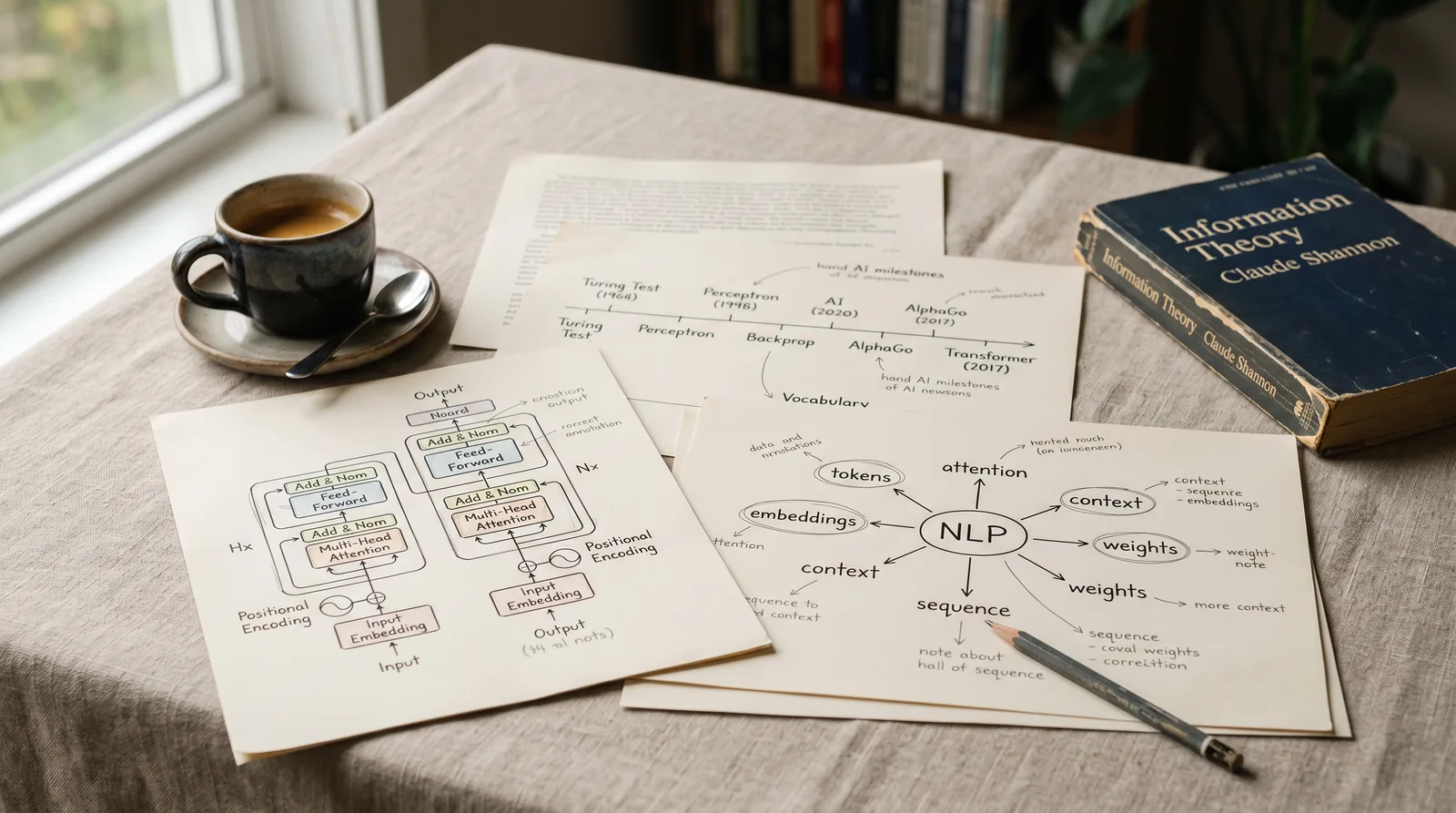
What you'll learn
What you'll be able to do
- Explain in plain language how machine learning, neural networks, and large language models actually work
- Trace the full history of AI from Alan Turing and symbolic systems to modern transformers and frontier models
- Confidently define and use core AI vocabulary — RAG, embeddings, tokens, context windows, agents, and more
- Understand why AI halluccinates, how inference differs from training, and what fine-tuning really changes
- Evaluate AI tools and vendor claims with a critical, informed eye rather than accepting marketing at face value
- Communicate AI concepts clearly to colleagues, clients, or leadership — bridging the gap between technical teams and everyone else
How it works
A school that adapts to you
This isn't a set of static videos. Every lesson is generated live and tuned to where you actually are.
We learn your level
A quick placement check tailors your starting point so you're never bored or lost.
Lessons adapt as you go
Each lesson is written for your pace and your goal, adjusting as your skills grow.
Your AI coach keeps you moving
Checkpoints, feedback, and gentle nudges turn progress into a real result.
The curriculum
What's inside your school
3 modules · 14 lessons

The History of Artificial Intelligence
Before diving into how AI works, learners first understand where it came from — grounding every modern concept in the intellectual journey that produced it. This historical lens prevents the 'AI is magic' mindset and makes the technical modules that follow feel inevitable rather than arbitrary.
- 1.1The Dream of Thinking MachinesIncluded
- 1.2Symbolic AI, Expert Systems, and the AI WintersIncluded
- 1.3The Rise of Machine Learning and Deep LearningIncluded
- 1.4Transformers, ChatGPT, and the Modern AI EraIncluded
How Artificial Intelligence Actually Works
The conceptual engine of the course. Learners build an accurate, non-mathematical mental model of machine learning, neural networks, and large language models — plus the critical distinctions (training vs. inference, hallucination causes) that let them evaluate AI behaviour and vendor claims with confidence.
- 2.1What Machine Learning Really IsIncluded
- 2.2Neural Networks Without the MathIncluded
- 2.3How Language Models WorkIncluded
- 2.4Training vs. Inference — and Why It MattersIncluded
- 2.5Why AI HallucinatesIncluded
The Language of AI
Equips learners with confident command of the vocabulary they will encounter in vendor conversations, job descriptions, news articles, and internal strategy documents. Every term is taught in context — not as a glossary entry, but as a functional concept that connects to the mental models built in the previous two modules.
- 3.1Tokens, Embeddings, and Vector DatabasesIncluded
- 3.2Context Windows, RAG, and MemoryIncluded
- 3.3Fine-Tuning — What It Really ChangesIncluded
- 3.4AI Agents — How They Actually WorkIncluded
- 3.5Multimodal AI and the Expanding FrontierIncluded
Who it's for
Is this you?

The Curious Manager
You make decisions that involve AI tools and teams, and you're tired of nodding along — you want the real understanding that lets you ask the right questions and spot vendor hype.

The Content Marketer
You use AI to write, ideate, and produce every day, and you want to understand what's actually happening so you can use it smarter and explain it confidently to clients.

The Strategy Consultant
You advise organisations on AI adoption and need a rigorous, honest mental model — not marketing talking points — to give your clients genuinely useful guidance.

The Knowledge Worker
AI has landed in the middle of your workflow and you want to move from vague familiarity to real comprehension, so you can evaluate what it's doing and when to trust it.

The Lifelong Learner
You're deeply curious about one of the most consequential technologies of your lifetime and you want to understand it properly — not through hype, but through clear, honest explanation.

The Non-Technical Founder
You're building with or around AI and need to communicate fluently with engineers, evaluate technical decisions, and see through the noise — without writing a single line of code.
Questions
Frequently asked
Your teacher
A note from your teacher

Carla Paton
If you've ever nodded along in a meeting while someone talked about embeddings or RAG or transformer architectures — and then quietly Googled them afterwards — I built this course for you.
There's nothing wrong with that experience. AI has moved extraordinarily fast, and the explanations that exist online tend to be either so technical they assume a computer-science background, or so shallow they leave you with nothing more than a few buzzwords and a vague sense of optimism. Neither is actually useful. What you need — what most people need — is someone to sit down with you and explain it clearly, in the right order, at the right depth. That's what I've tried to do here.
This course covers everything I think an intelligent, curious non-engineer needs to genuinely understand AI. We start at the beginning: Alan Turing, the dream of thinking machines, the long decades of symbolic AI and expert systems, the AI winters when the field nearly collapsed under the weight of its own promises. We work our way forward through the rise of machine learning and deep learning, and we arrive at the transformer architecture and the large language models that are reshaping how knowledge work gets done. The history isn't just background colour — it's where the intuition lives. Once you understand why previous approaches failed, today's systems make sense in a way they simply don't without that context.
From there, we get into how these systems actually work: what machine learning really is (it's simpler than you think, and stranger), what a neural network is doing when it processes your words, what the difference between training and inference means for how you use and trust these tools, and why hallucinations aren't a bug that's about to be fixed — they're a consequence of how the systems are built. We finish with the language of AI: tokens, embeddings, context windows, RAG, fine-tuning, agents, multimodal models. Not the glossary definitions — the real explanations.
I want you to finish this course and feel the difference immediately. Not just in conversations about AI, but in how you read product announcements, evaluate vendor claims, and think about where these tools are genuinely useful versus where they're being oversold. That critical, grounded perspective is rare, and it's more valuable than knowing any particular prompt trick.
If you've been waiting until you had time to "really learn this stuff" — this is that time, and this is that course. Come in curious. You'll leave genuinely informed.
— Carla Paton
Start your journey today
Join get instant access — learn at your own pace with an AI coach in your corner.
$29/mo
Recurring billing · cancel anytime
Secure checkout · Instant access
- 3 modules, 14 lessons
- AI-adaptive lessons tuned to your level
- Quizzes & checkpoints to lock in progress
- Your own AI learning coach
- Learn on any device, at your pace
- Full access for as long as you're subscribed