Master AI from first principles to frontier models
A rigorous, college-level curriculum — search algorithms, probabilistic reasoning, deep learning, transformers, reinforcement learning, and AI safety — taught by an AI professor with the mathematical precision of a top CS program, on your own schedule.

My job isn't to make AI feel easy — it's to make the hard parts genuinely, permanently clear.
— AI Professor Courses
What you'll learn
What you'll be able to do
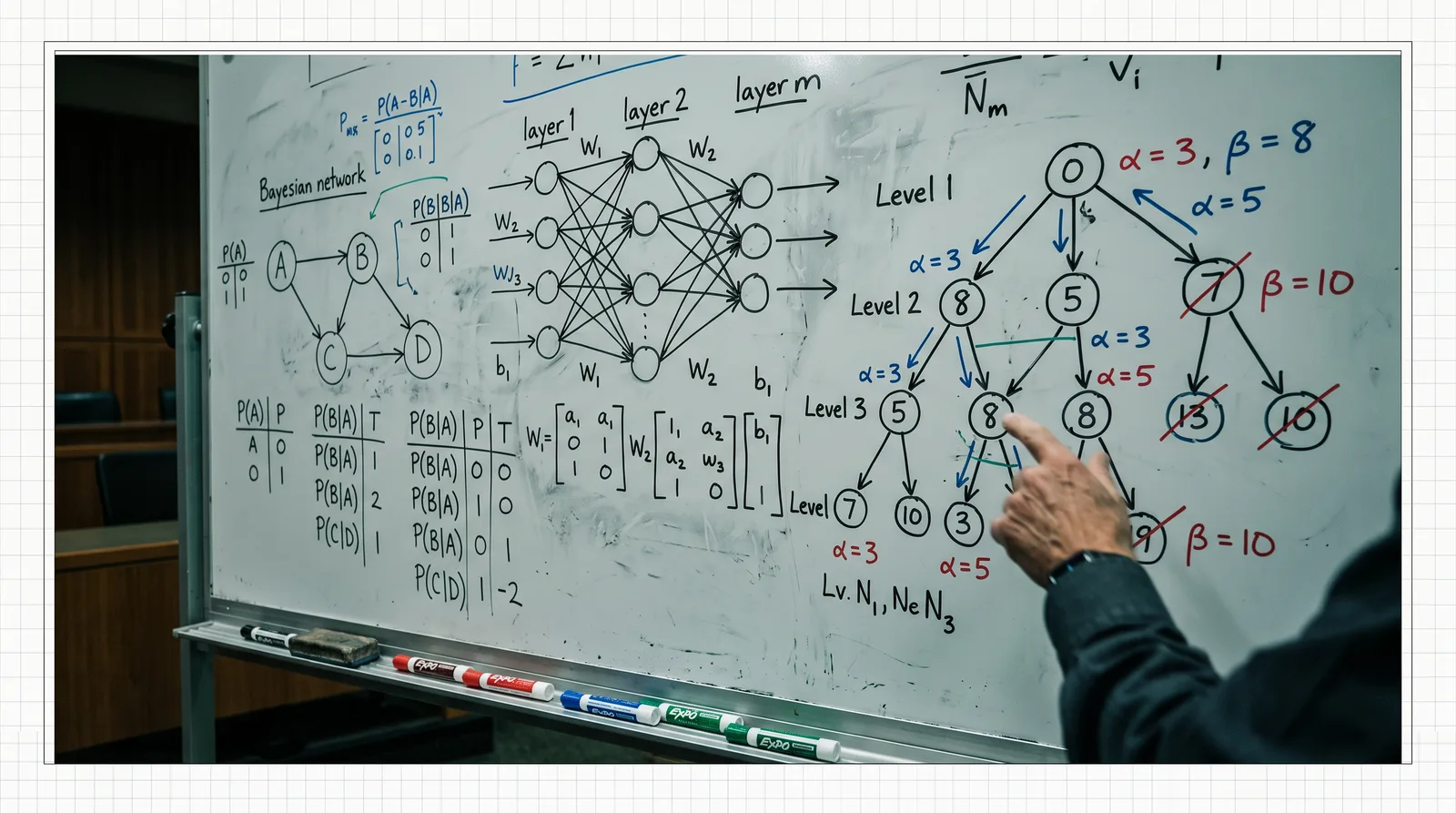
- Implement and compare classical search algorithms — DFS, BFS, A*, and Alpha-Beta Pruning — and select the right strategy for a given problem
- Build and query Bayesian networks, apply variable elimination, and reason correctly under uncertainty using probabilistic graphical models
- Train, regularize, and evaluate supervised and unsupervised machine learning models, diagnosing overfitting using PAC learning and VC dimension concepts
- Construct and train deep neural networks — CNNs, RNNs, and Transformers — using backpropagation, Adam optimization, and modern regularization strategies
- Architect and fine-tune Large Language Models, implement RAG pipelines with vector databases, and apply PEFT/LoRA for efficient domain adaptation
- Design reinforcement learning agents using Q-Learning, Deep Q-Networks, and PPO, and critically evaluate AI systems for safety, bias, fairness, and alignment
How it works
A school that adapts to you
This isn't a set of static videos. Every lesson is generated live and tuned to where you actually are.
We learn your level
A quick placement check tailors your starting point so you're never bored or lost.
Lessons adapt as you go
Each lesson is written for your pace and your goal, adjusting as your skills grow.
Your AI coach keeps you moving
Checkpoints, feedback, and gentle nudges turn progress into a real result.
The curriculum
What's inside your school
7 modules · 38 lessons

Foundations of Artificial Intelligence & Search
Establishes the core philosophy, history, and agent-based framing of AI, then builds a thorough toolkit of classical search strategies from blind to adversarial.
- 1.1Introduction to AI: History, Turing Test, Rational Agents, and Agent ArchitecturesIncluded
- 1.2Uninformed (Blind) Search: DFS, BFS, and Uniform Cost SearchIncluded
- 1.3Informed (Heuristic) Search: Greedy Best-First, A*, Admissibility, and ConsistencyIncluded
- 1.4Local Search & Optimization: Hill Climbing, Simulated Annealing, and Genetic AlgorithmsIncluded
- 1.5Adversarial Search & Game Theory: Minimax, Alpha-Beta Pruning, and MCTSIncluded
- 1.6Constraint Satisfaction Problems: Backtracking, Arc Consistency, and Forward CheckingIncluded
Knowledge Representation, Logic, & Automated Reasoning
Equips students to encode world knowledge formally — from propositional and first-order logic through probabilistic graphical models — and to derive sound conclusions automatically.
- 2.1Propositional Logic: Syntax, Semantics, Entailment, Validity, and SatisfiabilityIncluded
- 2.2Inference Rules & Proof Systems: Resolution, Forward Chaining, and Backward ChainingIncluded
- 2.3First-Order Logic: Quantifiers, Unification, and Knowledge EngineeringIncluded
- 2.4Knowledge Graphs & Ontologies: Semantic Networks, Description Logics, and RDFIncluded
- 2.5Reasoning Under Uncertainty: Probabilistic Reasoning, Joint Distributions, and IndependenceIncluded
- 2.6Bayesian Networks: Structure, Conditional Independence, Variable Elimination, Sampling, and MCMCIncluded
Machine Learning Mechanics & Optimization
Develops the mathematical and algorithmic foundations of classical machine learning, from core supervised and unsupervised methods through learning theory and the optimization engines that power them.
- 3.1Supervised Learning Foundations: Linear & Logistic Regression, Decision Trees, and k-NNIncluded
- 3.2Unsupervised Learning: k-Means Clustering, Expectation-Maximization, and PCAIncluded
- 3.3Probabilistic Machine Learning: Naive Bayes, Maximum Likelihood Estimation, and MAPIncluded
- 3.4Learning Theory & Model Assessment: Generalization, Overfitting, PAC Learning, and VC DimensionIncluded
- 3.5Mathematical Optimization: Convex Optimization, Gradient Descent Variants, and Lagrange MultipliersIncluded
Deep Learning & Neural Architectures
Constructs modern deep learning systems from first principles — building through backpropagation and optimization to the specialized CNN and sequence architectures that power real-world AI.
- 4.1Artificial Neural Networks: Multi-Layer Perceptrons and Activation FunctionsIncluded
- 4.2Mechanics of Deep Learning: Computational Graphs, Chain Rule, and BackpropagationIncluded
- 4.3Deep Learning Optimization: SGD, Momentum, Adam, and RMSpropIncluded
- 4.4Regularization Strategies: Dropout, Batch Normalization, L1/L2 Weight Decay, and Early StoppingIncluded
- 4.5Computer Vision: CNNs, Pooling, ResNet, and EfficientNetIncluded
- 4.6Sequence Models: RNNs, LSTMs, and Gated Recurrent UnitsIncluded
Natural Language Processing, Transformers, & Generative AI
Progresses from classical text representations through the Transformer revolution to large language models, generative architectures, and production RAG systems.
- 5.1Classical NLP & Embeddings: Tokenization, TF-IDF, Vector Space Models, Word2Vec, and GloVeIncluded
- 5.2Attention & Sequence-to-Sequence Models: Bahdanau, Luong, and Self-Attention MechanicsIncluded
- 5.3The Transformer Architecture: Encoder-Decoder Networks, Multi-Head Attention, and Positional EncodingIncluded
- 5.4Large Language Models: Pre-training, Fine-Tuning, Instruction Tuning, and PEFT/LoRAIncluded
- 5.5Generative Models: Variational Autoencoders, GANs, and Diffusion ModelsIncluded
- 5.6Applied GenAI Frameworks: Retrieval-Augmented Generation and Vector DatabasesIncluded
Reinforcement Learning & Sequential Decision-Making
Develops the theory and algorithms for learning through interaction — from Markov decision processes and dynamic programming through deep RL agents and multi-agent game theory.
- 6.1Markov Decision Processes: States, Actions, Rewards, Transition Probabilities, and Discount FactorsIncluded
- 6.2Dynamic Programming: Bellman Equations, Value Iteration, and Policy IterationIncluded
- 6.3Model-Free Reinforcement Learning: TD Learning, Q-Learning, and SARSAIncluded
- 6.4Deep Reinforcement Learning: Deep Q-Networks, Policy Gradients, and PPOIncluded
- 6.5Multi-Agent Systems & Game Theory: Nash Equilibrium and Cooperative vs. Competitive EnvironmentsIncluded
AI Safety, Alignment, Ethics, & Governance
Examines the societal responsibilities of AI practitioners — covering bias, fairness, interpretability, alignment, adversarial robustness, and privacy-preserving techniques.
- 7.1Algorithmic Bias, Fairness Metrics, and Bias Mitigation TechniquesIncluded
- 7.2Explainable & Interpretable AI: Feature Attribution, SHAP, and LIMEIncluded
- 7.3AI Alignment & Safety: RLHF, Constitutional AI, and Red TeamingIncluded
- 7.4Security & Privacy: Adversarial Attacks, Differential Privacy, and Federated LearningIncluded
Who it's for
Is this you?

CS undergraduates
Supplements or outpaces a university AI course with the mathematical depth and worked examples lecture slides rarely include.

Software engineers leveling up
Builds the rigorous theoretical foundation that on-the-job ML experience assumed but never formally taught.

Graduate students & researchers
Provides a structured, comprehensive reference across classical AI, deep learning, and alignment for those who need the full picture.

Bootcamp graduates going deeper
Replaces surface-level 'call the API' familiarity with genuine understanding of why models work — and when they don't.

STEM professionals pivoting to AI
Leverages existing mathematical maturity to fast-track a rigorous, first-principles understanding of the entire AI stack.

Tech leads & AI practitioners
Sharpens the theoretical grounding needed to evaluate architectures, diagnose failures, and make defensible design decisions.
Questions
Frequently asked
Your teacher
A note from your teacher
AI Professor Courses
If you've landed here, I suspect you're frustrated.
Maybe you've finished a popular ML course and can call model.fit() — but when a colleague asks you why you chose that architecture, or what your validation curve is actually telling you, you find yourself reaching for phrases that feel borrowed rather than understood. Maybe you're a CS student whose program moves too fast through the theory and too slowly through the parts that actually excite you. Maybe you're an engineer who's been handed a production AI system and realizes, with some alarm, that you're not entirely sure what's happening inside it.
That gap between familiarity and genuine understanding is exactly what this curriculum is designed to close.
I built The AI Professor because I believe the mathematical foundations of AI — the ones that textbooks like Russell & Norvig or Bishop treat seriously — are not optional enrichment for specialists. They are the difference between a practitioner who can adapt when a model fails and one who can only re-run the pipeline and hope. When you understand why A* is optimal under admissibility, you can reason about search problems you've never seen before. When you've worked through the derivation of backpropagation on a computational graph, debugging a gradient-flow issue stops being guesswork. When you know what RLHF is actually doing under the hood, you can evaluate an AI safety claim on its merits.
The curriculum covers the full intellectual arc of the field — from rational agents and propositional logic through Bayesian networks, deep learning, transformers, large language models, reinforcement learning, and AI alignment. Each unit is built the way a demanding but fair professor would build it: state the problem precisely, develop the formalism, work through canonical examples, and then ask the hard follow-up questions that reveal whether you've understood the idea or merely memorized it. There are no shortcuts, but there is always an honest attempt to show you the intuition living inside the mathematics.
This is the course I wish had existed when I was working to understand this field at depth. If you're ready to do the real intellectual work — to sit with a derivation until it clicks, to implement an algorithm from its equations rather than from a template — then I'll see you in the first lecture. The coffee is on you.
— AI Professor Courses
Start your journey today
Get instant access — learn at your own pace with an AI coach in your corner.
$5/mo
Recurring billing · cancel anytime
Secure checkout · Instant access
- 7 modules, 38 lessons
- AI-adaptive lessons tuned to your level
- Quizzes & checkpoints to lock in progress
- Your own AI learning coach
- Learn on any device, at your pace
- Full access for as long as you're subscribed