Understand the universe — rigorously
A full college-level astronomy education, from the physics of light to the fate of the cosmos — taught by an AI professor who makes every lecture feel like the best class you ever attended. No science degree required. Intellectual curiosity is enough.
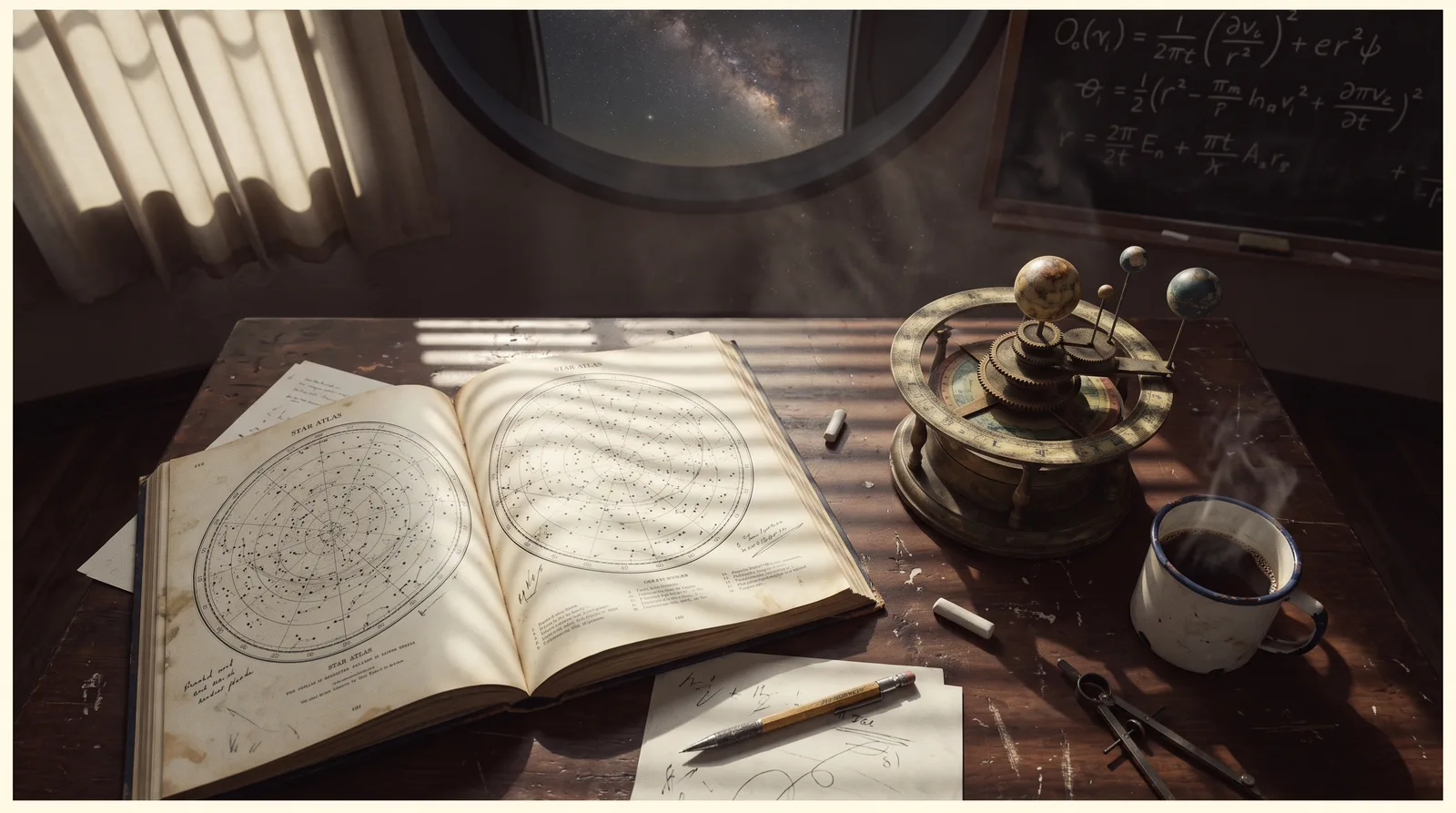
"Wonder got you here — but understanding is what I'm going to give you."
— AI Professor Courses
What you'll learn
What you'll be able to do
- Explain the life cycle of stars — from nebula to neutron star or black hole — using correct astrophysical terminology
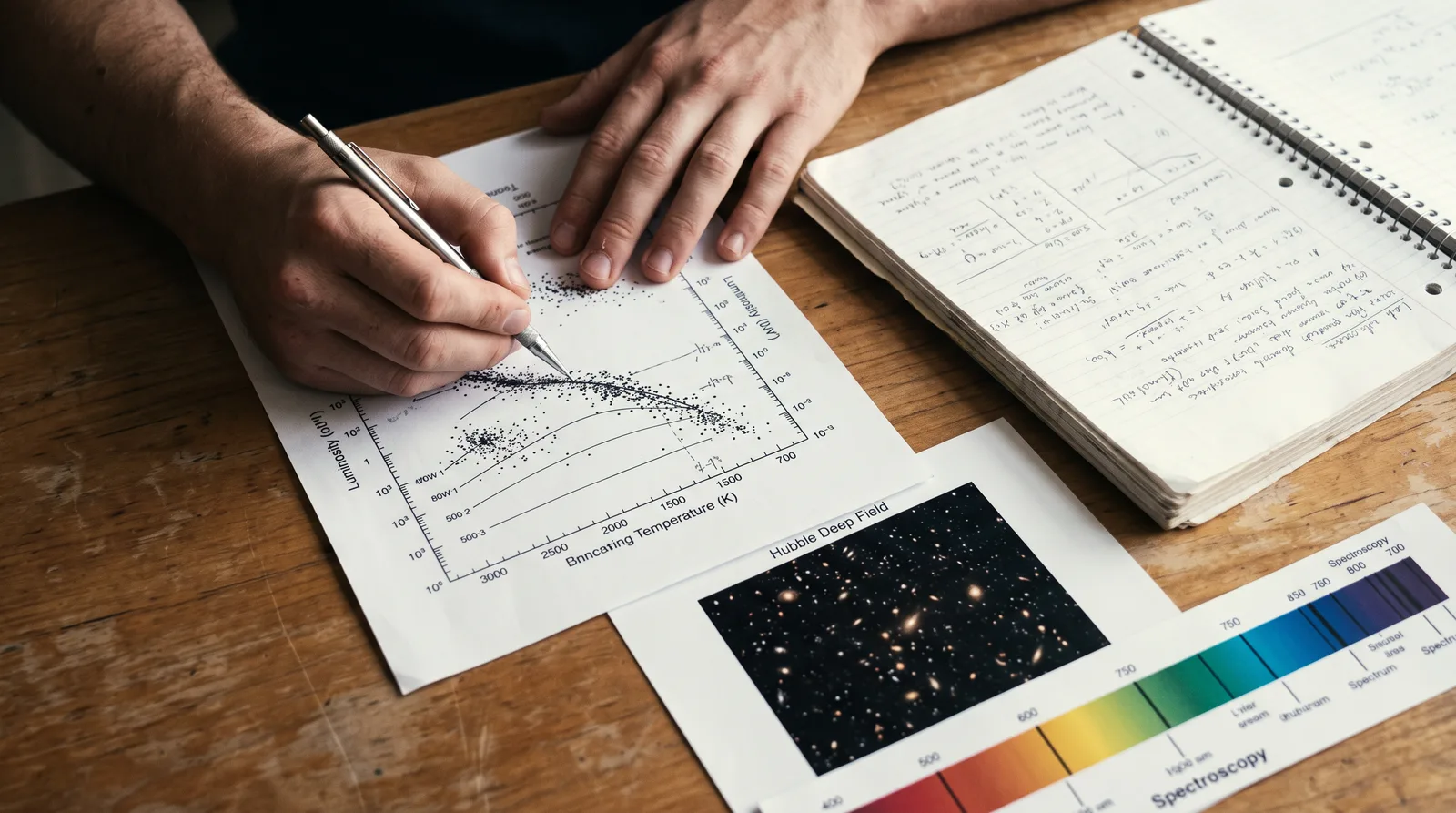
- Read and interpret real astronomical data, including Hertzsprung-Russell diagrams and light-curve graphs
- Describe the structure and scale of the universe, from the solar system to galaxy clusters and the cosmic web
- Understand the physics of gravity, light, and spacetime as they apply to celestial objects and cosmological events
- Identify key constellations, planets, and deep-sky objects and explain the observational techniques used to study them
- Critically evaluate news and discoveries in astronomy using the scientific method and peer-reviewed reasoning
How it works
A school that adapts to you
This isn't a set of static videos. Every lesson is generated live and tuned to where you actually are.
We learn your level
A quick placement check tailors your starting point so you're never bored or lost.
Lessons adapt as you go
Each lesson is written for your pace and your goal, adjusting as your skills grow.
Your AI coach keeps you moving
Checkpoints, feedback, and gentle nudges turn progress into a real result.
The curriculum
What's inside your school
6 modules · 29 lessons

The Astronomer's Toolkit
Establishes the foundational skills — scientific reasoning, the electromagnetic spectrum, and observational techniques — that underpin every topic that follows.
- 1.1How Science Works: The Astronomer's MethodIncluded
- 1.2Light as a Messenger: The Electromagnetic SpectrumIncluded
- 1.3Telescopes and Observational TechniquesIncluded
- 1.4Mapping the Sky: Coordinates, Constellations, and Star ChartsIncluded
- 1.5Reading Real Data: Light Curves and Spectral GraphsIncluded
Our Solar System: A Guided Tour
Surveys the structure, formation, and diverse worlds of our solar system, from the Sun's interior to the icy outer reaches.
- 2.1Formation of the Solar System: The Nebular HypothesisIncluded
- 2.2The Sun: Our Nearest StarIncluded
- 2.3The Terrestrial Planets: Rock, Heat, and Thin AirIncluded
- 2.4The Giant Planets and Their Moon SystemsIncluded
- 2.5Dwarf Planets, Asteroids, and Comets: The LeftoversIncluded
Stellar Physics: The Lives of Stars
Traces the complete life cycle of stars using astrophysical principles, from stellar nurseries through spectacular endpoints.
- 3.1Star Birth: Nebulae and ProtostarsIncluded
- 3.2The Hertzsprung-Russell Diagram: A Star's Report CardIncluded
- 3.3Main-Sequence Stars and Stellar EquilibriumIncluded
- 3.4Stellar Old Age: Giants, Supergiants, and Planetary NebulaeIncluded
- 3.5Stellar Endpoints: White Dwarfs, Neutron Stars, and Black HolesIncluded
Gravity, Light, and Spacetime
Builds physical intuition for the forces that govern the universe — Newtonian gravity, special relativity, and Einstein's general relativity.
- 4.1Newtonian Gravity: Orbits, Tides, and Escape VelocityIncluded
- 4.2Special Relativity: Time, Space, and the Speed of LightIncluded
- 4.3General Relativity: Curved Spacetime and Gravitational LensingIncluded
- 4.4Black Holes: Anatomy of a Spacetime SingularityIncluded
- 4.5Gravitational Waves: Listening to the UniverseIncluded
Galaxies: Islands of Stars
Explores the structure, classification, and dynamics of galaxies — including our own Milky Way — and the forces that shape them.
- 5.1The Milky Way: Our Galactic HomeIncluded
- 5.2Galaxy Classification: Spirals, Ellipticals, and IrregularsIncluded
- 5.3Active Galactic Nuclei and QuasarsIncluded
- 5.4Galaxy Clusters and the Cosmic WebIncluded
Cosmology: The Origin and Fate of the Universe
Addresses the biggest questions in science — the Big Bang, cosmic expansion, dark matter, dark energy, and the ultimate fate of the cosmos.
- 6.1The Expanding Universe: Hubble's Law and RedshiftIncluded
- 6.2The Big Bang: Evidence and TimelineIncluded
- 6.3Dark Matter: The Invisible ScaffoldIncluded
- 6.4Dark Energy and the Accelerating UniverseIncluded
- 6.5The Fate of the Universe and Frontiers of Modern AstronomyIncluded
Who it's for
Is this you?

Lifelong curious learners
You've always been fascinated by space and finally want real scientific understanding to match your enthusiasm.

College students & pre-science majors
You're headed into a STEM degree and want a rigorous head start — or a solid conceptual foundation to complement your coursework.

Retirees pursuing intellectual depth
You have the time, the curiosity, and the appetite for a real university-level intellectual challenge — on your own schedule.

STEM professionals expanding their horizons
You're comfortable with science and data in your field, and you want to apply that analytical mindset to the cosmos.

Amateur stargazers going deeper
You can find the Orion Nebula through your telescope — now you want to understand the astrophysics of what you're looking at.

Critical thinkers & science readers
You follow astronomy news closely and want the foundational knowledge to evaluate discoveries and headlines like a scientist.
Questions
Frequently asked
Your teacher
A note from your teacher
AI Professor Courses
If you're reading this, I suspect you've felt it — that particular frustration of watching a gorgeous documentary about black holes or the James Webb images and thinking: I want to actually understand this. Not just feel amazed by it. Understand it.
That gap between wonder and understanding is exactly what The Open Observatory is designed to close.
I've spent my career teaching astronomy at the university level, and the single biggest thing I've learned is this: the science itself — the real physics, the actual data, the genuine reasoning astronomers use — is not too hard for a motivated adult without a science degree. It's just rarely taught that way outside of a formal classroom. Most public-facing astronomy content is curated for awe, not comprehension. I built this school because I believe you deserve both.
Here's what that looks like in practice. We start with the astronomer's toolkit — not as a formality, but because understanding how we know is inseparable from understanding what we know. You'll learn to read a spectrum the way a chemist reads a fingerprint. You'll interpret a light-curve graph and understand what it reveals about an object millions of light-years away. Then we move through the solar system, stellar physics, relativity, galactic structure, and cosmology — not as a checklist of facts, but as a coherent, building scientific picture of the universe. Every unit earns the next one.
I won't pretend this course requires zero effort. It asks you to engage with real vocabulary, real data representations, and real physical reasoning. But I'll be with you every step — translating, contextualizing, and making sure the precision never tips into obscurity. My job is to make you feel the way the best students in my lecture hall feel: that you've been let in on something extraordinary, and that you have the tools to keep going deeper on your own.
If you've ever wanted to sit in on the kind of university class that changes how you see the sky — and by extension, how you see everything — this is your invitation. The cosmos has been waiting. Let's go look at it properly.
— AI Professor Courses
Start your journey today
Get instant access — learn at your own pace with an AI coach in your corner.
$5/mo
Recurring billing · cancel anytime
Secure checkout · Instant access
- 6 modules, 29 lessons
- AI-adaptive lessons tuned to your level
- Quizzes & checkpoints to lock in progress
- Your own AI learning coach
- Learn on any device, at your pace
- Full access for as long as you're subscribed