Master data science from first principles to production
An AI professor-led, university-grade curriculum that takes you from probability theory and linear algebra all the way to deployed ML models, MLOps pipelines, and executive-ready dashboards — with the rigor of a graduate program and none of the filler.
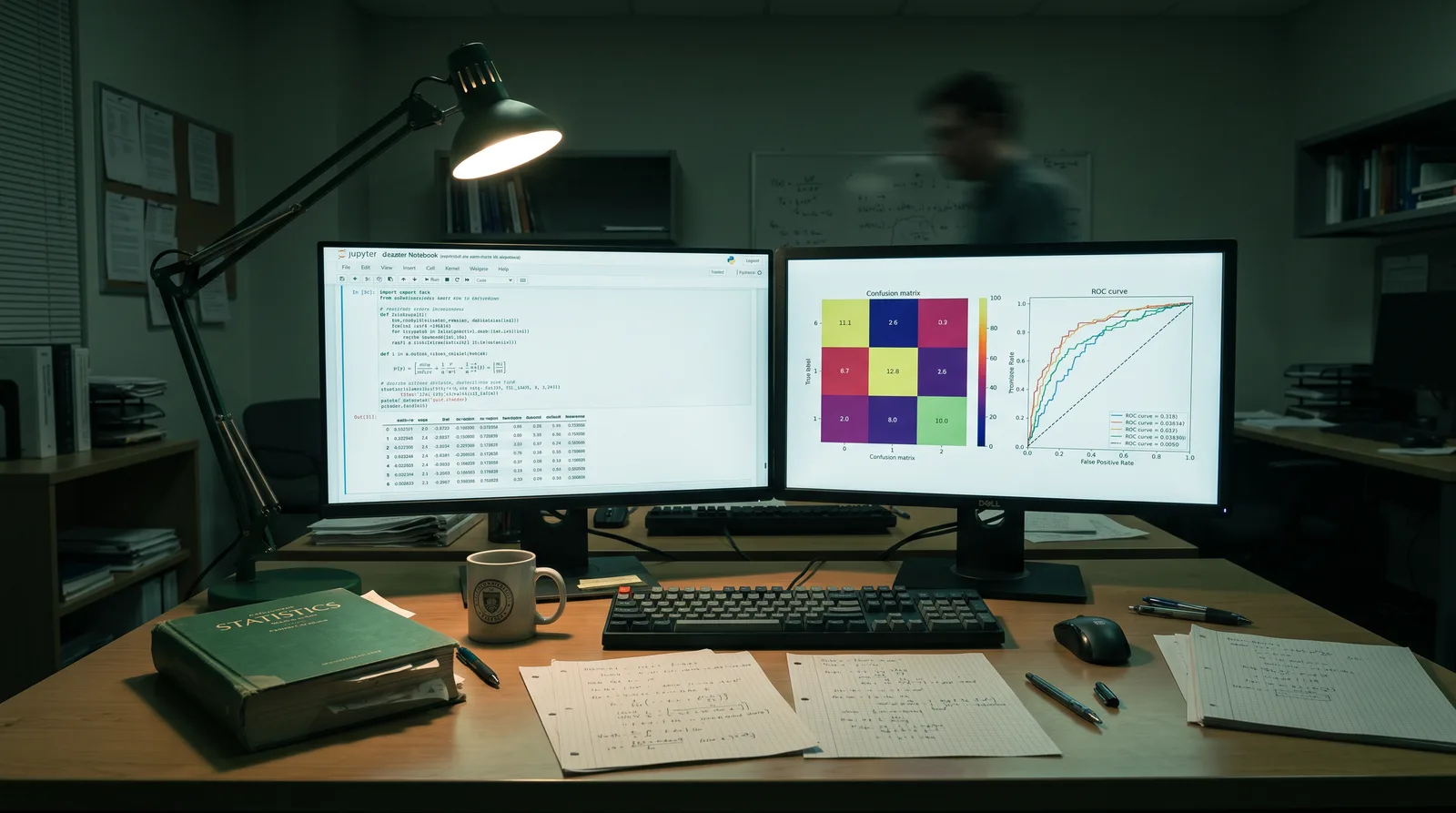
"I don't want you to recognize the answer — I want you to be able to derive it, even when you've never seen the problem before."
— AI Professor Courses

What you'll learn
What you'll be able to do
- Apply probability theory, statistical inference, and linear algebra to frame and solve real data problems from first principles
- Write production-quality Python code with Pandas and NumPy, query relational databases with advanced SQL, and ingest data from APIs, web scraping, and distributed systems like Apache Spark
- Execute a full exploratory data analysis pipeline — cleaning, transforming, engineering features, and communicating findings through publication-quality visualizations
- Build, tune, and rigorously evaluate supervised machine learning models including gradient boosting, SVMs, and regularized regression, with a deep understanding of the underlying mathematics
- Apply unsupervised learning techniques — clustering, PCA, anomaly detection, and association rule mining — to discover hidden structure in unlabeled datasets
- Deploy models to production using FastAPI, Docker, and MLOps best practices, while translating results into executive-ready dashboards and upholding standards of data ethics, fairness, and governance
How it works
A school that adapts to you
This isn't a set of static videos. Every lesson is generated live and tuned to where you actually are.
We learn your level
A quick placement check tailors your starting point so you're never bored or lost.
Lessons adapt as you go
Each lesson is written for your pace and your goal, adjusting as your skills grow.
Your AI coach keeps you moving
Checkpoints, feedback, and gentle nudges turn progress into a real result.
The curriculum
What's inside your school
7 modules · 37 lessons

Foundational Mathematics & Statistics
Builds the mathematical bedrock — probability, statistics, and linear algebra — that underpins every algorithm and model in the course.
- 1.1Probability Theory, Sample Spaces, and Bayes' TheoremIncluded
- 1.2Discrete and Continuous Probability DistributionsIncluded
- 1.3Descriptive StatisticsIncluded
- 1.4Inferential Statistics: Estimation and the Central Limit TheoremIncluded
- 1.5Hypothesis Testing: p-values, t-tests, ANOVA, and Chi-SquareIncluded
- 1.6Linear Algebra Fundamentals for Data ScienceIncluded
Programming, SQL, & Data Engineering
Equips students with production-ready Python skills, advanced SQL fluency, and the data engineering tools used to move and process data at scale.
- 2.1Python Programming Fundamentals for Data ScienceIncluded
- 2.2Relational Databases & Advanced SQLIncluded
- 2.3Data Manipulation with Pandas and NumPyIncluded
- 2.4Data Ingestion: APIs, Web Scraping, and File FormatsIncluded
- 2.5Big Data & Distributed Computing with Apache SparkIncluded
Exploratory Data Analysis & Data Wrangling
Teaches the complete EDA pipeline — from raw, messy data through cleaning, transformation, feature engineering, and publication-quality visualization.
- 3.1Data Cleaning: Missing Values, Duplicates, and OutliersIncluded
- 3.2Data Transformation: Normalization, Standardization, and EncodingIncluded
- 3.3Feature Engineering: Domain Variables and Interaction TermsIncluded
- 3.4Data Visualization with Matplotlib, Seaborn, and PlotlyIncluded
- 3.5Statistical Summaries and Correlation AnalysisIncluded
Supervised Machine Learning
Builds a rigorous, math-first understanding of supervised learning — from loss functions and gradient descent through tree-based ensembles and support vector machines.
- 4.1Mathematical Foundations of Supervised LearningIncluded
- 4.2Gradient Descent: Batch, Stochastic, and Mini-Batch VariantsIncluded
- 4.3Linear and Logistic RegressionIncluded
- 4.4Bias-Variance Tradeoff, Overfitting, and RegularizationIncluded
- 4.5Tree-Based Models: Decision Trees, Random Forests, and Gradient BoostingIncluded
- 4.6Support Vector Machines and k-Nearest NeighborsIncluded
Unsupervised Machine Learning & Dimensionality Reduction
Teaches techniques for discovering hidden structure in unlabeled data through clustering, dimensionality reduction, anomaly detection, and association mining.
- 5.1Clustering Algorithms: k-Means, Hierarchical, and DBSCANIncluded
- 5.2Dimensionality Reduction with PCA and t-SNEIncluded
- 5.3Anomaly and Outlier DetectionIncluded
- 5.4Association Rule Mining: Apriori and FP-GrowthIncluded
Model Evaluation, Validation, & MLOps
Covers rigorous model assessment strategies, hyperparameter optimization, and the full MLOps lifecycle from deployment to production monitoring.
- 6.1Train / Validation / Test Splits and Time-Series StrategiesIncluded
- 6.2k-Fold and Stratified Cross-ValidationIncluded
- 6.3Classification Performance MetricsIncluded
- 6.4Regression Performance MetricsIncluded
- 6.5Hyperparameter Tuning: Grid Search, Random Search, and Bayesian OptimizationIncluded
- 6.6Model Deployment & MLOps: FastAPI, Docker, and Model MonitoringIncluded
Data Storytelling, Ethics, & Applied Case Studies
Translates technical mastery into business impact by teaching executive communication, dashboard design, ethical AI, and reproducible research practices.
- 7.1Translating Technical Output into Executive Business InsightsIncluded
- 7.2Interactive Dashboard Creation with Tableau, Power BI, and StreamlitIncluded
- 7.3Data Privacy, Governance, and GDPR/CCPA ComplianceIncluded
- 7.4Algorithmic Bias, Fairness, and Explainable AI (SHAP & LIME)Included
- 7.5Reproducible Research: Jupyter Notebooks, Git, and DocumentationIncluded
Who it's for
Is this you?

Career-changers entering data science
You're pivoting from finance, engineering, or another analytical field and need a curriculum that builds genuine expertise, not just enough vocabulary to pass a phone screen.

Graduate students & advanced undergrads
You're enrolled in a quantitative program and want a parallel track that connects the theory in your textbooks to working Python code and real datasets.

Working analysts leveling up
You run reports and build dashboards professionally but want to move into machine learning and need the mathematical foundations that self-study never quite delivered.

Bootcamp graduates with gaps
You can train a model but struggle to explain what it's doing — this curriculum gives you the rigorous grounding that your bootcamp was designed to skip.

ML engineers moving into data science
You're strong on the engineering side but want to deepen your statistical foundations, model evaluation discipline, and ability to communicate findings to non-technical leadership.

Ambitious self-taught practitioners
You've cobbled together knowledge from tutorials and documentation, but you want a structured, academically rigorous curriculum that fills in every gap systematically.
Questions
Frequently asked
Your teacher
A note from your teacher
AI Professor Courses
If you've landed here, I'd guess you're somewhere I recognize well: you know data science is where you want to be, but you're not sure the education you've found so far has actually prepared you for it. Maybe you finished a bootcamp and felt the seams — the moment a real dataset didn't fit the pattern, or an interviewer asked you to explain the math and you couldn't. Maybe you're partway through a graduate program and want the concepts locked down with working code alongside them. Maybe you're a working analyst who can run a regression but couldn't tell me, under pressure, what the loss function is actually minimizing.
I built this curriculum to close that gap — permanently. Not by teaching tricks, but by teaching the discipline. We start with probability theory and linear algebra because those subjects are the load-bearing walls of everything that follows. Bayes' Theorem isn't trivia; it's the foundation of a coherent approach to uncertainty that runs through every model you'll ever build. The Central Limit Theorem isn't a footnote; it's the reason statistical inference works at all. When you understand those ideas at that level, the rest of data science stops feeling like a collection of disconnected tools and starts feeling like a unified field.
From that foundation, we build upward with intention. Production-quality Python. Advanced SQL. Distributed computing with Apache Spark. A full exploratory data analysis pipeline that produces publication-quality output. Supervised and unsupervised machine learning taught with their mathematical derivations intact — not hidden behind library calls. And then deployment: FastAPI, Docker, MLOps, model monitoring. Because a model that lives only in a notebook hasn't done its job yet.
I also take seriously what I think most technical curricula handle carelessly: the ethics and governance of the work. Algorithmic bias is not a PR problem — it is a mathematical problem, and we treat it that way. SHAP and LIME are not buzzwords; they are tools for making your models legible and accountable. GDPR and CCPA are not legal footnotes; they are constraints that shape how you design data pipelines. Reproducibility through Git and documented Jupyter Notebooks is not optional good practice; it is professional hygiene.
What I ask of you is straightforward: show up willing to do the hard work. Engage with the proofs. Run the code and then break it on purpose so you understand what it's doing. Ask hard questions. The students who get the most out of this curriculum are the ones who treat it like the serious intellectual undertaking it is — because that's exactly what it is. If that's you, I'm glad you're here. Let's get to work.
— AI Professor Courses
Start your journey today
Get instant access — learn at your own pace with an AI coach in your corner.
$5/mo
Recurring billing · cancel anytime
Secure checkout · Instant access
- 7 modules, 37 lessons
- AI-adaptive lessons tuned to your level
- Quizzes & checkpoints to lock in progress
- Your own AI learning coach
- Learn on any device, at your pace
- Full access for as long as you're subscribed