Master human development from womb to late adulthood
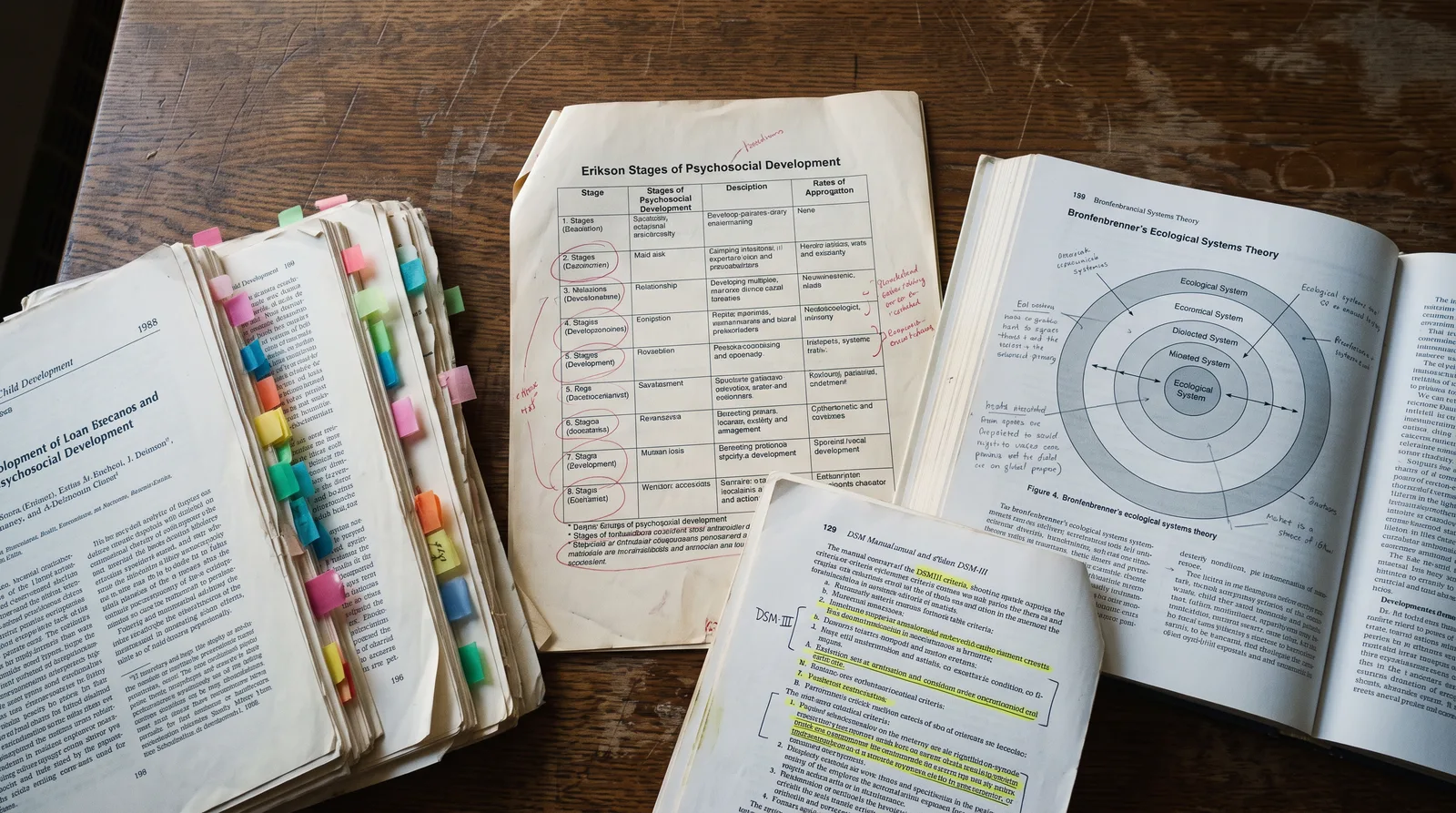
A rigorous, college-level journey through developmental psychology — covering Piaget, Vygotsky, Erikson, Bronfenbrenner, attachment theory, and the full arc of the lifespan — taught with the precision of a university seminar and the clarity of a professor who actually wants you to get it.

"I will never dumb this material down for you — but I will always build the scaffolding that lets you reach it."
— AI Professor Courses
What you'll learn
What you'll be able to do
- Explain and critically compare the major theoretical frameworks in developmental psychology — Piagetian, Vygotskian, Eriksonian, and bioecological.
- Trace cognitive, emotional, and social development from prenatal stages through late adulthood using empirical research and stage theory.
- Apply developmental concepts — such as attachment theory, scaffolding, and identity formation — to real-life case studies and clinical scenarios.
- Evaluate the influence of nature vs. nurture, socioeconomic context, and culture on developmental trajectories.
- Design and critically assess the research methods most commonly used in developmental studies, including longitudinal and cross-sectional designs.
- Prepare effectively for university exams, research papers, and graduate school applications in psychology and related fields.
How it works
A school that adapts to you
This isn't a set of static videos. Every lesson is generated live and tuned to where you actually are.
We learn your level
A quick placement check tailors your starting point so you're never bored or lost.
Lessons adapt as you go
Each lesson is written for your pace and your goal, adjusting as your skills grow.
Your AI coach keeps you moving
Checkpoints, feedback, and gentle nudges turn progress into a real result.
The curriculum
What's inside your school
6 modules · 30 lessons

Foundations of Developmental Psychology
Establishes the discipline's scope, history, and core theoretical frameworks students will apply throughout the course.
- 1.1What Is Developmental Psychology?Included
- 1.2Major Theoretical FrameworksIncluded
- 1.3The Nature vs. Nurture DebateIncluded
- 1.4Culture, Socioeconomic Context, and DevelopmentIncluded
- 1.5Research Methods in Developmental PsychologyIncluded
Prenatal Development and Infancy
Traces biological, cognitive, and socioemotional development from conception through the end of infancy.
- 2.1Prenatal Stages and TeratogensIncluded
- 2.2The Newborn's Perceptual and Motor WorldIncluded
- 2.3Cognitive Development in Infancy: Piaget's Sensorimotor StageIncluded
- 2.4Attachment Theory and Early Emotional BondsIncluded
- 2.5Language Beginnings: From Babbling to First WordsIncluded
Early and Middle Childhood
Covers the rapid cognitive, linguistic, moral, and social growth that unfolds from ages two through twelve.
- 3.1Preoperational Thinking and Its LimitsIncluded
- 3.2Vygotsky's Sociocultural Theory and ScaffoldingIncluded
- 3.3Theory of Mind and Social CognitionIncluded
- 3.4Moral Development: Piaget, Kohlberg, and BeyondIncluded
- 3.5Peer Relationships, Play, and School ReadinessIncluded
Adolescence: Identity, Cognition, and Social Worlds
Examines the biological, cognitive, and psychosocial transformations of adolescence through empirical and theoretical lenses.
- 4.1Puberty and Brain DevelopmentIncluded
- 4.2Formal Operational Thought and Adolescent ReasoningIncluded
- 4.3Erikson's Identity vs. Role ConfusionIncluded
- 4.4Peer Influence, Risk-Taking, and ResilienceIncluded
- 4.5Adolescent Mental Health: Vulnerability and InterventionIncluded
Adulthood and Aging Across the Lifespan
Traces cognitive, emotional, relational, and physical development from emerging adulthood through late life.
- 5.1Emerging Adulthood: A Distinct Developmental Stage?Included
- 5.2Erikson's Stages in Adulthood: Intimacy, Generativity, and IntegrityIncluded
- 5.3Cognitive Changes in Middle and Late AdulthoodIncluded
- 5.4Socioemotional Aging: Relationships, Loss, and Well-BeingIncluded
- 5.5Death, Dying, and the End of the LifespanIncluded
Applied Skills: Research, Case Analysis, and Academic Mastery
Builds the practical academic skills students need to excel in exams, research papers, and graduate school applications.
- 6.1Applying Theory to Case Studies and Clinical ScenariosIncluded
- 6.2Critically Evaluating Developmental ResearchIncluded
- 6.3Designing a Developmental StudyIncluded
- 6.4Mastering Exams: Essays, Multiple Choice, and Short AnswerIncluded
- 6.5Graduate School Preparation: Statements, Interviews, and Research FitIncluded
Who it's for
Is this you?

Psych undergraduates
Reinforces and deepens the coursework from their university developmental psychology class with the theoretical rigor and exam-ready skills their GPA demands.

Pre-grad school hopefuls
Builds the conceptual fluency, research methodology knowledge, and theoretical vocabulary that graduate admissions committees and first-year seminars expect.

Career-changers entering psychology
Gets the serious, college-level foundation in developmental theory and research that makes a convincing case for a pivot into psychology or counseling.

Lifelong intellectual learners
Engages with Piaget, Erikson, and Vygotsky at the academic level they always wanted — without the pressure of grades, but with all the intellectual substance.

Educators and school counselors
Grounds their classroom practice or student support work in the developmental science behind theory of mind, scaffolding, moral reasoning, and adolescent risk-taking.

Healthcare and social work practitioners
Applies attachment theory, Bronfenbrenner's bioecological model, and lifespan developmental frameworks to patient and client care with greater confidence and precision.
Questions
Frequently asked
Your teacher
A note from your teacher
AI Professor Courses
If you've ever sat through a developmental psychology lecture that reduced Vygotsky to a single buzzword, or opened a textbook chapter that listed Erikson's stages without ever asking you to think about them — I understand why you're looking for something better.
Most resources on this subject make a quiet trade: they sand off the complexity to make the content feel approachable. What they're actually doing is taking the most intellectually alive field in behavioral science and flattening it into a list of terms to memorize. I built The Dev Psych Lab because I believe you deserve more than that — and because I think the rigor is the accessibility, when it's taught well.
Here's what I mean. Piaget's theory of cognitive development isn't interesting because a child moves from the sensorimotor stage to the preoperational stage. It's interesting because Vygotsky looked at the same children and drew completely different conclusions — and both of them were right about something. That tension, that conversation between frameworks, is where developmental psychology actually lives. In this course, that's where we spend our time.
We start at the very beginning — prenatal development, the newborn's perceptual world, the first attachment bonds — and we follow human development all the way to late adulthood: cognitive aging, Erikson's crisis of integrity vs. despair, socioemotional change, and the psychology of dying. Every stage is examined through multiple theoretical lenses and connected to real research. And in the final unit, we do something most developmental courses never bother with: we apply all of that knowledge to the academic challenges you're actually facing — exam writing, research design, case analysis, and graduate school preparation.
I will not dumb this material down for you. What I will do is choose the right example at the right moment, ask the question that reframes what you thought you understood, and build the scaffolding — yes, in the Vygotskian sense — that lets you reach ideas you couldn't have reached on your own. That's teaching. That's what this school is for. If you're ready to engage with human development the way it deserves to be engaged with, I'd be glad to have you in the Lab.
— AI Professor Courses
Start your journey today
Get instant access — learn at your own pace with an AI coach in your corner.
$5/mo
Recurring billing · cancel anytime
Secure checkout · Instant access
- 6 modules, 30 lessons
- AI-adaptive lessons tuned to your level
- Quizzes & checkpoints to lock in progress
- Your own AI learning coach
- Learn on any device, at your pace
- Full access for as long as you're subscribed