Master Economics the Way Universities Teach It
A complete, rigorous journey through micro and macroeconomics — real models, real policy debates, real exam confidence — taught by an AI professor who makes the hard stuff click.

"I don't want you to memorize economics — I want you to think like an economist, and there's a real difference."
— AI Professor Courses
What you'll learn
What you'll be able to do
- Analyze consumer and firm behavior using core microeconomic models, including supply and demand, elasticity, and utility theory.
- Understand market structures — perfect competition, monopoly, oligopoly, and monopolistic competition — and their real-world implications.
- Interpret macroeconomic indicators such as GDP, inflation, unemployment, and interest rates to assess the health of an economy.
- Apply Keynesian and monetarist frameworks to evaluate fiscal and monetary policy decisions made by governments and central banks.
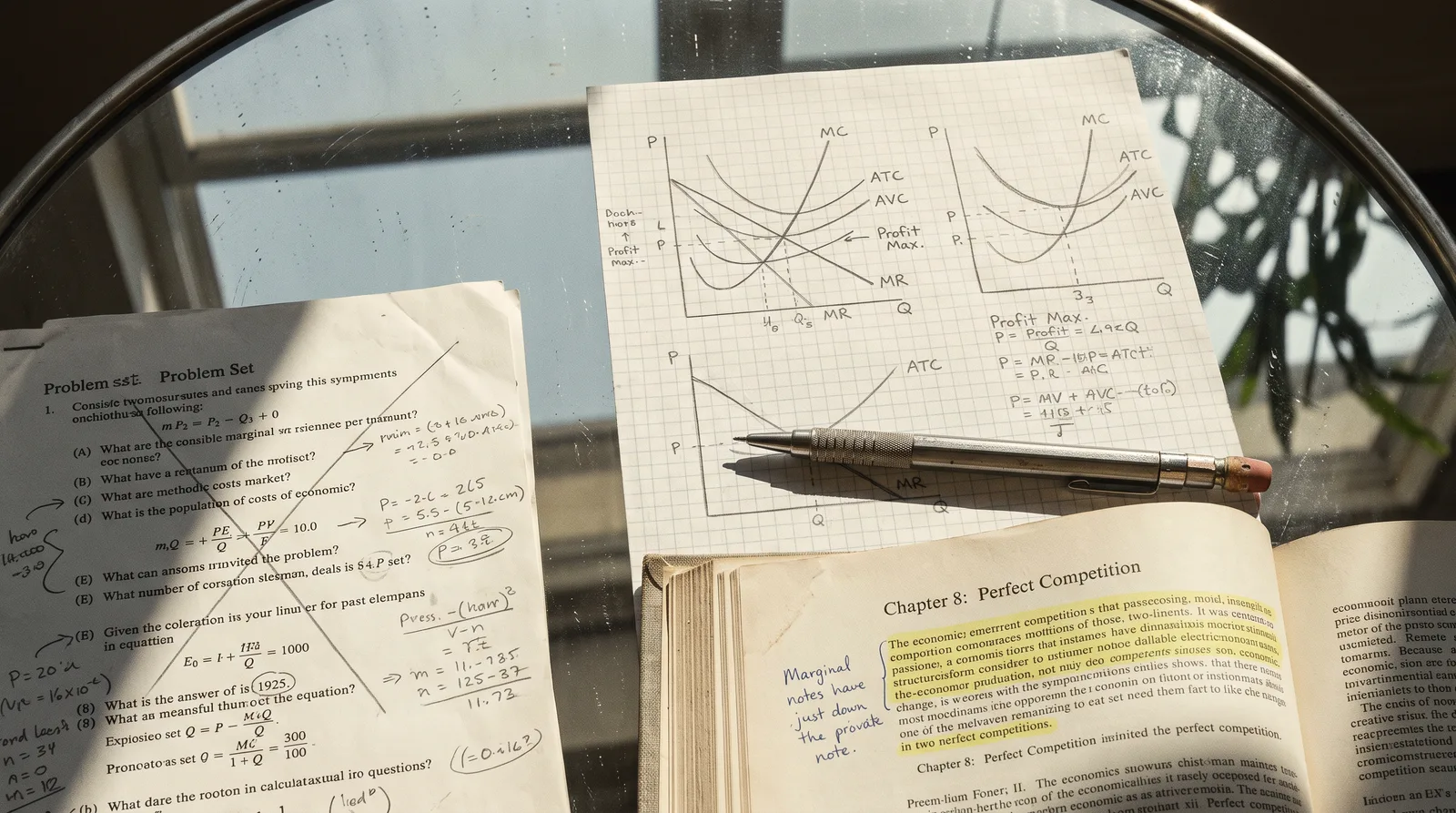
- Work through cost curves, production functions, and profit-maximization problems with exam-ready confidence.
- Connect economic theory to current events — trade policy, recessions, market failures — and form well-reasoned, evidence-based arguments.
How it works
A school that adapts to you
This isn't a set of static videos. Every lesson is generated live and tuned to where you actually are.
We learn your level
A quick placement check tailors your starting point so you're never bored or lost.
Lessons adapt as you go
Each lesson is written for your pace and your goal, adjusting as your skills grow.
Your AI coach keeps you moving
Checkpoints, feedback, and gentle nudges turn progress into a real result.
The curriculum
What's inside your school
10 modules · 46 lessons

Foundations of Economic Thinking
Builds the conceptual bedrock — scarcity, opportunity cost, incentives, and models — that underpins every topic in both micro and macro.
- 1.1Scarcity, Choice, and Opportunity CostIncluded
- 1.2Thinking at the MarginIncluded
- 1.3Economic Models and the Production Possibilities FrontierIncluded
- 1.4Microeconomics vs. Macroeconomics — The Big PictureIncluded
Supply, Demand, and Market Equilibrium
Develops the supply-and-demand framework in full, from the laws of behavior through price signals, elasticity, and real-world market outcomes.
- 2.1The Law of Demand and the Demand CurveIncluded
- 2.2The Law of Supply and the Supply CurveIncluded
- 2.3Market Equilibrium, Surpluses, and ShortagesIncluded
- 2.4Elasticity — Price, Income, and Cross-PriceIncluded
- 2.5Price Controls, Taxes, and Market InterventionIncluded
Consumer Choice and the Theory of the Firm
Digs into the decision-making logic of households and firms, covering utility maximization, production functions, cost curves, and profit maximization.
- 3.1Utility, Preferences, and the Rational ConsumerIncluded
- 3.2Budget Constraints and Indifference CurvesIncluded
- 3.3Production Functions and the Law of Diminishing ReturnsIncluded
- 3.4Short-Run and Long-Run Cost CurvesIncluded
- 3.5Profit Maximization and the MR = MC RuleIncluded
Market Structures and Strategic Behavior
Compares perfect competition, monopoly, monopolistic competition, and oligopoly — examining pricing power, efficiency, and real-world examples of each.
- 4.1Perfect Competition — Price Takers and Long-Run EquilibriumIncluded
- 4.2Monopoly — Pricing Power and Deadweight LossIncluded
- 4.3Price DiscriminationIncluded
- 4.4Monopolistic Competition and Product DifferentiationIncluded
- 4.5Oligopoly, Game Theory, and the Prisoner's DilemmaIncluded
Market Failures, Externalities, and Public Policy
Covers the conditions under which markets fail to allocate resources efficiently and the policy tools governments use to correct them.
- 5.1Externalities and the Coase TheoremIncluded
- 5.2Public Goods and the Free-Rider ProblemIncluded
- 5.3Information Asymmetry — Adverse Selection and Moral HazardIncluded
- 5.4Antitrust Policy and RegulationIncluded
Macroeconomic Measurement and Indicators
Teaches students to read the economy's vital signs — GDP, inflation, and unemployment — and understand what these numbers really reveal.
- 6.1Gross Domestic Product — Measuring the EconomyIncluded
- 6.2Inflation — Causes, Measurement, and ConsequencesIncluded
- 6.3Unemployment — Types, Measurement, and the Natural RateIncluded
- 6.4Business Cycles and Economic FluctuationsIncluded
- 6.5The Relationship Between Inflation and Unemployment — The Phillips CurveIncluded
Aggregate Demand, Aggregate Supply, and Macroeconomic Equilibrium
Builds the AD-AS model as the central framework for analyzing output, price levels, and the impact of economic shocks.
- 7.1Aggregate Demand — Components and ShiftersIncluded
- 7.2Short-Run and Long-Run Aggregate SupplyIncluded
- 7.3Macroeconomic Equilibrium and Economic ShocksIncluded
- 7.4The Keynesian Multiplier and Recessionary GapsIncluded
Fiscal Policy and Government Spending
Examines how governments use taxation and spending to stabilize the economy, with honest attention to the debates and limitations.
- 8.1The Keynesian Case for Fiscal PolicyIncluded
- 8.2Automatic Stabilizers and Discretionary Fiscal PolicyIncluded
- 8.3Government Deficits, Debt, and Crowding OutIncluded
- 8.4Fiscal Policy in Practice — US Case StudiesIncluded
Money, Banking, and Monetary Policy
Covers how money is created, how the Federal Reserve controls the money supply, and how monetary policy steers the economy.
- 9.1What Is Money? Functions, Types, and the Money SupplyIncluded
- 9.2The Federal Reserve — Structure and ToolsIncluded
- 9.3Expansionary and Contractionary Monetary PolicyIncluded
- 9.4The Monetarist View and Quantity Theory of MoneyIncluded
- 9.5Keynesian vs. Monetarist — Policy Debates and Real-World ApplicationsIncluded
International Trade, Finance, and the Global Economy
Connects domestic economic theory to international trade, exchange rates, and current debates over globalization and trade policy.
- 10.1Comparative Advantage and the Gains from TradeIncluded
- 10.2Trade Barriers — Tariffs, Quotas, and Their Economic EffectsIncluded
- 10.3Exchange Rates and the Foreign Exchange MarketIncluded
- 10.4Balance of Payments — Current Account and Capital AccountIncluded
- 10.5Globalization, Trade Policy Debates, and Current EventsIncluded
Who it's for
Is this you?

College students
Enrolled in Econ 101 or 102 and wants a professor who actually makes the models make sense before the midterm.

Self-taught learners
Never took a formal economics course but wants genuine college-level fluency, not just pop-economics talking points.

Early-career professionals
Works in finance, policy, or business and needs a structured foundation to understand the economic forces shaping their industry.

AP Econ students
Preparing for AP Microeconomics or Macroeconomics and wants rigorous, exam-aligned instruction that goes deeper than prep books.

Career changers
Pivoting toward economics, public policy, or finance and needs to build credible analytical foundations from scratch.

Curious lifelong learners
Wants to read economic news, follow policy debates, and engage with the world's financial decisions with real analytical confidence.
Questions
Frequently asked
Your teacher
A note from your teacher

AI Professor Courses
If you've ever sat in an economics lecture — or tried to teach yourself from a textbook — and felt like the pieces just wouldn't connect, I want you to know something: that's not a you problem. Economics is genuinely hard to learn when it's taught as a collection of graphs to memorize and formulas to plug numbers into. The logic gets buried. The "so what?" disappears. And you're left with a vague sense that you sort of understand supply and demand, but you couldn't explain why a price ceiling creates a shortage if someone put you on the spot.
That's exactly the gap I built this school to close.
I teach economics the way I believe it deserves to be taught — with rigor and clarity in equal measure. That means we use real models: indifference curves, cost functions, the AD-AS framework, the quantity theory of money. We don't dumb things down. But we also never move on until the underlying logic is clear, because in economics, understanding why a result holds is what lets you apply it somewhere new. When you genuinely understand why MR = MC is the profit-maximization condition, you don't have to memorize it — you can derive it. When you understand the Keynesian multiplier from first principles, fiscal policy debates in Congress stop sounding like noise.
The curriculum runs the full arc — from the foundational logic of scarcity and opportunity cost, through consumer theory, market structures, and market failures, all the way through macroeconomic measurement, fiscal and monetary policy, and international trade and finance. It's the equivalent of a two-semester college sequence, and it's structured the same way: each concept building on the last, with real-world examples and policy applications woven throughout. US case studies anchor the macroeconomics units — the Federal Reserve's tools, Congressional fiscal debates, trade policy — because theory without application is just abstraction.
I also want to address the objection I hear most often: "I'm not a math person." You don't need calculus for this course. You need careful, systematic thinking — the kind of thinking economics is actually designed to develop. The models here are rigorous, but they're also accessible to anyone willing to engage seriously with them.
Whether you're a college student who wants to actually understand what's on the syllabus (not just pass), a self-taught learner who wants a real economics education without a $60,000 price tag, or a professional who wants to stop nodding along when people talk about monetary policy and start having informed opinions — this school was built for you. The classroom is open. Let's get to work.
— AI Professor Courses
Start your journey today
Get instant access — learn at your own pace with an AI coach in your corner.
$5/mo
Recurring billing · cancel anytime
Secure checkout · Instant access
- 10 modules, 46 lessons
- AI-adaptive lessons tuned to your level
- Quizzes & checkpoints to lock in progress
- Your own AI learning coach
- Learn on any device, at your pace
- Full access for as long as you're subscribed