Write essays that actually earn the grade
The Composition Lab gives you the structure, grammar, research, and citation skills that college writing demands — taught with the rigor of a seasoned professor and the patience of a personal tutor.

"My job isn't to tell you you're a great writer — it's to give you the tools to actually become one."
— AI Professor Courses
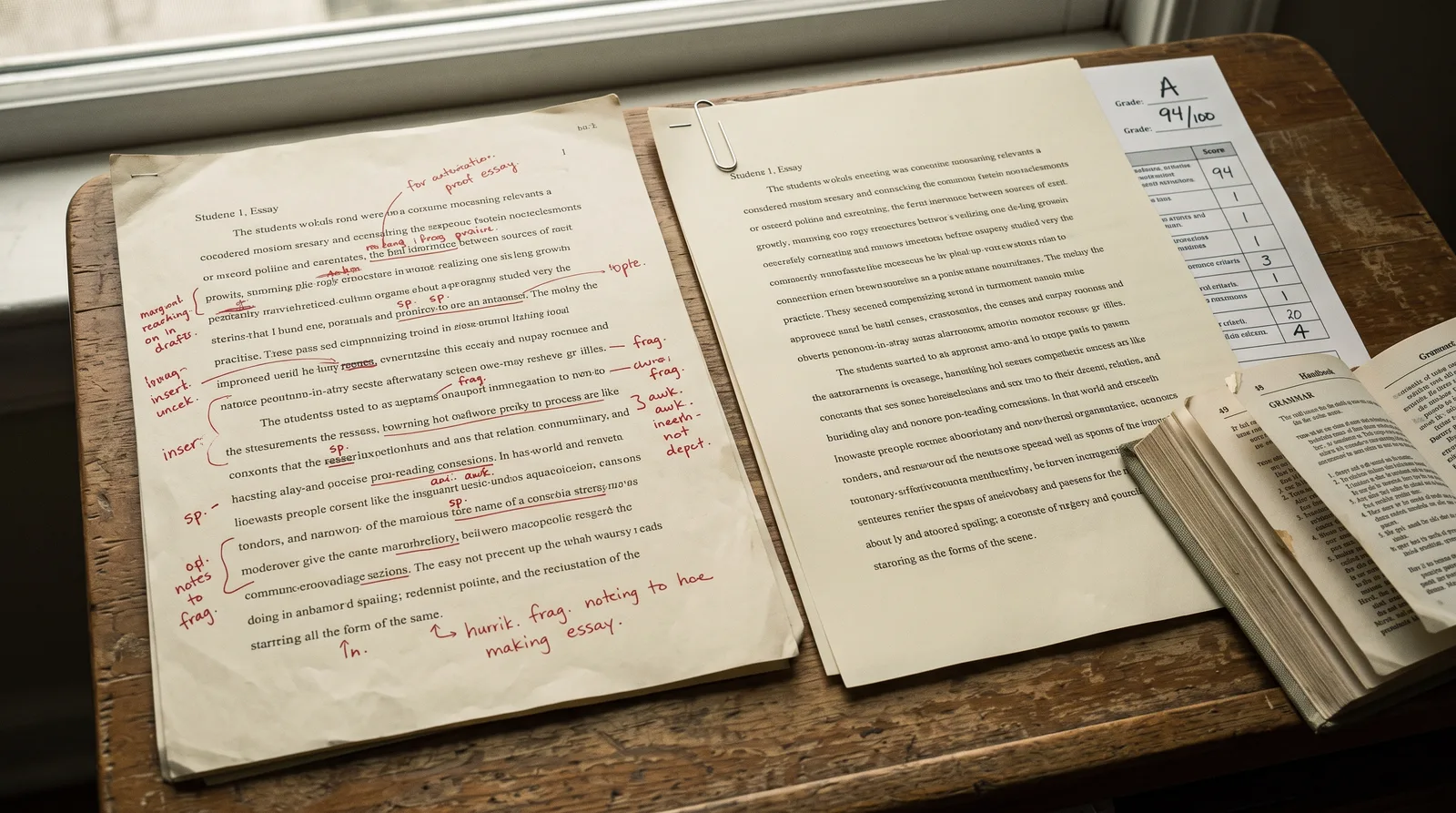
What you'll learn
What you'll be able to do
- Construct a well-argued, thesis-driven essay with a clear introduction, body, and conclusion
- Apply the conventions of MLA and APA citation formats accurately in academic papers
- Identify and eliminate common grammatical errors, run-ons, comma splices, and wordiness
- Develop a structured outline and use it to draft, revise, and polish any writing assignment
- Analyze a source critically and integrate quotes and paraphrases with proper attribution
- Write confidently across core academic modes: expository, persuasive, and analytical essays
How it works
A school that adapts to you
This isn't a set of static videos. Every lesson is generated live and tuned to where you actually are.
We learn your level
A quick placement check tailors your starting point so you're never bored or lost.
Lessons adapt as you go
Each lesson is written for your pace and your goal, adjusting as your skills grow.
Your AI coach keeps you moving
Checkpoints, feedback, and gentle nudges turn progress into a real result.
The curriculum
What's inside your school
6 modules · 24 lessons

The Foundation: How Academic Writing Works
Orients students to college-level writing expectations, the writing process, and what separates academic prose from casual communication.
- 1.1Thinking Like a College WriterIncluded
- 1.2Understanding the Writing ProcessIncluded
- 1.3Audience, Purpose, and ToneIncluded
- 1.4Building a Structured OutlineIncluded
The Thesis-Driven Essay: Introduction, Body, and Conclusion
Guides students through constructing every major section of a well-argued, thesis-centered essay.
- 2.1Crafting a Strong Thesis StatementIncluded
- 2.2Writing Effective IntroductionsIncluded
- 2.3Developing Body Paragraphs with PEELIncluded
- 2.4Writing Conclusions That Close and ResonateIncluded
- 2.5Transitions and Paragraph-Level CoherenceIncluded
Grammar, Clarity, and Sentence-Level Precision
Identifies and corrects the most common grammatical errors that undermine college writing and trains students to write with concision.
- 3.1Run-Ons and Comma SplicesIncluded
- 3.2Subject-Verb Agreement and Pronoun ReferenceIncluded
- 3.3Eliminating Wordiness and Vague LanguageIncluded
- 3.4Punctuation That Works For YouIncluded
Research, Sources, and Critical Reading
Builds the skills to find, evaluate, and read sources critically before integrating them into academic writing.
- 4.1Finding and Evaluating Credible SourcesIncluded
- 4.2Reading Critically and Annotating TextsIncluded
- 4.3Quoting, Paraphrasing, and SummarizingIncluded
- 4.4Avoiding PlagiarismIncluded
Citation Formats: MLA and APA
Gives students practical, accurate command of both major citation systems used in college coursework.
- 5.1MLA Format: In-Text Citations and Works CitedIncluded
- 5.2APA Format: In-Text Citations and References PageIncluded
- 5.3Formatting the Academic Paper: MLA vs. APAIncluded
Writing Across Academic Modes
Applies all previous skills to the three core essay types students encounter in college courses.
- 6.1The Expository Essay: Explaining with ClarityIncluded
- 6.2The Persuasive Essay: Arguing with EvidenceIncluded
- 6.3The Analytical Essay: Interpreting Texts and IdeasIncluded
- 6.4Revising and Polishing Any AssignmentIncluded
Who it's for
Is this you?

First-year college students
She's starting her first English Composition course and wants to walk in knowing how a thesis-driven essay is actually built.

Recent high school grads
He learned the five-paragraph essay in high school and needs to level up fast for college-level expectations.

Adult learners returning to school
She's going back to college after years away and needs a patient, structured refresh on academic writing from the ground up.

Non-native English speakers
He's fluent in English but wants precision — especially in grammar, citation formatting, and academic register.

Transfer students
She's moving from community college to a four-year university and wants to make sure her writing is ready for more rigorous coursework.

Self-directed learners
He never went to college but wants the skills — especially research, argumentation, and MLA/APA — to write and communicate at a professional level.
Questions
Frequently asked
Your teacher
A note from your teacher
AI Professor Courses
If you've ever stared at a blank document for an hour, written three sentences, deleted them all, and told yourself you're just "not a writer" — I want you to know something: that experience has almost nothing to do with talent, and almost everything to do with not having the right framework.
I've worked with college writers at every level, from students tackling their very first English Composition course to adults returning to school after a decade away. The same patterns come up again and again. Not lack of ideas — lack of structure. Not carelessness — lack of a clear, repeatable process. Writers who feel lost aren't failing because they can't write. They're failing because they were never taught how academic writing is actually built. That's the gap The Composition Lab exists to close.
Inside this school, I'll walk you through every stage of the academic writing process with the same rigor I'd bring to a college classroom — and with a level of individual attention a lecture hall simply can't offer. We'll start with the fundamentals: how to think like a college writer, how to build an outline that does real work, and how to write a thesis statement that takes an actual position rather than just announcing a topic. From there, we'll move into the craft of the thesis-driven essay — introductions that earn attention, body paragraphs built on the PEEL framework, and conclusions that close an argument with weight. We'll fix the grammar and sentence-level issues that quietly drain points from otherwise solid papers. And we'll build the research and citation skills — MLA and APA both — that distinguish a professionally formatted academic paper from a rough draft dressed up as one.
I know some of you are anxious about this. Maybe writing has always felt like a subject you weren't "supposed" to be good at. Maybe you've received feedback that stung without really explaining what to do differently. My approach is honest and direct — I won't paper over weak writing with generic encouragement — but it's also patient, because real improvement takes practice and a guide who believes you're capable of it. By the time you work through the expository, persuasive, and analytical essay units at the end of this school, you'll have a toolkit you can apply to any writing assignment that comes your way, in any course, at any level.
Come in as someone who dreads the blank page. Leave as someone who knows exactly what to do with it.
— AI Professor Courses
Start your journey today
Get instant access — learn at your own pace with an AI coach in your corner.
$5/mo
Recurring billing · cancel anytime
Secure checkout · Instant access
- 6 modules, 24 lessons
- AI-adaptive lessons tuned to your level
- Quizzes & checkpoints to lock in progress
- Your own AI learning coach
- Learn on any device, at your pace
- Full access for as long as you're subscribed