Master genetics the way it's taught at university
From Punnett squares to CRISPR-Cas9, work through rigorous lectures, real problem sets, and Socratic guidance — the full college-genetics experience, without the tuition bill.

"My job isn't to cover the material — it's to make sure you actually understand it."
— AI Professor Courses
What you'll learn
What you'll be able to do
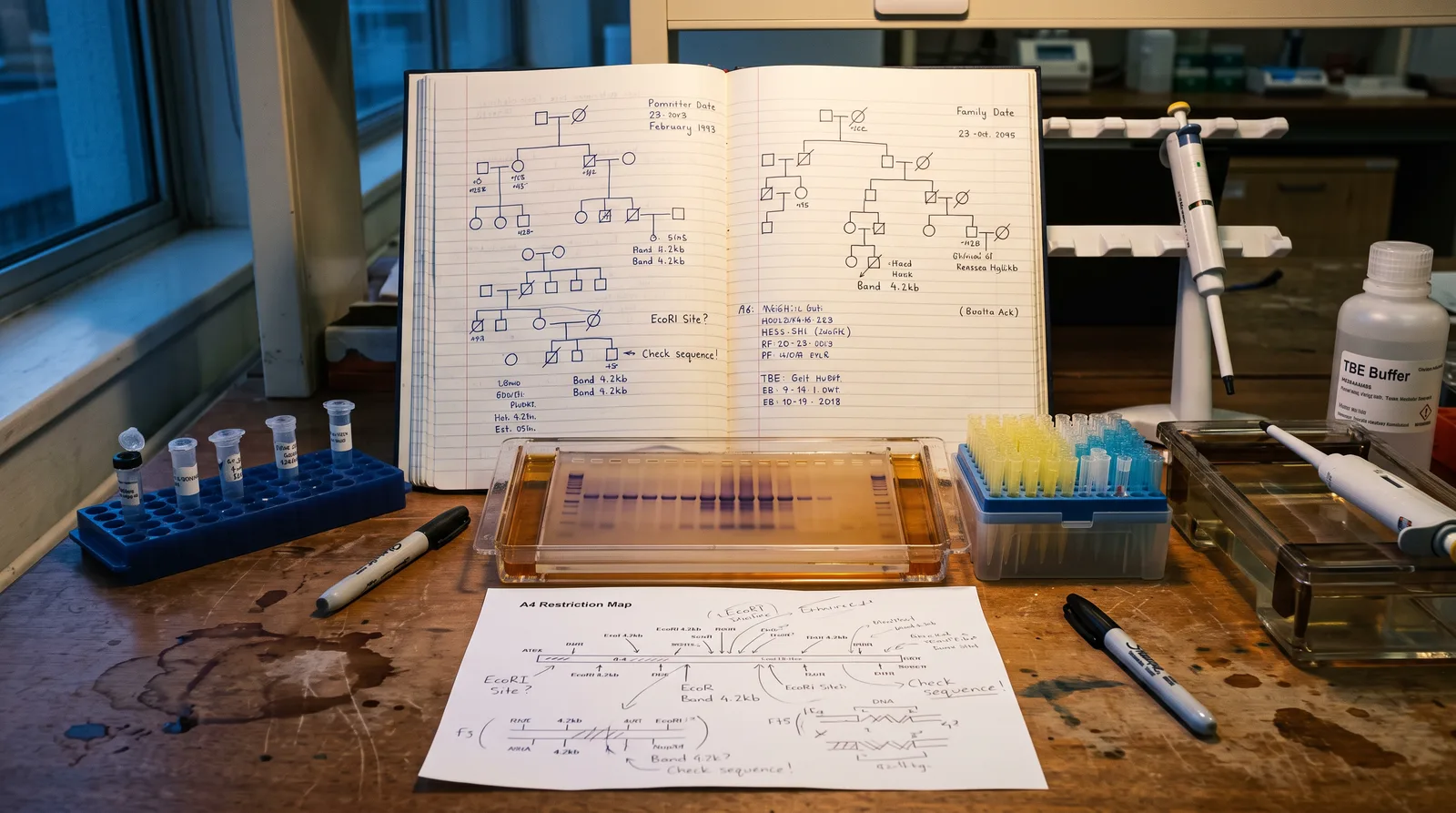
- Solve Mendelian and non-Mendelian inheritance problems, including dihybrid crosses and linkage analysis
- Explain DNA replication, transcription, and translation at a molecular level with mechanistic accuracy
- Interpret and construct pedigree charts to determine inheritance patterns in human families
- Analyze gene regulation in prokaryotes and eukaryotes, including the lac operon and chromatin remodeling
- Understand the principles and ethical implications of modern genomic technologies such as CRISPR-Cas9 and whole-genome sequencing
- Apply population genetics concepts — Hardy-Weinberg equilibrium, genetic drift, and natural selection — to real biological scenarios
How it works
A school that adapts to you
This isn't a set of static videos. Every lesson is generated live and tuned to where you actually are.
We learn your level
A quick placement check tailors your starting point so you're never bored or lost.
Lessons adapt as you go
Each lesson is written for your pace and your goal, adjusting as your skills grow.
Your AI coach keeps you moving
Checkpoints, feedback, and gentle nudges turn progress into a real result.
The curriculum
What's inside your school
6 modules · 30 lessons

Foundations of Heredity: Mendelian Genetics
Establishes the core rules of inheritance through Mendel's laws, probability, and hands-on problem solving with monohybrid and dihybrid crosses.
- 1.1Mendel's Laws and the Logic of InheritanceIncluded
- 1.2Monohybrid Crosses and Punnett SquaresIncluded
- 1.3Dihybrid Crosses and Independent AssortmentIncluded
- 1.4Probability Rules in GeneticsIncluded
- 1.5Chi-Square Analysis: Testing Genetic PredictionsIncluded
Beyond Mendel: Non-Mendelian and Complex Inheritance
Expands the inheritance framework to cover dominance variations, sex-linkage, epistasis, and chromosomal linkage.
- 2.1Incomplete Dominance, Codominance, and Multiple AllelesIncluded
- 2.2Sex-Linked Traits and X-InactivationIncluded
- 2.3Epistasis and Gene InteractionsIncluded
- 2.4Linked Genes and Recombination FrequencyIncluded
- 2.5Pedigree Analysis and Human Inheritance PatternsIncluded
Molecular Genetics: DNA, Replication, and Gene Expression
Examines the molecular mechanisms by which genetic information is stored, copied, and decoded into functional proteins.
- 3.1DNA Structure and the Double HelixIncluded
- 3.2DNA Replication: Mechanisms and EnzymesIncluded
- 3.3Transcription: From DNA to mRNAIncluded
- 3.4RNA Processing and the Genetic CodeIncluded
- 3.5Translation: Building Proteins at the RibosomeIncluded
Gene Regulation: Controlling When and How Genes Are Expressed
Analyzes the regulatory circuits that switch genes on and off in both prokaryotes and eukaryotes, from operons to chromatin remodeling.
- 4.1The lac Operon: Prokaryotic Gene RegulationIncluded
- 4.2The trp Operon and AttenuationIncluded
- 4.3Eukaryotic Transcription Factors and EnhancersIncluded
- 4.4Chromatin Remodeling, Histone Modification, and DNA MethylationIncluded
- 4.5Post-Transcriptional Regulation: miRNA and RNA InterferenceIncluded
Population Genetics and Evolutionary Forces
Applies mathematical and conceptual tools to understand how allele frequencies change across generations in populations.
- 5.1Hardy-Weinberg Equilibrium: The Null Model of EvolutionIncluded
- 5.2Mutation and Migration as Forces of ChangeIncluded
- 5.3Genetic Drift and the Founder EffectIncluded
- 5.4Natural Selection: Types, Coefficients, and OutcomesIncluded
- 5.5Molecular Evolution and PhylogeneticsIncluded
Genomics, Biotechnology, and the Ethics of Genetic Engineering
Surveys modern tools for reading and editing genomes, their revolutionary applications, and the ethical responsibilities they carry.
- 6.1Genome Sequencing: From Sanger to Next-Generation MethodsIncluded
- 6.2PCR, Gel Electrophoresis, and Recombinant DNA TechniquesIncluded
- 6.3CRISPR-Cas9: Mechanism and ApplicationsIncluded
- 6.4Genomic Medicine: Genetic Testing, Gene Therapy, and PharmacogenomicsIncluded
- 6.5Ethical, Legal, and Social Implications of Modern GeneticsIncluded
Who it's for
Is this you?

Undergrad biology students
Reinforces and deepens what's being covered in class, with the problem-solving rigor that lectures alone rarely provide.

Pre-med candidates
Builds the mechanistic, quantitative genetics understanding that the MCAT and medical school coursework demand.

Self-taught science learners
Delivers a genuine university-grade experience for those who want real depth, not a pop-science summary.

Lifelong learners
Perfect for intellectually curious adults who want to finally understand genetics — from heredity to CRISPR — at the level it deserves.

Career changers into biotech
Provides the foundational molecular and genomic genetics knowledge needed to pivot into life sciences or biotech roles.

High school advanced students
Gives AP Biology and dual-enrollment students a rigorous head start on university-level genetics concepts and problem sets.
Questions
Frequently asked
Your teacher
A note from your teacher
AI Professor Courses
Maybe you're sitting in a genetics lecture and the professor just rattled through independent assortment in ten minutes, leaving you nodding along but quietly lost. Maybe you're a pre-med student staring down the MCAT and realizing that your understanding of the lac operon is shakier than you'd like to admit. Or maybe you're simply someone who read about CRISPR in the news and thought — I want to actually understand how that works — not the magazine version, the real version.
I've taught genetics to students in exactly those situations. And what I've learned, over years in the classroom and office hours, is this: genetics is not hard because the concepts are beyond reach. It's hard because most people are never taught to reason through it. They memorize the rules without understanding the logic behind them. They can draw a Punnett square but can't tell you why independent assortment produces the ratios it does. That gap — between knowing a procedure and understanding a mechanism — is exactly what this school is designed to close.
Here, we start with Mendel, and we take him seriously. We reconstruct his reasoning, work through his crosses, and use probability and chi-square analysis the way a practicing geneticist would. Then we push past Mendel into the complications that make genetics genuinely rich: linkage, epistasis, sex-linkage, X-inactivation. At the molecular level, we follow DNA replication enzyme by enzyme, and we don't just describe transcription and translation — we ask how the machinery works and why it works that way. When we reach gene regulation, you'll understand the lac operon not as a diagram to memorize but as an elegant solution to a real cellular problem.
I want to be honest with you about what this school is. It is rigorous. You will be asked to solve problems, interpret data, and think carefully. I hold a high academic standard — because I respect your intelligence and your goals. But rigor, in the right hands, is not cold. I've spent my career making sure that every student who walks through the door of a challenging subject walks out the other side having genuinely mastered it. That's my commitment to you here.
By the time we reach CRISPR and genomic medicine, you won't just know what these technologies are — you'll understand the molecular mechanism, the clinical applications, and the ethical weight they carry. This is the kind of education that changes how you see biology, medicine, and the natural world. I'd be honored to be your professor for it. Let's get to work.
— AI Professor Courses
Start your journey today
Get instant access — learn at your own pace with an AI coach in your corner.
$5/mo
Recurring billing · cancel anytime
Secure checkout · Instant access
- 6 modules, 30 lessons
- AI-adaptive lessons tuned to your level
- Quizzes & checkpoints to lock in progress
- Your own AI learning coach
- Learn on any device, at your pace
- Full access for as long as you're subscribed