Master geometry the way mathematicians do
A rigorous, professor-led course that takes you from your first axiom to advanced theorems — building the logical reasoning and proof-writing skills that separate students who understand geometry from students who merely calculate it.

"I never skip a proof — because the proof is where the understanding actually lives."
— AI Professor Courses
What you'll learn
What you'll be able to do
- Write rigorous two-column and paragraph proofs using axioms, postulates, and established theorems
- Identify and apply properties of parallel lines, transversals, triangles, and polygons to solve real problems
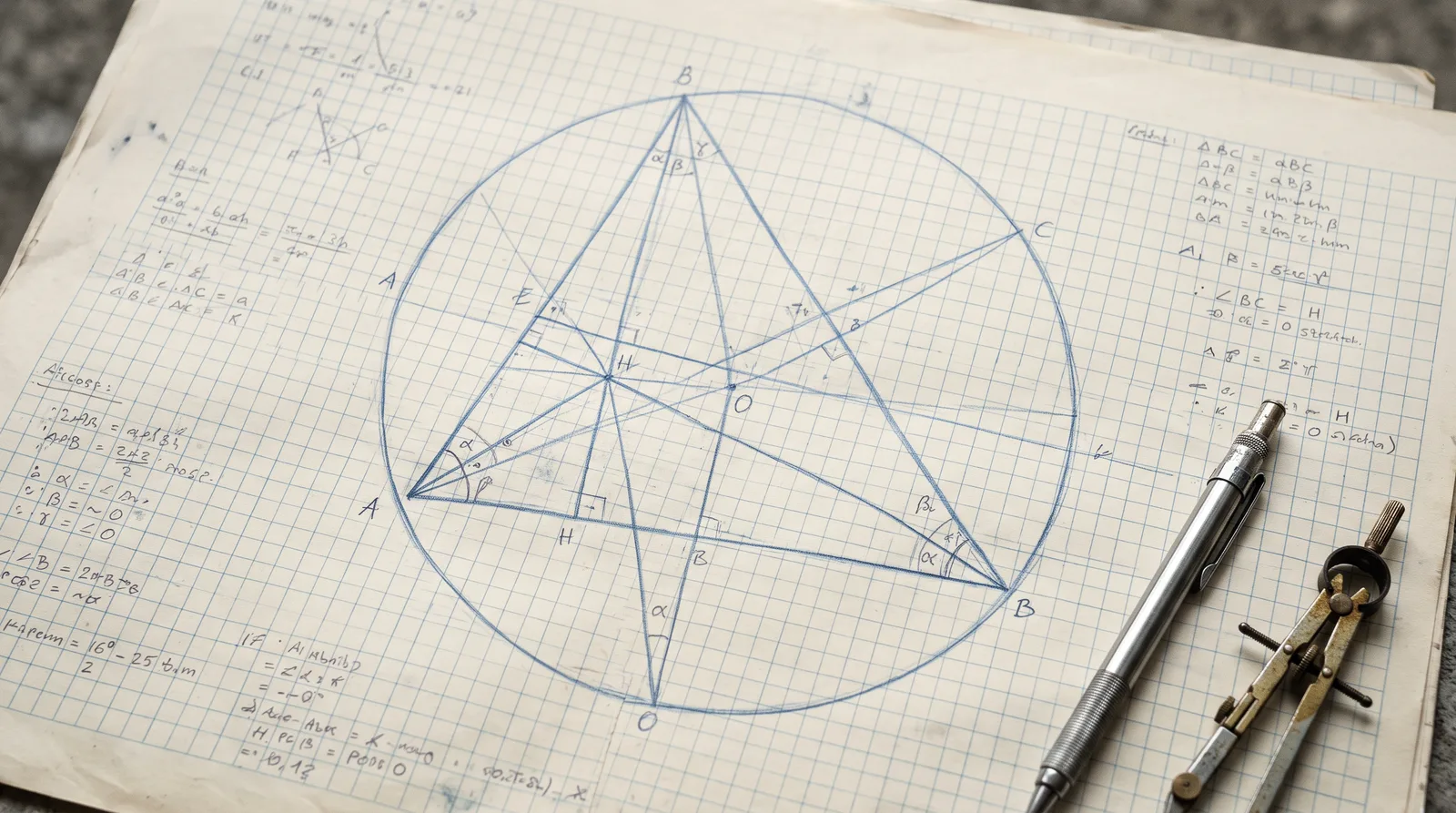
- Master circle geometry — chords, arcs, central angles, inscribed angles, and tangent relationships
- Calculate perimeter, area, surface area, and volume for all standard 2D and 3D figures with confidence
- Apply coordinate geometry to prove relationships and find distances, midpoints, and slopes analytically
- Understand and use similarity, congruence, and transformations — translations, rotations, reflections, and dilations
How it works
A school that adapts to you
This isn't a set of static videos. Every lesson is generated live and tuned to where you actually are.
We learn your level
A quick placement check tailors your starting point so you're never bored or lost.
Lessons adapt as you go
Each lesson is written for your pace and your goal, adjusting as your skills grow.
Your AI coach keeps you moving
Checkpoints, feedback, and gentle nudges turn progress into a real result.
The curriculum
What's inside your school
7 modules · 33 lessons

Foundations of Geometric Reasoning
Establishes the language, logic, and axiomatic system that underpins all geometric proof and problem-solving.
- 1.1Points, Lines, and PlanesIncluded
- 1.2Segments, Rays, and AnglesIncluded
- 1.3Conditional Statements and Logical ReasoningIncluded
- 1.4Introduction to Proof: Two-Column and Paragraph FormatsIncluded
- 1.5Midpoints, Bisectors, and Angle RelationshipsIncluded
Parallel Lines, Transversals, and Polygons
Develops the properties of parallel and perpendicular lines and extends them to classify and analyze polygons.
- 2.1Parallel Lines and TransversalsIncluded
- 2.2Perpendicular Lines and Their ProofsIncluded
- 2.3Classifying and Analyzing TrianglesIncluded
- 2.4Polygons: Interior and Exterior AnglesIncluded
- 2.5Properties of QuadrilateralsIncluded
Congruence, Similarity, and Transformations
Connects rigid motions and dilations to the formal criteria for triangle congruence and polygon similarity.
- 3.1Rigid Motions: Translations, Rotations, and ReflectionsIncluded
- 3.2Congruence Criteria: SSS, SAS, ASA, AAS, and HLIncluded
- 3.3Dilations and Scale FactorIncluded
- 3.4Similarity Criteria: AA, SAS, and SSSIncluded
- 3.5Applying Similarity: Midsegment and Triangle Proportionality TheoremsIncluded
Right Triangles and Trigonometric Ratios
Develops the Pythagorean Theorem, its converse, special triangles, and the trigonometric ratios used to solve right triangles.
- 4.1The Pythagorean Theorem and Its ConverseIncluded
- 4.2Special Right Triangles: 45-45-90 and 30-60-90Included
- 4.3Trigonometric Ratios: Sine, Cosine, and TangentIncluded
- 4.4Solving Right Triangles and Angles of Elevation and DepressionIncluded
Circle Geometry
Provides a rigorous treatment of circles, covering arcs, chords, tangents, secants, and angle and segment relationships.
- 5.1Circle Vocabulary: Radius, Chord, Diameter, and ArcIncluded
- 5.2Central Angles and Arc MeasureIncluded
- 5.3Inscribed Angles and Their TheoremsIncluded
- 5.4Tangent Lines, Secants, and Chord RelationshipsIncluded
- 5.5Arc Length and Sector AreaIncluded
Coordinate Geometry
Uses the coordinate plane analytically to prove geometric relationships and apply distance, midpoint, and slope formulas.
- 6.1Distance and Midpoint FormulasIncluded
- 6.2Slope and Equations of LinesIncluded
- 6.3Proving Geometric Relationships on the Coordinate PlaneIncluded
- 6.4Equations of CirclesIncluded
Perimeter, Area, Surface Area, and Volume
Builds fluency in computing measurements for all standard two-dimensional and three-dimensional figures.
- 7.1Perimeter and Area of PolygonsIncluded
- 7.2Circumference and Area of CirclesIncluded
- 7.3Surface Area of Prisms, Pyramids, and CylindersIncluded
- 7.4Volume of Prisms, Cylinders, Pyramids, Cones, and SpheresIncluded
- 7.5Effects of Scaling on Area and VolumeIncluded
Who it's for
Is this you?

College-bound high schooler
She wants to arrive at college with geometry already solid — proofs, theorems, and all — so she's not scrambling to catch up in a fast-moving math course.

Undergrad in a math-adjacent major
He's studying engineering or computer science and needs geometry to be genuinely rigorous, not just a memory of formulas from sophomore year.

Adult filling a knowledge gap
She got through school without ever really learning geometry and is ready, finally, to understand it properly — on her own terms and at her own pace.

Professional sharpening math foundations
He works in a field where spatial and logical reasoning matter and wants the rigorous, proof-based foundation he never got the first time around.

Self-directed math enthusiast
He loves mathematics for its own sake and wants a real college-level geometry course — complete with proofs — not a watered-down survey.

Student retaking or supplementing a course
Her current geometry class moves too fast and explains too little, and she wants a professor who will slow down and show every step, every time.
Questions
Frequently asked
Your teacher
A note from your teacher

AI Professor Courses
If you've ever sat in a math class and felt like the explanation stopped just before the part that would have actually made sense — I understand that frustration deeply. Most geometry instruction rushes toward answers. It gives you the formula, shows you one example, and moves on. And students are left with a procedure they can follow but not a concept they understand. That's not your fault. That's a failure of instruction.
I built this course because geometry, taught properly, is one of the most intellectually satisfying subjects in all of mathematics. It is the place where logic becomes visual, where an abstract argument lands as something you can see. The ancient Greeks understood this. Modern mathematicians understand it. And I want you to understand it too — not as a spectator, but as someone who can construct a proof, justify every step, and know exactly why the result is true.
Here's what you'll find in this course that you may not have found elsewhere: I don't skip proofs. When we establish a theorem, we establish it — from the postulates and definitions that support it, through every logical step, to the conclusion. Two-column proofs, paragraph proofs, coordinate proofs — you'll write all of them, and by the end, they'll feel natural. We cover all seven major domains of geometry: foundational reasoning, parallel lines and polygons, congruence and similarity, right triangles and trigonometry, circle geometry, coordinate geometry, and measurement in two and three dimensions. It's a complete course, not a highlight reel.
I also want to address the worry I hear most often: "I'm not a math person." That phrase, I'd gently suggest, usually means "No one has ever explained this to me at the right pace, with enough care." This course is deliberately patient. Every new concept is introduced with context, developed with examples, and reinforced through the logic that makes it inevitable. Careful thinking is rewarded here. You don't have to be fast — you have to be willing.
Whether you're a high school student getting ahead, an undergraduate who needs geometry to be solid before the next course, or an adult learner who has been meaning to fill this gap for years — you belong in this classroom. Come ready to think, and I promise you'll leave with something real: not just formulas, but the reasoning skills that make mathematics meaningful. I'll see you in the first lesson.
— AI Professor Courses
Start your journey today
Get instant access — learn at your own pace with an AI coach in your corner.
$5/mo
Recurring billing · cancel anytime
Secure checkout · Instant access
- 7 modules, 33 lessons
- AI-adaptive lessons tuned to your level
- Quizzes & checkpoints to lock in progress
- Your own AI learning coach
- Learn on any device, at your pace
- Full access for as long as you're subscribed