Think like a federal attorney. Argue like one too.
The Law Practicum takes you from legal foundations to FISA courts and international frameworks — using the same Socratic, case-based reasoning that elite law schools demand, without the six-figure tuition.

"I don't teach you what the law says — I teach you how to think until the right answer becomes the only answer you can defend."
— AI Professor Courses
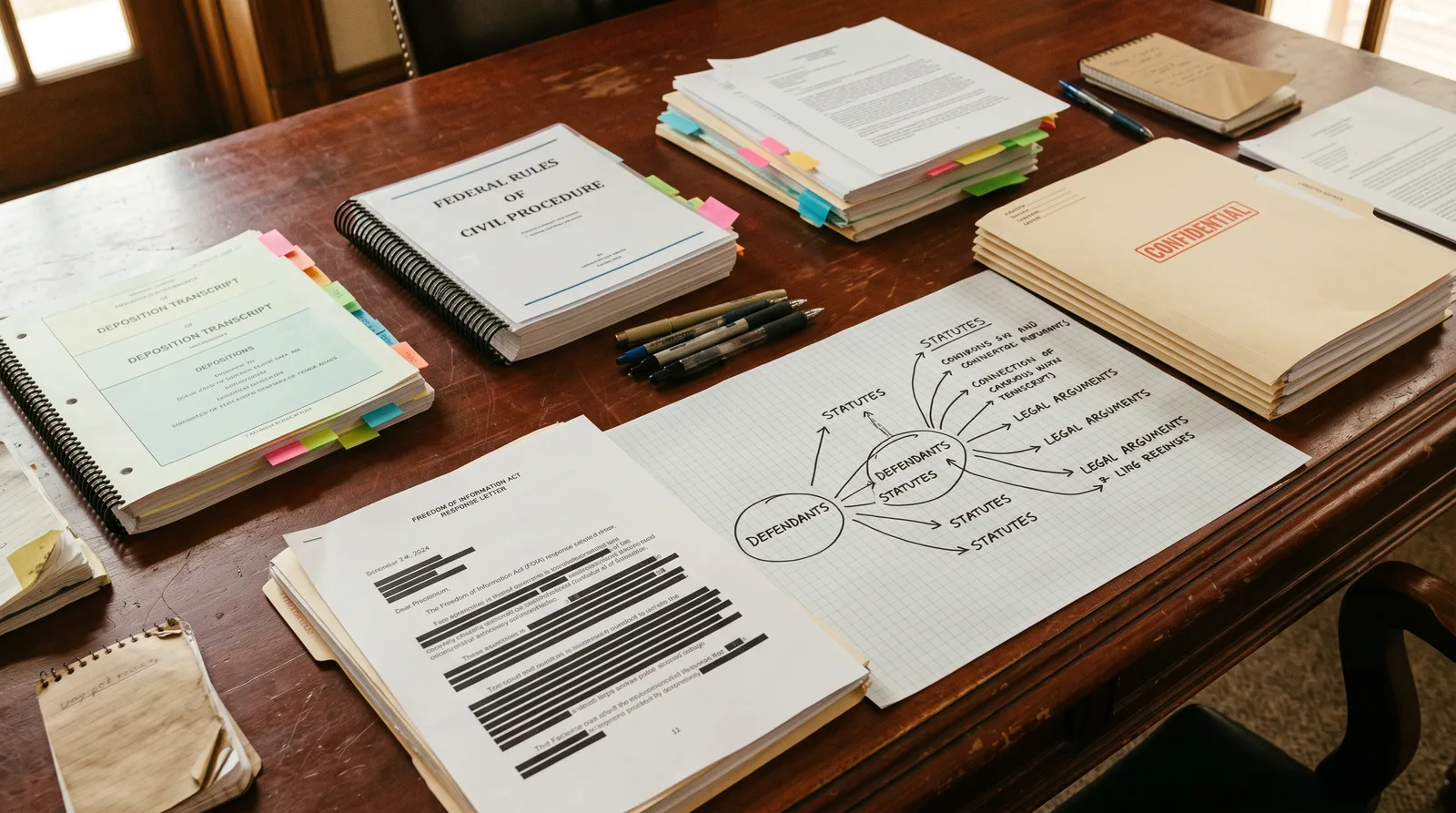
What you'll learn
What you'll be able to do
- Construct a legally sound criminal or civil case strategy from intake through trial, including evidence gathering, PI coordination, and court Discovery under the Federal Rules of Civil Procedure
- Analyze and apply constitutional law principles — including First, Fourth, Fifth, and Sixth Amendment doctrine — to real litigation scenarios at both state and federal levels
- Navigate the full landscape of U.S. tort law, business law, real estate law, and administrative law, identifying the correct cause of action, jurisdiction, and procedural pathway
- Draft and respond to FOIA requests under 5 U.S.C. § 552, identify applicable exemptions, and pursue administrative appeals or federal court enforcement
- Evaluate anti-terrorism, national security, and international law frameworks — including treaty obligations, the Authorization for Use of Military Force (AUMF), and the Foreign Intelligence Surveillance Act (FISA) — and explain how they interact with civil liberties protections
- Understand the FISA Court application process, the legal standards for Title I and Title VII orders, and the interplay between foreign intelligence collection and domestic criminal prosecution under the Fourth Amendment
How it works
A school that adapts to you
This isn't a set of static videos. Every lesson is generated live and tuned to where you actually are.
We learn your level
A quick placement check tailors your starting point so you're never bored or lost.
Lessons adapt as you go
Each lesson is written for your pace and your goal, adjusting as your skills grow.
Your AI coach keeps you moving
Checkpoints, feedback, and gentle nudges turn progress into a real result.
The curriculum
What's inside your school
9 modules · 51 lessons

Foundations of U.S. Law: Structure, Sources, and Jurisdiction
Establishes the constitutional architecture, court systems, and source hierarchy that underpin every area of U.S. law studied in this course.
- 1.1The U.S. Court System: Federal and State JurisdictionIncluded
- 1.2Sources of Law: Constitutions, Statutes, Regulations, and Common LawIncluded
- 1.3Reading and Briefing Cases: The IRAC MethodIncluded
- 1.4Federalism and the Supremacy Clause in PracticeIncluded
- 1.5Legal Ethics and Professional Responsibility for PractitionersIncluded
Constitutional Law: Rights, Doctrine, and Litigation
Examines the major constitutional doctrines — with deep focus on the First, Fourth, Fifth, and Sixth Amendments — as applied in real civil and criminal litigation.
- 2.1First Amendment: Free Speech, Religion, and the PressIncluded
- 2.2Fourth Amendment: Search, Seizure, and the Exclusionary RuleIncluded
- 2.3Fifth Amendment: Self-Incrimination, Due Process, and TakingsIncluded
- 2.4Sixth Amendment: Right to Counsel, Speedy Trial, and ConfrontationIncluded
- 2.5Equal Protection, Substantive Due Process, and 14th Amendment DoctrineIncluded
- 2.6Section 1983 Civil Rights Litigation Against Government ActorsIncluded
Civil Litigation: Case Construction, Evidence, and Discovery
Walks through the complete lifecycle of a civil case — from intake and pleadings through discovery, motions, and trial — under the Federal Rules of Civil Procedure.
- 3.1Case Intake: Client Screening, Conflict Checks, and Cause of Action AnalysisIncluded
- 3.2Pleadings: Complaints, Answers, and Rule 12 MotionsIncluded
- 3.3Evidence Gathering: Investigators, Surveillance, and Chain of CustodyIncluded
- 3.4Court Discovery: Interrogatories, Depositions, and Document RequestsIncluded
- 3.5Expert Witnesses, Daubert Standards, and Trial ExhibitsIncluded
- 3.6Summary Judgment, Settlement, and Alternative Dispute ResolutionIncluded
Criminal Law and Prosecution: Case Construction Through Verdict
Covers the full arc of criminal prosecution — from investigation and charging through trial strategy — for both state and federal offenses.
- 4.1Elements of Crime: Actus Reus, Mens Rea, and Statutory InterpretationIncluded
- 4.2Criminal Investigation: Warrants, Subpoenas, and Grand Jury PracticeIncluded
- 4.3Arrest, Charging Decisions, and the Indictment ProcessIncluded
- 4.4Pre-Trial Motions: Suppression, Speedy Trial, and Brady ObligationsIncluded
- 4.5Trial Strategy: Opening, Examination, Closing, and Jury InstructionsIncluded
- 4.6Sentencing, Appeals, and Post-Conviction ReliefIncluded
Tort Law, Business Law, and Real Estate Law
Surveys the major private law fields — negligence, intentional torts, contract and business disputes, and real property — with attention to the correct cause of action and procedural pathway.
- 5.1Negligence: Duty, Breach, Causation, and DamagesIncluded
- 5.2Intentional Torts and Strict LiabilityIncluded
- 5.3Contract Formation, Breach, and Remedies in Business DisputesIncluded
- 5.4Business Entities, Fiduciary Duties, and Corporate LiabilityIncluded
- 5.5Real Estate Law: Transactions, Title, Easements, and Landlord-TenantIncluded
- 5.6Damages, Equitable Relief, and Class Action LitigationIncluded
Administrative Law and the Freedom of Information Act
Teaches the regulatory state's legal framework — rulemaking, agency adjudication, judicial review — and the FOIA litigation pathway for compelling government transparency.
- 6.1The Administrative Procedure Act: Rulemaking and Agency AuthorityIncluded
- 6.2Judicial Review of Agency Action: Chevron, Loper Bright, and Arbitrary-and-Capricious ReviewIncluded
- 6.3FOIA Fundamentals: Drafting Requests Under 5 U.S.C. § 552Included
- 6.4FOIA Exemptions: National Security, Privacy, Deliberative Process, and Law EnforcementIncluded
- 6.5FOIA Administrative Appeals and Federal Court Enforcement LitigationIncluded
Anti-Terrorism Law, National Security, and the FISA Framework
Examines the legal architecture of U.S. national security law — FISA, the AUMF, material support statutes, and the FISA Court — and how these frameworks intersect with constitutional civil liberties.
- 7.1Legal Foundations of U.S. National Security LawIncluded
- 7.2The Authorization for Use of Military Force (AUMF) and the Law of WarIncluded
- 7.3Anti-Terrorism Statutes: Material Support, Designation, and ProsecutionIncluded
- 7.4The Foreign Intelligence Surveillance Act: Title I and Title VII OrdersIncluded
- 7.5The FISA Court: Application Process, Procedures, and OversightIncluded
- 7.6FISA Evidence in Criminal Prosecution and Fourth Amendment LimitsIncluded
- 7.7Civil Liberties, Surveillance Oversight, and Reform LegislationIncluded
International Law, Treaties, and Cross-Border Legal Frameworks
Grounds students in public international law doctrine and explains how treaties, customary international law, and foreign affairs statutes operate within and alongside U.S. domestic law.
- 8.1Sources and Principles of Public International LawIncluded
- 8.2Treaty Law: Formation, Ratification, Self-Execution, and WithdrawalIncluded
- 8.3Jurisdiction, Sovereign Immunity, and the Foreign Sovereign Immunities ActIncluded
- 8.4International Human Rights Law and U.S. Compliance ObligationsIncluded
- 8.5Extradition, Mutual Legal Assistance Treaties (MLATs), and Cross-Border EvidenceIncluded
Capstone: Integrated Case Simulation and Professional Readiness
Synthesizes every doctrinal module through a multi-issue, multi-party simulated case requiring students to apply civil, criminal, constitutional, FOIA, and national security law together.
- 9.1Case File Orientation: Analyzing a Complex Multi-Issue Legal MatterIncluded
- 9.2Litigation Strategy Memo: Choosing Civil vs. Criminal PathwaysIncluded
- 9.3Discovery Plan and Evidence Gathering ProtocolIncluded
- 9.4Constitutional and National Security Issue SpottingIncluded
- 9.5Oral Argument Simulation: Arguing Motions Before a Simulated CourtIncluded
Who it's for
Is this you?

1L Law Students
Build the case-briefing discipline, constitutional doctrine command, and procedural fluency that law school demands — before exams arrive.

Experienced Paralegals
Elevate from task execution to strategic legal thinking — understand the 'why' behind discovery, motions practice, and evidentiary standards.

Pre-Law Undergraduates
Get a rigorous preview of law school's Socratic method and substantive doctrine so you arrive on day one ahead of the curve.

Self-Represented Litigants
Understand the civil and criminal procedures, constitutional rights, and court system mechanics you need to advocate effectively for yourself.

National Security Professionals
Gain rigorous legal command of FISA, the AUMF, anti-terrorism statutes, and the Fourth Amendment limits that govern intelligence and prosecution.

Attorneys Expanding Practice
Cross into administrative law, FOIA enforcement, international frameworks, or national security law with the doctrinal precision your clients will expect.
Questions
Frequently asked
Your teacher
A note from your teacher

AI Professor Courses
If you have spent any time in a law school classroom, a federal courthouse, or a legal self-help forum, you already know the problem. Legal education in this country does one of two things: it gives you doctrine without procedure, or procedure without doctrine. You can read a hornbook cover to cover and still have no idea how to construct a case. You can memorize the Federal Rules of Civil Procedure and still freeze when a client walks in with a fact pattern that cuts across three practice areas at once.
That gap — between knowing the law and being able to use it — is exactly what The Law Practicum is designed to close.
I built this curriculum on a single premise: the law is not a collection of rules to be memorized. It is a structured system of arguments, counterarguments, and procedural moves — and the people who command it best are the ones who were trained to think through a legal problem, not just recognize one. Every module in this school applies that standard. We do not survey constitutional doctrine; we work through how a Fourth Amendment suppression motion actually gets litigated, what the government argues back, and where the circuit splits leave room for creative advocacy. We do not introduce the FISA Court as a news item; we walk through the legal standards, the application mechanics, and the downstream consequences for criminal prosecution under the Fourth Amendment.
I want to be direct about something: this curriculum will ask something of you. The Socratic method is not comfortable. Being asked why — not just what — is not comfortable. Sitting with a complex fact pattern until the correct legal theory reveals itself is not comfortable. I make no apologies for that. The discomfort is the instruction. Every time you are pushed to justify a legal conclusion, to identify the weakest link in your own argument, to anticipate what the other side will say — that is the moment the skill is actually being built.
What I can promise you is this: the complexity will always be earned. Every dense doctrine gets broken down to its structural bones first. The elements of a cause of action. The burden of proof. The procedural vehicle. The strategic consequences of getting it wrong. And then — only then — do we rebuild it at full complexity, with the case law, the circuit splits, the policy tensions, and the ethical obligations that a practitioner actually has to navigate.
Wherever you are in your legal journey — first-year law student, veteran paralegal, self-represented litigant, or experienced attorney stepping into national security territory for the first time — there is a seat for you in this seminar. Come prepared to think. Come prepared to be challenged. And come prepared to leave with the analytical architecture that separates people who know the law from people who can wield it.
— AI Professor Courses
Start your journey today
Get instant access — learn at your own pace with an AI coach in your corner.
$5/mo
Recurring billing · cancel anytime
Secure checkout · Instant access
- 9 modules, 51 lessons
- AI-adaptive lessons tuned to your level
- Quizzes & checkpoints to lock in progress
- Your own AI learning coach
- Learn on any device, at your pace
- Full access for as long as you're subscribed