Understand the psychology of every stage of life
A rigorous, college-quality deep dive into lifespan development — from prenatal biology to dying and bereavement — taught through the landmark theories, real research methods, and critical thinking skills that define the discipline.

"I want you to be able to use these theories as lenses, not just recite them as facts."
— AI Professor Courses
What you'll learn
What you'll be able to do
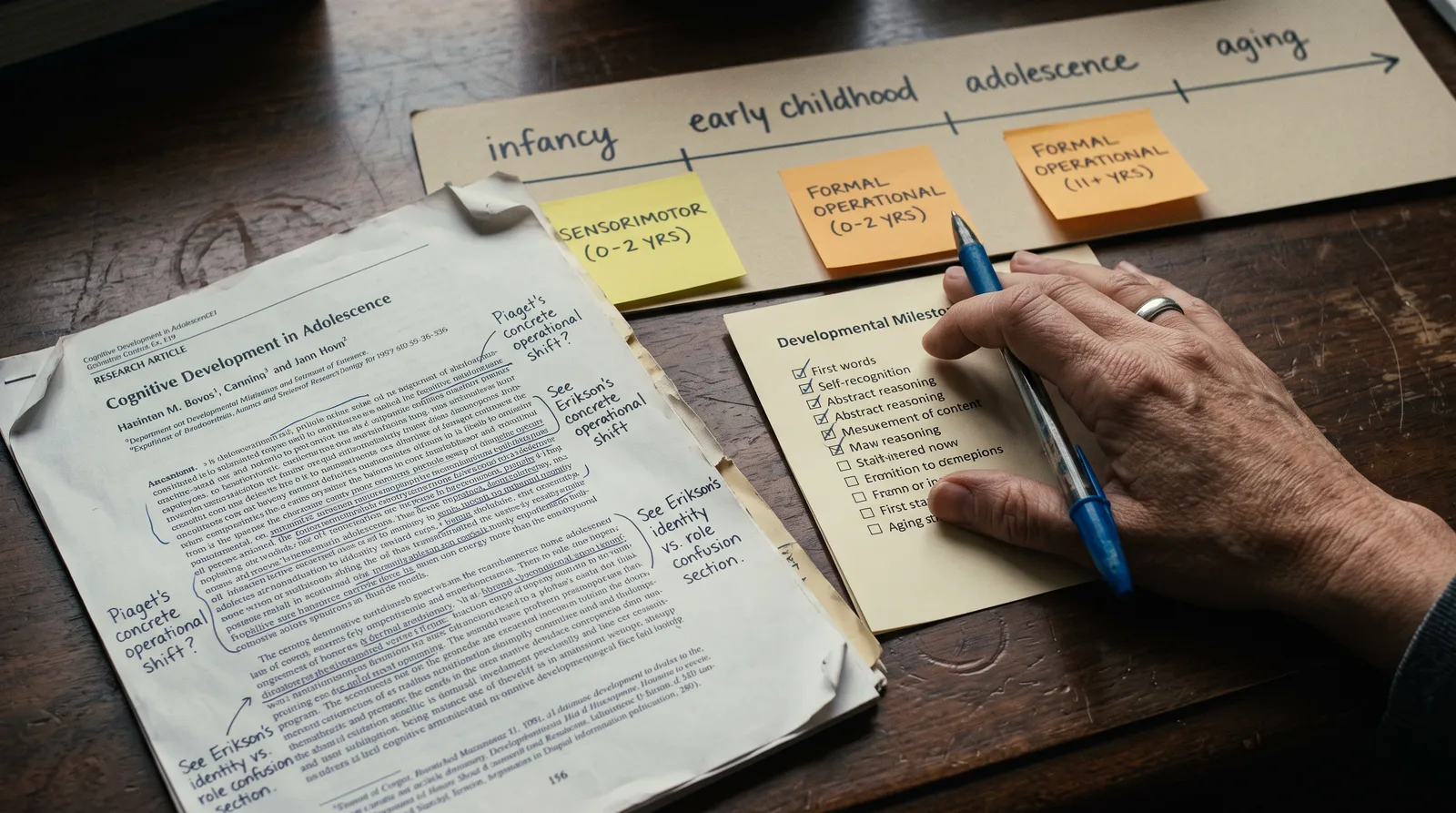
- Identify and compare the major theoretical frameworks of lifespan development, including Erikson's psychosocial stages, Piaget's cognitive stages, and Bronfenbrenner's ecological model.
- Describe the key physical, cognitive, and socioemotional milestones from prenatal development through late adulthood and death.
- Apply developmental research methods — including longitudinal, cross-sectional, and sequential designs — to critically evaluate psychological studies.
- Analyze how biological, environmental, cultural, and socioeconomic factors interact to shape individual development across the lifespan.
- Explain attachment theory, identity formation, moral reasoning, and other core psychological constructs and their role at different life stages.
- Synthesize lifespan development concepts to interpret real-world scenarios in education, counseling, parenting, healthcare, and social policy.
How it works
A school that adapts to you
This isn't a set of static videos. Every lesson is generated live and tuned to where you actually are.
We learn your level
A quick placement check tailors your starting point so you're never bored or lost.
Lessons adapt as you go
Each lesson is written for your pace and your goal, adjusting as your skills grow.
Your AI coach keeps you moving
Checkpoints, feedback, and gentle nudges turn progress into a real result.
The curriculum
What's inside your school
6 modules · 28 lessons

Foundations of Lifespan Development
Establishes the discipline's core vocabulary, historical roots, theoretical frameworks, and research methods that underpin all subsequent study.
- 1.1Welcome to Lifespan DevelopmentIncluded
- 1.2Major Theories of DevelopmentIncluded
- 1.3Nature, Nurture, and the Interactionist ViewIncluded
- 1.4Research Methods in Developmental PsychologyIncluded
- 1.5Culture, Diversity, and Social ContextIncluded
Prenatal Development, Birth, and the Newborn
Traces human development from conception through birth, covering biological milestones, prenatal risks, the birth process, and newborn capabilities.
- 2.1Conception and Prenatal StagesIncluded
- 2.2Prenatal Risks and Protective FactorsIncluded
- 2.3Birth, the Perinatal Period, and Newborn AssessmentIncluded
Infancy and Early Childhood
Explores the dramatic physical, cognitive, language, and socioemotional growth that unfolds from birth through the preschool years.
- 3.1Physical and Brain Development in InfancyIncluded
- 3.2Cognitive Development in Infancy and ToddlerhoodIncluded
- 3.3Language Acquisition in Early ChildhoodIncluded
- 3.4Attachment Theory and Early RelationshipsIncluded
- 3.5Socioemotional Development and Parenting StylesIncluded
Middle Childhood and Adolescence
Covers the school years through young adulthood, with emphasis on cognitive leaps, identity formation, moral reasoning, and peer relationships.
- 4.1Physical Development and the School-Age BrainIncluded
- 4.2Cognitive Development in Middle ChildhoodIncluded
- 4.3Moral Reasoning: Piaget, Kohlberg, and GilliganIncluded
- 4.4Puberty, Adolescent Brain Development, and Risk-TakingIncluded
- 4.5Identity Formation, Self-Concept, and Peer RelationshipsIncluded
Early and Middle Adulthood
Examines the physical, cognitive, and socioemotional challenges and milestones of adult life from the twenties through midlife.
- 5.1Physical Development and Health in Early AdulthoodIncluded
- 5.2Cognitive Development and Emerging AdulthoodIncluded
- 5.3Intimacy, Love, and Close RelationshipsIncluded
- 5.4Career Development, Work, and PurposeIncluded
- 5.5Midlife: Generativity, Crisis, and StabilityIncluded
Late Adulthood, Aging, and Death
Provides a rigorous, compassionate examination of the biology of aging, cognitive changes, resilience in late life, and the psychology of dying.
- 6.1Physical Aging and LongevityIncluded
- 6.2Cognitive Aging: Memory, Wisdom, and DementiaIncluded
- 6.3Socioemotional Aging: Relationships, Retirement, and Well-BeingIncluded
- 6.4Death, Dying, and BereavementIncluded
- 6.5Integrating the Lifespan: Real-World ApplicationsIncluded
Who it's for
Is this you?

Psychology undergraduates
Building a rigorous academic foundation in developmental theory, research methods, and the lifespan canon before upper-division coursework.

Social work & counseling students
Deepening clinical insight into attachment, identity, moral reasoning, and aging to better serve clients across every stage of life.

Education students & teachers
Understanding the cognitive and socioemotional development of children and adolescents to inform more effective, developmentally grounded teaching.
Lifelong learners
Curious adults who want the real college-level course — full theories, real research, precise vocabulary — not a pop-science summary.

Healthcare professionals
Nurses, physicians, and allied health workers seeking a deeper evidence-based understanding of prenatal risk, cognitive aging, and end-of-life psychology.

Parents & family advocates
Grounding their parenting instincts in the actual science of attachment, brain development, moral reasoning, and adolescent risk-taking.
Questions
Frequently asked
Your teacher
A note from your teacher
AI Professor Courses
If you've ever found yourself wondering why — why a toddler can't yet take another person's perspective, why teenagers take risks that baffle the adults around them, why midlife can feel simultaneously like crisis and consolidation, why some people seem to age with remarkable grace while others decline sharply — then you already have the instincts of a developmental psychologist. You've been asking the right questions. This course exists to give those questions the serious, systematic treatment they deserve.
I designed Human Development Lab because I believe the psychology of human development is one of the most intellectually rich and practically useful bodies of knowledge that exists — and yet most people who encounter it get either a watered-down pop-psychology version or a dry textbook march through milestones. Neither does justice to the field. The theories of Erikson, Piaget, Vygotsky, and Bronfenbrenner are not just academic landmarks to be memorized and moved past. They are lenses — competing, sometimes contradictory, always illuminating — through which human experience comes into sharper focus. I want you to be able to use them, not just recite them.
What you'll find here is a course that takes you seriously as a thinker. We move through the entire lifespan — from the prenatal environment and the remarkable competence of newborns, through the cognitive revolutions of childhood, the identity crucible of adolescence, the intimacy and generativity of adulthood, and the neuroscience and existential terrain of aging and death — and at every stage, I'll ask you to think critically. What does the evidence actually show? Where do the theories conflict, and what do those conflicts reveal? How does culture complicate what a "universal" stage model claims? These are the questions that make developmental psychology alive rather than inert.
I also want to be honest about what this course asks of you: genuine intellectual engagement. That means grappling with research methodology — understanding why a longitudinal design tells us something a cross-sectional study cannot, and why that distinction matters when you're trying to understand cognitive aging or the long-term effects of early attachment. It means reading carefully, thinking carefully, and being willing to sit with complexity rather than reaching for the nearest oversimplification. You can absolutely do this, whatever your background.
Whether you're an undergrad building your psychology foundation, a social worker or educator who wants to understand the people you serve more deeply, a healthcare professional confronting the realities of aging and end-of-life care, or simply an adult who has always wanted to take this subject seriously — I'm glad you're here. This is the course I wish more people had access to. Let's do the work.
— AI Professor Courses
Start your journey today
Get instant access — learn at your own pace with an AI coach in your corner.
$5/mo
Recurring billing · cancel anytime
Secure checkout · Instant access
- 6 modules, 28 lessons
- AI-adaptive lessons tuned to your level
- Quizzes & checkpoints to lock in progress
- Your own AI learning coach
- Learn on any device, at your pace
- Full access for as long as you're subscribed