Redesign your job around AI - before someone does it for you
A two-track, role-specific school for working professionals who need practical methods, not inspiration, to rebuild how their work actually gets done as Generative and Agentic AI move in.

"Every exercise in this school ends in something you can use on Monday, if it doesn't, it doesn't belong in the curriculum."
— Daniel Silverman
What you'll learn
What you'll be able to do
- Accurately diagnose your own workflow — identifying which tasks are human-only, copilot-assist, agent-ready, automatable, or eliminable — using a structured task inventory.
- Write tight, reusable AI briefs (goals, constraints, context, examples, definition of done, failure modes) that produce consistent, audit-worthy output across any major AI platform.
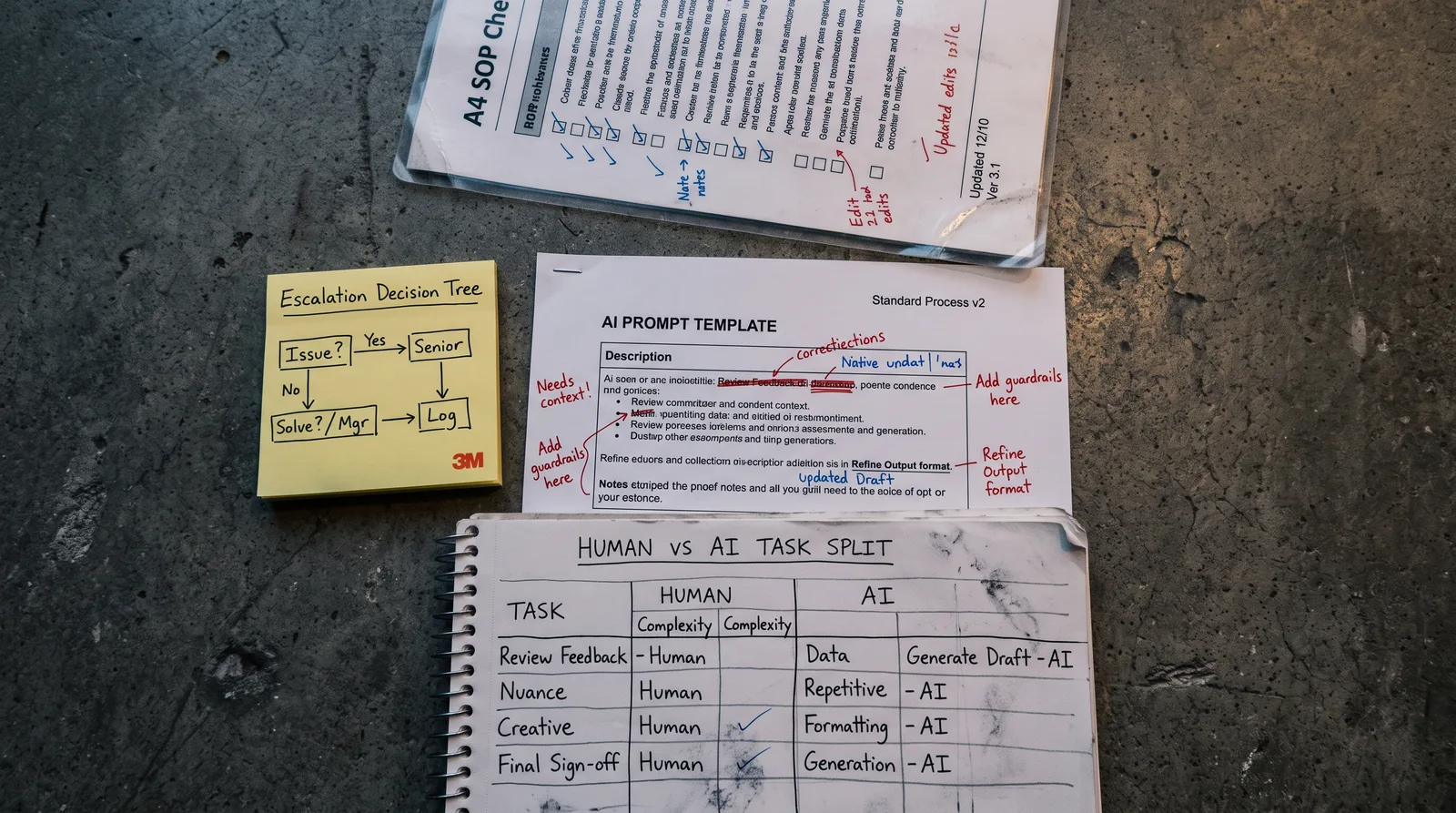
- Apply the full Work Redesign Method to at least one real workflow in your role, producing a revised SOP, prompt/agent brief, quality rubric, and escalation rules.
- Design human-in-the-loop guardrails — defining when an AI may act autonomously, when it must surface a decision, and when a human must sign — so you can delegate to agents without losing accountability.
- Measure the real impact of AI adoption beyond time saved, tracking cycle time, rework rate, quality deltas, and customer or stakeholder impact to make a credible business case.
- Complete a role-specific AI-Native Playbook covering your core recurring workflows, ready to share with your team or manager as a living operating standard.
How it works
A school that adapts to you
This isn't a set of static videos. Every lesson is generated live and tuned to where you actually are.
We learn your level
A quick placement check tailors your starting point so you're never bored or lost.
Lessons adapt as you go
Each lesson is written for your pace and your goal, adjusting as your skills grow.
Your AI coach keeps you moving
Checkpoints, feedback, and gentle nudges turn progress into a real result.
The curriculum
What's inside your school
7 modules · 38 lessons

Orientation & Role Picker
Diagnose your current work, understand what this school asks of you, and choose your track and primary role.
- 1.1Your Work Under the MicroscopeIncluded
- 1.2The Three Layers of AI-Native WorkIncluded
- 1.3Pick Your Track and Primary RoleIncluded
- 1.4How to Get Full Value from This SchoolIncluded
Shared Foundation: AI Literacy That Actually Transfers
Build the conceptual and practical foundation both tracks share — human-AI division of labor, briefing, evaluation, guardrails, privacy, and measuring real value.
- 2.1GenAI vs. Agents vs. Automation — What Each Is Actually Good AtIncluded
- 2.2The Human-AI Division of Labor: Decide, Draft, Do, Check, OwnIncluded
- 2.3Briefing AI Well: Goals, Constraints, Context, Examples, Definition of Done, Failure ModesIncluded
- 2.4Evaluating Output: Accuracy, Completeness, Tone, Source Trust, Hidden AssumptionsIncluded
- 2.5Human-in-the-Loop Design: When AI May Act, Must Ask, or Must EscalateIncluded
- 2.6Privacy, Confidentiality, IP, and What Never Goes Into a Public ModelIncluded
- 2.7Measuring Real Value: Beyond Time SavedIncluded
- 2.8The 4Rs of Work Change: Redesign, Reskill, Redeploy, RebalanceIncluded
The Work Redesign Method
Learn and apply the school's repeatable, role-agnostic spine — the method every track and role course uses to build your AI-Native playbook.
- 3.1Map the Current Workflow: Trigger → Work → Handoff → DoneIncluded
- 3.2Task Labeling: Human-Only, Copilot-Assist, Agent-Can-Run, Automate, EliminateIncluded
- 3.3Write the New Operating ProcedureIncluded
- 3.4Build the Artifact Set: Prompt Brief, Checklist, Quality Rubric, Escalation RulesIncluded
- 3.5Run the 7-Day PilotIncluded
- 3.6Review, Tighten, and CommitIncluded
Track A — SMB Roles: Redesigning the Core of Your Business
Apply the Work Redesign Method to the highest-leverage workflows across SMB owner and functional lead roles — operations, marketing, sales, support, HR, and finance.
- 4.1Owner & Ops Lead: Running the Business on a Smaller TeamIncluded
- 4.2Marketing Lead: From Brief to Published Content Without the BottleneckIncluded
- 4.3Sales Lead: Prospecting, Proposals, and Follow-Up at ScaleIncluded
- 4.4Customer Support & Success: Faster Resolution, Higher ConsistencyIncluded
- 4.5HR, Finance & Admin: Routine Processes That Finally Run ThemselvesIncluded
Track B — Enterprise & Agile Roles: AI-Native Ways of Working at Scale
Apply the Work Redesign Method to the recurring workflows of product, agility, delivery, and change roles inside larger organizations.
- 5.1Product Owner & Product Manager: Discovery, Backlog, and Stakeholder AlignmentIncluded
- 5.2Scrum Master & Team Coach: Ceremonies, Impediments, and Team HealthIncluded
- 5.3Business Analyst: Requirements, Models, and TraceabilityIncluded
- 5.4RTE, Agile Coach & Transformation Lead: PI Planning, Dependency Maps, and Change NarrativesIncluded
- 5.5Engineering & Delivery Manager: Capacity, Risk, and ReportingIncluded
- 5.6People Manager & UX Lead: Feedback, Development, and Research SynthesisIncluded
Agentic AI: Delegating Multi-Step Work Under Human Control
Go beyond copilot use to design, launch, and govern simple agents that take multi-step action inside real workflows — with guardrails that keep humans accountable.
- 6.1What an Agent Actually Is — and Is NotIncluded
- 6.2Writing an Agent Brief: Scope, Tools, Permissions, Escalation, and Shutdown CriteriaIncluded
- 6.3Your First No-Code Agent: Build One for a Real Recurring TaskIncluded
- 6.4Governing Agents: Logs, Audits, Drift Detection, and Kill SwitchesIncluded
- 6.5Scaling to Multi-Agent Workflows: Orchestrator, Specialists, and Human CheckpointsIncluded
Your AI-Native Playbook: Finalize, Share, and Keep It Alive
Assemble all work-redesign artifacts into a shareable, living AI-Native Playbook and build the habits that keep it current as AI capabilities evolve.
- 7.1Assemble Your Playbook: SOPs, Briefs, Rubrics, and Escalation Rules in One PlaceIncluded
- 7.2Make the Business Case: Presenting Your Redesign to a Manager or Leadership TeamIncluded
- 7.3Teaching Your Team the New Way of WorkingIncluded
- 7.4Keeping the Playbook Alive: Quarterly Review and AI Capability DriftIncluded
Who it's for
Is this you?

Product Owner / PM
She needs to run leaner discovery, tighten backlog hygiene, and use AI to align stakeholders faster — without losing her judgment in the loop.

SMB Founder & Ops Lead
He's wearing too many hats and needs AI to make a five-person operation run like a ten-person one — with SOPs and agent guardrails that don't require a tech hire.

Business Analyst
He wants to accelerate requirements gathering, build traceable models faster, and produce audit-worthy documentation — without AI introducing hidden assumptions he has to catch later.

Scrum Master & Team Coach
She's ready to redesign ceremonies, surface impediments earlier, and use AI to support team health reporting — while keeping the human judgment that coaching actually requires.

RTE / Agile Coach
He runs PI planning, manages dependency maps, and drives change narratives at scale — and needs AI to reduce the prep and admin load without losing strategic control.

People Manager & Functional Lead
She manages feedback cycles, development conversations, and cross-functional reporting — and wants AI to handle the drafting and synthesis so she can focus on the human side of the work.
Questions
Frequently asked
Your teacher
A note from your teacher
Daniel Silverman
Let me be direct with you about where I think you are right now.
You're good at your job. You've been doing it long enough to have real judgment, real context, real relationships. And now you're watching AI tools get rolled out — sometimes by people who've never done your job — with the implicit message that you should "figure it out." Meanwhile, your actual deliverables haven't paused. The backlog is still full. The quarter is still moving.
That tension is real, and it's what this school was built to resolve.
I built AI-Native Work School because I kept seeing the same problem: smart, experienced professionals who were either ignoring AI entirely (because the hype was exhausting) or adopting it piecemeal (a prompt here, a summarization shortcut there) without a method underneath any of it. Neither approach compounds. Neither approach protects you. What actually works is treating AI adoption the same way a good operator treats any process change — with a structured diagnosis, a deliberate redesign, a pilot, a measurement plan, and a standard you can hand to someone else.
That's the Work Redesign Method at the center of this school. It's not a framework I invented to sell a course. It's what I'd walk you through if you hired me as a consultant and needed to actually change how a real workflow runs — not in theory, but starting Monday. Every module ends in an artifact you'll keep using: a revised SOP, a brief you can hand to an AI or a team member, a rubric for evaluating what comes back, rules for when a human must stay in the loop.
I'm also not going to pretend that handing work to an agent is risk-free. The Agentic AI section of this school is governance-first for a reason: the professionals who are going to win with this technology are the ones who delegate clearly, audit consistently, and stay accountable for output they didn't personally produce. That's a skill set, and it's teachable.
If you came here looking for a shortcut or a list of prompts to copy-paste, this probably isn't your school. But if you want to finish this course with a working playbook for your actual role — something you can present to your manager, teach to your team, and update as the technology evolves — you're in exactly the right place. Let's get to work.
— Daniel Silverman
Start your journey today
Get instant access — learn at your own pace with an AI coach in your corner.
$150/6 mo
Recurring billing · cancel anytime
Secure checkout · Instant access
- 7 modules, 38 lessons
- AI-adaptive lessons tuned to your level
- Quizzes & checkpoints to lock in progress
- Your own AI learning coach
- Learn on any device, at your pace
- Full access for as long as you're subscribed