Master Organic Chemistry — From First Principles
A rigorous, professor-led course that takes you from atomic orbitals to multi-step synthesis — built for students who want to genuinely understand orgo, not just survive it.

My job isn't to help you pass organic chemistry — it's to make sure you actually understand it, because that's the only version of success that holds up.
— AI Professor Courses
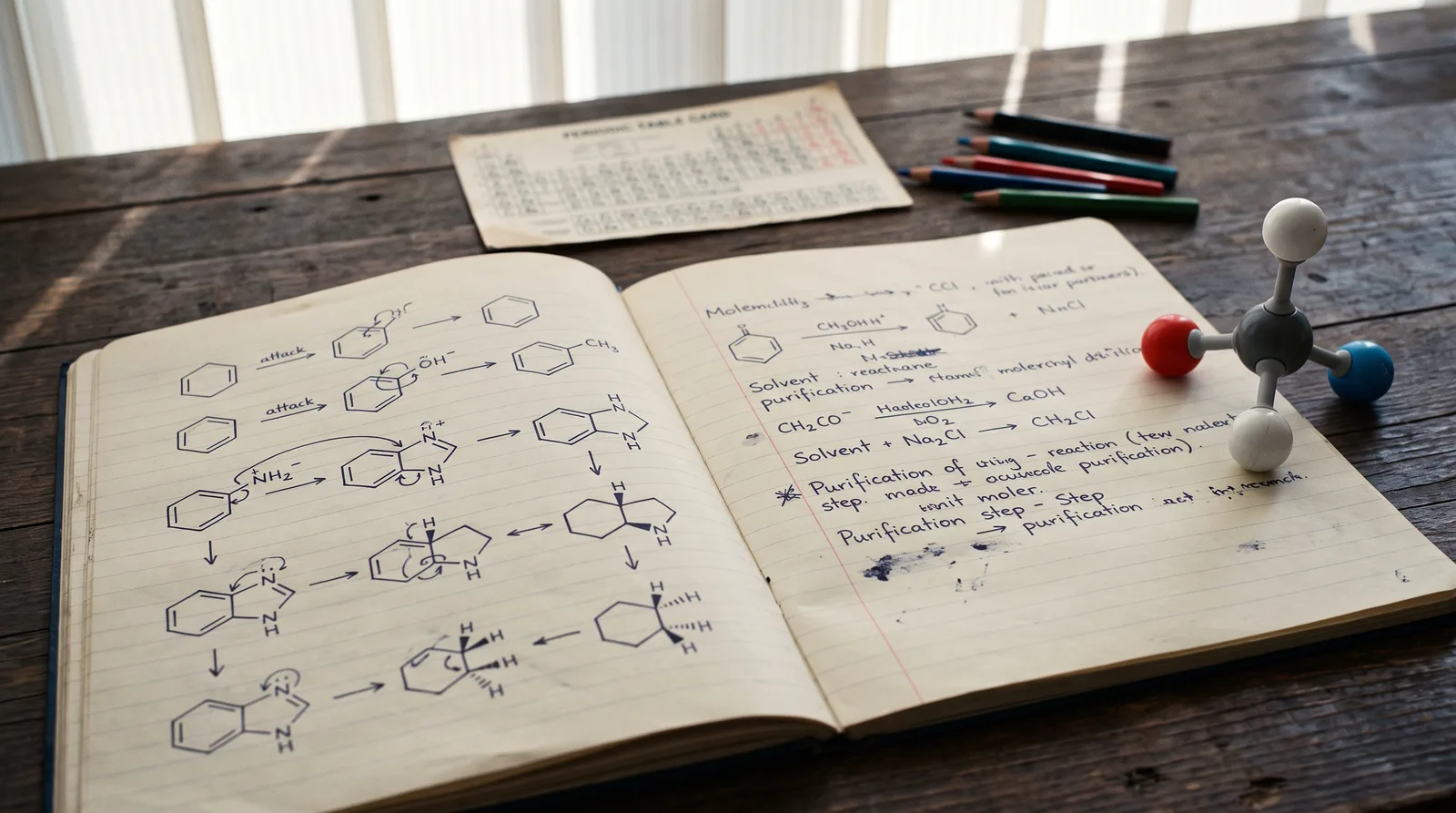
What you'll learn
What you'll be able to do
- Draw and interpret arrow-pushing mechanisms for substitution, elimination, addition, and carbonyl reactions with confidence
- Predict the products of organic reactions and select reagents for multi-step synthesis problems
- Assign R/S and E/Z stereochemistry and explain how stereochemistry affects reaction outcomes
- Interpret 1H NMR, IR, and mass spectra to identify unknown organic compounds
- Understand and apply resonance, inductive effects, and aromaticity to explain molecular reactivity
- Approach exam-style problems with a systematic, professor-level problem-solving strategy
How it works
A school that adapts to you
This isn't a set of static videos. Every lesson is generated live and tuned to where you actually are.
We learn your level
A quick placement check tailors your starting point so you're never bored or lost.
Lessons adapt as you go
Each lesson is written for your pace and your goal, adjusting as your skills grow.
Your AI coach keeps you moving
Checkpoints, feedback, and gentle nudges turn progress into a real result.
The curriculum
What's inside your school
6 modules · 29 lessons

Foundations of Organic Chemistry
Establishes the essential language, bonding theory, and electronic principles that underpin every reaction and mechanism in the course.
- 1.1Atomic Orbitals, Hybridization, and BondingIncluded
- 1.2Lewis Structures, Formal Charge, and ResonanceIncluded
- 1.3Inductive Effects, Electronegativity, and PolarityIncluded
- 1.4Acids, Bases, and pKa in Organic ChemistryIncluded
- 1.5Functional Groups and the Organic Chemistry RoadmapIncluded
Stereochemistry
Develops a rigorous, three-dimensional understanding of molecular structure and its direct consequences for reaction outcomes.
- 2.1Constitutional Isomers, Conformations, and Ring StrainIncluded
- 2.2Chirality, Stereocenters, and R/S AssignmentIncluded
- 2.3Enantiomers, Diastereomers, and Meso CompoundsIncluded
- 2.4E/Z Geometry in AlkenesIncluded
- 2.5Stereochemical Outcomes of ReactionsIncluded
Mechanisms I — Substitution, Elimination, and Addition
Builds systematic arrow-pushing fluency across the core aliphatic reaction classes through deep mechanistic analysis.
- 3.1Introduction to Arrow-Pushing and Reaction MechanismsIncluded
- 3.2SN2 and SN1 Substitution ReactionsIncluded
- 3.3E2 and E1 Elimination ReactionsIncluded
- 3.4Substitution vs. Elimination — Predicting the OutcomeIncluded
- 3.5Electrophilic Addition to Alkenes and AlkynesIncluded
Aromaticity and Electrophilic Aromatic Substitution
Covers the theory of aromaticity and the reactivity patterns that govern benzene and substituted aromatic systems.
- 4.1Aromaticity and Hückel's RuleIncluded
- 4.2Electrophilic Aromatic Substitution MechanismsIncluded
- 4.3Directors — Activating, Deactivating, and Ortho/Para vs. MetaIncluded
- 4.4Nucleophilic Aromatic Substitution and BenzyneIncluded
Mechanisms II — Carbonyl Chemistry
Explores the rich reactivity of carbonyl-containing compounds through nucleophilic addition, substitution, and enolate chemistry.
- 5.1Carbonyl Structure, Reactivity, and Nucleophilic AdditionIncluded
- 5.2Nucleophilic Acyl Substitution — Carboxylic Acids and DerivativesIncluded
- 5.3Enols, Enolates, and Alpha-Carbon ReactivityIncluded
- 5.4Aldol Condensation and Claisen CondensationIncluded
- 5.5Conjugate Addition and the Michael ReactionIncluded
Spectroscopy and Multi-Step Synthesis
Trains students to identify unknown compounds from spectral data and to plan retrosynthetic routes with reagent-level precision.
- 6.1Infrared (IR) SpectroscopyIncluded
- 6.21H NMR Spectroscopy — Chemical Shift, Integration, and SplittingIncluded
- 6.313C NMR and Mass SpectrometryIncluded
- 6.4Structure Elucidation — Combining Spectral DataIncluded
- 6.5Retrosynthesis and Multi-Step Synthesis PlanningIncluded
Who it's for
Is this you?

The pre-med student
Needs more than a passing grade — MCAT Organic Chemistry demands the mechanistic depth this course is built to deliver.

The struggling sophomore
Feeling lost in lecture and falling behind on mechanisms — this course provides the clear, rigorous second explanation that makes everything click.

The chemistry or biochem major
Needs the kind of deep, principled orgo foundation that will carry directly into advanced coursework and undergraduate research.

The self-taught learner
Pursuing orgo independently and wants a structured, academically serious curriculum — not fragmented YouTube videos and scattered textbook chapters.

The exam retaker
Has been through orgo once, knows the vocabulary, but needs to rebuild real mechanistic understanding before attempting the course again.

The career changer
Returning to science after years away and needs a rigorous, professor-quality refresher to prepare for graduate or professional school prerequisites.
Questions
Frequently asked
Your teacher
A note from your teacher
AI Professor Courses
I know exactly where you are right now.
You're staring at a mechanism, and you have no idea why the electrons are moving the way they are. Or you've memorized the SN2 reaction, but the moment the question changes the substrate or the solvent, you freeze. Or you're doing fine — technically — but you have this nagging feeling that you're pattern-matching your way through a subject you don't actually understand. And with the MCAT, biochemistry, or a research lab somewhere on your horizon, that feeling matters.
I built this course because that gap — between surface familiarity and real understanding — is exactly what destroys students in organic chemistry. Not a lack of intelligence. Not insufficient hours spent studying. A lack of a coherent, principled framework for thinking about molecules. When you understand why a tertiary carbocation is more stable than a primary one, you don't need to memorize which reactions proceed through carbocation intermediates — you can reason to the answer. When you understand what a curved arrow actually represents, arrow-pushing stops being an art form and becomes a logic exercise. That is the kind of understanding this course is designed to produce.
We move systematically from the ground up: atomic orbitals and hybridization, resonance and pKa, functional groups and the logic that connects them. Then stereochemistry — not as a disconnected detour, but as the essential three-dimensional context for everything that follows. Then mechanisms, two full units of them, covering substitution, elimination, addition, aromaticity, and the full landscape of carbonyl chemistry: nucleophilic addition, acyl substitution, enolate reactions, aldol and Claisen condensations, and the Michael reaction. We finish with spectroscopy and retrosynthesis — the skills that separate students who know organic chemistry from students who can use it.
I want to be honest with you about what this course is: it is rigorous. I will ask you to think carefully, to work through problems you find hard, and to resist the urge to look up the answer before you've genuinely tried. I'll use analogies to make abstract concepts concrete, and I'll ask Socratic questions to sharpen your reasoning — but I will not hand you shortcuts that collapse the moment an exam question is phrased differently than you expected. What I will give you is a durable, transferable, professor-level understanding of organic chemistry.
If you're willing to work at that level, I am genuinely glad you're here. Let's get to work.
— AI Professor Courses
Start your journey today
Get instant access — learn at your own pace with an AI coach in your corner.
$5/mo
Recurring billing · cancel anytime
Secure checkout · Instant access
- 6 modules, 29 lessons
- AI-adaptive lessons tuned to your level
- Quizzes & checkpoints to lock in progress
- Your own AI learning coach
- Learn on any device, at your pace
- Full access for as long as you're subscribed