Understand disease — don't just memorize it
A seasoned college professor walks you from cellular dysfunction all the way to clinical presentation, building the mechanistic reasoning that top nursing and medical students — and working clinicians — rely on for every patient encounter and high-stakes exam.

"My job isn't to hand you facts — it's to build the mechanistic framework that makes every clinical finding make sense."
— AI Professor Courses
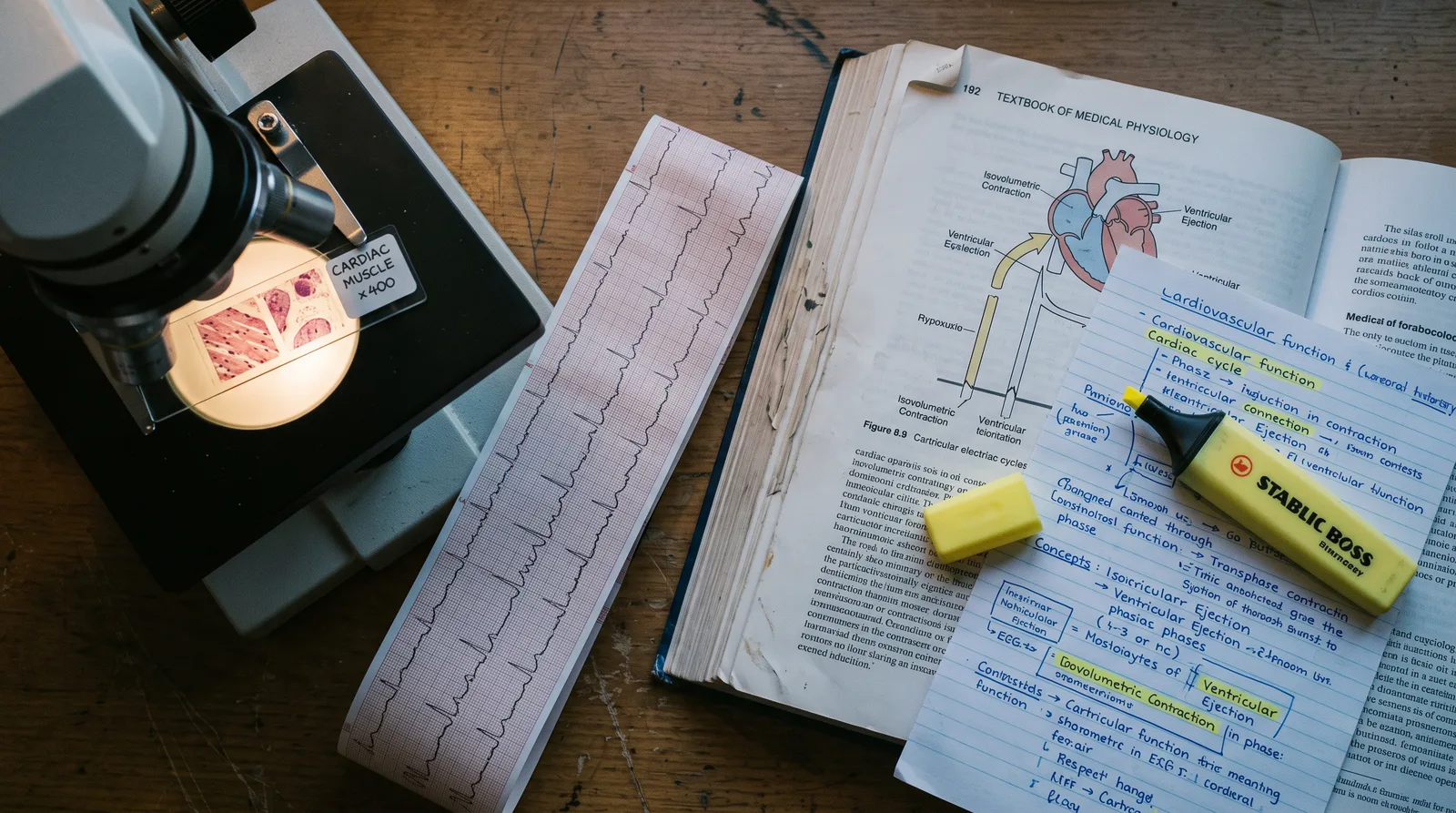
What you'll learn
What you'll be able to do
- Explain the cellular and molecular mechanisms underlying common diseases, including inflammation, necrosis, and apoptosis
- Trace the pathophysiological progression of cardiovascular, respiratory, renal, and endocrine disorders from cause to clinical presentation
- Interpret key diagnostic findings — lab values, imaging patterns, and clinical signs — in the context of underlying disease mechanisms
- Apply clinical reasoning frameworks to connect a patient's signs and symptoms back to their root pathophysiological process
- Distinguish between compensatory and pathological physiological responses across major organ systems
- Prepare confidently for NCLEX, USMLE Step 1, or university pathophysiology exams using evidence-based study strategies
How it works
A school that adapts to you
This isn't a set of static videos. Every lesson is generated live and tuned to where you actually are.
We learn your level
A quick placement check tailors your starting point so you're never bored or lost.
Lessons adapt as you go
Each lesson is written for your pace and your goal, adjusting as your skills grow.
Your AI coach keeps you moving
Checkpoints, feedback, and gentle nudges turn progress into a real result.
The curriculum
What's inside your school
6 modules · 28 lessons

Foundations of Pathophysiology
Establishes the cellular and molecular bedrock — how healthy cells fail, adapt, and die — that underlies every disease mechanism in the course.
- 1.1What Is Pathophysiology? The Professor's FrameworkIncluded
- 1.2Cellular Adaptation: Hypertrophy, Atrophy, Hyperplasia, and MetaplasiaIncluded
- 1.3Cell Injury, Necrosis, and ApoptosisIncluded
- 1.4Inflammation: Acute and Chronic MechanismsIncluded
- 1.5Tissue Repair, Regeneration, and FibrosisIncluded
Immune Pathophysiology and Infection
Covers the immune system's role as both protector and perpetrator of disease, from hypersensitivity reactions to autoimmunity and infectious pathology.
- 2.1The Immune Response Gone Wrong: Hypersensitivity Types I–IVIncluded
- 2.2Autoimmune Disease: When Self-Tolerance FailsIncluded
- 2.3Immunodeficiency: Primary and Secondary DisordersIncluded
- 2.4Infectious Pathophysiology: Bacteria, Viruses, and SepsisIncluded
Cardiovascular and Hematologic Pathophysiology
Traces the pathophysiological progression of the most clinically tested cardiac, vascular, and blood disorders from cellular mechanism to bedside presentation.
- 3.1Atherosclerosis and Coronary Artery DiseaseIncluded
- 3.2Heart Failure: Compensatory Mechanisms and DecompensationIncluded
- 3.3Hypertension: Primary vs. Secondary and End-Organ DamageIncluded
- 3.4Anemia: Pathophysiologic Classification and Clinical ReasoningIncluded
- 3.5Thrombosis, Embolism, and Coagulation DisordersIncluded
Respiratory and Renal Pathophysiology
Examines how disrupted gas exchange and impaired filtration cascade into acid-base imbalances and systemic illness.
- 4.1Obstructive Lung Disease: Asthma vs. COPDIncluded
- 4.2Restrictive Lung Disease and Respiratory FailureIncluded
- 4.3Acute Kidney Injury: Pre-renal, Intrinsic, and Post-renalIncluded
- 4.4Chronic Kidney Disease and UremiaIncluded
- 4.5Acid-Base Disorders: Connecting Lung and Kidney PathologyIncluded
Endocrine, Neurologic, and GI Pathophysiology
Explores how hormonal dysregulation, neural injury, and gastrointestinal barrier failure produce widespread systemic effects.
- 5.1Diabetes Mellitus: Type 1 vs. Type 2 Mechanisms and ComplicationsIncluded
- 5.2Thyroid and Adrenal Disorders: Excess and Deficiency StatesIncluded
- 5.3Neurologic Pathophysiology: Stroke, Increased ICP, and NeurodegenerationIncluded
- 5.4GI Pathophysiology: Peptic Ulcer Disease, IBD, and Liver FailureIncluded
Diagnostics, Clinical Reasoning, and Exam Mastery
Synthesizes the entire course into applied clinical reasoning skills and evidence-based strategies for excelling on NCLEX, USMLE Step 1, and university exams.
- 6.1Interpreting Lab Values Through a Pathophysiology LensIncluded
- 6.2Imaging and Clinical Signs: Connecting Findings to MechanismsIncluded
- 6.3The Clinical Reasoning Framework: From Symptom to Root CauseIncluded
- 6.4Compensatory vs. Pathological Responses: A Cross-System ReviewIncluded
- 6.5Exam Strategy and High-Yield Review for NCLEX, USMLE Step 1, and Course ExamsIncluded
Who it's for
Is this you?

Nursing students
Building the deep mechanistic understanding behind NCLEX priorities that lecture-heavy programs rarely have time to develop.

Pre-med students
Mastering the organ-system pathology and clinical reasoning that USMLE Step 1 tests at every turn.

Allied health majors
Gaining the physiologic depth in respiratory, renal, and cardiovascular disease that elevates clinical decision-making across any health profession.

Practicing RNs & clinicians
Filling the mechanistic gaps that fast-paced clinical training leaves behind — so every lab trend and patient change makes immediate sense.

Pathophysiology course retakers
Rebuilding the conceptual foundation that a rushed first pass didn't have time to establish, from cellular injury all the way to systemic disease.

Graduate health science students
Reinforcing and deepening foundational pathology knowledge before advanced coursework in pharmacology, diagnostics, or clinical medicine.
Questions
Frequently asked
Your teacher
A note from your teacher

AI Professor Courses
If you're here, I suspect you've had this experience: you study for hours, you can recite the symptoms of heart failure or name the types of hypersensitivity reactions, and then an exam question reframes the scenario slightly — and the answer suddenly isn't obvious. Or you're in the clinical setting, a patient's labs are trending in a direction that concerns you, and you wish you had a stronger mental model to know why and what next. That gap between memorized facts and genuine mechanistic understanding is exactly what I've spent my teaching career trying to close.
Pathophysiology is not a subject that yields to passive review. It's a discipline that rewards structured, layered thinking — starting at the cell and following the cascade outward until you arrive at the patient in front of you. That's the approach I use in this course. We begin with the universal language of pathology: how cells adapt, how they die, how the inflammatory response mobilizes and sometimes overreaches. Then we move system by system — cardiovascular, respiratory, renal, endocrine, neurologic, gastrointestinal — always tracing the same arc from molecular mechanism to clinical presentation. By the time we reach diagnostics and clinical reasoning in the final unit, you're not learning new information so much as you are consolidating a framework you've been building all along.
I want to be direct with you about what this course is and isn't. It is rigorous. I use precise anatomical and clinical vocabulary because that precision matters — in an exam room and at a bedside. I don't simplify concepts to the point of distortion. But I also punctuate every major mechanism with patient-case analogies, because I have taught this material long enough to know that abstract pathology becomes permanent knowledge the moment it attaches to a real clinical story. The goal is not for you to survive this content — it's for you to genuinely understand it and carry that understanding forward.
I've also built the final unit specifically for the realities of high-stakes examinations: NCLEX, USMLE Step 1, and demanding university pathophysiology courses. We'll work through how to read lab values as pathophysiologic clues, how to interpret imaging and clinical signs through a mechanistic lens, and how to apply a systematic clinical reasoning framework that brings you from a patient's chief complaint all the way back to the root cause. These are not test tricks. They are the cognitive habits that distinguish clinicians who think clearly under pressure from those who simply hope the right answer surfaces.
If you are a nursing student, a pre-med student, an allied health major, or a working healthcare professional who is ready to stop memorizing and start reasoning — this course was built for you. I'm glad you're here. Let's get to work.
— AI Professor Courses
Start your journey today
Get instant access — learn at your own pace with an AI coach in your corner.
$5/mo
Recurring billing · cancel anytime
Secure checkout · Instant access
- 6 modules, 28 lessons
- AI-adaptive lessons tuned to your level
- Quizzes & checkpoints to lock in progress
- Your own AI learning coach
- Learn on any device, at your pace
- Full access for as long as you're subscribed