Master physics the way universities actually teach it
From Newton's laws to Maxwell's equations to special relativity — rigorous, professor-led instruction that builds real problem-solving skill, one carefully numbered step at a time. No shortcuts, no hand-waving, just physics that finally makes sense.

"Physics doesn't reward memorisation — it rewards the student who can show their reasoning, check their units, and ask whether the answer makes sense. That's what I'm here to teach you."
— AI Professor Courses
What you'll learn
What you'll be able to do
- Solve multi-step classical mechanics problems involving forces, energy, and momentum with confidence
- Apply Maxwell's equations and core principles of electromagnetism to real circuit and field problems
- Interpret and calculate wave behaviour, including interference, diffraction, and the Doppler effect
- Understand and apply special relativity concepts including time dilation, length contraction, and mass-energy equivalence
- Work through thermodynamics problems using the laws of thermodynamics and statistical mechanics
- Critically read and evaluate physics problems the way a professor grades them — identifying assumptions, units, and limiting cases
How it works
A school that adapts to you
This isn't a set of static videos. Every lesson is generated live and tuned to where you actually are.
We learn your level
A quick placement check tailors your starting point so you're never bored or lost.
Lessons adapt as you go
Each lesson is written for your pace and your goal, adjusting as your skills grow.
Your AI coach keeps you moving
Checkpoints, feedback, and gentle nudges turn progress into a real result.
The curriculum
What's inside your school
6 modules · 29 lessons

Classical Mechanics: Forces, Motion, and Energy
Builds the foundational mechanics framework — kinematics, Newton's laws, work-energy, and momentum — needed for all subsequent physics coursework.
- 1.1Kinematics in One and Two DimensionsIncluded
- 1.2Newton's Three Laws and Free-Body DiagramsIncluded
- 1.3Work, Kinetic Energy, and the Work-Energy TheoremIncluded
- 1.4Potential Energy, Conservation of Energy, and PowerIncluded
- 1.5Linear Momentum, Impulse, and CollisionsIncluded
Rotational Mechanics and Gravitation
Extends mechanics to rotating systems and gravitational fields, completing the classical mechanics outcome.
- 2.1Rotational Kinematics and TorqueIncluded
- 2.2Rotational Inertia and Newton's Second Law for RotationIncluded
- 2.3Angular Momentum and Its ConservationIncluded
- 2.4Universal Gravitation and Orbital MechanicsIncluded
Thermodynamics and Statistical Mechanics
Covers the laws of thermodynamics, heat engines, entropy, and an introduction to statistical mechanics for rigorous problem-solving.
- 3.1Temperature, Thermal Equilibrium, and the Ideal Gas LawIncluded
- 3.2The First Law of Thermodynamics: Heat and Internal EnergyIncluded
- 3.3Thermodynamic Processes and Heat EnginesIncluded
- 3.4The Second Law, Entropy, and the Arrow of TimeIncluded
- 3.5Introduction to Statistical MechanicsIncluded
Waves, Sound, and Optics
Develops a rigorous understanding of wave behavior — including interference, diffraction, and the Doppler effect — for both mechanical and electromagnetic waves.
- 4.1Wave Properties: Amplitude, Frequency, and Wave SpeedIncluded
- 4.2Superposition, Interference, and Standing WavesIncluded
- 4.3Diffraction and the Limits of Geometric OpticsIncluded
- 4.4The Doppler Effect for Sound and LightIncluded
- 4.5Reflection, Refraction, and Optical InstrumentsIncluded
Electromagnetism: Fields, Circuits, and Maxwell's Equations
Covers electric and magnetic fields, real circuit analysis, and Maxwell's equations as the unifying framework of classical electromagnetism.
- 5.1Electric Force, Electric Field, and Gauss's LawIncluded
- 5.2Electric Potential, Potential Energy, and CapacitanceIncluded
- 5.3DC Circuits: Resistance, Kirchhoff's Laws, and PowerIncluded
- 5.4Magnetic Fields, Forces, and Faraday's Law of InductionIncluded
- 5.5Maxwell's Equations and Electromagnetic WavesIncluded
Special Relativity and Physics Problem-Solving Mastery
Delivers special relativity — time dilation, length contraction, and mass-energy equivalence — then equips students to read, analyze, and solve physics problems the way a professor grades them.
- 6.1The Postulates of Special Relativity and the Lorentz FactorIncluded
- 6.2Time Dilation and Length ContractionIncluded
- 6.3Relativistic Momentum, Energy, and Mass-Energy EquivalenceIncluded
- 6.4Spacetime Diagrams and the Relativity of SimultaneityIncluded
- 6.5Reading Physics Problems Like a ProfessorIncluded
Who it's for
Is this you?

AP Physics preppers
She needs rigorous worked examples and free-response discipline to score 5s on AP Physics C — not another formula sheet.

Struggling undergrads
He's a sophomore whose lectures move too fast; he needs step-by-step derivations that rebuild his foundation before the midterm.

Engineering students
Calculus-based classical mechanics and electromagnetism are core to his degree, and he wants instruction precise enough to match his coursework exactly.

Ambitious self-learners
She's teaching herself university-level physics out of intellectual drive and needs a structured, trustworthy curriculum — not a playlist of random videos.

Career changers & returners
He studied physics years ago and is returning to a STEM field; he wants to rebuild rigorous understanding, not just refresh half-remembered formulas.

Physics olympiad competitors
She's training for competitive physics and needs the depth — rotational mechanics, special relativity, thermodynamics — that goes well beyond the standard high school syllabus.
Questions
Frequently asked
Your teacher
A note from your teacher

AI Professor Courses
If you've ever walked out of a physics lecture feeling more confused than when you walked in, I want you to know: that's not a you problem. It's a teaching problem. And it's exactly why I built this school.
Physics is one of those subjects where a single gap in understanding — a shaky picture of what a force actually is, or a fuzzy sense of what conservation of energy really means — will quietly undermine everything that comes after it. Students end up memorising formulas they don't trust, skipping steps they don't understand, and hoping the exam doesn't ask the one question that exposes the gap. I've seen this pattern at every level, and I've spent my teaching career doing one thing about it: building the clearest, most logically disciplined explanations I know how to write.
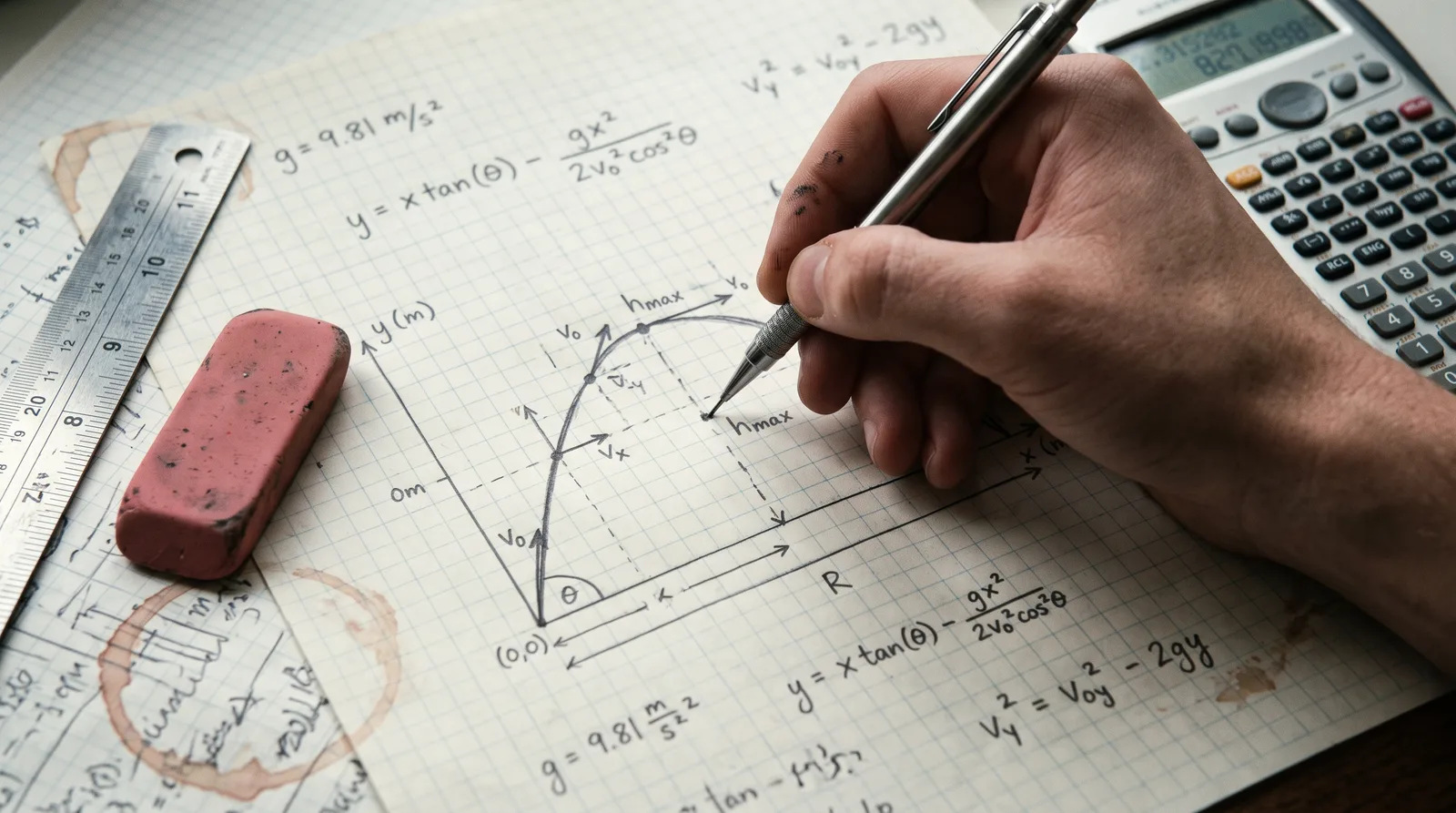
Every lesson in this school is structured the way I wish every textbook chapter was structured. We state what we're trying to show. We draw the diagram. We write the equation and say out loud where it comes from. We solve the problem one numbered step at a time, checking units, stating assumptions, and asking what happens in the limiting cases. That last habit — asking "does this answer make sense when the velocity goes to zero, or when the mass becomes very large?" — is how physicists actually think, and it's something I'll train you to do until it becomes second nature.
The curriculum runs the full arc: classical mechanics and rotational dynamics, thermodynamics and statistical mechanics, waves and optics, electromagnetism through Maxwell's equations, and special relativity. Each unit is a genuine prerequisite for the next. By the time we reach the Lorentz factor, you'll have the mechanical and mathematical fluency to follow every step of the derivation — not because I've made it easier, but because we've built the right foundation underneath it.
I also included something most physics courses quietly skip: a unit on reading physics problems the way a professor grades them. How to identify what a problem is actually asking. How to spot the assumption buried in the setup. How to write a solution that demonstrates understanding, not just a correct final number. That skill is worth more on an AP free-response or a university final than any single formula.
Whether you're a high school student who wants more than an AP prep book offers, an undergraduate trying to find solid ground in a course that's moving too fast, or a self-learner who simply wants to understand how the universe behaves at a rigorous level — this school is for you. Come ready to think carefully, write out your steps, and trust the process. The clarity you're looking for is on the other side of that discipline, and I'll walk you there.
— AI Professor Courses
Start your journey today
Get instant access — learn at your own pace with an AI coach in your corner.
$5/mo
Recurring billing · cancel anytime
Secure checkout · Instant access
- 6 modules, 29 lessons
- AI-adaptive lessons tuned to your level
- Quizzes & checkpoints to lock in progress
- Your own AI learning coach
- Learn on any device, at your pace
- Full access for as long as you're subscribed