Need Help With Political Science? Are You Political Science Curious?
For just $5/month, you have 24/7 access to an AI coach who teaches, tutors and guides you in your learning journey. This AI-Adaptive course is perfect for college students and anyone who has an interest in the subject. Take a free lesson.

My job isn't to tell you what to think about power — it's to make sure you have the tools to think about it clearly.
— AI Professor Courses
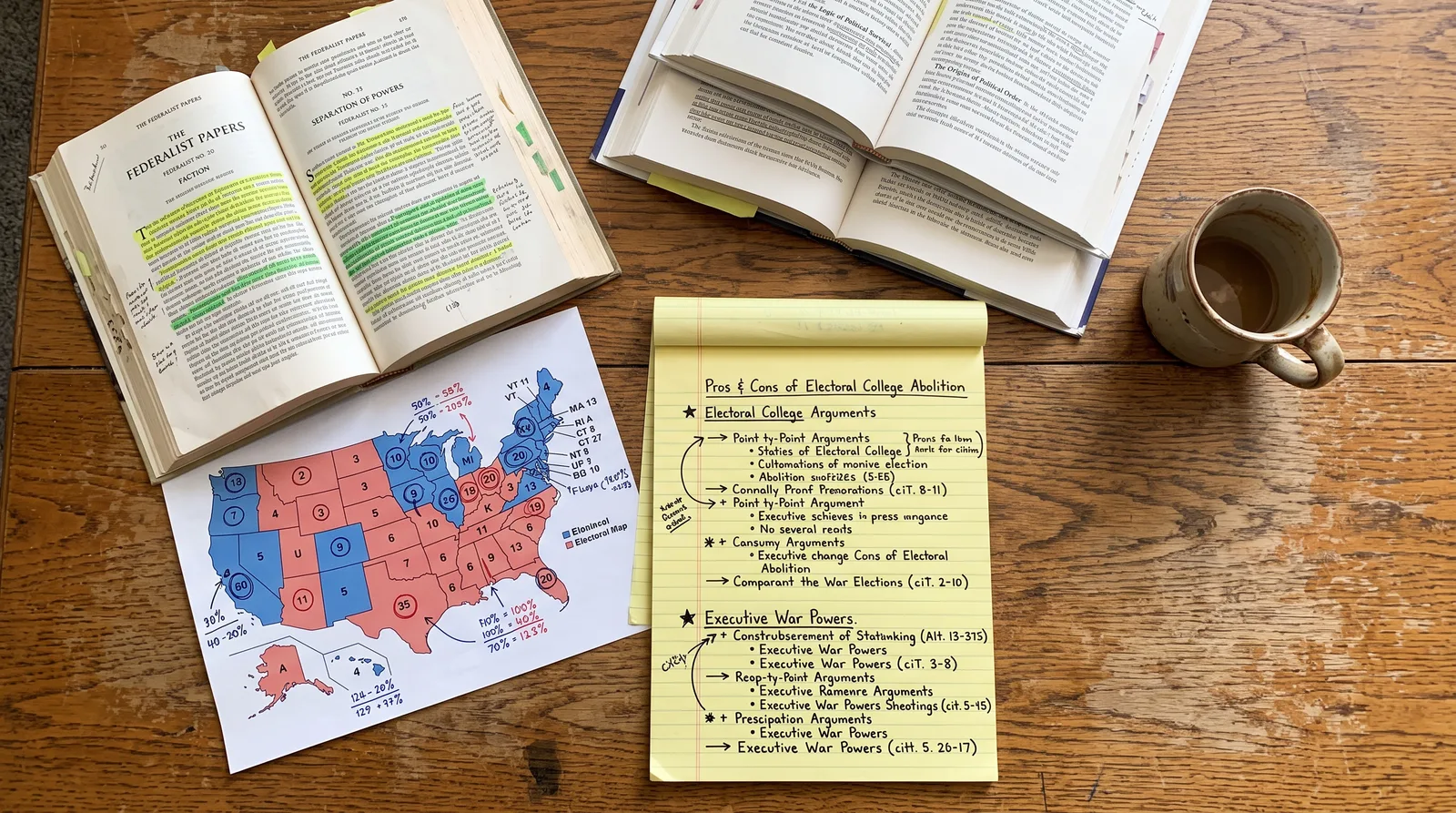
What you'll learn
What you'll be able to do
- Explain and compare major political ideologies — liberalism, conservatism, socialism, and beyond — with confidence and nuance
- Analyze the structure and function of different governmental systems, from parliamentary democracies to authoritarian regimes
- Apply foundational political theory (Locke, Rousseau, Hobbes, Rawls, Arendt) to contemporary policy debates
- Critically evaluate how elections, voting systems, and political parties shape democratic outcomes
- Interpret international relations through key frameworks including realism, liberalism, and constructivism
- Dissect current events and policy decisions using the analytical tools of a trained political scientist
How it works
A school that adapts to you
This isn't a set of static videos. Every lesson is generated live and tuned to where you actually are.
We learn your level
A quick placement check tailors your starting point so you're never bored or lost.
Lessons adapt as you go
Each lesson is written for your pace and your goal, adjusting as your skills grow.
Your AI coach keeps you moving
Checkpoints, feedback, and gentle nudges turn progress into a real result.
The curriculum
What's inside your school
6 modules · 29 lessons

Foundations of Political Science
Introduces the discipline's core vocabulary, methods, and enduring questions about power, authority, and the state.
- 1.1What Is Political Science?Included
- 1.2The State, Sovereignty, and LegitimacyIncluded
- 1.3How Political Scientists Think: Methods and EvidenceIncluded
- 1.4Power, Authority, and Ideology: Key ConceptsIncluded
Political Theory and the Great Thinkers
Traces the canonical texts and arguments — from social contract theory to 20th-century justice and power — that underpin modern political thought.
- 2.1Hobbes, Locke, and Rousseau: The Social Contract DebateIncluded
- 2.2Liberty, Equality, and Justice: Mill, Marx, and BeyondIncluded
- 2.3Rawls and the Liberal Theory of JusticeIncluded
- 2.4Hannah Arendt: Power, Totalitarianism, and Political ActionIncluded
- 2.5Applying Theory to Today: From the Lecture Hall to the HeadlinesIncluded
Political Ideologies
Maps the major ideological traditions — and their internal divisions — that structure political conflict in the US and around the world.
- 3.1Liberalism: Classical and ModernIncluded
- 3.2Conservatism: Tradition, Markets, and OrderIncluded
- 3.3Socialism, Social Democracy, and the LeftIncluded
- 3.4Nationalism, Populism, and the Radical RightIncluded
- 3.5Beyond the Spectrum: Feminism, Environmentalism, and LibertarianismIncluded
Governmental Systems and Political Institutions
Compares how democracies, hybrid regimes, and authoritarian states structure executive power, legislatures, courts, and constitutions.
- 4.1Democracy: Types, Features, and Trade-OffsIncluded
- 4.2Presidential vs. Parliamentary SystemsIncluded
- 4.3Federalism and the Division of PowerIncluded
- 4.4Constitutions, Courts, and the Rule of LawIncluded
- 4.5Authoritarianism, Hybrid Regimes, and Democratic BackslidingIncluded
Elections, Parties, and Democratic Participation
Analyzes how voting systems, political parties, and civic behavior determine who gets power and how they keep it.
- 5.1Electoral Systems: Plurality, Proportional, and MixedIncluded
- 5.2Political Parties: Functions, Structures, and RealignmentsIncluded
- 5.3Voter Behavior, Public Opinion, and Political ParticipationIncluded
- 5.4Money, Media, and Campaign PoliticsIncluded
- 5.5Gerrymandering, Voting Rights, and Electoral IntegrityIncluded
International Relations and Global Affairs
Equips students with the major IR frameworks and analytical tools to interpret conflicts, alliances, trade, and global power shifts.
- 6.1Realism: Power, Anarchy, and the National InterestIncluded
- 6.2Liberalism and Institutionalism in International RelationsIncluded
- 6.3Constructivism: Ideas, Identity, and Norms in World PoliticsIncluded
- 6.4War, Diplomacy, and International SecurityIncluded
- 6.5Globalization, Human Rights, and the Future of World OrderIncluded
Who it's for
Is this you?

The college undergraduate
Supplements lectures and textbooks with a professor who explains the same material more clearly — and connects it to the world outside the exam.

The intellectually curious adult
Never studied political science formally and wants the real, rigorous version — not another podcast opinion, but actual analytical tools.

The news junkie who wants depth
Follows current events closely but wants frameworks — realism, constructivism, democratic backsliding — to move from reacting to genuinely analyzing.

The international student or reader
Wants a structured command of Western political theory, US institutions, and global IR frameworks to make sense of politics at home and abroad.

The lifelong learner
Retired or winding down a career and finally has time to pursue the serious intellectual education that earlier life didn't allow.

The policy or law professional
Works adjacent to government or law and wants the foundational political science vocabulary and theory to sharpen their professional analysis.
Questions
Frequently asked
Your teacher
A note from your teacher
AI Professor Courses
Let me guess where you are right now.
You care about politics — genuinely, seriously. You follow the news, you have opinions, and you can hold your own in most conversations. But somewhere underneath it all, there's a nagging sense that you're working without a foundation. That you're reacting to events rather than analyzing them. That everyone around you — pundits, politicians, professors — seems to be speaking a language you almost understand, but not quite.
That gap is not your fault. It's structural. The serious study of political science — the kind that teaches you how power works, not just who currently holds it — has mostly been locked behind university tuition, prerequisite gatekeeping, and lectures that assume you already belong there. The Poli Sci Professor is my attempt to fix that.
What I've built here is a rigorous, structured political science curriculum that moves the way a great university course moves: from foundational concepts — the state, sovereignty, legitimacy, methodology — through the great thinkers (Hobbes, Locke, Rousseau, Mill, Rawls, Arendt) and the ideological landscape they shaped, into the architecture of real governments and institutions, the mechanics of elections and democratic participation, and finally the frameworks that explain how states behave in a world without a referee. Every unit is taught the way I'd teach it in a lecture hall: precise vocabulary, real case studies, Socratic questions that make you stop and think, and the kind of dry wit that keeps dense material from becoming a slog.
I won't pretend this is casual. The vocabulary is academic because the concepts demand it. The analysis goes deep because shallow analysis is what you could get anywhere for free. But I also genuinely love this material — and I've found that when a subject is taught by someone who cares about it, rigor stops feeling like a burden and starts feeling like a privilege.
You deserve a real education in political science — one that gives you the tools to understand the world, not just an opinion about it. This is your seat. Come take it.
— AI Professor Courses
Start your journey today
Get instant access — learn at your own pace with an AI coach in your corner.
$5/mo
Recurring billing · cancel anytime
Secure checkout · Instant access
- 6 modules, 29 lessons
- AI-adaptive lessons tuned to your level
- Quizzes & checkpoints to lock in progress
- Your own AI learning coach
- Learn on any device, at your pace
- Full access for as long as you're subscribed