Master psychology the way it was meant to be taught
A rigorous, college-level psychology education — covering everything from neuroscience and conditioning to personality theory and clinical disorders — guided by a professor who challenges you to think, not just memorize.
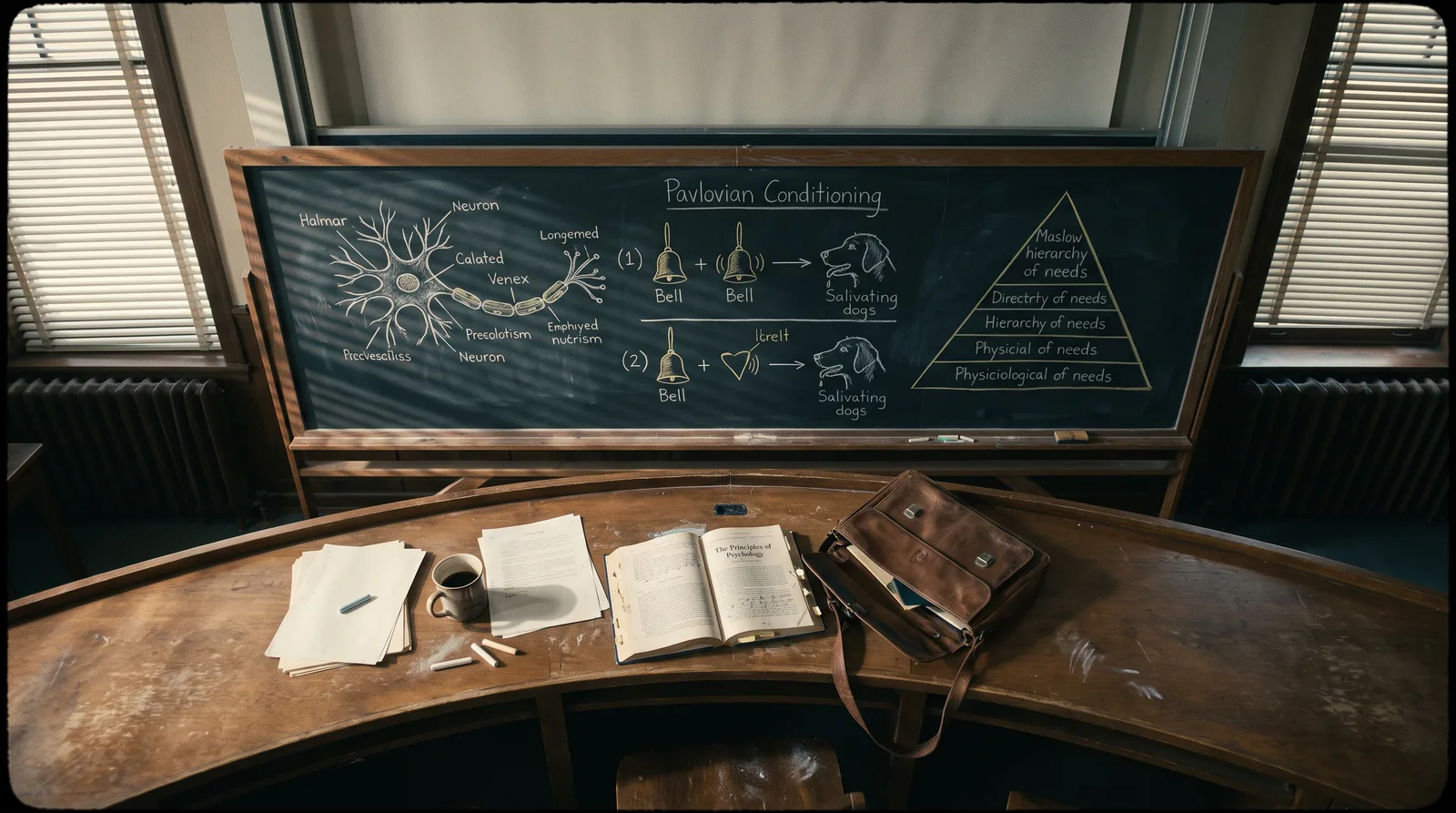
My goal isn't to give you answers — it's to give you a mind that asks better questions about why people do what they do.
— AI Professor Courses

What you'll learn
What you'll be able to do
- Explain the major schools of psychological thought — from Freudian psychoanalysis to cognitive-behavioral frameworks — and trace how each shaped modern practice.
- Apply core psychological concepts such as classical conditioning, cognitive dissonance, and the biopsychosocial model to real-world situations.
- Critically evaluate research studies, identifying methodological strengths, biases, and ethical considerations in psychological science.
- Distinguish between major psychological disorders using DSM-aligned criteria and understand the evidence-based treatments associated with each.
- Articulate the influence of development, culture, and social context on human behavior across the lifespan.
- Compose structured, thesis-driven analyses of psychological phenomena using proper academic argumentation and APA citation conventions.
How it works
A school that adapts to you
This isn't a set of static videos. Every lesson is generated live and tuned to where you actually are.
We learn your level
A quick placement check tailors your starting point so you're never bored or lost.
Lessons adapt as you go
Each lesson is written for your pace and your goal, adjusting as your skills grow.
Your AI coach keeps you moving
Checkpoints, feedback, and gentle nudges turn progress into a real result.
The curriculum
What's inside your school
6 modules · 30 lessons

Foundations of Psychology
Establishes the discipline's origins, major theoretical schools, and the scientific methods that define psychological inquiry.
- 1.1What Is Psychology? Scope, Goals, and Career PathsIncluded
- 1.2A History of Psychological ThoughtIncluded
- 1.3Major Theoretical Frameworks TodayIncluded
- 1.4The Science of Psychology: Research MethodsIncluded
- 1.5Evaluating Research: Statistics, Bias, and EthicsIncluded
Biological and Developmental Bases of Behavior
Examines the neurological, genetic, and lifespan-developmental foundations that shape who we are and how we behave.
- 2.1The Brain and Nervous SystemIncluded
- 2.2Genetics, Evolution, and BehaviorIncluded
- 2.3Sensation, Perception, and ConsciousnessIncluded
- 2.4Lifespan Development: Childhood and AdolescenceIncluded
- 2.5Lifespan Development: Adulthood and AgingIncluded
Learning, Memory, and Cognition
Covers the mechanisms by which people acquire, store, retrieve, and apply knowledge — and where those processes break down.
- 3.1Classical and Operant ConditioningIncluded
- 3.2Observational Learning and Cognitive Behavior TheoryIncluded
- 3.3Memory: Encoding, Storage, and RetrievalIncluded
- 3.4Thinking, Language, and Problem-SolvingIncluded
- 3.5Intelligence and Cognitive AssessmentIncluded
Social, Cultural, and Motivational Psychology
Investigates how social context, culture, motivation, and emotion drive human thought and behavior.
- 4.1Motivation and EmotionIncluded
- 4.2Social Cognition: Attitudes, Attribution, and PersuasionIncluded
- 4.3Group Dynamics, Conformity, and ObedienceIncluded
- 4.4Prejudice, Discrimination, and Intergroup RelationsIncluded
- 4.5Culture, Diversity, and Cross-Cultural PsychologyIncluded
Personality, Psychological Disorders, and Treatment
Profiles major personality theories, DSM-aligned disorder categories, and the evidence-based therapies used to treat them.
- 5.1Theories of PersonalityIncluded
- 5.2Stress, Health, and CopingIncluded
- 5.3Understanding Psychological Disorders: Classification and ControversyIncluded
- 5.4Major Disorder Categories: Mood, Anxiety, Psychotic, and BeyondIncluded
- 5.5Psychological Treatment: Therapies and Evidence-Based PracticeIncluded
Thinking and Writing Like a Psychologist
Builds the academic skills needed to read, analyze, and write about psychology at the college level using APA conventions.
- 6.1Reading and Critiquing Journal ArticlesIncluded
- 6.2Cognitive Dissonance and Critical Thinking in PsychologyIncluded
- 6.3Constructing a Psychological ArgumentIncluded
- 6.4APA Style: Citations, References, and Academic IntegrityIncluded
- 6.5Capstone Analysis: Applying Psychology to a Real-World IssueIncluded
Who it's for
Is this you?

Undergraduate students
Supplements lecture-heavy college courses with clear, structured instruction that connects the dots between theories, research, and real application.

Exam preppers
Preparing for a psychology CLEP, AP exam, or university final and needs a rigorous, organized review that goes beyond flashcards.

Healthcare professionals
Works in nursing, social work, or allied health and wants a deeper behavioral science foundation to inform patient care and communication.
Lifelong learners
Never stopped being curious about the human mind and finally wants a college-caliber education to match their decades of self-directed reading.

Career changers
Exploring a pivot into counseling, HR, UX research, or education and needs credible, structured grounding in psychological science.

Self-taught thinkers
Has read widely in psychology but wants the academic rigor — research methods, APA writing, and critical analysis — to take their thinking to the next level.
Questions
Frequently asked
Your teacher
A note from your teacher
AI Professor Courses
If you're reading this, I'm guessing you already know that psychology is everywhere — in the choices you make, the relationships you navigate, the news you consume, the biases you carry without knowing it. And I suspect you want more than the surface-level version you've been offered so far.
Maybe you're an undergraduate who feels like your lectures move too fast, or your textbook is 900 pages of definitions with no real thread connecting them. Maybe you're someone who never got to take a psychology course and has always regretted it. Maybe you work in education, healthcare, business, or law, and you've realized that understanding human behavior isn't just interesting — it's essential. Whoever you are, you've arrived at the right place.
I built this school because I believe that rigorous education should not be a privilege rationed out by zip code or tuition bracket. The curriculum I've designed here covers everything a serious undergraduate psychology student needs to know: the history and major theoretical frameworks, the biology of the brain and behavior, learning and memory, social influence, personality, psychopathology, and the craft of thinking and writing as a psychologist. We move through these topics in a sequence that actually makes sense — each unit prepares you for the next, so nothing lands out of nowhere.
What I will not do is talk at you. I use the Socratic method because I believe you learn psychology best when you're pushed to interrogate your own assumptions. We'll look at real research studies together and ask whether the methodology holds up. We'll examine case studies and ask what multiple frameworks would say about the same person. We'll read the DSM and also read its critics. My job isn't to give you a set of facts to memorize for a test — it's to change the way you see human behavior, permanently.
If you're ready for that kind of education, I'd be honored to be your professor. Come in curious, expect to be challenged, and leave with something that lasts.
— AI Professor Courses
Start your journey today
Get instant access — learn at your own pace with an AI coach in your corner.
$5/mo
Recurring billing · cancel anytime
Secure checkout · Instant access
- 6 modules, 30 lessons
- AI-adaptive lessons tuned to your level
- Quizzes & checkpoints to lock in progress
- Your own AI learning coach
- Learn on any device, at your pace
- Full access for as long as you're subscribed