Think like a researcher. Work like a scholar.
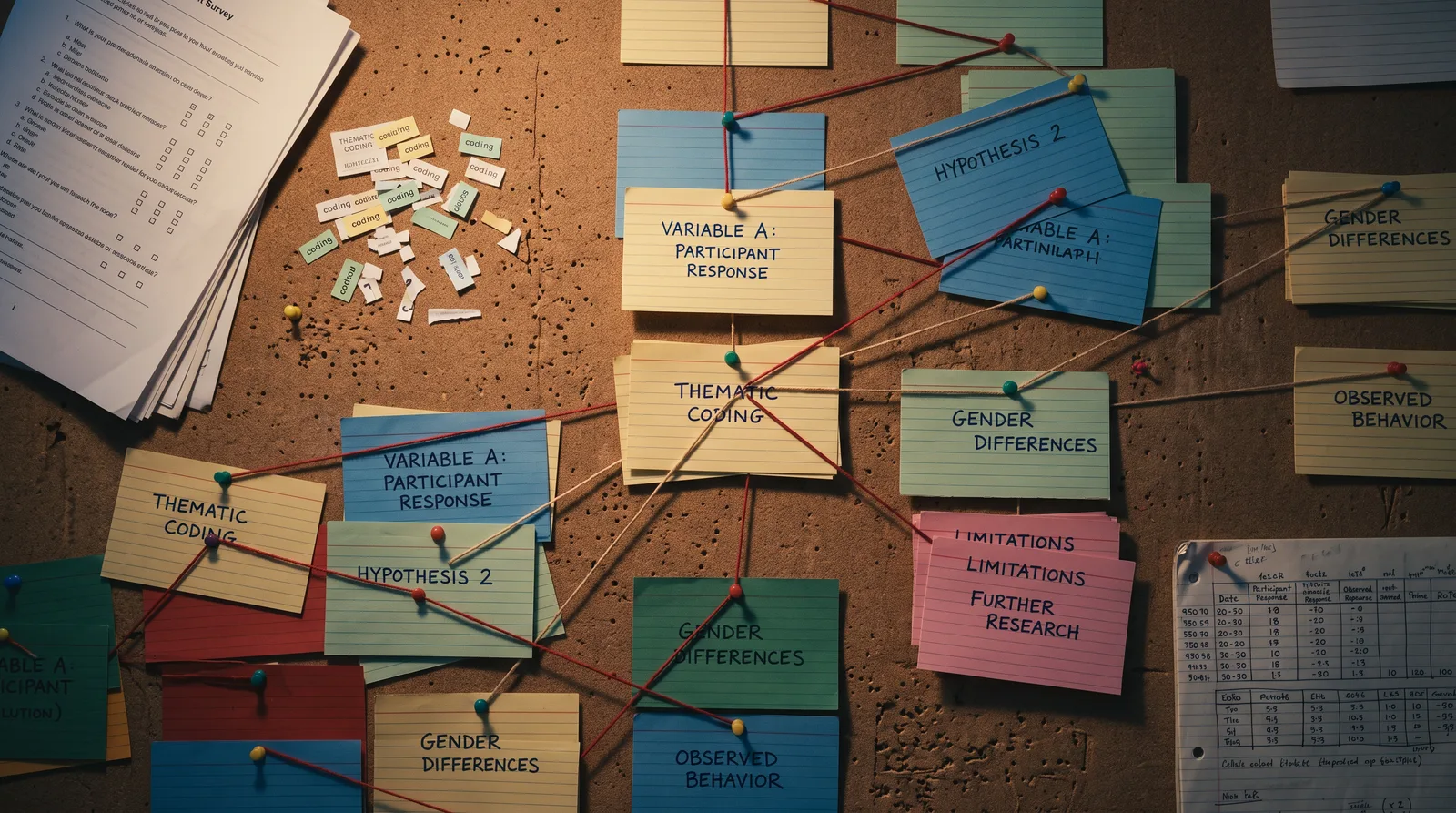
From forming a rigorous research question to defending your findings, this lab-style course walks you through every stage of the research process — with the precision and expectations of a real academic environment.

"Rigor isn't about making research harder — it's about making it defensible, and that's the difference between work that matters and work that disappears."
— AI Professor Courses
What you'll learn
What you'll be able to do
- Design a complete research study from a well-formed research question through hypothesis, methodology, and analysis plan
- Distinguish between quantitative, qualitative, and mixed-methods approaches and choose the right one for any research problem
- Evaluate the validity, reliability, and bias of primary and secondary sources with scholarly precision
- Construct and administer surveys, interviews, or experiments following ethical and methodological best practices
- Interpret descriptive and inferential statistics accurately and communicate findings in APA or discipline-appropriate format
- Critically appraise published research — identifying flaws in design, sampling, or analysis — as a peer reviewer would
How it works
A school that adapts to you
This isn't a set of static videos. Every lesson is generated live and tuned to where you actually are.
We learn your level
A quick placement check tailors your starting point so you're never bored or lost.
Lessons adapt as you go
Each lesson is written for your pace and your goal, adjusting as your skills grow.
Your AI coach keeps you moving
Checkpoints, feedback, and gentle nudges turn progress into a real result.
The curriculum
What's inside your school
6 modules · 29 lessons

Foundations of Research Thinking
Establishes the mindset, vocabulary, and philosophical grounding every researcher needs before designing a single study.
- 1.1What Is Research? Definitions, Purpose, and TypesIncluded
- 1.2Epistemology and Research ParadigmsIncluded
- 1.3The Research Process: An End-to-End MapIncluded
- 1.4Academic Integrity, Ethics, and IRB BasicsIncluded
Building Your Research Question and Literature Foundation
Teaches students to move from a broad topic to a precise, researchable question anchored in existing scholarship.
- 2.1Identifying a Research Problem and GapIncluded
- 2.2Writing Strong Research Questions and HypothesesIncluded
- 2.3Conducting a Systematic Literature SearchIncluded
- 2.4Reading and Synthesizing Scholarly SourcesIncluded
- 2.5Evaluating Source Validity, Reliability, and BiasIncluded
Research Design: Quantitative Approaches
Develops competency in designing experiments, surveys, and other numeric studies that test hypotheses and measure variables.
- 3.1Core Concepts: Variables, Operationalization, and MeasurementIncluded
- 3.2Experimental and Quasi-Experimental DesignsIncluded
- 3.3Survey Design and Questionnaire ConstructionIncluded
- 3.4Sampling Strategies: Probability and Non-Probability MethodsIncluded
- 3.5Validity and Reliability in Quantitative ResearchIncluded
Research Design: Qualitative and Mixed-Methods Approaches
Builds skill in designing interview studies, ethnographies, case studies, and mixed-methods projects that explore meaning and context.
- 4.1When and Why to Go QualitativeIncluded
- 4.2Major Qualitative Traditions: Phenomenology, Grounded Theory, Ethnography, and Case StudyIncluded
- 4.3Designing and Conducting Interviews and Focus GroupsIncluded
- 4.4Trustworthiness: Credibility, Transferability, and ReflexivityIncluded
- 4.5Mixed-Methods Design: Integration, Rationale, and SequencingIncluded
Data Collection, Analysis, and Interpretation
Equips students to gather data systematically and analyze it accurately using both statistical and interpretive techniques.
- 5.1Descriptive Statistics: Summarizing Your DataIncluded
- 5.2Inferential Statistics: Hypothesis Testing and SignificanceIncluded
- 5.3Correlation, Regression, and CausationIncluded
- 5.4Qualitative Data Analysis: Coding and Thematic AnalysisIncluded
- 5.5Interpreting Results and Avoiding Analytical ErrorsIncluded
Communicating Research and Critical Appraisal
Prepares students to write up, present, and peer-review research to the standards of academic and professional audiences.
- 6.1Writing the Research Report in APA FormatIncluded
- 6.2Presenting Research to Academic and Professional AudiencesIncluded
- 6.3How to Critically Appraise a Published StudyIncluded
- 6.4Common Flaws in Published Research and How to Spot ThemIncluded
- 6.5Designing Your Own Research Proposal: Putting It All TogetherIncluded
Who it's for
Is this you?

Thesis-track undergraduates
Preparing a senior thesis or honors project and needs a complete, rigorous methodology — not just the basics covered in a single lecture.

Graduate students
Entering a master's or doctoral program and wants to build the methods literacy that seminars assume rather than teach from scratch.

Evidence-based professionals
Works in healthcare, policy, education, or consulting and needs to evaluate published research critically rather than accept findings at face value.

Career changers entering research roles
Transitioning into a research-intensive position and needs formal grounding in study design, analysis, and scholarly communication to compete credibly.

Experienced practitioners upskilling
Has years of field experience but gaps in formal research methodology — and wants to close them before presenting findings to academic or institutional audiences.

Independent researchers and writers
Conducts original research outside a university setting and wants the disciplinary standards and analytical tools that make findings credible and publishable.
Questions
Frequently asked
Your teacher
A note from your teacher
AI Professor Courses
If you are reading this, there is a good chance you are facing some version of the same challenge my students describe at the start of every semester: you know you need to do research, or evaluate it, or produce it under real scrutiny — and you are not entirely confident that what you know is enough. Maybe you have a thesis proposal ahead of you. Maybe your program suddenly requires a methods section and the textbook feels impenetrable. Maybe you are a working professional who needs to assess evidence for a high-stakes decision and realize you have been taking published studies at face value for too long. Whatever brought you here, I want you to know: that gap you feel is not a personal failing. It is what happens when research methods are taught piecemeal — statistics in one course, literature review in another, design almost never — instead of as the coherent, end-to-end discipline they actually are.
Research Methods Lab was built to give you the complete picture. I structured it the way I would structure a rigorous graduate methods seminar: we begin with the epistemological foundations — what counts as knowledge, how paradigms shape methodology, what the research process actually looks like from inception to dissemination — because without that scaffolding, every subsequent skill is disconnected from its rationale. Then we work systematically through research question formulation, literature synthesis, study design, data collection, analysis, and communication. Nothing is treated as obvious. Nothing is skipped because it seems introductory. The fundamentals are where most errors live.
What I insist on in this course is precision — not perfectionism, but the kind of intellectual rigor that lets you defend your choices. Why did you select a phenomenological approach rather than a survey? Why did you use a non-probability sample, and what does that mean for your generalizability claims? Why is that correlation in a published study not evidence of causation? These are the questions that separate researchers who understand their craft from those who merely execute a template. I will hold you to that standard — not to make the work harder, but because that standard is what makes the work meaningful.
I also want to be direct about something that often goes unsaid: learning to critically appraise published research is not an advanced or optional skill. It is one of the most immediately useful things you can do, whether you are a graduate student, a clinician reviewing the literature, or a policy analyst evaluating program evidence. We spend dedicated time on exactly that — on how peer reviewers think, on common design and sampling flaws, on the kinds of analytical errors that survive editorial review more often than any of us would like to admit.
You do not need to walk into this course with a research background. You do need to bring intellectual seriousness and the willingness to do the thinking that rigorous methods require. If you bring that, I will provide the rest — the framework, the vocabulary, the worked examples, and the scaffolding to turn your curiosity into credible, well-designed inquiry. I look forward to working with you in the lab.
— AI Professor Courses
Start your journey today
Get instant access — learn at your own pace with an AI coach in your corner.
$5/mo
Recurring billing · cancel anytime
Secure checkout · Instant access
- 6 modules, 29 lessons
- AI-adaptive lessons tuned to your level
- Quizzes & checkpoints to lock in progress
- Your own AI learning coach
- Learn on any device, at your pace
- Full access for as long as you're subscribed