Make your brand the answer AI gives
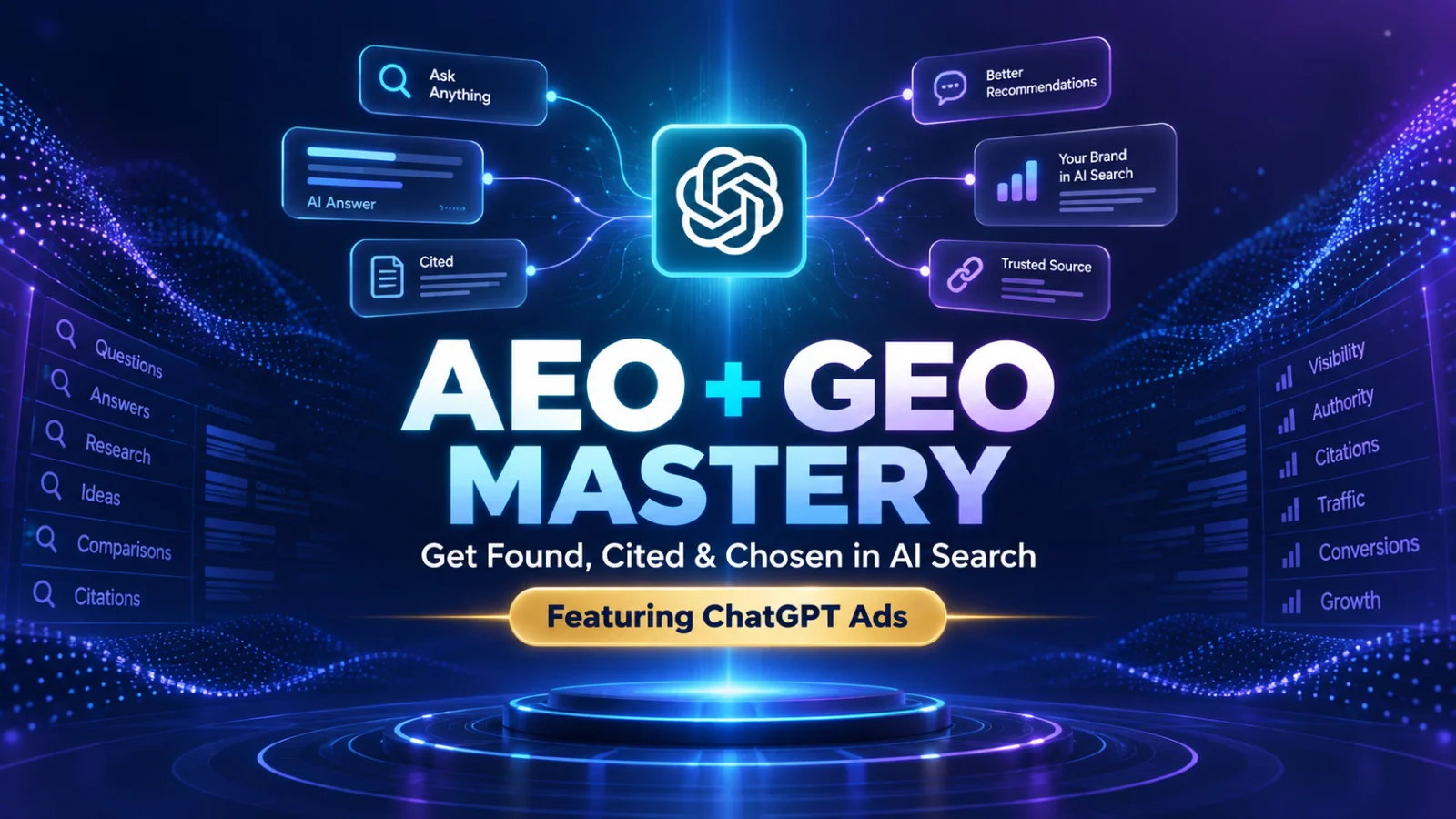
A practical, no-code course that teaches entrepreneurs and marketers exactly how to optimize for AEO and GEO — so ChatGPT, Perplexity, Google AI Overviews, and every other AI answer engine finds, trusts, cites, and recommends your business instead of someone else's.
"I built this course on one belief: if your business is worth finding, you should be the answer AI gives — and I'll show you exactly how to make that happen."
— N. Gina Malak

What you'll learn
What you'll be able to do
- Explain how AI answer engines like ChatGPT, Perplexity, and Google AI Overviews discover and cite brand information — and why traditional SEO alone is no longer enough.
- Map your customers' real conversational questions and search intent to build a targeted AEO and GEO content strategy.
- Build a complete brand entity profile — including consistent name, authority signals, knowledge-graph presence, and trust indicators — that AI platforms can confidently understand and recommend.
- Create optimized answer cards, FAQ pages, and structured articles written for machine readability and eligible for AI-generated citations.
- Implement schema markup and structured data for your brand, products, and content without writing code.
- Complete a full AEO and GEO brand audit, build an AI visibility scorecard, and deliver a custom 30-day optimization roadmap for your own business or a client.
How it works
A school that adapts to you
This isn't a set of static videos. Every lesson is generated live and tuned to where you actually are.
We learn your level
A quick placement check tailors your starting point so you're never bored or lost.
Lessons adapt as you go
Each lesson is written for your pace and your goal, adjusting as your skills grow.
Your AI coach keeps you moving
Checkpoints, feedback, and gentle nudges turn progress into a real result.
The curriculum
What's inside your school
11 modules · 51 lessons

The Shift from SEO to AEO and GEO
Explains how AI-powered answer engines are replacing traditional blue-link search results and why brands must adapt their visibility strategy.
- 1.1From Blue Links to AI-Generated AnswersIncluded
- 1.2What AEO and GEO Actually MeanIncluded
- 1.3Why Traditional SEO Is No Longer EnoughIncluded
- 1.4The AI Search Landscape: Platforms and PlayersIncluded
- 1.5Your AEO and GEO OpportunityIncluded
How AI Search and Answer Engines Work
Demystifies how large language models and answer engines find, interpret, trust, and cite brand information — in plain, non-technical language.
- 2.1How Large Language Models Learn About BrandsIncluded
- 2.2How Answer Engines Retrieve and Rank InformationIncluded
- 2.3Trust, Authority, and Citation SignalsIncluded
- 2.4Knowledge Graphs and Entity UnderstandingIncluded
- 2.5What Makes AI Choose One Brand Over AnotherIncluded
Mapping Customer Questions and Conversational Search Intent
Teaches students to discover the real conversational queries their customers use and translate them into an AEO and GEO content strategy.
- 3.1How People Search in the Age of AIIncluded
- 3.2Research Tools for Finding Real Customer QuestionsIncluded
- 3.3Understanding Search Intent Behind Every QuestionIncluded
- 3.4Building Your Customer Question MapIncluded
- 3.5Matching Questions to Content Across Business TypesIncluded
Building Brand Entities, Authority, and Trust Signals
Shows students how to establish a consistent, authoritative brand entity that AI platforms can confidently understand and recommend.
- 4.1What Is a Brand Entity and Why It MattersIncluded
- 4.2Creating a Consistent Brand Entity ProfileIncluded
- 4.3Building Topical Authority in Your NicheIncluded
- 4.4Digital PR, Mentions, and Third-Party Authority SignalsIncluded
- 4.5Reviews, Ratings, and Social Proof as Trust SignalsIncluded
Creating AI-Friendly Content: Answer Cards, FAQs, and Structured Articles
Teaches students to write and format content specifically designed for machine readability, AI citation eligibility, and direct answer generation.
- 5.1Writing Content AI Can Read, Parse, and TrustIncluded
- 5.2Crafting High-Performance Answer CardsIncluded
- 5.3Building FAQ Pages That Win AI AnswersIncluded
- 5.4Structuring Articles for AI Readability and CitationIncluded
- 5.5Content Templates for Every Business TypeIncluded
Implementing Structured Data and Schema Markup — No Code Required
Demystifies schema markup and shows students how to implement structured data for their brand, content, and products without writing code.
- 6.1What Structured Data Is and Why AI Loves ItIncluded
- 6.2The Schema Types That Matter Most for AEO and GEOIncluded
- 6.3Generating and Adding Schema Without Writing CodeIncluded
- 6.4Testing and Validating Your Structured DataIncluded
Earning Citations, Mentions, Backlinks, and Third-Party Validation
Covers the off-site authority-building tactics that signal to AI platforms that your brand is credible, established, and worth recommending.
- 7.1Why Off-Site Signals Influence AI RecommendationsIncluded
- 7.2Building a Citation and Directory PresenceIncluded
- 7.3Earning Media Mentions and Expert PlacementsIncluded
- 7.4A Review and Reputation Strategy for AI VisibilityIncluded
- 7.5Link Building and Partnership Strategies That CountIncluded
Conducting Your AEO and GEO Brand Audit
Guides students through a full audit of their brand's current AI visibility, surfacing gaps and opportunities across every key signal.
- 8.1The AEO and GEO Audit FrameworkIncluded
- 8.2Auditing Your Brand Entity and Online ConsistencyIncluded
- 8.3Auditing Your Content for AI Readability and Answer EligibilityIncluded
- 8.4Auditing Structured Data, Citations, and Authority SignalsIncluded
- 8.5Compiling Your Audit Findings and Priority Gap ListIncluded
Measuring AI Visibility and Tracking Brand Mentions
Equips students with the tools and metrics to monitor how often and how accurately AI platforms surface and recommend their brand.
- 9.1Defining AI Visibility: What to Measure and WhyIncluded
- 9.2Tools for Monitoring Brand Mentions Across AI PlatformsIncluded
- 9.3Building Your AI Visibility ScorecardIncluded
- 9.4Interpreting Results and Adjusting Your StrategyIncluded
Your 30-Day AEO and GEO Implementation Plan and Final Project
Brings the entire course together as students build a customized, week-by-week roadmap and complete their AEO and GEO brand portfolio.
- 10.1Building Your Week-by-Week 30-Day RoadmapIncluded
- 10.2Putting It All Together: Your AEO and GEO Brand PortfolioIncluded
- 10.3Adapting the Strategy for Different Business TypesIncluded
- 10.4Presenting and Applying Your Optimization PlanIncluded
Advertising on ChatGPT: How to Create and Run ChatGPT Ads
Add this as a separate knowledge section in TeachClub. It correctly distinguishes paid ChatGPT Ads from organic AEO/GEO visibility.
ChatGPT Ads: Paid Visibility in Conversational Search
What Are ChatGPT Ads?
ChatGPT Ads is OpenAI’s advertising platform designed to help people discover relevant products and services within AI-powered experiences. It gives advertisers a paid method of increasing visibility while potential customers are researching problems, evaluating solutions, comparing options, or preparing to make a purchase.
Unlike traditional search advertising, which is primarily organized around short keywords, conversational advertising can align promotions with the broader context and intent of what a person is trying to accomplish.
ChatGPT Ads and organic AI visibility are not the same:
- AEO helps content become eligible to appear in direct answers.
- GEO helps brands become understandable, trustworthy, and citable by generative AI systems.
- ChatGPT Ads provides paid placement opportunities through advertising campaigns.
- Paying for an advertisement does not automatically make a brand an organic source or recommendation.
A strong AI visibility strategy can combine organic AEO/GEO practices with paid advertising.
ChatGPT Ads Campaign Structure
ChatGPT Ads uses a structured advertising hierarchy:
- Campaign: Controls the advertising objective, total budget, schedule, and targeting.
- Ad group: Organizes ads that share bidding, targeting, products, or other delivery settings.
- Ad: Contains the promotional message, creative elements, destination, and call to action.
Advertisers can create and manage campaigns through the ChatGPT Ads Manager. OpenAI also provides an Advertiser API that allows authorized advertisers and technology partners to programmatically create campaigns, manage ads, update product feeds, track conversions, and retrieve performance reports.
Campaign Objectives, Bidding, and Budgets
Advertisers select an objective based on the business outcome they want to achieve. A campaign may be designed to generate:
- Website traffic
- Product discovery
- Purchases
- Registrations
- Lead submissions
- Other measurable conversion actions
Campaigns can include spending limits and bidding strategies. Advertisers should choose a strategy based on their desired outcome, available budget, customer value, conversion rate, and need for control.
New campaigns should begin with a controlled test budget. Advertisers can then review performance, improve their targeting and creative, and increase spending only when the campaign demonstrates acceptable results.
Targeting
ChatGPT Ads supports targeting controls that can determine who is eligible to receive an advertisement. Official documentation includes:
- Geographic targeting
- Platform targeting
- Audience targeting
- Custom-audience inclusion and exclusion
- Context hints
Targeting settings work together. Exclusion rules take priority when someone belongs to both an included and excluded audience.
Contextual targeting should focus on the customer’s current need or objective instead of relying only on broad demographics. For example, a legal-services advertiser may want to reach people researching how to form an LLC, protect intellectual property, create a business contract, or respond to a trademark dispute.
Advertisers should not assume that they receive access to a user’s private ChatGPT conversations. Targeting capabilities, privacy practices, and available audience controls must be explained according to OpenAI’s current documentation and advertising policies.
Product Feeds
Businesses with a product catalog can use product feeds to organize and advertise their inventory. A product feed can contain information such as:
- Product name
- Description
- Price
- Availability
- Product image
- Product category
- Product URL
- Brand
- Promotional information
Product information can be inserted into ad templates when an advertisement is displayed. Accurate, complete, and current product data improves the quality of the advertisement and reduces the risk of showing outdated prices, unavailable products, or incorrect descriptions.
Product feeds are especially useful for e-commerce brands and companies with frequently changing catalogs.
Conversion Tracking
ChatGPT Ads provides tools for measuring actions people take after interacting with an advertisement. Conversion actions may include:
- Purchases
- Lead-form submissions
- Account registrations
- Appointment requests
- Quote requests
- Newsletter subscriptions
- Other meaningful business outcomes
OpenAI provides a website measurement pixel and a server-side Conversions API. The measurement pixel records approved events from a website, while the Conversions API can send conversion events from a company’s server.
Advertisers should establish clear conversion goals before launching a campaign. Clicks alone do not prove that a campaign is profitable. The most valuable measurements connect advertising activity to actual business outcomes.
Reporting and Performance Metrics
The ChatGPT Ads reporting system can provide information about ad delivery, cost, products, and attributed conversions. Reporting can be reviewed at the account, campaign, ad-group, or individual-ad level.
Important performance indicators may include:
- Impressions
- Clicks
- Click-through rate
- Advertising spend
- Cost per click
- Conversions
- Conversion rate
- Cost per acquisition
- Revenue
- Return on advertising spend
Advertisers should also evaluate lead quality, customer lifetime value, sales-cycle length, and whether the advertisement attracted the right type of customer.
Creating Effective Conversational Ads
Effective conversational ads should match the user’s intent and provide a logical next step. The message should clearly communicate:
- The problem the business solves
- Who the solution is for
- The primary benefit
- Evidence supporting the claim
- A clear call to action
- An accurate landing-page destination
Avoid exaggerated claims, misleading urgency, unsupported guarantees, and advertisements that appear to be an independent recommendation from the AI.
A strong advertisement adds value to the customer’s decision-making process rather than interrupting it.
Connecting ChatGPT Ads With AEO and GEO
ChatGPT Ads can create paid visibility, but a business still needs strong digital foundations. Before investing heavily in advertising, the business should have:
- A clearly defined brand and service offering
- Consistent business information across the internet
- Helpful and authoritative website content
- Structured product or service information
- Relevant landing pages
- Credible reviews and third-party validation
- Accurate schema markup
- Clear conversion paths
- Reliable analytics and conversion tracking
AEO and GEO build organic authority. ChatGPT Ads can accelerate paid discovery. Together, they can support a broader conversational-search strategy.
Important Course Disclaimer
ChatGPT Ads is an evolving platform. Features, eligibility requirements, targeting options, pricing, policies, geographic availability, and reporting capabilities may change. Students should verify current information using official OpenAI documentation before creating or managing campaigns.
Last reviewed: September 19, 2026.
Official references:
- 11.1How ChatGPT Ads Work and Why They Matter for Your BrandIncluded
- 11.2Setting Up Your ChatGPT Ads Account and Campaign StructureIncluded
- 11.3Writing Ad Copy That Works Inside a ConversationIncluded
- 11.4Measuring Performance and Optimizing Your ChatGPT Ad CampaignsIncluded
Who it's for
Is this you?

Independent consultants
She wants to add AI search optimization as a repeatable, billable service — and needs a proven audit and roadmap framework she can deliver to clients immediately.

Small business owners
He built his business on Google traffic and word-of-mouth, and now needs to understand why AI answer engines aren't mentioning him — and how to fix it without hiring a developer.

Content creators & bloggers
She produces high-quality content that deserves citations, and wants to structure her articles, FAQs, and answer cards so AI platforms actually quote her — not a competitor.

In-house digital marketers
He owns SEO and content strategy for his company and needs a clear framework to extend that work into AEO and GEO before leadership starts asking why they're invisible in AI results.

Brand-new entrepreneurs
She's launching a business and wants to build her brand entity, authority signals, and structured content right from the start — so AI platforms learn to trust her before the competition is entrenched.

Agency owners & strategists
He leads a marketing agency and wants to upskill his team and package AEO and GEO optimization as a differentiated service offering his competitors haven't caught up to yet.
Questions
Frequently asked
Your teacher
A note from your teacher

N. Gina Malak
If you've built something worth finding, you deserve to be found — and right now, that's not a given.
I know what it's like to watch the rules of search change underneath you. You did the work: the website, the content, maybe some SEO. And for a while, it worked. Then AI-generated answers started showing up at the top of every results page, and suddenly the game shifted. Not a little. Fundamentally. The question stopped being "can I rank on page one?" and became "will AI even mention me at all?" That's a disorienting place to be when your business depends on being discovered.
That's exactly why I built this course — and why I built it the way I did. No fluff, no theory for theory's sake, no jargon that makes you feel like you need a computer science degree to participate. Every section answers a specific business question: How does an AI engine actually decide which brand to cite? How do I make my content readable and trustworthy to a machine? How do I build a brand entity that Google's knowledge graph and ChatGPT both understand? And then — critically — here's exactly what to do next. Because knowing is only useful when it leads to action.
What you'll build in this course is real. A customer question map grounded in how people actually search with AI. A complete brand entity profile with consistent authority signals across the web. Answer cards and FAQ pages written for machine readability. Schema markup implemented without touching code. A citation and reputation strategy that earns off-site trust. And a full AEO and GEO brand audit that ends with a 30-day roadmap you can start executing the day you finish. This isn't a course you take and then wonder what to do with — it's a course you work through and walk away from with a concrete plan.
Whether you're a solo entrepreneur trying to protect your visibility, a marketer who needs to brief a team, or a consultant who wants to add AI search optimization as a billable service, this course meets you where you are. No coding required. No prior AEO or GEO experience assumed. Just a willingness to do the work — and I'll show you exactly what that work looks like, step by step.
The window to get ahead of this is still open. Come build your visibility before someone else takes your answer.
— N. Gina Malak
Start your journey today
Get instant access — learn at your own pace with an AI coach in your corner.
$79/yr
Recurring billing · cancel anytime
Secure checkout · Instant access
- 11 modules, 51 lessons
- AI-adaptive lessons tuned to your level
- Quizzes & checkpoints to lock in progress
- Your own AI learning coach
- Learn on any device, at your pace
- Full access for as long as you're subscribed