Understand how the shadow world actually works
A rigorous, AI professor-led deep dive into spy tradecraft, intelligence agencies, covert operations, and national security law — taught with real case studies and declassified detail, not Hollywood fantasy.
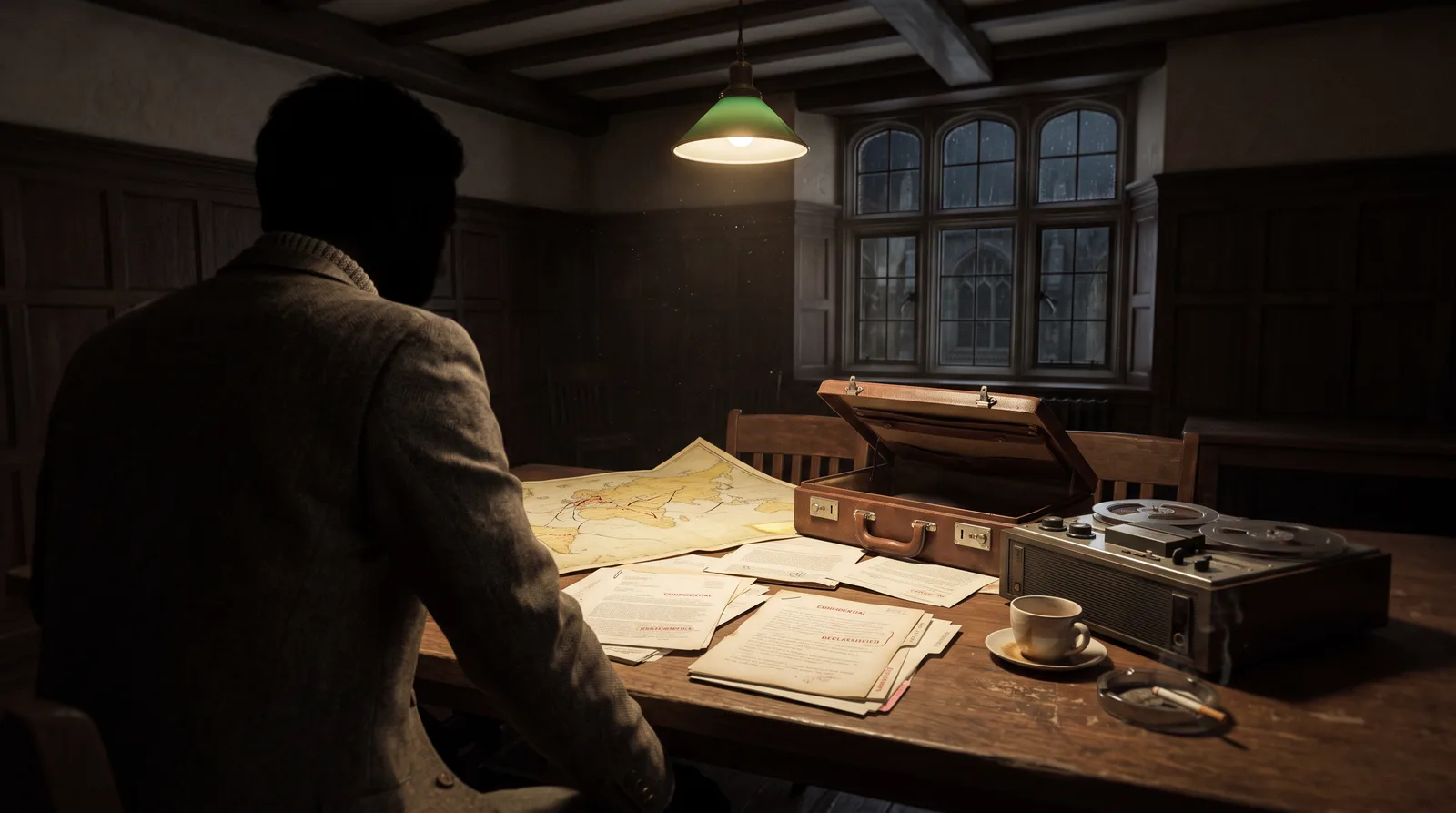
"The shadow world operates on identifiable principles — my job is to give you the framework to finally see them clearly."
— AI Professor Courses
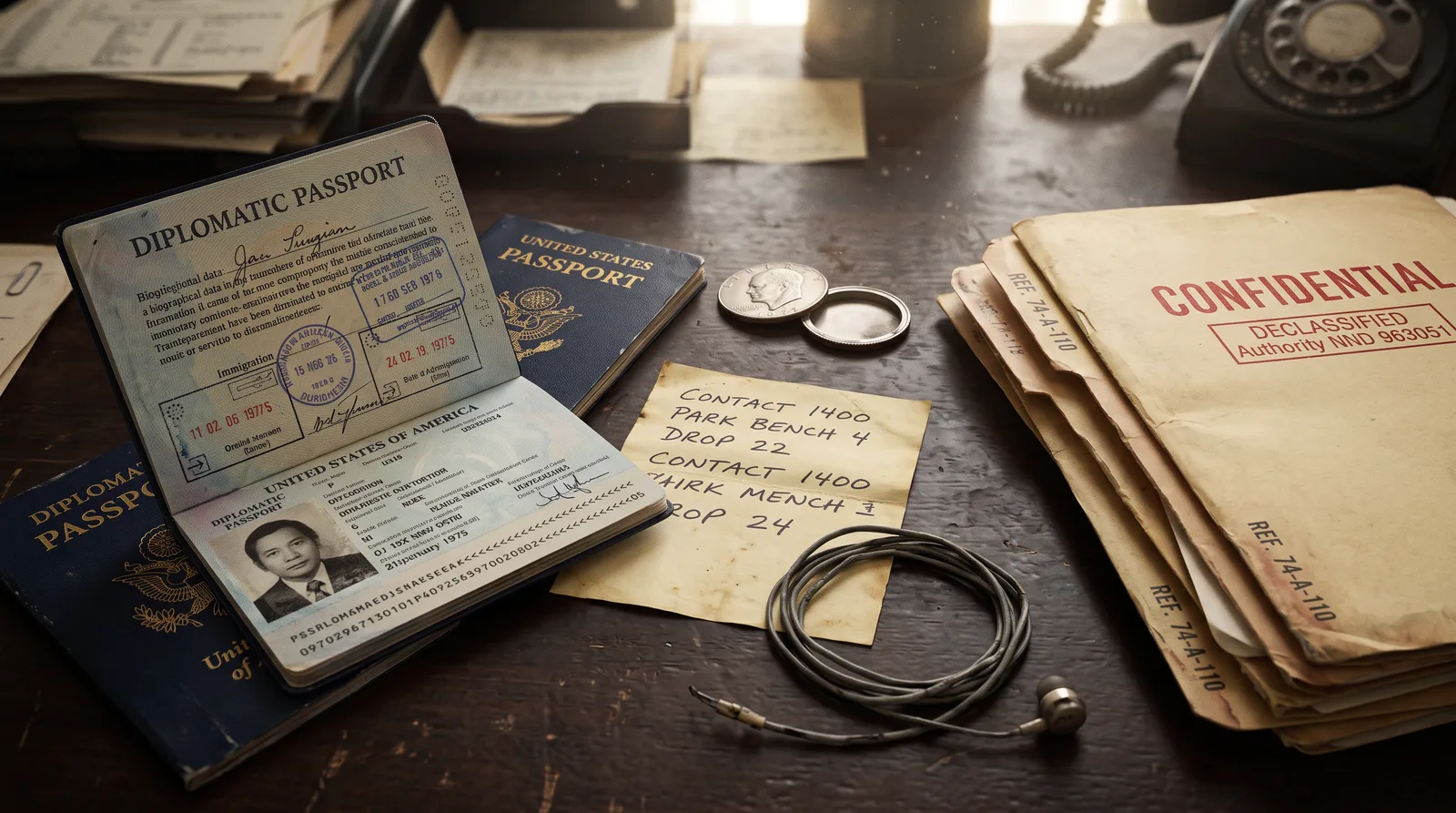
What you'll learn
What you'll be able to do
- Identify and explain the full tradecraft of spies and operatives — including cover stories, disguise, deception, denial, and plausible deniability — and distinguish how each technique is applied in the field.
- Analyze the structure, history, and methods of the world's major intelligence agencies (CIA, MI6, FSB, Mossad, MSS, and others) and evaluate how their missions and cultures differ.
- Deconstruct covert and black operations from recruitment and tasking through execution and exfiltration, including sleeper cell operations, deep-cover assignments, honey traps, and sexpionage.
- Assess intelligence products — HUMINT, SIGINT, OSINT, and finished reports — and apply evaluative criteria to distinguish high-value, actionable intelligence from noise or disinformation.
- Apply counterintelligence principles to real-world scenarios: detect foreign agents and operatives, recognize foreign intelligence operations disguised as ordinary crime, and understand U.S. national security law and famous espionage cases.
- Navigate the professional realities of intelligence careers — including how spies and analysts are recruited, vetted, compensated (salaries, bonuses, living allowances, cover perks), and what consequences await those caught operating against a foreign government.
How it works
A school that adapts to you
This isn't a set of static videos. Every lesson is generated live and tuned to where you actually are.
We learn your level
A quick placement check tailors your starting point so you're never bored or lost.
Lessons adapt as you go
Each lesson is written for your pace and your goal, adjusting as your skills grow.
Your AI coach keeps you moving
Checkpoints, feedback, and gentle nudges turn progress into a real result.
The curriculum
What's inside your school
6 modules · 33 lessons

The Shadow World: Foundations of Espionage
Establishes the vocabulary, history, and conceptual framework of the intelligence profession before any tradecraft is introduced.
- 1.1What Is Espionage? Defining the CraftIncluded
- 1.2Spy vs. Operative vs. Agent: Who Is WhoIncluded
- 1.3A Brief History of Spying: From Ancient Empires to the Cold WarIncluded
- 1.4The World's Major Intelligence Agencies TodayIncluded
- 1.5The U.S. Intelligence Community: Structure and OversightIncluded
Spy Tradecraft: The Art of Operating in the Shadows
Covers the full personal tradecraft toolkit a spy or operative uses to survive, communicate, and maneuver undetected in the field.
- 2.1Cover Stories, Legends, and False IdentitiesIncluded
- 2.2Disguise, Surveillance Detection, and Counter-SurveillanceIncluded
- 2.3Deception, Denial, and Plausible DeniabilityIncluded
- 2.4Trickery, Lies, and False ProfilingIncluded
- 2.5Covert Communications: Dead Drops, Signals, and EncryptionIncluded
- 2.6Exfiltration, Escape, and EvasionIncluded
Recruitment, Assignments, and Human Operations
Details how intelligence services identify, recruit, task, and manage human sources from first contact through termination.
- 3.1Recruitment: Spotting, Assessing, and Developing TargetsIncluded
- 3.2Confidential Informants, Assets, and HandlersIncluded
- 3.3Assignment Types: How Spy Missions Are Designed and TaskedIncluded
- 3.4Deep Cover Operations and NOC OfficersIncluded
- 3.5Sleeper Cells: Recruitment, Activation, and OperationsIncluded
- 3.6Sexpionage, Honeypots, and Honey TrapsIncluded
Covert and Black Operations
Examines how governments plan, authorize, execute, and disavow clandestine and covert action programs beyond routine collection.
- 4.1Covert Action vs. Clandestine Collection: Key DistinctionsIncluded
- 4.2Black Operations: Authorization, Deniability, and ExecutionIncluded
- 4.3Influence Operations, Propaganda, and Active MeasuresIncluded
- 4.4Famous Covert Operations: Case Studies from the CIA and BeyondIncluded
- 4.5Paramilitary and Lethal Covert ActionIncluded
Intelligence Collection, Analysis, and Products
Builds the analytic side of the profession — how raw intelligence is collected, evaluated, processed, and turned into finished products.
- 5.1The Intelligence Cycle: From Requirement to Finished ProductIncluded
- 5.2HUMINT, SIGINT, OSINT, GEOINT, and MASINT ExplainedIncluded
- 5.3Evaluating Intelligence: What Makes a Report High-Value?Included
- 5.4Intelligence Products: From Raw Cables to the President's Daily BriefIncluded
- 5.5Disinformation, Noise, and Intelligence FailuresIncluded
Counterintelligence, National Security Law, and Espionage Careers
Closes the course by covering CI tradecraft, U.S. legal frameworks, famous American espionage cases, and the full realities of intelligence careers.
- 6.1Counterintelligence Fundamentals: Detecting and Neutralizing Foreign ThreatsIncluded
- 6.2Recognizing a Foreign Intelligence Operation vs. an Ordinary CrimeIncluded
- 6.3U.S. National Security Law: FISA, the Espionage Act, and Executive OrdersIncluded
- 6.4Famous U.S. Espionage Cases: Ames, Hanssen, Pollard, and WalkerIncluded
- 6.5What Happens When Spies Are Caught: Consequences Across JurisdictionsIncluded
- 6.6Intelligence Careers: Recruitment, Vetting, Compensation, and Life in the ProfessionIncluded
Who it's for
Is this you?

History & geopolitics buffs
Finally understand the covert operations and intelligence failures that actually drove the Cold War, proxy conflicts, and modern geopolitical flashpoints — not the myth, the mechanism.

Aspiring intelligence analysts
Get the professional vocabulary, analytical frameworks, and career realities — recruitment, vetting, compensation — before you ever walk into an agency interview.

Law enforcement professionals
Learn to recognize when an investigation has crossed into foreign intelligence territory, and understand the legal architecture — FISA, the Espionage Act — that governs it.

National security & policy students
Build the rigorous, agency-specific, operationally grounded knowledge base that political science and IR programs rarely provide at this level of detail.

True-crime & thriller enthusiasts
Move beyond the drama and understand exactly how real-world cases like Ames, Hanssen, and the Walker ring unfolded — and what the operational failures actually were.
Military professionals
Deepen your understanding of the intelligence community's structure, collection disciplines, and covert action authorities that operate alongside — and sometimes ahead of — conventional force.
Questions
Frequently asked
Your teacher
A note from your teacher
AI Professor Courses
If you've picked up this page, I suspect you already know the feeling: you read a story about a foreign intelligence operation, a sleeper network, a counterintelligence failure — and you realize that the reporting, however good, is only gesturing at something far more structured and intricate underneath. You want to understand the actual machinery. I built this course for exactly that impulse.
I've spent my career in the serious study of intelligence — its history, its doctrine, its tradecraft, and its legal and ethical architecture. What I've found, consistently, is that the gap between public understanding and operational reality is enormous. Not because the truth is classified (most of what matters is documented, if you know where to look), but because no one has organized it coherently for a general audience without condescending to that audience. That's the gap The Espionage Academy is designed to close.
Here's what you will actually learn to do: You'll be able to identify a tradecraft technique — a cover legend, a surveillance detection route, a dead drop protocol — and explain not just what it is, but why it's used and what it costs operationally. You'll analyze the structural differences between the CIA, MI6, the FSB, Mossad, and China's MSS with the same clarity a foreign policy analyst brings to it. You'll deconstruct how human intelligence operations are built from first contact through exfiltration. You'll read an intelligence product — even a public summary — and evaluate its sourcing, its gaps, and its vulnerabilities to disinformation. And you'll understand U.S. national security law well enough to follow an Espionage Act prosecution without getting lost.
I know the common objection: "I'm not a professional — is this really for me?" My answer is that intellectual seriousness is the only prerequisite. This course is taken by historians, journalists, military officers, law-enforcement professionals, policy students, novelists, and people who simply refuse to stay at the surface of a subject that shapes the world they live in. The material respects your intelligence. It will ask you to think carefully, to hold complexity, and to update your assumptions when the evidence demands it.
The shadow world is not, in the end, that shadowy — it operates according to identifiable principles, documented histories, and real human motivations. You just need the right framework to see it clearly. That's what I'm here to give you. I hope you'll join me inside.
— AI Professor Courses
Start your journey today
Get instant access — learn at your own pace with an AI coach in your corner.
$5/mo
Recurring billing · cancel anytime
Secure checkout · Instant access
- 6 modules, 33 lessons
- AI-adaptive lessons tuned to your level
- Quizzes & checkpoints to lock in progress
- Your own AI learning coach
- Learn on any device, at your pace
- Full access for as long as you're subscribed