Understand the sky like a scientist
A rigorous, professor-guided meteorology course that takes you from atmospheric fundamentals to real forecasting models — built for curious minds who want more than surface-level answers.

"My job is to give you the framework first — so that when you look at a weather map, a sounding, or a radar loop, you're not guessing. You're reasoning."
— AI Professor Courses
What you'll learn
What you'll be able to do
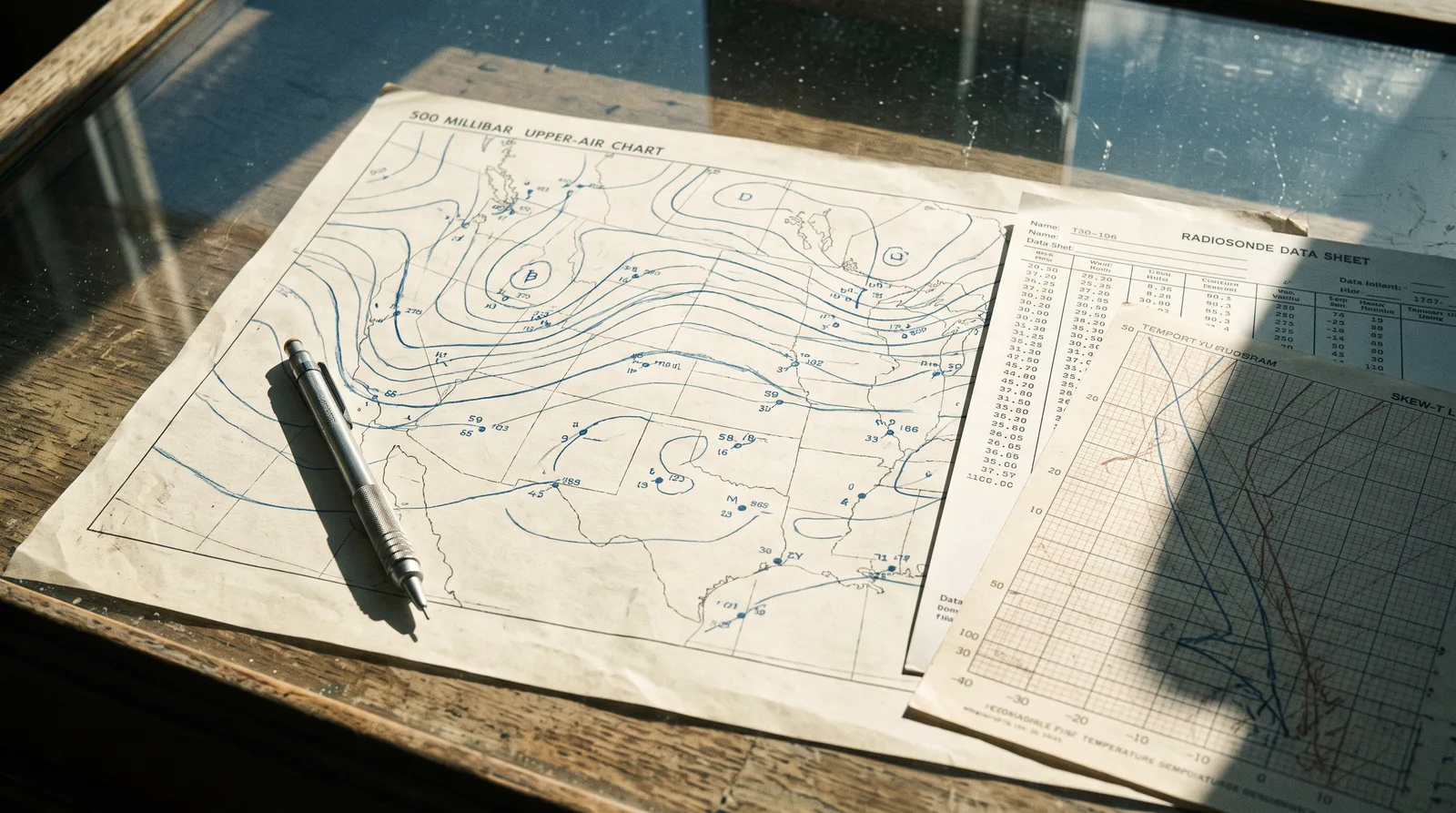
- Interpret synoptic weather maps, isobars, and pressure systems to analyze current atmospheric conditions
- Explain the thermodynamic principles driving cloud formation, precipitation, and storm development
- Identify and differentiate mesoscale phenomena including thunderstorms, tornadoes, and tropical cyclones
- Apply the fundamentals of numerical weather prediction and understand how modern forecasting models work
- Analyze upper-atmosphere dynamics including jet streams, Rossby waves, and their influence on surface weather
- Communicate weather data and forecasts accurately using standard meteorological tools and terminology
How it works
A school that adapts to you
This isn't a set of static videos. Every lesson is generated live and tuned to where you actually are.
We learn your level
A quick placement check tailors your starting point so you're never bored or lost.
Lessons adapt as you go
Each lesson is written for your pace and your goal, adjusting as your skills grow.
Your AI coach keeps you moving
Checkpoints, feedback, and gentle nudges turn progress into a real result.
The curriculum
What's inside your school
6 modules · 30 lessons

Foundations of the Atmosphere
Establishes the physical and chemical structure of Earth's atmosphere as the scientific bedrock for all meteorological study.
- 1.1Atmospheric Composition and Vertical StructureIncluded
- 1.2Temperature, Pressure, and Density RelationshipsIncluded
- 1.3Energy Balance and Solar RadiationIncluded
- 1.4Heat Transfer: Conduction, Convection, and RadiationIncluded
- 1.5The Coriolis Effect and Large-Scale CirculationIncluded
Reading the Sky: Surface Analysis and Synoptic Meteorology
Trains students to decode synoptic-scale weather maps and identify the pressure systems and fronts that govern day-to-day weather.
- 2.1Pressure Systems: Highs, Lows, and IsobarsIncluded
- 2.2Air Masses: Origins, Properties, and ClassificationIncluded
- 2.3Frontal Systems: Cold, Warm, Stationary, and OccludedIncluded
- 2.4The Mid-Latitude Cyclone Life CycleIncluded
- 2.5Station Models and Surface Map AnalysisIncluded
Thermodynamics, Moisture, and Cloud Physics
Builds the thermodynamic framework needed to understand how moisture, instability, and lift combine to produce clouds and precipitation.
- 3.1Atmospheric Moisture: Humidity, Dewpoint, and Mixing RatioIncluded
- 3.2Atmospheric Stability and the Lifted IndexIncluded
- 3.3The Skew-T Log-P DiagramIncluded
- 3.4Cloud Formation, Types, and ClassificationIncluded
- 3.5Precipitation Processes: Collision-Coalescence and the Bergeron ProcessIncluded
Upper-Atmosphere Dynamics
Examines the winds, waves, and circulation patterns of the upper troposphere and their powerful influence on surface weather.
- 4.1Geostrophic and Gradient Wind BalanceIncluded
- 4.2The Jet Stream: Structure, Variability, and Weather ImpactsIncluded
- 4.3Rossby Waves and Long-Wave PatternsIncluded
- 4.4Divergence, Vorticity, and Upper-Level ForcingIncluded
- 4.5Upper-Air Sounding Networks and Radiosonde DataIncluded
Mesoscale Weather: Thunderstorms, Tornadoes, and Tropical Cyclones
Investigates the formation, structure, and hazards of the most impactful mesoscale and convective weather systems.
- 5.1Thunderstorm Development: Ordinary Cells to SupercellsIncluded
- 5.2Convective Parameters: CAPE, CIN, and Wind ShearIncluded
- 5.3Tornado Formation, Structure, and the Tornado Warning ProcessIncluded
- 5.4Mesoscale Convective Systems and Squall LinesIncluded
- 5.5Tropical Cyclones: Formation, Intensification, and StructureIncluded
Numerical Weather Prediction, Forecasting, and Science Communication
Connects the physical theory of the whole course to modern operational forecasting tools, model interpretation, and professional meteorological communication.
- 6.1Principles of Numerical Weather PredictionIncluded
- 6.2Major Operational Models: GFS, NAM, and ECMWFIncluded
- 6.3Ensemble Forecasting and Probabilistic ThinkingIncluded
- 6.4Doppler Radar, Satellites, and Observational ToolsIncluded
- 6.5Communicating Forecasts: Terminology, Graphics, and Public MessagingIncluded
Who it's for
Is this you?

Atmospheric science undergrads
Reinforces and extends coursework with professor-level explanations of thermodynamics, synoptic analysis, and upper-air dynamics that go deeper than most textbooks.

Dedicated weather enthusiasts
Finally delivers the rigorous physics behind fronts, severe storms, and forecast models — so passion for weather becomes real scientific understanding.

Early-career forecasters
Solidifies the physical foundations — CAPE, wind shear, vorticity, ensemble thinking — that separate intuition from defensible, professional forecasting.

Self-directed adult learners
Offers a complete, structured college-level curriculum for intellectually curious adults who want to study atmospheric science on their own terms.

Pre-meteorology students
Builds the conceptual framework — from the Coriolis effect to numerical weather prediction — before stepping into a formal degree program.

STEM educators
Provides an authoritative, well-sequenced meteorology reference to enrich earth science and physics instruction with real atmospheric examples.
Questions
Frequently asked
Your teacher
A note from your teacher
AI Professor Courses
If you've ever watched a line of thunderstorms approach on radar, or stared at a weather map and wished you actually understood what you were looking at — I want you to know that feeling is the beginning of something real. That curiosity, that sense that there's a deeper physical logic to the sky if someone would just explain it properly, is exactly what this course is built for.
I've taught atmospheric science at the college level, and the most consistent thing I've observed is this: when students struggle with meteorology, it's almost never because the subject is beyond them. It's because they were handed conclusions without frameworks. They memorized frontal symbols without understanding the thermodynamic contrasts that create fronts. They learned the word "vorticity" without ever being shown why it matters for surface cyclone development. My job — the job I take seriously in every lesson — is to give you the framework first, so that everything else clicks into place.
In The Meteorology Lab, we start where the atmosphere starts: composition, structure, energy balance, and the physical laws that govern how air behaves. From there, we build systematically — through surface analysis and synoptic meteorology, through the thermodynamics of clouds and precipitation, through the upper-atmosphere dynamics that most introductory resources skip entirely, and into the mesoscale phenomena — supercells, tornadoes, tropical cyclones — that make this science feel urgent and alive. We finish where the profession lives: numerical weather prediction, the major operational models, ensemble thinking, and the craft of communicating forecast information clearly and accurately.
I know some of these topics have a reputation for being intimidating. The Skew-T Log-P diagram. Rossby waves. Geostrophic balance. I won't pretend they're trivial — but I will promise you this: I have explained each of them to students who thought they couldn't understand them, and watched the moment it clicked. That moment is what I teach toward, every time. You're not here to be overwhelmed. You're here to become someone who genuinely understands how the atmosphere works.
If you're a student looking to reinforce or go deeper than your coursework, a weather enthusiast who has always wanted the real science, or an early-career scientist building a stronger foundation — pull up a surface map, and let's get to work.
— AI Professor Courses
Start your journey today
Get instant access — learn at your own pace with an AI coach in your corner.
$5/mo
Recurring billing · cancel anytime
Secure checkout · Instant access
- 6 modules, 30 lessons
- AI-adaptive lessons tuned to your level
- Quizzes & checkpoints to lock in progress
- Your own AI learning coach
- Learn on any device, at your pace
- Full access for as long as you're subscribed