Finally understand why the world is the way it is
A rigorous, AI professor-led journey through world history — from the first river civilizations to the fractures of the modern era — that teaches you to think like a historian, not just remember like a student.
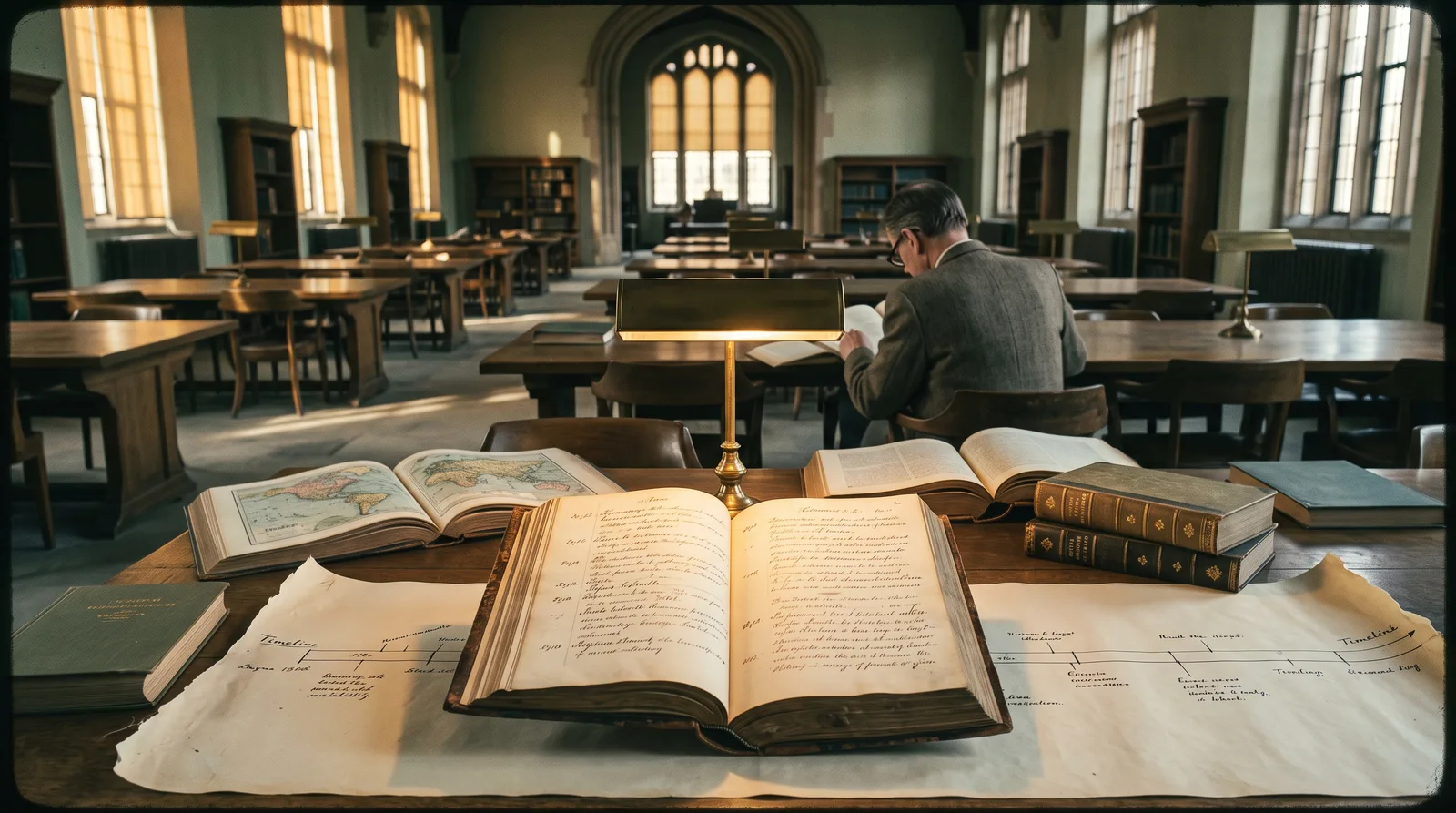
"History isn't a list of things that happened — it's an argument about why they matter, and I'm going to teach you how to make that argument yourself."
— AI Professor Courses
What you'll learn
What you'll be able to do
- Trace the rise and fall of major world civilizations — from Mesopotamia and the Han Dynasty to the Ottoman and British Empires — and explain the structural forces behind each.
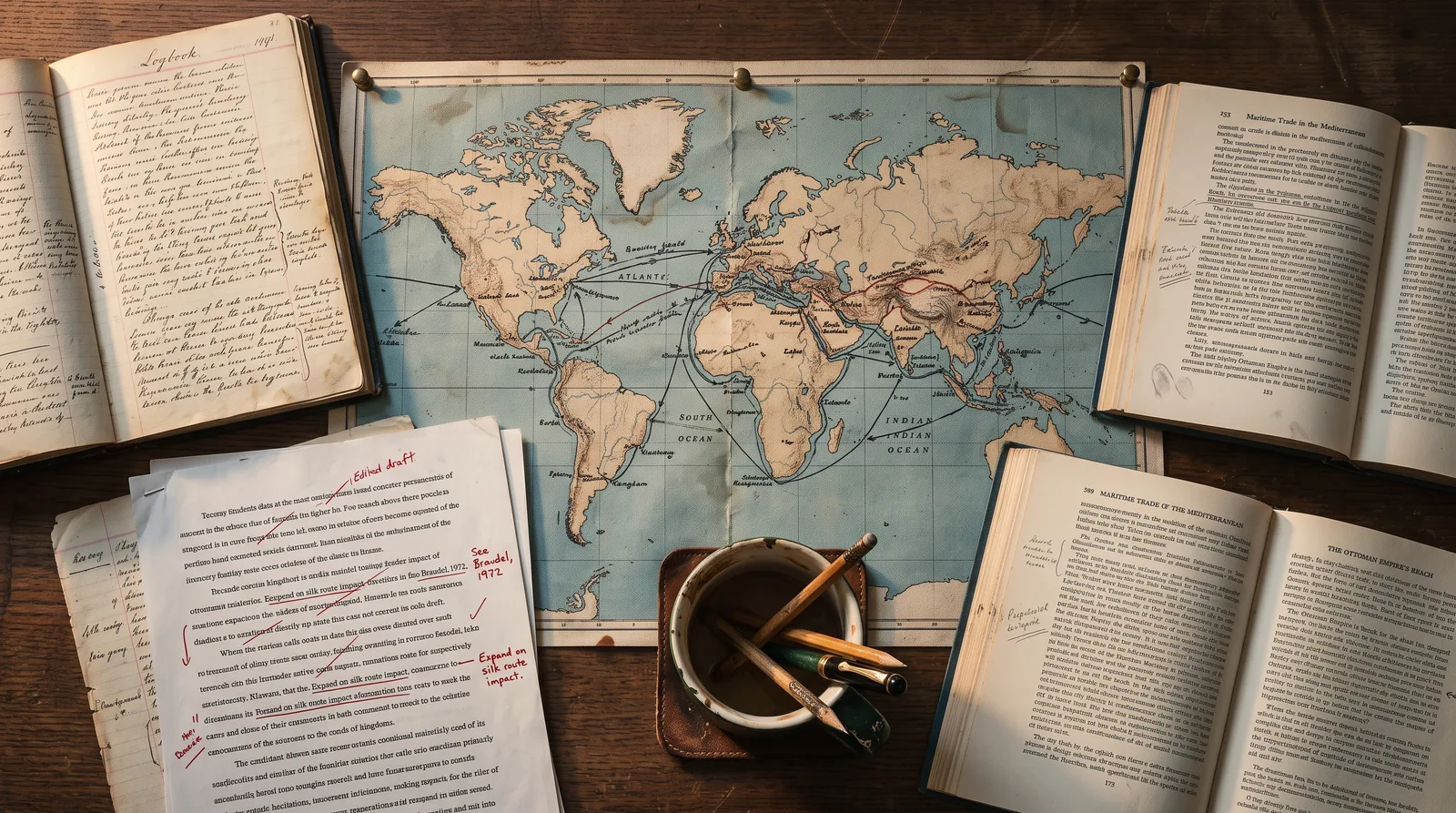
- Analyze primary sources, maps, and historical documents the way a trained historian does, constructing evidence-based arguments rather than simply memorizing dates.
- Connect turning-point events (the Black Death, the Age of Exploration, the Industrial Revolution) to their long-term global consequences across economics, culture, and politics.
- Compare how different world regions developed in parallel — and in relation to each other — dismantling the Eurocentric narrative that dominates most standard curricula.
- Apply core historiographical frameworks (social history, postcolonial theory, world-systems analysis) to evaluate why historians disagree and how interpretation shapes the past.
- Construct a well-reasoned historical essay or research argument, using proper citation, thesis development, and counterargument — skills that transfer across every academic discipline.
How it works
A school that adapts to you
This isn't a set of static videos. Every lesson is generated live and tuned to where you actually are.
We learn your level
A quick placement check tailors your starting point so you're never bored or lost.
Lessons adapt as you go
Each lesson is written for your pace and your goal, adjusting as your skills grow.
Your AI coach keeps you moving
Checkpoints, feedback, and gentle nudges turn progress into a real result.
The curriculum
What's inside your school
6 modules · 30 lessons
Thinking Like a Historian
Equips students with the core methods, frameworks, and habits of mind that professional historians use before diving into content.
- 1.1What Is History — and Who Gets to Write It?Included
- 1.2Primary vs. Secondary SourcesIncluded
- 1.3Historiographical FrameworksIncluded
- 1.4Maps, Data, and Visual EvidenceIncluded
- 1.5Building a Historical ArgumentIncluded
The Ancient World — Cradles of Civilization (3500–300 BCE)
Explores the structural conditions that gave rise to the world's earliest complex societies across multiple regions simultaneously.
- 2.1Mesopotamia and the Nile — Rivers and State FormationIncluded
- 2.2The Indus Valley and Early South AsiaIncluded
- 2.3Shang and Zhou China — Early East Asian CivilizationIncluded
- 2.4The Ancient Mediterranean — Greece, Persia, and Cross-Regional ContactIncluded
- 2.5Parallel Worlds — Comparing Ancient Civilizations Across RegionsIncluded
Empires, Exchange, and Belief Systems (300 BCE–1200 CE)
Covers the great empires and transcontinental networks that connected — and transformed — the ancient and classical world.
- 3.1The Han Dynasty and the Roman Empire — Comparing Superpower ModelsIncluded
- 3.2The Silk Roads and Indian Ocean TradeIncluded
- 3.3The Spread of Universal ReligionsIncluded
- 3.4The Islamic Golden Age and Abbasid CivilizationIncluded
- 3.5Sub-Saharan Africa and the Americas — Civilizations Beyond EurasiaIncluded
Crisis, Contact, and Early Globalization (1200–1700)
Examines the catastrophes, conquests, and encounters that fractured old worlds and forged the first truly global connections.
- 4.1The Mongol Empire — Destruction, Integration, and the Pax MongolicaIncluded
- 4.2The Black Death and Its Global ConsequencesIncluded
- 4.3The Age of Exploration — European Expansion and Its MotivesIncluded
- 4.4The Columbian Exchange and Colonial ViolenceIncluded
- 4.5The Ottoman, Safavid, and Mughal Empires — A Non-European Early Modern WorldIncluded
Revolution, Industry, and Empire (1700–1914)
Traces the political revolutions, industrial transformation, and imperial expansion that reshaped global power in the modern era.
- 5.1The Atlantic Revolutions — America, France, and HaitiIncluded
- 5.2The Industrial Revolution — Origins, Spread, and Human CostIncluded
- 5.3The Scramble for Africa and the Logic of EmpireIncluded
- 5.4Asia in the Age of Imperialism — China, Japan, and IndiaIncluded
- 5.5Latin America, the Caribbean, and the Limits of IndependenceIncluded
The Modern World and Its Fractures (1914–Present)
Brings global history to the present by connecting 20th-century crises to the structural forces students have traced throughout the course.
- 6.1The World Wars — Global Conflict, Colonial Soldiers, and Contested MemoryIncluded
- 6.2Decolonization and the Making of the Third WorldIncluded
- 6.3The Cold War as a Global SystemIncluded
- 6.4Globalization, Inequality, and the 21st CenturyIncluded
- 6.5Your Historical Essay — From Argument to Final DraftIncluded
Who it's for
Is this you?

The undergraduate history major
Wants a structured, rigorous foundation that prepares her for upper-division seminars and the kind of analytical writing her professors actually expect.

The lifelong learner filling the gaps
Reads widely but wants the scaffolding — the frameworks, the source skills, the comparative sweep — that turns curious reading into real historical understanding.

The student tired of Eurocentric history
Knows something is missing from the standard curriculum and wants a course that takes Africa, Asia, and the Americas as seriously as it takes Europe.

The professional going back to school
Considering a graduate program in history, political science, or international relations and needs to rebuild — or build for the first time — a college-level foundation.

The non-history student who needs to write
A pre-law, economics, or social science student who wants the thesis-building, citation, and argumentation skills this course develops as its capstone.

The retired reader who wants more than narrative
Has read the popular histories but craves the analytical depth, the 'why it happened,' and the global perspective that popular books rarely provide.
Questions
Frequently asked
Your teacher
A note from your teacher
AI Professor Courses
If you're reading this, I suspect you already know the feeling: you finish a history book, or a documentary, or even a university survey course, and you come away with names and dates and a vague sense of narrative — but not understanding. Not the kind of understanding that lets you look at a modern headline and trace its roots back two hundred years, or read a political map and see the ghost of a colonial border. That gap between information and comprehension is exactly what this course is designed to close.
I built The World Historian because I believe the way most of us are taught history is fundamentally broken. We are handed a timeline and told to memorize it. We are given Europe as the default center of gravity and everyone else as context. We are never shown the tools that actual historians use — the frameworks, the source criticism, the willingness to say "here is where the evidence is contested." And then we wonder why history feels irrelevant. It isn't irrelevant. The teaching was just incomplete.
What you will get here is something closer to what happens in a genuinely good university seminar. We start at the beginning — not just of civilization, but of historical thinking itself. What is a primary source, and why does it matter who produced it? What does it mean to apply a world-systems lens to the Silk Roads, or a postcolonial lens to the Scramble for Africa? How do you build an argument that holds up under scrutiny, rather than just an opinion dressed in fancy language? These are not abstract skills. They are how you move from being a passive recipient of other people's narratives to being someone who can evaluate, argue, and think independently about the past.
The content itself spans the full arc of human civilization — Mesopotamia and the Nile, the Han and Roman empires, the Islamic Golden Age, the Mongol world-system, the Columbian Exchange, Atlantic revolutions, industrialization and empire, decolonization, the Cold War, and the fractures of the 21st century. And at every stop, we ask: who else was in the room? What was happening in West Africa while Europe had the Black Death? What did Japan make of Western imperialism — and what did that decision cost? The course is structured to build a genuinely comparative, non-Eurocentric picture of how the world got here.
I want to be honest with you about one more thing. This course will ask something of you. Not memorization — I have no interest in that — but genuine intellectual effort. You will be asked to read sources critically, to sit with ambiguity, to change your mind when the evidence demands it, and eventually to write a historical argument of your own. I will walk you through every step of that process. But the thinking is yours to do. If that sounds like exactly what you've been looking for, then I'll see you in the first unit.
Welcome. History is not the past — it is the most powerful tool we have for understanding the present. Let's learn to use it properly.
— AI Professor Courses
Start your journey today
Get instant access — learn at your own pace with an AI coach in your corner.
$5/mo
Recurring billing · cancel anytime
Secure checkout · Instant access
- 6 modules, 30 lessons
- AI-adaptive lessons tuned to your level
- Quizzes & checkpoints to lock in progress
- Your own AI learning coach
- Learn on any device, at your pace
- Full access for as long as you're subscribed