Understand Every Religion on Earth
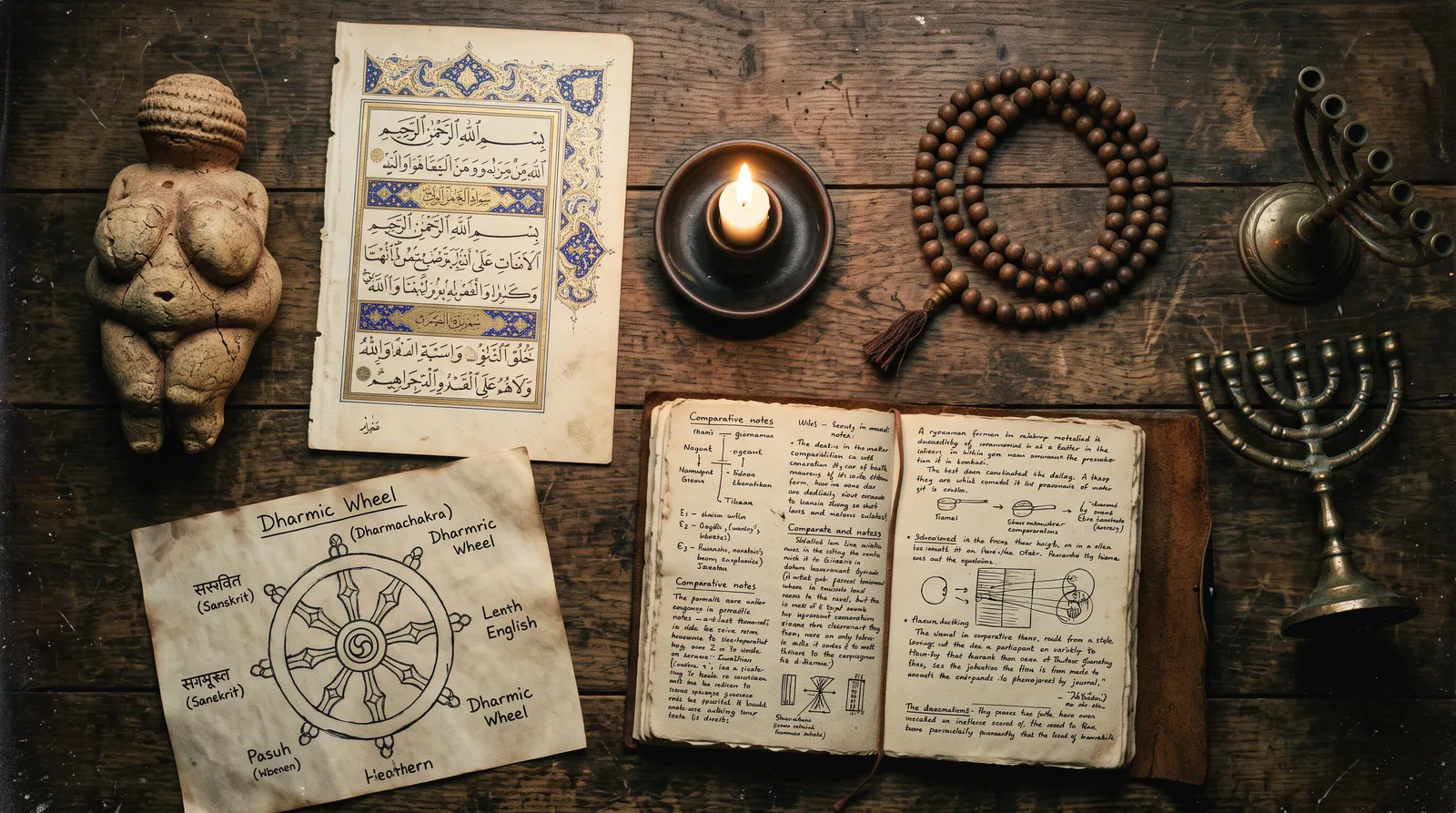
A college-level survey of human religious history — from Neanderthal burial rites to the world's living faiths — taught with academic rigor, zero dogma, and the expectation that you will actually think.

"I will not ask you to believe anything — only to understand everything, and to think with more precision than you did before."
— AI Professor Courses
What you'll learn
What you'll be able to do
- Trace the evolution of religious thought from prehistoric burial rites and cave art through the Axial Age and into modernity
- Accurately describe the core beliefs, sacred texts, rituals, and historical origins of the world's major religions — including Hinduism, Buddhism, Judaism, Christianity, Islam, and more
- Identify and explain pre-literate and indigenous religious traditions, including animism, shamanism, and ancestor veneration
- Analyze how geography, trade, migration, and political power shaped the spread and transformation of religious traditions
- Apply key comparative religion concepts — such as myth, ritual, symbol, and the sacred vs. profane — to evaluate any faith tradition critically
- Distinguish historical fact from theological claim, engaging respectfully and academically with all traditions without bias
How it works
A school that adapts to you
This isn't a set of static videos. Every lesson is generated live and tuned to where you actually are.
We learn your level
A quick placement check tailors your starting point so you're never bored or lost.
Lessons adapt as you go
Each lesson is written for your pace and your goal, adjusting as your skills grow.
Your AI coach keeps you moving
Checkpoints, feedback, and gentle nudges turn progress into a real result.
The curriculum
What's inside your school
12 modules · 62 lessons

The Study of Religion: Methods, Concepts, and Foundations
Equips students with the academic vocabulary and analytical frameworks used by scholars of comparative religion before any tradition is examined.
- 1.1What Is Religion? Defining the IndefinableIncluded
- 1.2The Sacred and the ProfaneIncluded
- 1.3Myth, Ritual, and SymbolIncluded
- 1.4Historical Fact vs. Theological ClaimIncluded
- 1.5How to Study a Religion Fairly: The Comparative MethodIncluded
Before Writing: Prehistoric and Pre-Literate Religion
Examines the archaeological and anthropological evidence for religious behavior among early humans, from the Lower Paleolithic to the dawn of civilization.
- 2.1Reading the Deep Past: Archaeological Evidence for BeliefIncluded
- 2.2The Neanderthal Question: Intentional Burial and Early RitualIncluded
- 2.3Cave Art and the Paleolithic MindIncluded
- 2.4Animism, Shamanism, and the Spirit WorldIncluded
- 2.5Ancestor Veneration and the Origins of the Sacred DeadIncluded
The First Civilizations and Their Gods
Explores the polytheistic religious systems that emerged alongside writing, cities, and states in Mesopotamia, Egypt, and the ancient world.
- 3.1Religion and the Birth of Cities: MesopotamiaIncluded
- 3.2Gods of the Nile: Ancient Egyptian ReligionIncluded
- 3.3The Indus Valley and the Roots of South Asian ReligionIncluded
- 3.4Ancient Canaan, Ugarit, and the Religions of the LevantIncluded
- 3.5Greece, Rome, and the Classical PantheonsIncluded
The Axial Age: When the World Started Thinking Differently
Examines the remarkable 800–200 BCE period when prophets, philosophers, and sages across four civilizations independently transformed religion toward interiority, ethics, and transcendence.
- 4.1Karl Jaspers and the Axial Age HypothesisIncluded
- 4.2The Vedic Tradition and the Upanishadic RevolutionIncluded
- 4.3The Hebrew Prophets and the Rise of Ethical MonotheismIncluded
- 4.4Zoroaster and the Birth of DualismIncluded
- 4.5Confucius, Laozi, and the Chinese Axial MomentIncluded
Hinduism: The World's Oldest Living Religion
Surveys Hindu tradition from Vedic origins through classical Hinduism to contemporary practice, covering its staggering theological and ritual diversity.
- 5.1What Is Hinduism? One Name, Many TraditionsIncluded
- 5.2Sacred Texts: The Vedas, Upanishads, Epics, and PuranasIncluded
- 5.3The Great Paths: Jnana, Bhakti, Karma, and Raja YogaIncluded
- 5.4The Major Traditions: Vaishnavism, Shaivism, and ShaktismIncluded
- 5.5Hinduism in History and the Modern WorldIncluded
Jainism and Buddhism: The Great Renunciant Traditions
Examines the two great Indian reform movements that rejected Vedic authority, centering instead on liberation through self-discipline, non-harm, and insight.
- 6.1Mahavira and the Jain Vision of Non-ViolenceIncluded
- 6.2The Life and Awakening of Siddhartha GautamaIncluded
- 6.3The Dharma: Four Noble Truths, Eightfold Path, and Core TeachingsIncluded
- 6.4The Spread of Buddhism: Theravada, Mahayana, and VajrayanaIncluded
- 6.5Buddhism in the Modern WorldIncluded
Judaism: Covenant, Torah, and 3,000 Years of History
Traces Judaism from its ancient Israelite roots through the biblical period, rabbinic reinvention, medieval flourishing, and modern movements.
- 7.1Origins: From Polytheism to Monotheism in Ancient IsraelIncluded
- 7.2The Hebrew Bible: Structure, Themes, and Historical ContextIncluded
- 7.3The Destruction of the Temple and the Rabbinic RevolutionIncluded
- 7.4Medieval Judaism: Talmud, Kabbalah, Philosophy, and PersecutionIncluded
- 7.5Modern Judaism: Reform, Orthodox, Conservative, and SecularIncluded
Christianity: From Jewish Sect to Global Religion
Traces Christianity from its first-century Jewish origins through its councils, schisms, reformations, and spread to become the world's largest religion.
- 8.1The Historical Jesus: What Scholars Can and Cannot KnowIncluded
- 8.2The New Testament: Formation, Canon, and InterpretationIncluded
- 8.3The Early Church, Constantine, and the CouncilsIncluded
- 8.4Schism, Crusade, and Inquisition: Medieval ChristianityIncluded
- 8.5The Reformation and the Fracturing of Western ChristianityIncluded
- 8.6Global Christianity Today: Catholicism, Orthodoxy, and ProtestantismIncluded
Islam: Revelation, Empire, and a Global Ummah
Examines Islam from the life of Muhammad and the Quran through classical civilization, legal schools, Sunni-Shia division, Sufism, and contemporary Islam.
- 9.1Arabia Before Islam: The Religious and Historical ContextIncluded
- 9.2Muhammad: Prophet, Statesman, and the Revelation of the QuranIncluded
- 9.3The Five Pillars and Core Islamic TheologyIncluded
- 9.4Sunni and Shia: The Great Divide and Its OriginsIncluded
- 9.5Sufism: The Mystical Heart of IslamIncluded
- 9.6Islam in the Modern World: Reform, Colonialism, and RevivalIncluded
Sikhism, Zoroastrianism, and Other Living Traditions
Surveys important but often under-covered living religions — Sikhism, Zoroastrianism, Bahá'í, and Shinto — each with distinct origins and global significance.
- 10.1Sikhism: Guru Nanak and the Path of the SikhIncluded
- 10.2Zoroastrianism: The Oldest Prophetic ReligionIncluded
- 10.3Shinto: Japan's Indigenous TraditionIncluded
- 10.4The Bahá'í Faith: Unity in DiversityIncluded
Indigenous and African Religious Traditions
Surveys indigenous religious traditions of the Americas, Africa, Oceania, and East Asia, centering their intellectual seriousness and diversity.
- 11.1What Is Indigenous Religion? Moving Beyond 'Primitive'Included
- 11.2African Traditional Religions: Cosmology, Ancestors, and RitualIncluded
- 11.3The Americas: Aztec, Maya, Inca, and Native North American TraditionsIncluded
- 11.4Oceania and the Pacific: Mana, Tapu, and Ancestral ConnectionIncluded
- 11.5Diaspora and Synthesis: Vodou, Candomblé, and Syncretic TraditionsIncluded
Religion in the Modern World: Pluralism, Secularism, and the Future of Faith
Examines the forces reshaping all religious traditions in the contemporary world and invites students to synthesize what they have learned.
- 12.1Secularization and Its Discontents: Is Religion Dying?Included
- 12.2Fundamentalism, Reform, and the Politics of ReligionIncluded
- 12.3New Religious Movements and the Spiritual MarketplaceIncluded
- 12.4Interfaith Dialogue and Religious PluralismIncluded
- 12.5Religion, Science, and the Boundaries of KnowledgeIncluded
- 12.6Synthesis: Becoming a Literate Citizen of the World's ReligionsIncluded
Who it's for
Is this you?

The Lifelong Learner
A well-read adult who is hungry for the university-level depth they never got — or want again — on a subject that touches everything from history to current events.

The Undergraduate Supplementer
A college student taking an intro humanities or history course who wants a structured, authoritative second voice to sharpen their understanding and exam preparation.

The Secular Curious
Someone who grew up with little or no religious background and finds the entire subject fascinating but has never had a reliable, unbiased way in.

The Believer Who Wants Context
A person of faith who knows their own tradition well but wants honest historical and comparative knowledge about the broader religious world — without proselytizing or hostility.

The Future Educator or Journalist
A teacher, writer, or communicator who needs to engage with religion accurately and fairly in their professional life and cannot afford to get it wrong.

The Retired Professional
An experienced adult with time to finally pursue serious intellectual interests who wants structured, college-quality learning without the tuition bill or the commute.
Questions
Frequently asked
Your teacher
A note from your teacher

AI Professor Courses
If you've ever found yourself watching the news, reading a novel, or walking through a foreign city — and realized you didn't have the tools to make sense of what you were seeing religiously — you're exactly the person I built this course for.
Maybe you grew up inside one tradition and know it well, but feel embarrassingly uncertain the moment the conversation turns to Islam, or Buddhism, or the indigenous traditions of the Americas. Maybe you grew up with no religious background at all and find the entire subject opaque. Maybe you took a religion course decades ago and remember very little beyond a few names and dates. Whatever brought you here, I want you to know: the gap you feel is not a personal failing. It's a gap in how we educate people. And it's entirely closeable.
What I have designed here is the course I wish every thoughtful adult could take — rigorous in the way a good university survey should be rigorous, but built for independent learners who don't have the luxury of a semester-long seminar. We begin where every honest course of this kind must begin: with method. Before we look at a single religion, we establish how scholars study religion, what distinguishes a historical claim from a theological one, and what it means to approach an unfamiliar tradition fairly. Those tools will serve you for the rest of the course — and for the rest of your life.
From there, we move through the full sweep of human religious history. We spend real time with the archaeological record of prehistoric belief — the Neanderthal burials, the cave paintings at Lascaux, the deep origins of shamanism and ancestor veneration — because you cannot understand where religion is going if you don't understand where it came from. We examine the gods of the ancient world: Mesopotamia, Egypt, Canaan, Greece, Rome. We linger over the Axial Age, that remarkable period when Confucius, the Hebrew prophets, Zoroaster, and the composers of the Upanishads were all, independently, reimagining the sacred at roughly the same moment in history. And then, unit by unit, we work through the living traditions: Hinduism, Buddhism, Jainism, Judaism, Christianity, Islam, Sikhism, Zoroastrianism, Shinto, the Bahá'í Faith, African traditional religions, and the syncretic traditions of the diaspora.
I won't pretend this is light reading. The academic vocabulary matters — eschatology, syncretism, orthopraxy, the numinous — and I use it, because imprecise language produces imprecise thinking. But I also unpack every term before I expect you to use it, and I promise you that by the end, you will wield this vocabulary naturally. More than that: you will be the person in the room who actually understands what's being talked about when religion comes up — historically, theologically, comparatively. That is the transformation this course delivers.
If you're ready to do the work — to read carefully, think critically, and hold your assumptions up to the light — then I'm genuinely glad you're here. Let's begin.
— AI Professor Courses
Start your journey today
Get instant access — learn at your own pace with an AI coach in your corner.
$5/mo
Recurring billing · cancel anytime
Secure checkout · Instant access
- 12 modules, 62 lessons
- AI-adaptive lessons tuned to your level
- Quizzes & checkpoints to lock in progress
- Your own AI learning coach
- Learn on any device, at your pace
- Full access for as long as you're subscribed