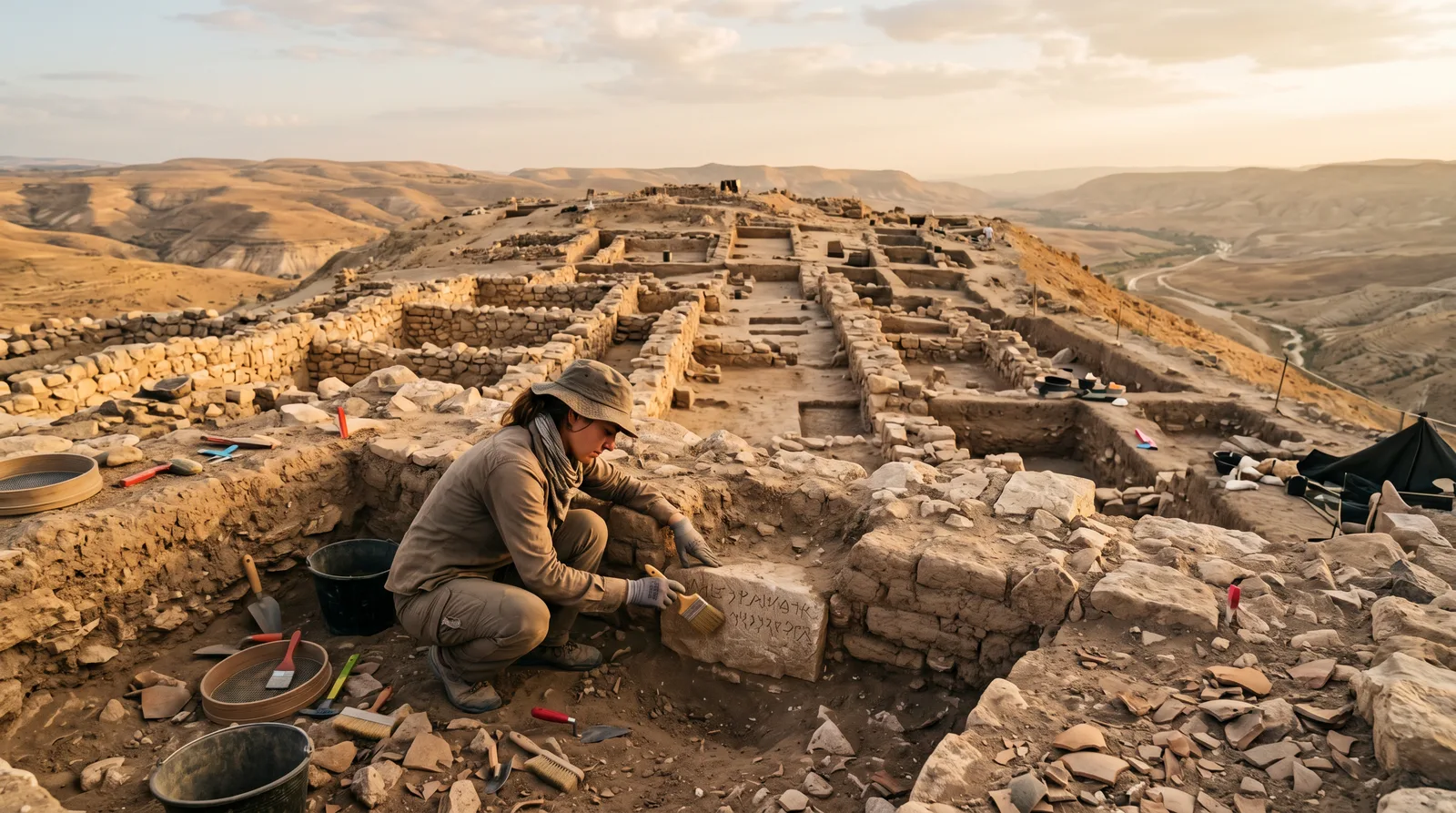
Understand the world that made the Bible
A rigorous, evidence-grounded journey through the history, archaeology, and religion of ancient Israel — from the Bronze Age villages of Canaan to the theological revolution of the Exile, taught the way it deserves to be: without shortcuts.
"The Bible becomes a more extraordinary document the more honestly you reckon with the world that made it — and that reckoning is exactly what we're here to do."— Carla Paton
What you'll learn
What you'll be able to do
- Trace the emergence of Israelite identity from Late Bronze Age Canaan through the Iron Age, situating it within the broader ancient Near Eastern world.
- Analyze the rise, consolidation, and collapse of the united and divided monarchies of Israel and Judah using both textual and archaeological evidence.
- Describe the social structures, family life, economy, and daily material culture of ancient Israelite society.
- Explain the development of Israelite religion — from early polytheistic and henotheistic practices to the emergence of biblical monotheism.
- Interpret key portions of the Hebrew Bible as historical documents, understanding their literary genres, compositional contexts, and theological agendas.
- Engage critically with primary sources such as the Mesha Stele, Lachish Letters, and Elephantine Papyri alongside the biblical narrative.
How it works
A school that adapts to you
This isn't a set of static videos. Every lesson is generated live and tuned to where you actually are.
We learn your level
A quick placement check tailors your starting point so you're never bored or lost.
Lessons adapt as you go
Each lesson is written for your pace and your goal, adjusting as your skills grow.
Your AI coach keeps you moving
Checkpoints, feedback, and gentle nudges turn progress into a real result.
The curriculum
What's inside your school
6 modules · 28 lessons

The Ancient Near Eastern World and the Problem of Israelite Origins
Establishes the geographical, cultural, and historiographical foundations students need before engaging the question of where Israel came from.
- 1.1The Lay of the Land: Geography, Ecology, and the Ancient Near EastIncluded
- 1.2Sources and Methods: Archaeology, Texts, and the Hebrew BibleIncluded
- 1.3Late Bronze Age Canaan: City-States, Empires, and Canaanite CultureIncluded
- 1.4Who Were the Early Israelites? Theories of EmergenceIncluded
- 1.5Iron Age I: Material Culture and the Formation of Israelite IdentityIncluded
Tribes, Judges, and the Road to Monarchy
Traces Israelite society from its pre-state, tribal organization through the political and religious pressures that produced the monarchy.
- 2.1Tribal Society and the Period of the JudgesIncluded
- 2.2The Philistines and External Pressure on Early IsraelIncluded
- 2.3Samuel, Saul, and the Contested Birth of KingshipIncluded
- 2.4Reading the Book of Judges Historically: Genre, Rhetoric, and MemoryIncluded
The United Monarchy: David, Solomon, and Their Contested Legacy
Investigates the reign of David and Solomon — their political achievements, the archaeological debate, and their towering legacy in biblical tradition.
- 3.1David: Outlaw, King, and Literary IconIncluded
- 3.2The Tel Dan Inscription and the House of DavidIncluded
- 3.3Solomon's Kingdom: Temple, Trade, and Imperial AmbitionIncluded
- 3.4The 'Low Chronology' Debate: How Big Was the United Monarchy?Included
- 3.5The Jerusalem Temple: Architecture, Symbolism, and TheologyIncluded
The Divided Kingdoms: Israel and Judah from Schism to Exile
Follows the two kingdoms through political rivalry, Assyrian and Babylonian imperial pressure, and ultimate collapse, integrating textual and archaeological evidence at every turn.
- 4.1Schism and Rivalry: The Northern Kingdom of IsraelIncluded
- 4.2The Mesha Stele: Reading a Royal Inscription Against the BibleIncluded
- 4.3Assyria, the Fall of Samaria, and the Fate of the Ten TribesIncluded
- 4.4Judah Alone: Hezekiah, Josiah, and the Reform MovementsIncluded
- 4.5The Lachish Letters, Babylon, and the Destruction of JerusalemIncluded
Society, Family, and Daily Life in Ancient Israel
Reconstructs the lived experience of ordinary Israelites — their households, economies, gender roles, and material world — beneath the level of royal politics.
- 5.1The Israelite Household: Kinship, Land, and the Beit AvIncluded
- 5.2Agriculture, Pastoralism, and the Village EconomyIncluded
- 5.3Women, Gender, and Power in Ancient IsraelIncluded
- 5.4Literacy, Scribal Culture, and the Composition of the BibleIncluded
Israelite Religion: From Canaanite Roots to Biblical Monotheism
Traces the long, contested development of Israelite religion from early polytheistic and henotheistic practices through the emergence of exclusive Yahwism and biblical monotheism.
- 6.1El, Baal, and Yahweh: Israelite Religion in Its Canaanite ContextIncluded
- 6.2Asherah, Household Gods, and Popular ReligionIncluded
- 6.3Priests, Prophets, and the Official CultIncluded
- 6.4The Rise of Monotheism: Exile, Deutero-Isaiah, and the Theological RevolutionIncluded
- 6.5The Elephantine Papyri: A Jewish Colony and Its GodsIncluded
Who it's for
Is this you?

Serious Bible readers
You know the text well and sense there is a historical and cultural world beneath it that your reading has never fully reached.

Seminary students
You need rigorous grounding in historical-critical method and ancient Near Eastern context to complement your theological training.

Ancient history enthusiasts
You are drawn to Bronze Age empires, Iron Age cultures, and the civilizations of the Levant — and Israel belongs in that picture.

Archaeology followers
Sites like Megiddo, Lachish, and Tel Dan are on your radar, and you want to understand what the digs actually reveal about Israelite society.

Theology & religion students
You are tracing how Israelite religion developed from Canaanite polytheism through to biblical monotheism and need the historical evidence to do it properly.

Lifelong learners
You are a curious, intellectually serious adult who wants university-level engagement with ancient Israel without having to enroll in a degree program.
Questions
Frequently asked
Your teacher
A note from your teacher

Carla Paton
If you have spent time with the Hebrew Bible — whether in a sanctuary, a seminary classroom, or simply on your own — you have probably had the experience of sensing that there is more beneath the surface than you know how to reach. The names, the places, the political conflicts, the strange religious practices: they gesture toward a world that is almost within grasp but keeps slipping away. That gap between the text and its world is exactly what this school is designed to close.
I have spent my academic life working at the intersection of ancient Near Eastern history, biblical archaeology, and the study of Israelite religion. What I have come to believe, deeply, is that the Hebrew Bible is a more interesting document when you understand the world that produced it — not less interesting, not more troubling, but genuinely richer. When you know what a royal inscription like the Mesha Stele is doing, and you read it alongside 2 Kings, something clicks into place. When you understand the archaeology of an Iron Age Israelite village — the four-room house, the grain storage pits, the household figurines — the social world behind Amos and Micah and Ruth suddenly has texture and weight. That is what I want to give you.
This school does not offer easy answers, because the field does not have them. The debates about Israelite origins, about the historicity of the united monarchy, about when and why monotheism emerged — these are live questions, argued at conferences and in journal pages, and I would rather walk you through the actual arguments than hand you a tidy summary that flattens the complexity. My commitment is to give you the tools to think historically: to read texts critically, to interpret material culture, to weigh competing theories against the evidence. These are skills, and like all skills, they become your own.
What I can promise is that nothing will be dumbed down, and nothing will be off-limits. Whether you are a lifelong churchgoer who has never encountered critical scholarship, a seminary student looking for deeper historical grounding, or a history enthusiast who has always been curious about the ancient Near East, you will be treated as an intelligent adult who is capable of handling real complexity. That is the only way I know how to teach.
I hope you will join me. The world of ancient Israel is one of the most fascinating civilizations the ancient Near East produced — and the evidence, when you learn to read it, is waiting to speak for itself.
— Carla Paton
Start your journey today
Join get instant access — learn at your own pace with an AI coach in your corner.
$19/mo
Recurring billing · cancel anytime
Secure checkout · Instant access
- 6 modules, 28 lessons
- AI-adaptive lessons tuned to your level
- Quizzes & checkpoints to lock in progress
- Your own AI learning coach
- Learn on any device, at your pace
- Full access for as long as you're subscribed