Score a 4 or 5 on AP® Bio — without drowning in a textbook
Pass Faster AI zeroes in on the exact concepts, question patterns, and free-response moves College Board actually tests — so every study minute moves your score forward, not sideways.

"The AP® Biology exam is completely learnable once you stop studying everything and start studying what actually shows up — that's the only thing I teach."— Leigh Baumann

What you'll learn
What you'll be able to do
- Accurately interpret AP® Biology data tables, graphs, and experimental setups to answer free-response and multiple-choice questions with confidence
- Apply core biological principles — from macromolecule structure to ecosystem dynamics — to novel, unfamiliar scenarios exactly as the AP® exam demands
- Design and critique controlled experiments using proper AP® scientific reasoning conventions, including identifying variables, controls, and sources of error
- Write high-scoring free-response answers using a structured, point-targeting approach aligned to College Board rubrics
- Diagnose and close personal knowledge gaps across all 8 AP® Biology units through adaptive mastery quizzes and spaced repetition
- Sit a full-length, timed AP® Biology practice exam under authentic College Board conditions and receive unit-by-unit performance feedback with targeted remediation
How it works
A school that adapts to you
This isn't a set of static videos. Every lesson is generated live and tuned to where you actually are.
We learn your level
A quick placement check tailors your starting point so you're never bored or lost.
Lessons adapt as you go
Each lesson is written for your pace and your goal, adjusting as your skills grow.
Your AI coach keeps you moving
Checkpoints, feedback, and gentle nudges turn progress into a real result.
The curriculum
What's inside your school
6 modules · 17 lessons

Diagnostic & Personalized Roadmap Setup
Students begin by experiencing the real structure and timing of the AP® Biology exam before taking a full diagnostic assessment that mirrors official College Board conditions. Results are analyzed to generate a personalized study roadmap that prioritizes the highest-impact gaps across all 8 units, skill types (conceptual understanding, data analysis, experimental reasoning), and question formats (MCQ and FRQ). This module is intentionally placed first so every subsequent lesson is driven by evidence — not guesswork. No content knowledge is assumed at this stage; the goal is calibration and orientation.
- 1.1How the AP® Biology Exam Actually WorksIncluded
- 1.2AP® Biology Diagnostic ExamIncluded
Chemistry of Life & Cell Structure
This is the essential prerequisite module for all biological content that follows. Students cannot meaningfully interpret enzyme kinetics graphs, membrane transport experiments, or signal transduction pathways without first understanding the molecular foundation of life. The module moves from atoms and water through macromolecules, then into cell structure and communication — following the exact bottom-up logic of College Board Unit 1 and Unit 2. AP® exam questions in this area frequently embed chemistry concepts inside experimental data scenarios, so every lesson pairs conceptual understanding with graph and data-table interpretation from the start.
- 2.1Biological Macromolecules — Structure Dictates FunctionIncluded
- 2.2Membrane Transport & Cell OrganellesIncluded
- 2.3Cell Communication & Signal TransductionIncluded
Cellular Energetics & the Cell Cycle
Energy transformation is the engine of all biological processes, and the AP® exam tests it heavily through graphs, experimental data, and metabolic pathway questions. This module builds from photosynthesis through cellular respiration — establishing energy currency (ATP) and its production mechanisms — before transitioning to the cell cycle, which depends on that energetic foundation. Mitosis and meiosis are placed here (rather than in the Heredity module) because they are mechanistic processes rooted in cell biology, while genetic outcomes of meiosis are revisited in the Heredity module. Cell cycle regulation and cancer are included because they are direct extensions of mitosis signaling and represent a high-yield AP® topic.
- 3.1Photosynthesis — Inputs, Outputs, and Experimental InterpretationIncluded
- 3.2Cellular Respiration — Connecting Metabolism to ATP YieldIncluded
- 3.3Mitosis, Meiosis & Cell Cycle RegulationIncluded
Heredity, Gene Expression & Biotechnology
This module covers the flow of genetic information from DNA replication through gene expression, inheritance patterns, and the biotechnology tools used to analyze and manipulate DNA — all of which the AP® exam tests heavily. Mendelian and non-Mendelian genetics are established first because they require the meiosis foundation from the previous module. Gene expression (replication, transcription, translation) follows because it explains how inherited alleles are converted into traits. Biotechnology tools are placed last because they are applied applications of gene expression knowledge, and AP® questions about PCR, gel electrophoresis, and CRISPR require understanding what DNA, RNA, and proteins are before they can be meaningfully interpreted.
- 4.1Mendelian Genetics & Non-Mendelian Inheritance PatternsIncluded
- 4.2DNA Replication, Transcription & TranslationIncluded
- 4.3Biotechnology — PCR, Gel Electrophoresis & CRISPR ApplicationsIncluded
Evolution, Ecology & Population Dynamics
This module covers the broadest conceptual territory of the course — from the molecular evidence for evolution through population genetics, species interactions, ecosystem energy flow, and global biodiversity. It is placed after all cellular and molecular content because AP® evolution and ecology questions frequently embed molecular, genetic, and cellular concepts (e.g., 'a mutation in this gene increases fitness — explain the evolutionary consequence'). The module moves from mechanisms of evolution → evidence → population genetics → ecology, which mirrors the AP® exam's own conceptual scaffolding and ensures Hardy-Weinberg calculations build on the allele and genotype understanding established in the Heredity module.
- 5.1Natural Selection, Evidence for Evolution & PhylogeneticsIncluded
- 5.2Population Genetics & Hardy-Weinberg EquilibriumIncluded
- 5.3Ecosystem Dynamics, Energy Flow & Population ModelsIncluded
AP® Exam Mastery — FRQ Writing, Scientific Reasoning & Full Practice Exam
Every content concept has now been established. This final module shifts entirely to exam execution — the skill of converting biological knowledge into AP® points under real exam conditions. Scientific reasoning and experimental design are addressed before FRQ writing because students need the reasoning framework before they can write high-scoring responses about experiments. The full practice exam closes the course so that performance data is maximally meaningful (students have completed all content) and targeted remediation addresses genuine, post-instruction gaps rather than simply incomplete preparation.
- 6.1Scientific Reasoning & Experimental DesignIncluded
- 6.2FRQ Mastery — The Point-Targeting Writing SystemIncluded
- 6.3Full-Length Practice Exam & Targeted RemediationIncluded
Who it's for
Is this you?

The Self-Studier
Taking AP® Bio without a classroom course and needs a structured, complete roadmap that covers every testable unit from the ground up.

The Score Booster
Already enrolled in AP® Bio but scoring in the 2–3 range on practice tests and wants targeted help closing the gap to a 4 or 5.

The Last-Minute Prepper
Exam is weeks away and needs an efficient, high-impact study sprint — no time for textbook rereads, just the concepts and skills that actually move the needle.

The FRQ Struggler
Knows the biology but consistently loses free-response points and needs the Point-Targeting Writing System to turn knowledge into rubric credit.

The Data & Graph Avoider
Freezes up on experiment-based and graph-interpretation questions and wants to build real confidence analyzing AP®-style data before exam day.

The Classroom Supplementer
Has a teacher and a textbook but wants sharper, exam-focused explanations that connect every concept directly to what College Board will test.
Questions
Frequently asked
Your teacher
A note from your teacher
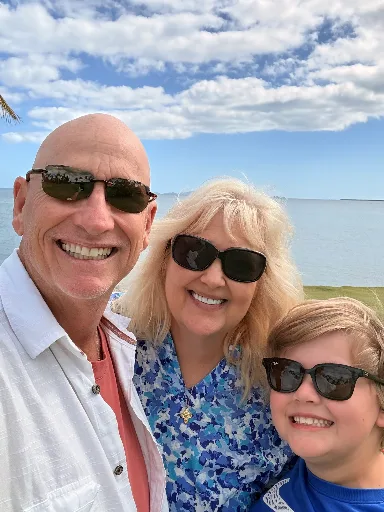
Leigh Baumann
Hey — if you're here, there's a good chance you've already spent more time staring at AP® Biology notes than you'd like to admit, and you're still not sure if it's going to be enough. I get it. AP® Bio has a reputation for being overwhelming, and honestly, a lot of the advice out there makes it worse — "just read the textbook," "make flashcards for everything," "go through every past FRQ." That approach burns time and energy you don't have.
Here's what I've learned from digging deep into exactly how this exam works: AP® Biology is not a test of how much biology you've memorized. It's a test of how well you can apply biological thinking to scenarios you've never seen, analyze data College Board puts in front of you, and write answers that hit specific rubric points. Those are learnable skills. And once you see the patterns, the whole exam starts to feel a lot more manageable.
That's why Pass Faster AI is built the way it is. We start with a diagnostic so you're not wasting a single hour on content you already know. Every lesson in this course — from photosynthesis inputs and outputs to Hardy-Weinberg equilibrium to PCR and CRISPR — is taught with one question in mind: what does College Board actually want you to do with this? We connect every concept to real exam question logic, real data interpretation, real experimental design reasoning. Because that's what moves your score.
The FRQ module is something I'm especially proud of. Free-response questions are where students with solid knowledge lose points unnecessarily — not because they don't know the biology, but because they don't know how to write for rubric credit. The Point-Targeting Writing System changes that. You'll finish this course knowing how to read a prompt, structure a response, and capture points deliberately.
I built Pass Faster AI because I believe the exam is fair — if you know what it's actually testing. You don't need to read the whole textbook. You need the right roadmap, sharp explanations, and enough practice reps to make the patterns second nature. That's exactly what's waiting for you inside. Let's get your 4 or 5.
— Leigh Baumann
Start your journey today
Join get instant access — learn at your own pace with an AI coach in your corner.
$29/mo
Recurring billing · cancel anytime
Secure checkout · Instant access
- 6 modules, 17 lessons
- AI-adaptive lessons tuned to your level
- Quizzes & checkpoints to lock in progress
- Your own AI learning coach
- Learn on any device, at your pace
- Full access for as long as you're subscribed