Turn Chemistry Confusion into Exam Confidence
Master every topic on the AQA GCSE Chemistry specification — from moles to organic chemistry — with step-by-step explanations, worked calculations, and exam-technique drills built around the exact mark scheme your examiner uses.

Every mark-scheme answer that feels impossible right now is just a clear explanation you haven't been shown yet — and that's what I'm here for.— Renstay
What you'll learn
What you'll be able to do
- Recall and apply every topic on the AQA GCSE Chemistry specification with confidence
- Write structured, mark-scheme-perfect answers to 4- and 6-mark exam questions
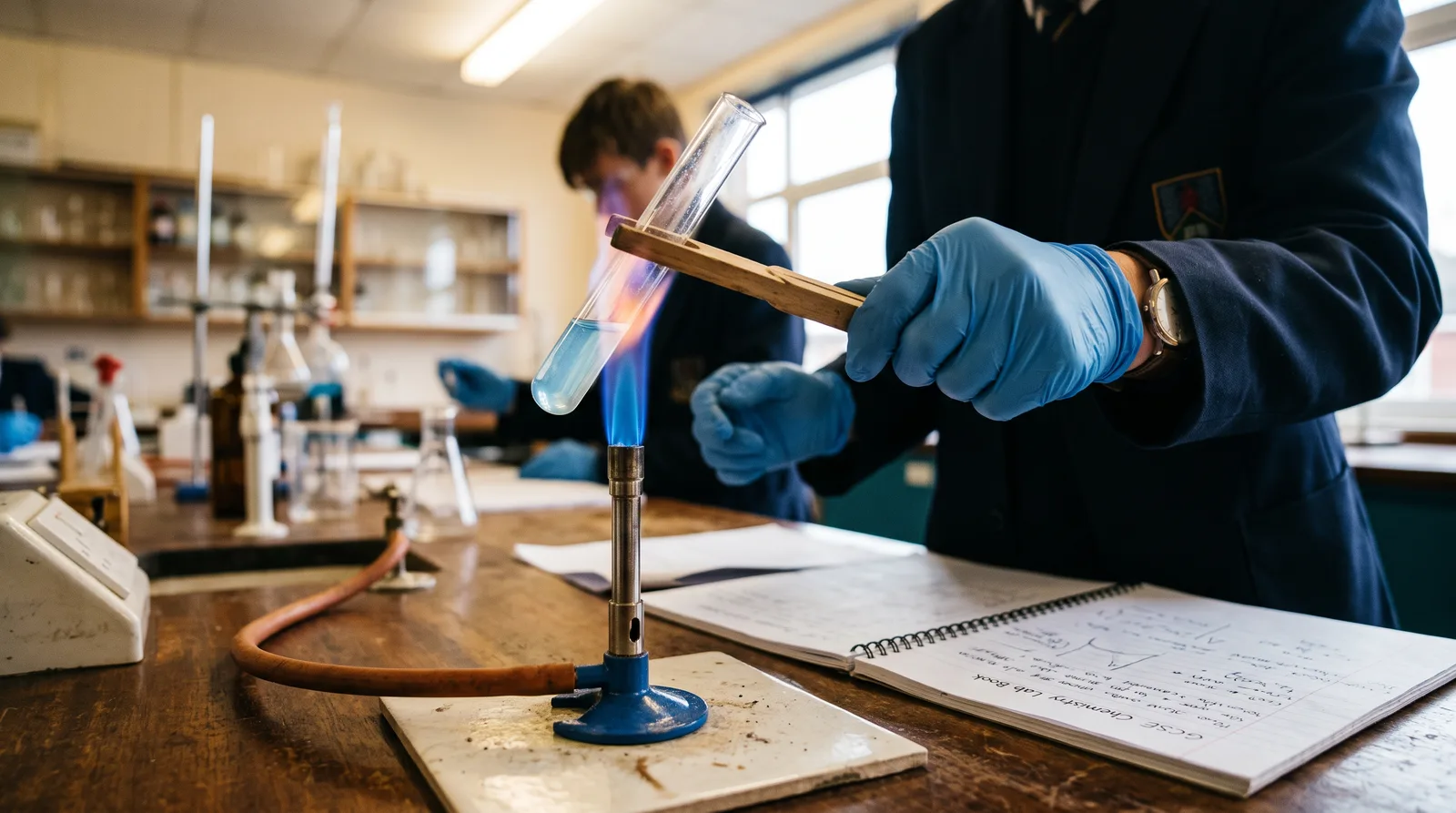
- Perform and check required practical write-ups to the standard expected by AQA examiners
- Accurately calculate moles, concentrations, yields, and other key quantitative chemistry problems
- Explain chemical bonding, atomic structure, and periodic trends using correct scientific language
- Identify and avoid the most common exam mistakes that cost students grade boundaries
How it works
A school that adapts to you
This isn't a set of static videos. Every lesson is generated live and tuned to where you actually are.
We learn your level
A quick placement check tailors your starting point so you're never bored or lost.
Lessons adapt as you go
Each lesson is written for your pace and your goal, adjusting as your skills grow.
Your AI coach keeps you moving
Checkpoints, feedback, and gentle nudges turn progress into a real result.
The curriculum
What's inside your school
6 modules · 30 lessons

Atomic Structure & the Periodic Table
Builds the essential foundation of atomic theory, subatomic particles, electron configuration, and how the periodic table is organised and used.
- 1.1Subatomic Particles & Atomic StructureIncluded
- 1.2Isotopes & Relative Atomic MassIncluded
- 1.3Electron Configuration & Energy LevelsIncluded
- 1.4The Periodic Table: Groups & PeriodsIncluded
- 1.5Properties of Group 1, Group 7 & Group 0Included
Bonding, Structure & Properties of Matter
Covers ionic, covalent, and metallic bonding and directly links bonding type to the physical properties of materials.
- 2.1Ionic Bonding & Giant Ionic StructuresIncluded
- 2.2Covalent Bonding & Simple Molecular StructuresIncluded
- 2.3Giant Covalent Structures & PolymersIncluded
- 2.4Metallic Bonding & Properties of MetalsIncluded
- 2.5Nanoparticles & Their UsesIncluded
Quantitative Chemistry
Develops the calculation skills students need to accurately work with moles, masses, concentrations, yields, and gas volumes.
- 3.1The Mole & Relative Formula MassIncluded
- 3.2Reacting Masses & Mole RatiosIncluded
- 3.3Concentration & Titration CalculationsIncluded
- 3.4Percentage Yield & Atom EconomyIncluded
- 3.5Volumes of Gases (Higher)Included
Chemical Changes, Reactivity & Energy
Explores the reactivity series, acids and bases, electrolysis, and energy changes in chemical reactions.
- 4.1The Reactivity Series & Displacement ReactionsIncluded
- 4.2Acids, Bases & Salt PreparationIncluded
- 4.3Electrolysis: Principles & ProductsIncluded
- 4.4Energy Changes: Exothermic & Endothermic ReactionsIncluded
- 4.5Rates of Reaction & Collision TheoryIncluded
Organic Chemistry & Chemical Analysis
Introduces the key organic chemistry families on the AQA specification and the analytical techniques used to identify substances.
- 5.1Alkanes, Alkenes & Crude OilIncluded
- 5.2Reactions of Alkenes & Addition PolymersIncluded
- 5.3Alcohols, Carboxylic Acids & EstersIncluded
- 5.4Chemical Analysis: Tests for Ions & GasesIncluded
- 5.5Chromatography & Instrumental AnalysisIncluded
Required Practicals, Exam Technique & Grade Boundaries
Consolidates all required practicals to AQA standard and sharpens the exam skills needed to turn knowledge into top marks.
- 6.1Required Practicals MasterclassIncluded
- 6.2Writing 4- & 6-Mark AnswersIncluded
- 6.3Command Words & Question DecodingIncluded
- 6.4Common Exam Mistakes & How to Avoid ThemIncluded
- 6.5Full Paper Practice & Mark-Scheme ReviewIncluded
Who it's for
Is this you?

The Struggling Student
Finds chemistry abstract and overwhelming, and needs patient, step-by-step explanations that make the content finally click.

The Grade-Boundary Chaser
Knows the content reasonably well but loses marks on longer questions and wants sharp exam technique to push into higher grades.

The Maths-Anxious Learner
Dreads the quantitative chemistry questions and needs worked, methodical examples to build real confidence with mole and calculation problems.

The Supportive Parent
Wants to understand what their child is being assessed on so they can give meaningful help at home and spot where extra practice is needed.

The Private Tutor
Needs a specification-aligned, structured resource to anchor sessions and give students consistent, exam-focused practice between meetings.

The Last-Minute Reviser
Exams are approaching fast and needs a focused, no-fluff walkthrough of every AQA topic alongside targeted exam-technique drills.
Questions
Frequently asked
Your teacher
A note from your teacher

Renstay
If you've ever stared at a chemistry question — one you thought you understood — and felt your confidence drain away as soon as you picked up your pen, I want you to know: that feeling is incredibly common, and it's not a sign that chemistry isn't for you. It's usually a sign that the topic was explained in a way that didn't quite click, or that nobody ever showed you how to turn what you know into what the mark scheme is looking for.
That's exactly the gap I built this school to close.
AQA GCSE Chemistry is a subject where the pieces genuinely do connect — atomic structure helps you understand bonding, bonding helps you understand reactions, reactions help you understand organic chemistry — but only if each piece is taught clearly and in the right order. Here, every topic is introduced with a logical explanation, grounded in everyday analogies where they help, and then built up carefully using the precise scientific language AQA examiners expect. We don't skip the hard bits. We just break them down until they make sense.
I pay particular attention to the parts that most students find hardest. Quantitative chemistry — the mole calculations, titration problems, percentage yield, reacting masses — gets a thorough, step-by-step treatment, because these questions reward method and practice above everything else. Required practicals are covered as proper exam content, not an afterthought. And the exam-technique section is something I'm especially proud of: learning to decode a command word, structure a 6-mark answer, and avoid the predictable mistakes that cost grades is a skill in itself, and it's entirely teachable.
Whether you're a student who's starting to panic, one who's quietly aiming for the top grades, or a parent or tutor supporting someone through their GCSEs — you're in the right place. Work through this school steadily and methodically, and I promise the exam will feel like far less of a mystery. Let's get started.
— Renstay
Start your journey today
Join get instant access — learn at your own pace with an AI coach in your corner.
$10/mo
Recurring billing · cancel anytime
Enrolling a child? Sign up as a parent — you'll add your student right here after.
Secure checkout · Instant access
- 6 modules, 30 lessons
- AI-adaptive lessons tuned to your level
- Quizzes & checkpoints to lock in progress
- Your own AI learning coach
- Learn on any device, at your pace
- Full access for as long as you're subscribed