
Master the economics behind Asia's rise
A rigorous, case-driven school for development professionals and serious students — dissecting the real policy decisions, institutional architecture, and growth engines that turned South Korea, Singapore, Vietnam, and beyond into the defining economic story of our era.

"The Asian growth story is the world's most instructive development laboratory — and we're going to take it apart mechanism by mechanism until you can use it."
— Val (Valdas) Samonis
What you'll learn
What you'll be able to do
- Identify and compare the core institutional and policy drivers behind rapid industrialization in Asian tiger and emerging economies.
- Analyze the role of developmental states — from South Korea's chaebol system to Singapore's technocratic governance — as replicable or context-bound models.
- Evaluate how infrastructure investment, export orientation, and human capital formation interact to sustain long-run growth.
- Distinguish why some Asian nations (Vietnam, Bangladesh) have successfully leapfrogged while others have stalled, using specific causal frameworks.
- Apply lessons from Asian development cases to assess growth strategies in other emerging-market contexts.
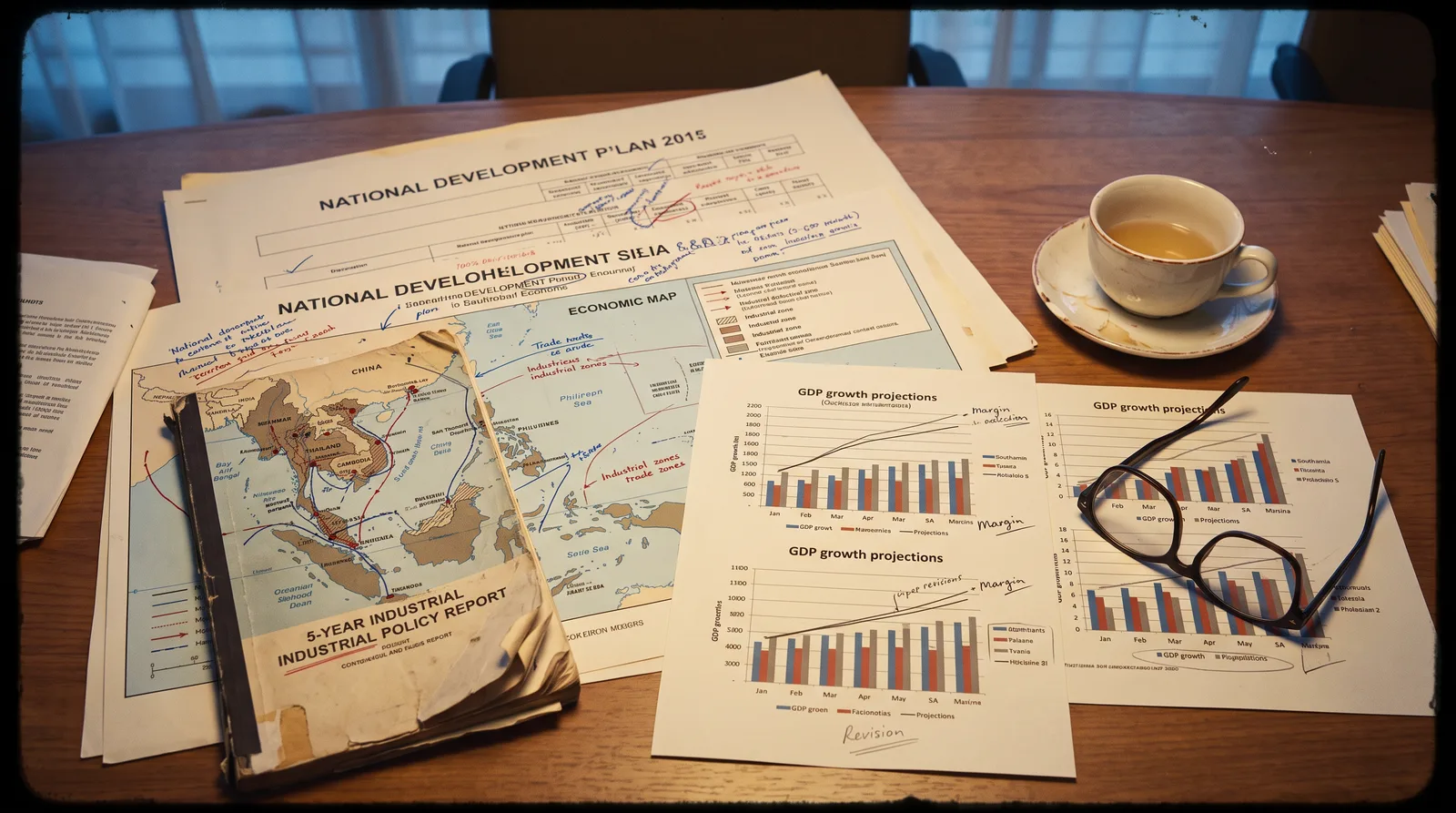
- Critically read and debate primary sources — IMF reports, World Bank data, national development plans — with the analytical fluency of a development economist.
How it works
A school that adapts to you
This isn't a set of static videos. Every lesson is generated live and tuned to where you actually are.
We learn your level
A quick placement check tailors your starting point so you're never bored or lost.
Lessons adapt as you go
Each lesson is written for your pace and your goal, adjusting as your skills grow.
Your AI coach keeps you moving
Checkpoints, feedback, and gentle nudges turn progress into a real result.
The curriculum
What's inside your school
6 modules · 30 lessons

Foundations of Development: Theories, Metrics, and the Asian Puzzle
Establishes the analytical toolkit — growth theory, institutional economics, and key data sources — needed to interrogate Asian development cases rigorously.
- 1.1What Is Development and How Do We Measure It?Included
- 1.2Classical and New Growth Theory: From Solow to Endogenous GrowthIncluded
- 1.3Institutional Economics and the Role of the StateIncluded
- 1.4Reading the Data: IMF Reports, World Bank Indicators, and National Development PlansIncluded
- 1.5The Asian Miracle as Puzzle: Shared Traits and Divergent PathsIncluded
The Developmental State: Models, Mechanisms, and Limits
Examines the developmental state paradigm through East Asia's foundational cases, assessing how state-led capitalism was designed, executed, and constrained.
- 2.1Anatomy of the Developmental State: Johnson's MITI and BeyondIncluded
- 2.2South Korea: Chaebol, Industrial Policy, and Compressed IndustrializationIncluded
- 2.3Taiwan: SME Networks, State Banks, and a Different CapitalismIncluded
- 2.4Singapore: Technocratic Governance, FDI Strategy, and the City-State AdvantageIncluded
- 2.5Is the Developmental State Replicable? Conditions, Critiques, and Context-DependencyIncluded
Infrastructure, Export Orientation, and the Growth Engines of Development
Investigates how physical infrastructure investment, trade policy, and export-led growth strategies have functioned as interlocking engines of sustained development across Asian economies.
- 3.1Export-Led Growth: The Logic, the Evidence, and the CriticsIncluded
- 3.2Infrastructure as Strategy: Roads, Ports, Power, and Digital ConnectivityIncluded
- 3.3China's Infrastructure-Led Model: Belt and Road and Domestic InvestmentIncluded
- 3.4Special Economic Zones: Design, Performance, and Lessons from Shenzhen to Subic BayIncluded
- 3.5Global Value Chains and Asia's Integration into World Production NetworksIncluded
Human Capital, Innovation, and the Shift to Knowledge Economies
Explores how education policy, workforce development, and innovation ecosystems have powered Asia's move up the value chain beyond low-cost manufacturing.
- 4.1Education as Industrial Policy: Lessons from Korea, Japan, and SingaporeIncluded
- 4.2Technological Catch-Up: Licensing, Reverse Engineering, and R&D InvestmentIncluded
- 4.3South Korea and Taiwan's Transition to Innovation-Led GrowthIncluded
- 4.4China's Innovation Ecosystem: From 'Made in China' to 'Invented in China'Included
- 4.5India's IT Sector and the Limits of Services-Led DevelopmentIncluded
Leapfroggers, Latecomers, and the Stalled: Why Some Nations Rise and Others Don't
Applies causal frameworks to explain divergent outcomes across South and Southeast Asia, identifying the conditions that enable leapfrogging versus stagnation.
- 5.1Vietnam's Doi Moi and Manufacturing Surge: A Leapfrog Case StudyIncluded
- 5.2Bangladesh's Garment-Led Industrialization: Fragile Success or Durable Model?Included
- 5.3Why Some Countries Stall: The Middle-Income Trap and Institutional BottlenecksIncluded
- 5.4Myanmar, Cambodia, and the Role of Political Economy in Development OutcomesIncluded
- 5.5Leapfrogging via Technology: Mobile Finance, Digital Infrastructure, and New PathwaysIncluded
Applying Asian Lessons: Synthesis, Transferability, and the Future of Development
Synthesizes course frameworks and debates their transferability to other emerging markets, equipping learners to apply Asian development logic to novel policy contexts.
- 6.1What Asia Teaches the World: Distilling the Core Policy LessonsIncluded
- 6.2Can Africa or Latin America Replicate Asia's Playbook? Conditions and ConstraintsIncluded
- 6.3New Pressures: Climate Change, Demographic Shifts, and the Future of Asian GrowthIncluded
- 6.4Geopolitics, US–China Competition, and the Restructuring of Asian Development PathwaysIncluded
- 6.5Capstone: Designing a Development Strategy — From Evidence to Policy RecommendationIncluded
Who it's for
Is this you?

Development economists
Wants rigorous, case-grounded frameworks to sharpen analytical work on emerging-market growth and institutional reform.

Policy professionals
Works in government or international organizations and needs evidence-based models — not abstractions — to inform real development strategy.

Graduate researchers
Building a dissertation or research agenda on Asian political economy and needs both theoretical depth and command of primary data sources.

International affairs practitioners
Navigates trade, aid, or geopolitical work in the Indo-Pacific and wants a sharper analytical lens on the region's economic architecture.

Emerging-market strategists
Advising on investment or business strategy in Asia and needs to understand the institutional and policy context driving growth trajectories.

Curious intellectuals
Reads widely on history and global affairs and wants to engage with Asia's rise at the level of evidence and causal reasoning, not popular narrative.
Questions
Frequently asked
Your teacher
A note from your teacher

Val (Valdas) Samonis
If you've spent time reading about Asian economic development — the miracle, the tigers, the 'China model' — you've probably noticed that the popular accounts rarely satisfy. They flatten decades of deliberate, contested, often fragile policymaking into a single triumphant arc. And if you work in policy, research, or international affairs, you already know how much that matters: the gap between the narrative and the actual causal mechanism is exactly where bad policy gets made.
That's the gap this school is built to close.
I designed Asian Development Edge for the people who want to move beyond the headline and into the machinery. That means starting where good analysis starts — with theory and measurement. What does development actually mean, and how do we read the data we use to track it? From there, we go deep into the cases that matter: the structural differences between South Korea's chaebol-centered industrial policy and Taiwan's SME-network capitalism; Singapore's FDI strategy and what the city-state model actually requires to function; Vietnam's Doi Moi reforms and why they produced a manufacturing surge rather than the stagnation that followed similar openings elsewhere. We spend real time on infrastructure, export orientation, human capital formation, and innovation ecosystems — not as buzzwords, but as policy levers with specific mechanisms, specific tradeoffs, and specific evidence behind them.
I want to be direct about what this school asks of you. The material is analytically demanding. We read primary sources — IMF reports, World Bank indicators, national development plans — and we read them critically, the way a development economist would. We distinguish between correlation and causation. We name the institutional bottlenecks that explain why some countries stall in the middle-income trap while others leapfrog via mobile finance or digital infrastructure. We take the hard questions seriously: Is the developmental state actually replicable? What does US–China geopolitical competition mean for the next generation of Asian growth? Can the lessons from Shenzhen or Subic Bay translate to sub-Saharan Africa where I worked as an advisor to The African Capacity Building Foundation?
The capstone brings it all together. You'll design a development strategy — from evidence to policy recommendation — the kind of exercise that separates someone who has studied development from someone who can practice it. If that's the level you want to work at, this school is built for you. I'd be glad to have you in the seminar room.
— Val (Valdas) Samonis
Start your journey today
Get instant access — learn at your own pace with an AI coach in your corner.
$79/mo
Recurring billing · cancel anytime
Secure checkout · Instant access
- 6 modules, 30 lessons
- AI-adaptive lessons tuned to your level
- Quizzes & checkpoints to lock in progress
- Your own AI learning coach
- Learn on any device, at your pace
- Full access for as long as you're subscribed