
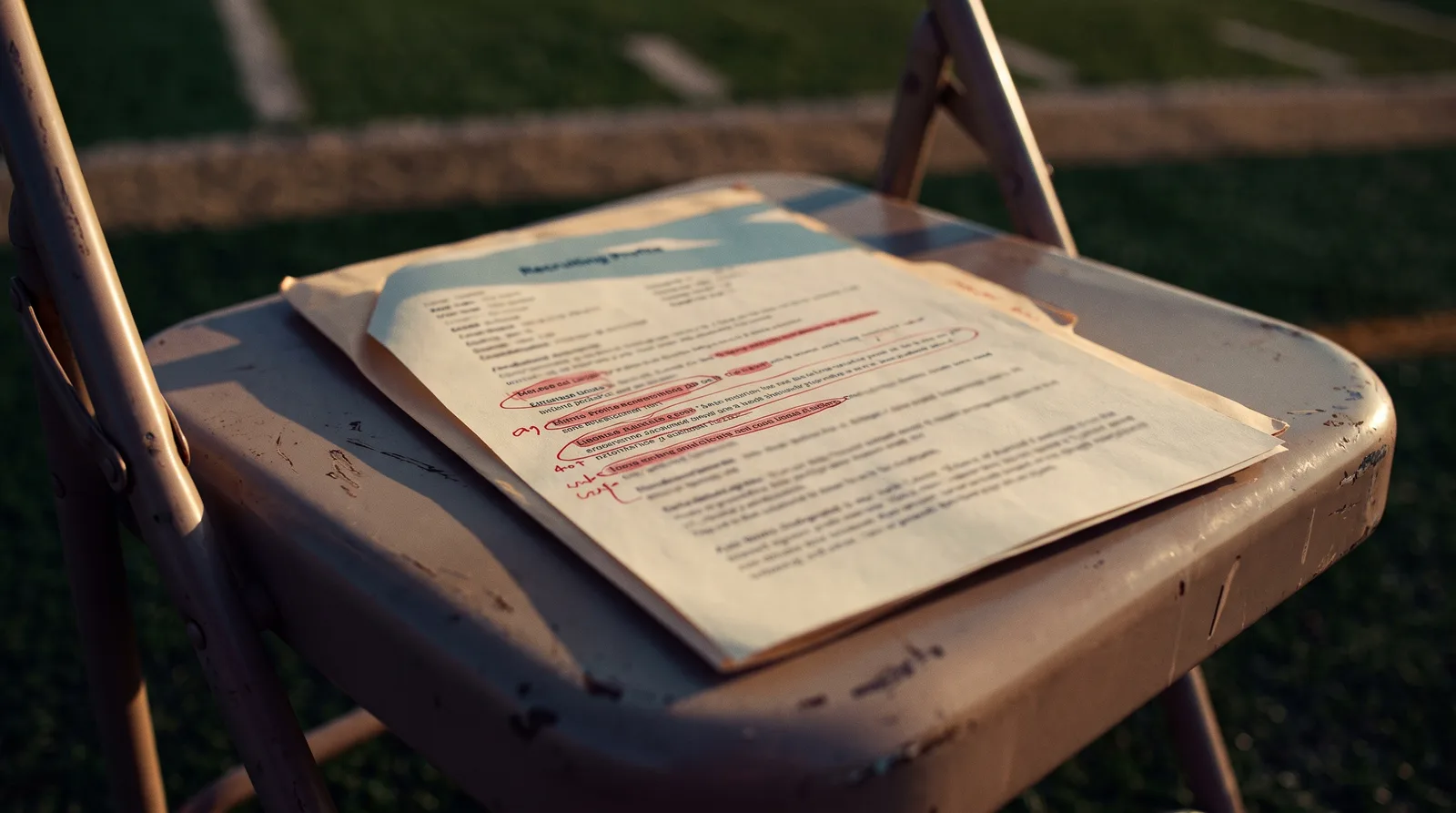
Every college coach I've ever talked to about recruiting says the same thing: they're not short on profiles to look at. They're short on profiles worth looking at.
That's the brutal reality parents need to hear. Your athlete can be genuinely talented and still get completely ignored — not because coaches aren't interested in players like them, but because the profile you submitted looks identical to the 47 others that landed in the same inbox that morning. Same layout. Same vague highlights. Same missing information that forces a coach to do extra homework they don't have time for.
The fix isn't expensive. It's specific. Here's what actually separates a profile that earns a response from one that doesn't.
Lead With the Most Searchable Version of Your Athlete
The very top of the profile needs to answer the three questions a coach asks in the first five seconds: What position? What class year? What are the numbers?
Don't bury this. Don't make it pretty at the expense of making it clear. A coach filtering their board for a 2026 outside linebacker at 6'1", 215 lbs needs to see that combination immediately — or your profile is already gone.
List: position, graduation year, height, weight, 40-yard dash time, and GPA. That's your header. Everything else earns its place below it.
One important note on measurables: only post numbers you can verify. A coach who invites your athlete for a camp visit and clocks a 4.8 when the profile said 4.5 won't just move on — they'll remember the dishonesty. Post your real numbers and let the film do the convincing.
GPA Is Not an Afterthought — Put It Near the Top
A lot of parents list GPA at the bottom of the profile like a footnote. That's backwards. For most college programs, especially at the Division II and Division III level, academic eligibility is the first filter — not the last. A coach who falls in love with your athlete's film and then discovers the GPA isn't there has wasted their time, and they know it.
Put your unweighted GPA, your SAT or ACT score (if you have one worth posting), and your intended major near the top of the profile. This signals to a coach that your family understands how college athletics actually works. That alone sets you apart.
Timestamp Your Film Like a Coach Is Watching It at 1.5x Speed — Because They Are
This is the single most overlooked detail in the entire recruiting process, and it's also the easiest to fix.
When you embed or link your highlight film, include a written breakdown underneath it. Not a paragraph — a list. Timestamp every meaningful clip.
It looks like this:
- 0:08 — Slot fade route, back-shoulder catch in tight coverage, 14-yard gain
- 0:22 — Zone read option, gap recognition, tackles for loss
- 0:41 — Pass rush, swim move off the edge, quarterback pressure
You're doing the coach's job for them. They don't want to scrub through four minutes of film hoping something stands out. When you tell them exactly where to look and what to look for, they look. And when they look, they evaluate. That's all you need — a fair evaluation.
Keep your highlight film under four minutes. Lead with your three or four absolute best plays. Coaches are not going to wade through mediocre reps waiting for the good stuff.
Write a Contact Section That Removes Every Barrier
You'd be surprised how many profiles have no direct email for the athlete, no phone number for a parent, or a social media link that goes to a private account.
Make contact frictionless. List:
- Athlete's direct email
- Parent contact name and phone number
- A public link to extended film (Hudl, YouTube — make sure it's set to "anyone with the link")
- Head coach's name and contact at the current high school
That last one matters more than most parents realize. College coaches will often call the high school coach before they call the family. If you make that easy, you've already moved ahead of athletes who didn't.
Update It — Actively and Consistently
A profile with a junior-year photo and sophomore stats is a red flag. It signals that the family isn't actively in the process, which makes a coach wonder how serious the athlete really is.
Set a reminder to update the profile after every season, after every significant camp performance, and anytime a measurable improves. Add a short "Recent Activity" line near the top: Updated after State Championship game, December 2024 tells a coach this family is engaged and current.
The Profile Is Not the Product — Your Athlete Is
Everything I've walked you through is about removing friction so a college coach can see the real thing clearly. The profile doesn't get your athlete recruited. It gets your athlete noticed — and that's the step most families are stuck on.
Get the profile right, and the conversation can start. That's where everything else begins.
If you want the full system — outreach templates, coach contact strategy, camp selection, and timeline — that's exactly what we build together inside The Exposure Engine. But start here. Get this right first. It matters more than most families know.