
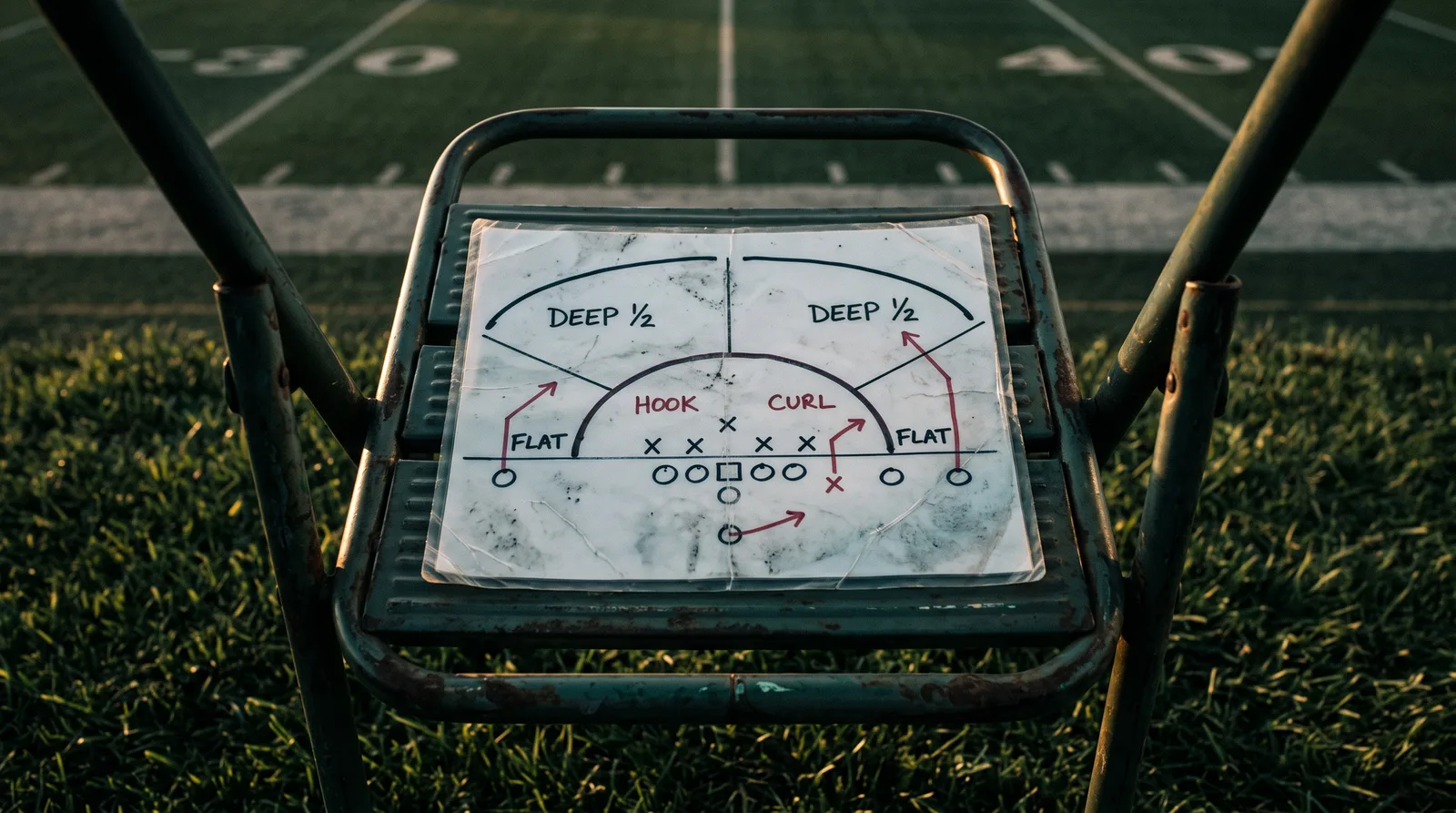
If you've ever heard an announcer say "they're playing Cover 2" and nodded along without really knowing what that means — this post is for you. Whether you're a player trying to read defenses faster, a parent trying to actually follow the game, or an athlete getting ready to study film, understanding Cover 2 is one of the best places to start building real football IQ.
Let's break it down from scratch.
The Big Idea: Dividing the Field Into Zones
Every coverage scheme is built around one question: who is responsible for which part of the field?
Cover 2 answers that question by splitting the deep part of the field into two halves — left and right — and assigning one safety to each half. That's where the name comes from. Two deep safeties. Two deep zones. Nobody is playing man-to-man in a true Cover 2. Everyone has an area of grass to protect.
Picture the field from the back of the end zone looking forward. Now draw a vertical line down the middle of the field. The left safety owns everything deep on the left. The right safety owns everything deep on the right. Simple concept, but the execution gets interesting fast.
Who Is Responsible for What
Here's how all eleven defenders are assigned in a base Cover 2:
Two Safeties (deep halves) Each safety drops back at the snap and takes ownership of the deep half on his side. Their job is to prevent any receiver from getting behind them. They're the last line of defense.
Two Cornerbacks (flat zones) This is the part that surprises most beginners. In Cover 2, the corners do not drop deep — they stay near the line of scrimmage and take the flat zones, which are the short outside areas on each side of the field. When a receiver runs a short out-route or a running back leaks out of the backfield to the sideline, the corner is responsible for that space.
Two Outside Linebackers (curl-to-flat or hook zones) The outside linebackers typically take the area between the flat and the middle of the field — often called the curl zone. They're responsible for receivers who settle in at intermediate depth on the outside.
Middle Linebacker (hook/middle zone) The middle linebacker stays in the middle of the field and takes any crossers, tight ends working across the formation, or shallow routes through the interior.
Defensive Line (four down linemen) Their job is to rush the quarterback and collapse the pocket. The faster they can get to the QB, the less time he has to find the soft spots in the coverage — and there are soft spots, which we'll get to in a second.
The Built-In Weakness: The Seams
No coverage is perfect, and Cover 2 has two well-known vulnerabilities.
The seam routes. Remember that dividing line down the middle of the field? The area just outside the hash marks on each side — where the corner's zone ends and the safety's zone begins — is called the seam. If a receiver (usually a slot or tight end) runs a straight vertical route up that seam, the corner is supposed to pass him off to the safety. But if the corner gets too shallow too fast, or the safety doesn't get his depth quickly enough, that seam is wide open.
The deep middle. Because both safeties are responsible for their individual halves, there's no centerfield defender in a traditional Cover 2. A receiver running a deep post — cutting from the outside hash toward the middle of the field — can split both safeties if the quarterback places the ball perfectly. This is why you'll see offenses run "trips" formations to one side: it forces both safeties to honor one side of the field, opening up the post on the back side.
How Offenses Attack It
When an offense knows they're facing Cover 2, there's a basic game plan: stress the seams and punish the corners.
- Four verticals — sending all four eligible receivers straight downfield forces both safeties to choose. Someone is going to be alone on a seam.
- Corner routes — running a receiver toward the corner of the end zone forces the safety to cover ground laterally, which is hard to do at full speed.
- High-low the flat defender — flood one side of the field with a deep route and a flat route at the same time. The corner can't cover both, and the linebacker has to choose.
Why This Matters Beyond the X's and O's
Understanding Cover 2 isn't just trivia. When a quarterback can identify Cover 2 at the line of scrimmage, he knows before the snap where the defense is soft. When a receiver knows the corner is going to stay shallow, he knows he needs to win vertically off the line. When a running back reads Cover 2, he knows the middle linebacker may be carrying extra responsibility.
Football intelligence compounds. Every concept you learn makes the next one easier to understand — and makes you faster to process what you're seeing in real time.
This is just one coverage, and already you can see how deep the game goes. That's exactly what makes it worth studying.