Read the whole Bible as one story
A rigorous, canonically grounded course that equips you to trace God's single redemptive narrative — from creation to new creation — across every covenant, theme, and testament.

"The coherence of the biblical story is not something you have to defend — it's something you learn to see, and once you do, every passage opens up in a new way."— Carla Paton
What you'll learn
What you'll be able to do
- Distinguish biblical theology from systematic theology and explain the unique methods and questions each discipline asks
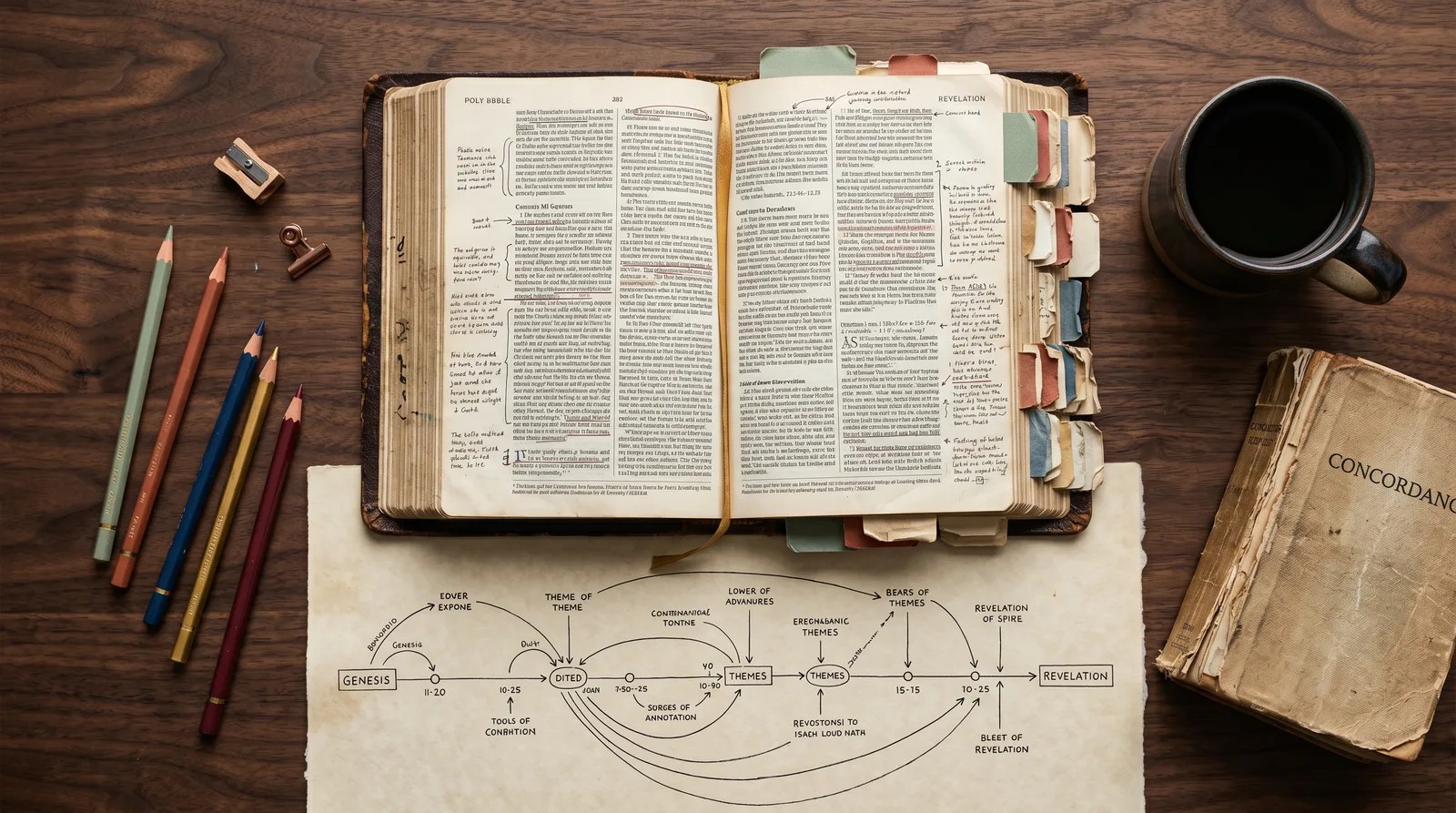
- Trace major biblical themes — covenant, kingdom, temple, sacrifice, exile, and new creation — across both the Old and New Testaments
- Identify how later biblical authors deliberately draw upon, reinterpret, and fulfill earlier texts and traditions
- Place any individual passage within its broader canonical context and explain how it contributes to the overarching redemptive story
- Analyze how the covenants with Noah, Abraham, Moses, David, and the New Covenant relate to and build upon one another
- Articulate a coherent theology of Scripture as a unified yet diverse witness to God's purposes in history
How it works
A school that adapts to you
This isn't a set of static videos. Every lesson is generated live and tuned to where you actually are.
We learn your level
A quick placement check tailors your starting point so you're never bored or lost.
Lessons adapt as you go
Each lesson is written for your pace and your goal, adjusting as your skills grow.
Your AI coach keeps you moving
Checkpoints, feedback, and gentle nudges turn progress into a real result.
The curriculum
What's inside your school
6 modules · 19 lessons

Reading the Bible as One Story
This foundational module establishes the intellectual framework for the entire course. Students are introduced to biblical theology as a discipline — what it is, how it works, and how it differs from other ways of reading Scripture. Before tracing any theme, students must understand the lens through which they will read. The module also introduces intertextuality as a core method, so students can recognize how biblical writers consciously engage earlier texts. Sequenced first because all later modules depend on these conceptual tools.
- 1.1What Is Biblical Theology?Included
- 1.2The Canon as a Unified WholeIncluded
- 1.3Intertextuality: How Biblical Authors Read Each OtherIncluded
Creation, Fall, and the Shape of the Problem
Before students can trace themes of covenant, kingdom, and redemption, they need to understand what the problem is that redemption addresses. This module establishes the theological foundations of the entire biblical story: creation as the original good order that defines what God intends, and the Fall as the disruption that sets the redemptive story in motion. Placed second so that all subsequent covenantal and messianic content is understood as God's response to a clearly defined problem.
- 2.1Creation as Theological FoundationIncluded
- 2.2The Fall and Its Consequences Across ScriptureIncluded
Covenant: The Architecture of Redemption
Covenant is the primary structural framework through which God organizes his redemptive purposes. This module traces the major biblical covenants — Noah, Abraham, Moses, David, and the New Covenant — showing how each builds upon the previous, how each introduces new dimensions of God's saving promise, and how all of them find their fulfillment in Christ. Placed third because students now understand the problem (Fall/exile) that the covenants progressively address. A lesson on the New Covenant is treated as a culminating synthesis rather than a standalone topic, and the Davidic covenant is given its own proper lesson to meet the target outcome requiring analysis of each covenant.
- 3.1Noah and Abraham: Covenant FoundationsIncluded
- 3.2Moses and the Law: Covenant at SinaiIncluded
- 3.3David and the Messianic Promise: The Royal CovenantIncluded
- 3.4The New Covenant: Fulfillment and TransformationIncluded
Kingdom, Temple, and Sacrifice
This module explores three of the most theologically dense and canonically pervasive themes in Scripture: the kingdom of God, the temple as the meeting place of heaven and earth, and sacrifice as the mechanism of atonement and approach to God. These themes are treated together because they are deeply interwoven — the king rules from the temple, and the temple is where sacrifice is offered. Placed after the covenant module because covenantal context is essential for understanding each theme's development, especially the Davidic covenant's relationship to the temple and the Mosaic covenant's relationship to sacrifice.
- 4.1The Kingdom of God Across the CanonIncluded
- 4.2Temple: Where Heaven Meets EarthIncluded
- 4.3Sacrifice and Atonement: From Altar to CrossIncluded
Exile, Return, and the Messianic Hope
Exile is not merely a historical event in Israel's past — it is a theological category that shapes the entire biblical narrative. This module explores exile as the culminating expression of covenant failure and the Fall's consequences, the prophetic response to exile as the seedbed of Israel's deepest hopes, and the Messianic expectation that crystallizes around the figure of the promised king, servant, and son. Placed fifth because students now have the covenantal, royal, and sacrificial foundations needed to understand the prophets' complex interweaving of these themes. A lesson on the return from exile is added as an explicit prerequisite for understanding the Messianic Hope, since the partial return and its disappointment are what sharpens eschatological expectation.
- 5.1Exile as Theological CrisisIncluded
- 5.2Return, Restoration, and Unfulfilled HopeIncluded
- 5.3The Messianic Hope: Reading the Prophets ForwardIncluded
New Creation and the Unified Story
The final module brings the entire course to its culmination. New creation is not merely the last chapter — it is the goal toward which every covenant, king, prophet, temple, and sacrifice has been pointing. This module examines new creation as the eschatological horizon of the biblical story, equips students to place any individual passage within its canonical context, and ends with a synthetic theological reflection on Scripture as a unified yet richly diverse witness. An added lesson on resurrection as the hinge between old and new creation ensures students have the Christological center needed for the final synthesis.
- 6.1Resurrection: The Hinge of the New CreationIncluded
- 6.2New Creation: The Goal of Redemptive HistoryIncluded
- 6.3Reading Any Passage in Canonical ContextIncluded
- 6.4Scripture as Unified Witness: Theological ReflectionIncluded
Who it's for
Is this you?

Committed lay believer
You've read the Bible faithfully for years and are ready to move from familiarity to genuine theological understanding of how it all fits together.

College-age student
You're encountering biblical studies academically for the first time and want a rigorous, intellectually honest framework before you go further.

Small group or Sunday school teacher
You lead others through Scripture regularly and want the canonical depth to teach any passage with greater confidence and theological coherence.

Seminary-curious independent learner
You want seminary-level biblical theology on your own terms — structured, precise, and grounded in the actual text rather than surface-level devotion.

Thoughtful skeptic or seeker
You take the Bible seriously as a historical and literary document and want to understand what its authors were actually claiming across the whole canon.

Pastor or ministry leader
You preach and teach regularly but want a more rigorous, story-shaped biblical theology to ground your exegesis and shape your long-term preaching plan.
Questions
Frequently asked
Your teacher
A note from your teacher

Carla Paton
If you've spent real time in Scripture — reading through it, studying it, even teaching it — and still carry a nagging sense that the pieces haven't fully clicked into place, I want you to know that feeling is not a failure of faith or diligence. It's actually a sign that you are asking the right question. The Bible is not a flat anthology. It has architecture. It has a plot. It builds toward something. And once you learn to see that structure, you cannot unsee it — and you will never read the text the same way again.
That is exactly what this course is designed to do. We are going to trace the single, unfolding story of God's redemptive work from the opening verses of Genesis to the closing vision of Revelation. Not by skimming across the surface, but by going deep into the structural grammar of Scripture itself — the covenants, the recurring themes of kingdom and temple and sacrifice and exile, the deliberate way later biblical writers reach back into earlier texts and transform them. You will learn to read the Bible the way the biblical authors themselves read it.
I want to be honest about what kind of course this is. It is intellectually demanding. We will use precise theological vocabulary — biblical theology, intertextuality, typology, canonical context — because those are the right tools for this work, and I will introduce each one carefully so it becomes genuinely useful rather than just impressive-sounding. We will make arguments, test them against the text, and build a framework step by step. If you come ready to think, you will be well served here.
But rigor is not the same as coldness. I have taught this material because I am personally convinced that the coherence of the biblical story is one of the most compelling things about it — and I want you to feel that. When you see how the New Covenant fulfills and transforms everything that came before it, or how Revelation gathers the entire canon into its final vision, there is a kind of wonder available that is both intellectually satisfying and spiritually significant. I want to get you there.
Whether you are a college student encountering biblical studies for the first time, a lay believer who has read the Bible through multiple times and wants a deeper framework, or a teacher who wants to lead others more confidently through the whole counsel of Scripture — this course was built for you. Come ready to read carefully, think precisely, and be genuinely surprised by how much more there is to see.
— Carla Paton
Start your journey today
Join get instant access — learn at your own pace with an AI coach in your corner.
$19/mo
Recurring billing · cancel anytime
Secure checkout · Instant access
- 6 modules, 19 lessons
- AI-adaptive lessons tuned to your level
- Quizzes & checkpoints to lock in progress
- Your own AI learning coach
- Learn on any device, at your pace
- Full access for as long as you're subscribed