Finally make A&P click
Body Mechanics turns every organ system, cellular process, and anatomical term into something you actually understand — with plain-language lessons, vivid analogies, and clinical context that makes the material stick long after the exam.

Once you understand the logic of a system, the details stop feeling like memorization and start feeling like common sense.— Tracy Burke
What you'll learn
What you'll be able to do
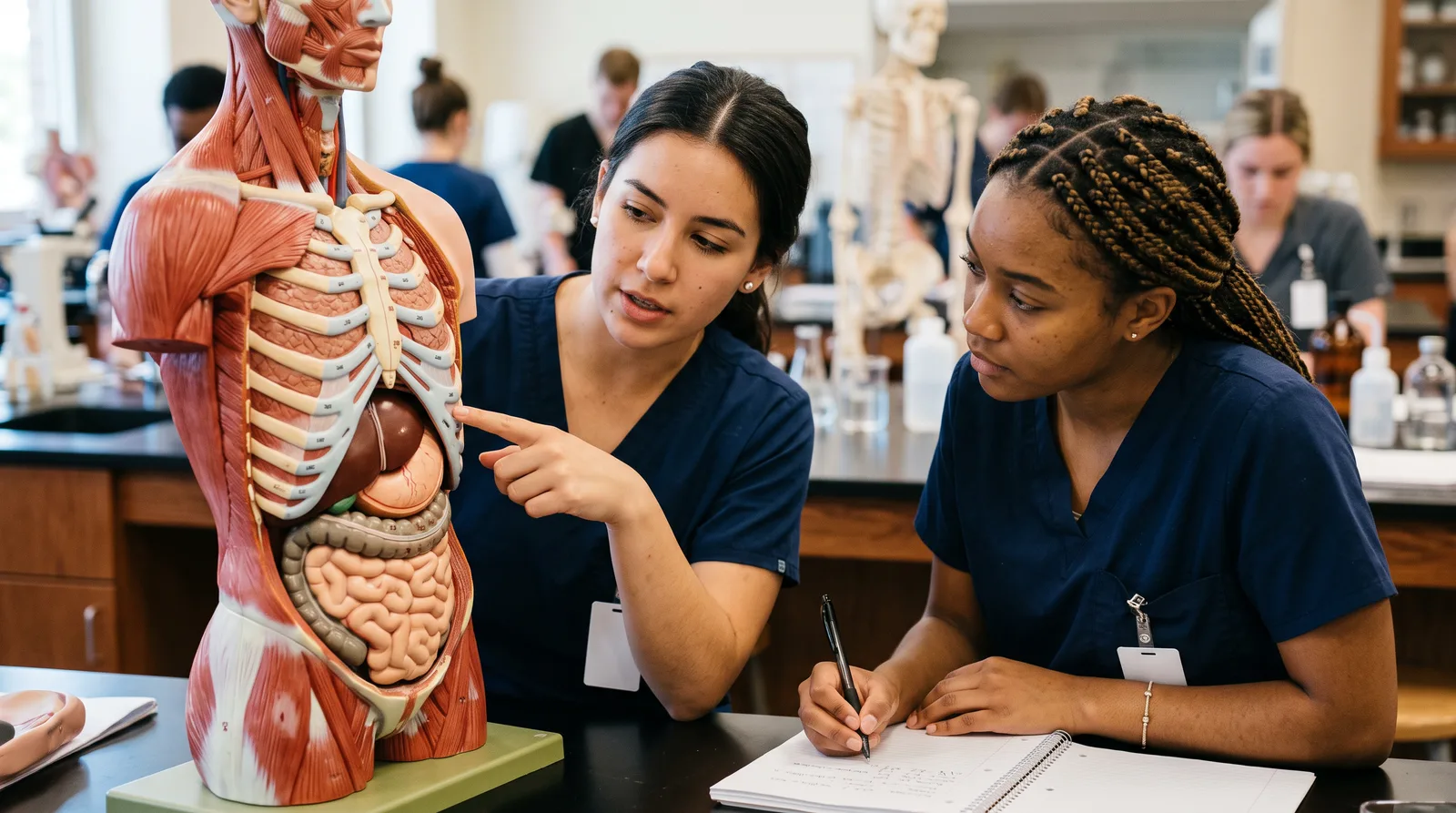
- Identify and describe every major organ system — skeletal, muscular, nervous, cardiovascular, respiratory, digestive, endocrine, and more — and explain how they interact.
- Read and interpret anatomical terminology, directional language, and body-plane diagrams with confidence.
- Trace the physiology of key processes — from a nerve impulse firing to how the heart regulates blood pressure — step by step.
- Apply A&P knowledge to real-world clinical scenarios, such as understanding why a broken femur causes blood loss or how diabetes disrupts homeostasis.
- Prepare effectively for standardized exams (HESI, TEAS, NCLEX prerequisites) using embedded quizzes, mnemonics, and study frameworks.
- Explain how lifestyle factors — exercise, nutrition, stress, and sleep — alter normal physiology at the cellular and systemic level.
How it works
A school that adapts to you
This isn't a set of static videos. Every lesson is generated live and tuned to where you actually are.
We learn your level
A quick placement check tailors your starting point so you're never bored or lost.
Lessons adapt as you go
Each lesson is written for your pace and your goal, adjusting as your skills grow.
Your AI coach keeps you moving
Checkpoints, feedback, and gentle nudges turn progress into a real result.
The curriculum
What's inside your school
6 modules · 30 lessons

Foundations of Anatomy & Physiology
Establishes the language, organizational levels, and core concepts every A&P student must master before studying any body system.
- 1.1The Language of AnatomyIncluded
- 1.2Levels of Structural OrganizationIncluded
- 1.3Homeostasis and Feedback LoopsIncluded
- 1.4Reading Anatomical Diagrams & Body CavitiesIncluded
- 1.5Exam Strategy: Mnemonics & Study Frameworks for A&PIncluded
The Cell & Tissues
Builds a working understanding of cell structure, membrane physiology, cell division, and the four tissue types that form every organ.
- 2.1Cell Structure and Organelle FunctionsIncluded
- 2.2Cell Membrane TransportIncluded
- 2.3Cell Division: Mitosis and MeiosisIncluded
- 2.4The Four Tissue TypesIncluded
- 2.5How Lifestyle Alters Cellular PhysiologyIncluded
The Skeletal & Muscular Systems
Covers bone structure, joint mechanics, and muscle physiology, connecting anatomy directly to movement, injury, and clinical scenarios.
- 3.1Bone Structure, Classification & GrowthIncluded
- 3.2The Axial and Appendicular SkeletonIncluded
- 3.3Joints: Classification and Range of MotionIncluded
- 3.4Skeletal Muscle Microanatomy & the Sliding Filament TheoryIncluded
- 3.5Major Muscles, Movements & Clinical ConnectionsIncluded
The Nervous & Endocrine Systems
Explains how the body's two master control systems — electrical and chemical — generate responses and regulate every organ system.
- 4.1Neuron Anatomy and the Nerve ImpulseIncluded
- 4.2The Central Nervous System: Brain & Spinal CordIncluded
- 4.3The Peripheral & Autonomic Nervous SystemsIncluded
- 4.4Special SensesIncluded
- 4.5Endocrine Glands, Hormones & Feedback RegulationIncluded
The Cardiovascular & Respiratory Systems
Follows blood from the heart through the circulation and into the lungs, linking cardiac physiology and gas exchange to clinical monitoring and disease.
- 5.1Heart Anatomy and the Cardiac CycleIncluded
- 5.2Blood: Composition, Types & ClottingIncluded
- 5.3Blood Vessel Structure & Blood Pressure RegulationIncluded
- 5.4Respiratory Anatomy & the Mechanics of BreathingIncluded
- 5.5Gas Exchange, Transport & Respiratory DisordersIncluded
Digestive, Urinary, Immune, Reproductive & Integumentary Systems
Completes the organ-system survey by covering digestion and metabolism, waste filtration, immune defense, reproduction, and the body's outer barrier.
- 6.1Digestive System Anatomy & Nutrient ProcessingIncluded
- 6.2Metabolism, Energy Balance & Nutritional PhysiologyIncluded
- 6.3The Urinary System & Fluid-Electrolyte BalanceIncluded
- 6.4The Immune System: Innate & Adaptive DefensesIncluded
- 6.5Reproductive Systems & the Integumentary SystemIncluded
Who it's for
Is this you?

Pre-Nursing Students
Building the A&P foundation they need to ace entrance exams and hit the ground running in nursing school.

A&P Re-Takers
A fresh approach — plain language, vivid analogies, and real clinical context — to finally make the material stick the second time around.

Fitness Professionals
Deepening their understanding of musculoskeletal anatomy, cardiovascular physiology, and how exercise changes the body at a cellular level.

Massage Therapists
Gaining the structural and neurological knowledge that makes them more effective, confident, and clinically informed practitioners.
Allied Health Students
From radiography to respiratory therapy, building the organ-system fluency their programs demand from day one.

Curious Adults
No exam, no pressure — just a genuine desire to understand the body they live in, explained clearly and without condescension.
Questions
Frequently asked
Your teacher
A note from your teacher
Tracy Burke
If you've ever stared at an A&P diagram and felt your brain quietly give up — I want you to know that's not a you problem. That's a how it was taught problem.
I've worked with pre-nursing students the night before a HESI, fitness professionals trying to finally understand what's happening inside the clients they train, and curious adults who just want to know how their own body actually works. The struggle is almost always the same: the information exists, but no one ever built a bridge between the jargon and the understanding. So the terminology stays foreign, the systems stay disconnected, and the whole thing feels like memorizing a phone book in a language you don't speak.
Body Mechanics is that bridge. I built this school around one core belief — that if you understand the logic of a system, the details follow naturally. We don't start with 206 bones. We start with why bones are shaped the way they are, what they're actually doing, and what goes wrong when something breaks. We don't introduce the nervous system with a list of brain regions. We trace a single nerve impulse, step by step, until the whole wiring diagram makes sense. Every lesson is written the way I'd explain it to a smart friend sitting across the table from me.
I also know that most of you are learning under pressure — a retake on the line, an entrance exam in twelve weeks, a certification you need to move your career forward. I haven't ignored that. Exam strategy, mnemonics, and clinical connections are built into the curriculum from the start, because understanding the material and being ready to perform on test day are not two separate goals. They're the same goal, approached the right way.
So wherever you're coming from — whether A&P has beaten you up before, or you're walking in fresh and just want to do it right the first time — you belong here. The body is genuinely fascinating once someone helps you see the pattern. That's what I'm here to do. Let's get into it.
— Tracy Burke
Start your journey today
Join get instant access — learn at your own pace with an AI coach in your corner.
$49.99/mo
Recurring billing · cancel anytime
Enrolling a child? Sign up as a parent — you'll add your student right here after.
Secure checkout · Instant access
- 6 modules, 30 lessons
- AI-adaptive lessons tuned to your level
- Quizzes & checkpoints to lock in progress
- Your own AI learning coach
- Learn on any device, at your pace
- Full access for as long as you're subscribed