Give Your Child the Best Start School Can Offer
Bright Foundations Academy is a full K–2 virtual school — not a worksheet packet — where phonics, real math, science inquiry, and social-emotional learning come together in joyful, structured lessons built for every kind of learner, including yours.

Every child I've ever taught has shown me that wonder is the most powerful learning tool there is — so I built an entire school around it.— Pauline Smith EdD
What you'll learn
What you'll be able to do
- Read and comprehend grade-level texts using phonics, fluency, and comprehension strategies aligned to Common Core ELA standards
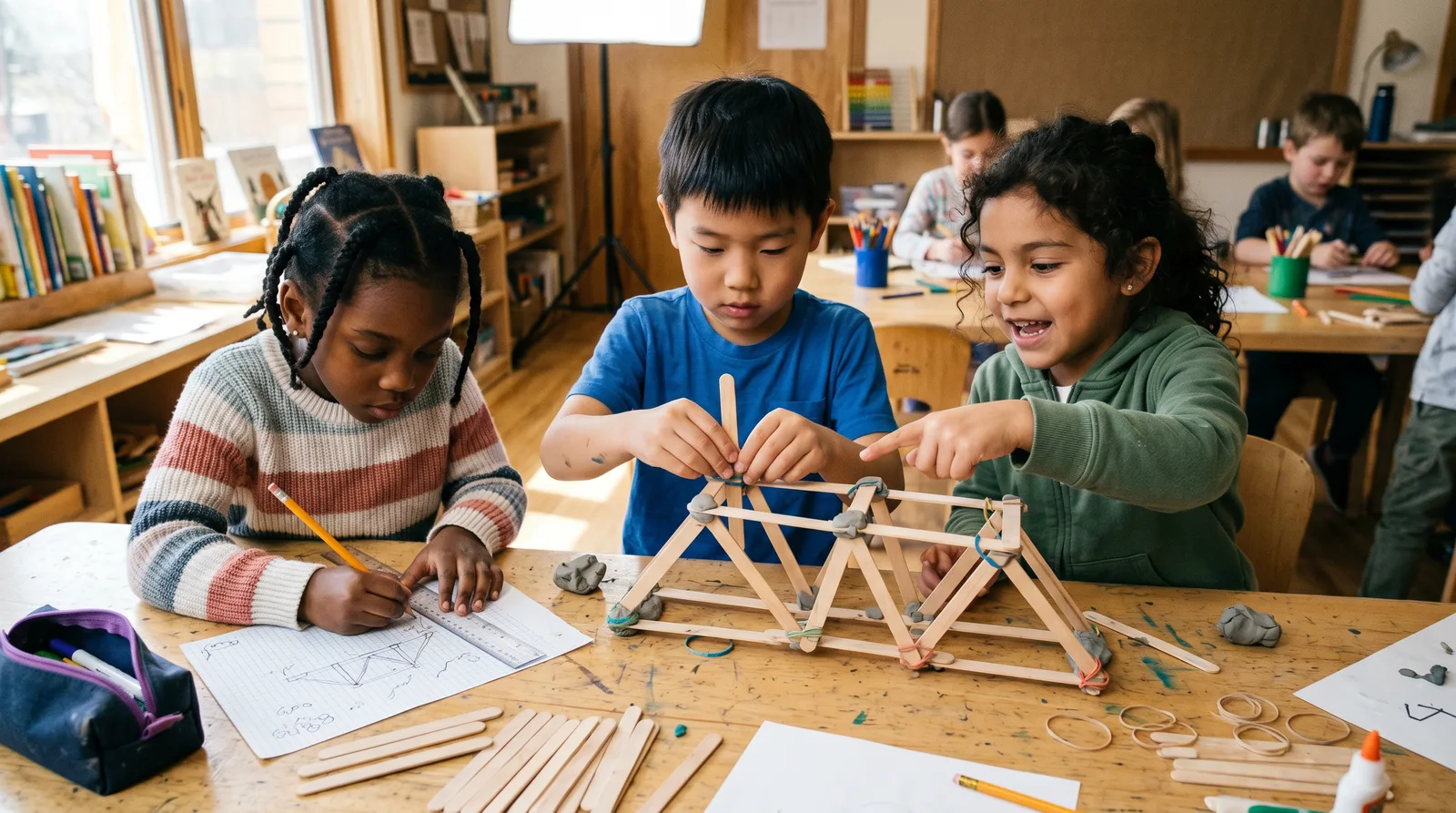
- Solve real-world math problems with confidence by applying the Standards for Mathematical Practice, number sense, and early MESA engineering challenges
- Demonstrate social-emotional self-regulation, empathy, and collaborative communication skills through embedded SEL routines and reflection practices
- Design and present original creative solutions to open-ended problems using the Odyssey of the Mind framework and IB inquiry cycles
- Access and fully participate in every lesson regardless of learning style or ability, thanks to UDL-structured content with multiple means of engagement and expression
- Show measurable grade-level mastery across all core subjects — literacy, math, science, and social studies — in a credit-bearing portfolio ready for school-record transfer
How it works
A school that adapts to you
This isn't a set of static videos. Every lesson is generated live and tuned to where you actually are.
We learn your level
A quick placement check tailors your starting point so you're never bored or lost.
Lessons adapt as you go
Each lesson is written for your pace and your goal, adjusting as your skills grow.
Your AI coach keeps you moving
Checkpoints, feedback, and gentle nudges turn progress into a real result.
The curriculum
What's inside your school
6 modules · 26 lessons
Foundations of Learning: SEL, UDL Routines & IB Learner Identity
This foundational module orients K–2 learners to the virtual school environment before any academic content begins. Students build self-awareness, establish daily emotional check-in habits, discover their personal learning profiles, and learn to navigate the digital tools and family-supported routines that will sustain them across the full 10-month program. Every lesson is UDL-structured with multiple means of representation, engagement, and expression — ensuring universal access from day one. Completing this module first is a deliberate sequencing choice: identity, safety, and routine are prerequisites for academic risk-taking.
- 1.1Who Am I as a Learner? Introducing the IB Learner ProfileIncluded
- 1.2Feelings Are Information: Daily SEL Check-In RoutinesIncluded
- 1.3My UDL Toolkit: Multiple Ways to Learn, Show, and EngageIncluded
- 1.4Setting Up Our Virtual Learning Space: Routines, Schedules & Family RolesIncluded
Literacy Foundations: Phonics, Fluency, Comprehension & IB Inquiry Through Story
This module delivers the full arc of Common Core ELA literacy development for K–2 learners: systematic phonics and phonemic awareness, reading comprehension through IB inquiry cycles, writing and multimodal composition, and fluency with academic vocabulary. Lessons are sequenced from decoding (the prerequisite skill) through comprehension and expression so that each lesson builds directly on the previous one. SEL is embedded through the choice of emotionally resonant texts; UDL is maintained through consistent multi-format options for reading, responding, and composing.
- 2.1Cracking the Code: Systematic Phonics & Phonemic AwarenessIncluded
- 2.2Reading to Wonder: IB Inquiry Cycles Through LiteratureIncluded
- 2.3Writers Are Thinkers: Composition, Voice & Multimodal ExpressionIncluded
- 2.4Fluency, Vocabulary & Reading StaminaIncluded
Mathematical Thinking & Early MESA Engineering: Number Sense to Problem-Solving
This module delivers rigorous, joyful mathematics aligned to CCSS Math K–2 standards and the Standards for Mathematical Practice (SMP), organized to move from foundational number sense through operations, measurement and geometry, and data and algebraic reasoning. MESA engineering mini-challenges are embedded in every lesson to connect mathematical concepts to real-world design problems. Challenge-based and Odyssey of the Mind-style open constraints are woven throughout to develop creative quantitative reasoning. UDL ensures multiple representations (concrete, pictorial, abstract) are always available.
- 3.1Numbers Make Sense: Counting, Cardinality & Place ValueIncluded
- 3.2Operations in Action: Addition, Subtraction & the Story Behind the MathIncluded
- 3.3Measurement, Geometry & the Shape of Our WorldIncluded
- 3.4Data, Patterns & Mathematical ReasoningIncluded
Science as Inquiry: IB PYP Transdisciplinary Science & MESA Challenges
This module was identified as having a critical gap in the original draft: it contained only three lessons, omitting the foundational scientific practices prerequisite (observation, questioning, and fair testing) that students need BEFORE engaging in disciplinary content. A new opening lesson has been added to address this. Students then explore life science, earth science, and physical science through IB transdisciplinary inquiry, Next Generation Science Standards (NGSS) aligned practices, and MESA engineering design challenges. Every investigation uses the same inquiry cycle established in Module 2, creating coherent repetition across subjects.
- 4.1Scientists Ask Questions: Observation, Inquiry & the Scientific MethodIncluded
- 4.2Living Things & Their Habitats: Tuning Into Life ScienceIncluded
- 4.3Earth, Weather & Our EnvironmentIncluded
- 4.4Forces, Motion & Physical Science ExplorationIncluded
Social Studies, Global Citizenship & IB Transdisciplinary Units of Inquiry
This module builds civic identity, geographic literacy, historical thinking, and economic reasoning aligned to National Council for Social Studies (NCSS) standards and IB PYP transdisciplinary themes. Sequencing moves from self and community (most concrete and immediate for K–2 learners) outward to geography, then backward in time to historical thinking, and finally to economics — a deliberately concentric expansion that honors developmental readiness. SEL is embedded throughout as students practice perspective-taking, empathy, and collaborative decision-making. A new prerequisite lesson on Map Skills & Spatial Thinking has been added, as geographic tools are required in Lessons 2 and 3 but were previously untaught.
- 5.1Who Are We? Community, Identity & BelongingIncluded
- 5.2Map Skills & Spatial Thinking: Tools for Exploring Our WorldIncluded
- 5.3How People and Places Shape Each Other: Geography & EnvironmentIncluded
- 5.4Past and Present: Early Historical Thinking & TimelinesIncluded
- 5.5Economics, Needs vs. Wants & Making ChoicesIncluded
Creative Problem-Solving, Innovation & Portfolio Mastery: Odyssey of the Mind, TAG Extensions & Capstone
This capstone module is deliberately sequenced last because it synthesizes every prior module: students draw on their literacy skills to write and present, their math and science skills to engineer and measure, their social studies knowledge to ground their solutions in community context, and their SEL skills to collaborate and persevere. The Odyssey of the Mind long-term problem framework, IB Exhibition-style inquiry, and TAG extensions give the most advanced learners challenge without ceiling, while UDL ensures every student crosses the finish line. A new prerequisite lesson on Collaboration Skills & Teamwork Foundations has been added, as the original draft sent students into group problem-solving without building those skills explicitly.
- 6.1Collaboration Skills & Teamwork FoundationsIncluded
- 6.2The Innovator's Mindset: Creative Problem-Solving Frameworks & Odyssey of the Mind StructuresIncluded
- 6.3The Big Challenge: Interdisciplinary Long-Term Problem DesignIncluded
- 6.4Presenting With Confidence: Oral Communication, Storytelling & Audience AwarenessIncluded
- 6.5Portfolio Assembly, Mastery Evidence & Credit-Bearing GraduationIncluded
Who it's for
Is this you?

The Homeschooling Parent
Ready to graduate from patchwork resources to a full, structured school experience with real credentials and a clear daily framework.
Parent of a Gifted Learner
Their child devours books and bores easily — TAG extensions, IB inquiry cycles, and the Odyssey of the Mind capstone give that big brain somewhere worthy to run.
Caregiver of a Neurodiverse Child
UDL-structured lessons mean every on-ramp, every way of showing mastery, and every routine is already designed with their child's needs built in — not squeezed in as an afterthought.

Rural & Remote Family
Miles from the nearest quality school, they need a rigorous, full-grade-level curriculum that travels with them — this is it.

School-Transfer Planner
Moving mid-year or planning to re-enter traditional school — the credit-bearing portfolio and Common Core alignment mean nothing gets lost in the transition.

Working Guardian Seeking Structure
They need lessons their child can engage with independently or with a co-caregiver — the clear daily routines and jargon-light parent guides make that actually possible.
Questions
Frequently asked
Your teacher
A note from your teacher

Pauline Smith EdD
I see you.
You're sitting at the kitchen table — or in a spare room, or on the couch — trying to figure out how to give your child something that actually feels like school. Not worksheets downloaded at midnight. Not a YouTube playlist you hope is educational. Not the hollow feeling that your little one is somehow missing something every other kid seems to be getting somewhere else.
You want rigor. You want joy. You want your child to light up when they learn — and you want to know it's counting for something.
That's exactly why I built Bright Foundations Academy.
Every lesson in this program was designed from the ground up with the youngest learners at the center — their curiosity, their enormous emotional lives, their wildly different ways of making sense of the world. We open every day with a feelings check-in because a child who knows how to name what's happening inside them is a child who can actually concentrate and connect. We crack the phonics code systematically, because fluent readers become independent thinkers. We do real math — story problems anchored in actual life, geometry found in the shapes of our world, data that tells us something we actually care about. We investigate science the way scientists do: with questions first, observations second, and genuine wonder all the way through.
And when your child reaches our Creative Problem-Solving capstone — designing, building, and presenting an original solution using the Odyssey of the Mind framework — they won't just be showing you what they know. They'll be showing themselves what they're capable of.
Here's what I want you to know about who this program was built for: it was built for the gifted kid who's been quietly bored for two years. It was built for the neurodiverse learner who's never had a lesson designed for them first. It was built for the family three hours from the nearest good school who deserves the same excellent education as anyone else. And it was built for you — the parent who is doing the bravest, most loving thing by refusing to settle for less than your child deserves.
You don't need a teaching degree to guide your child through this. You need this curriculum and a little trust — in the program, and in yourself. I've made the parent-facing guides as clear and warm as I can, because you are a partner in this school, not an afterthought.
Come on in. Your child's adventure starts here.
— Pauline Smith EdD
Start your journey today
Join get instant access — learn at your own pace with an AI coach in your corner.
$200/mo
Recurring billing · cancel anytime
Secure checkout · Instant access
- 6 modules, 26 lessons
- AI-adaptive lessons tuned to your level
- Quizzes & checkpoints to lock in progress
- Your own AI learning coach
- Learn on any device, at your pace
- Full access for as long as you're subscribed