Think like the architect of everything you own
Build Your Empire teaches founders and multi-venture owners how to design layered entity structures — holding companies, operating LLCs, trusts, and intercompany agreements — so your assets are protected, your business is transferable, and your ownership is built to last. No law degree required.

Structure isn't about complexity — it's about intention, and I'll show you exactly how to build yours with both eyes open.
— Dr. Olga Cerafima Gabrielle
What you'll learn
What you'll be able to do
- Design a layered ownership and entity structure — holding companies, operating LLCs, trusts, and management entities — tailored to your ventures, assets, and risk profile
- Distinguish between legal structure and tax classification, and explain how entities like LLCs, S-corps, C-corps, and partnerships differ in ownership, liability, and governance
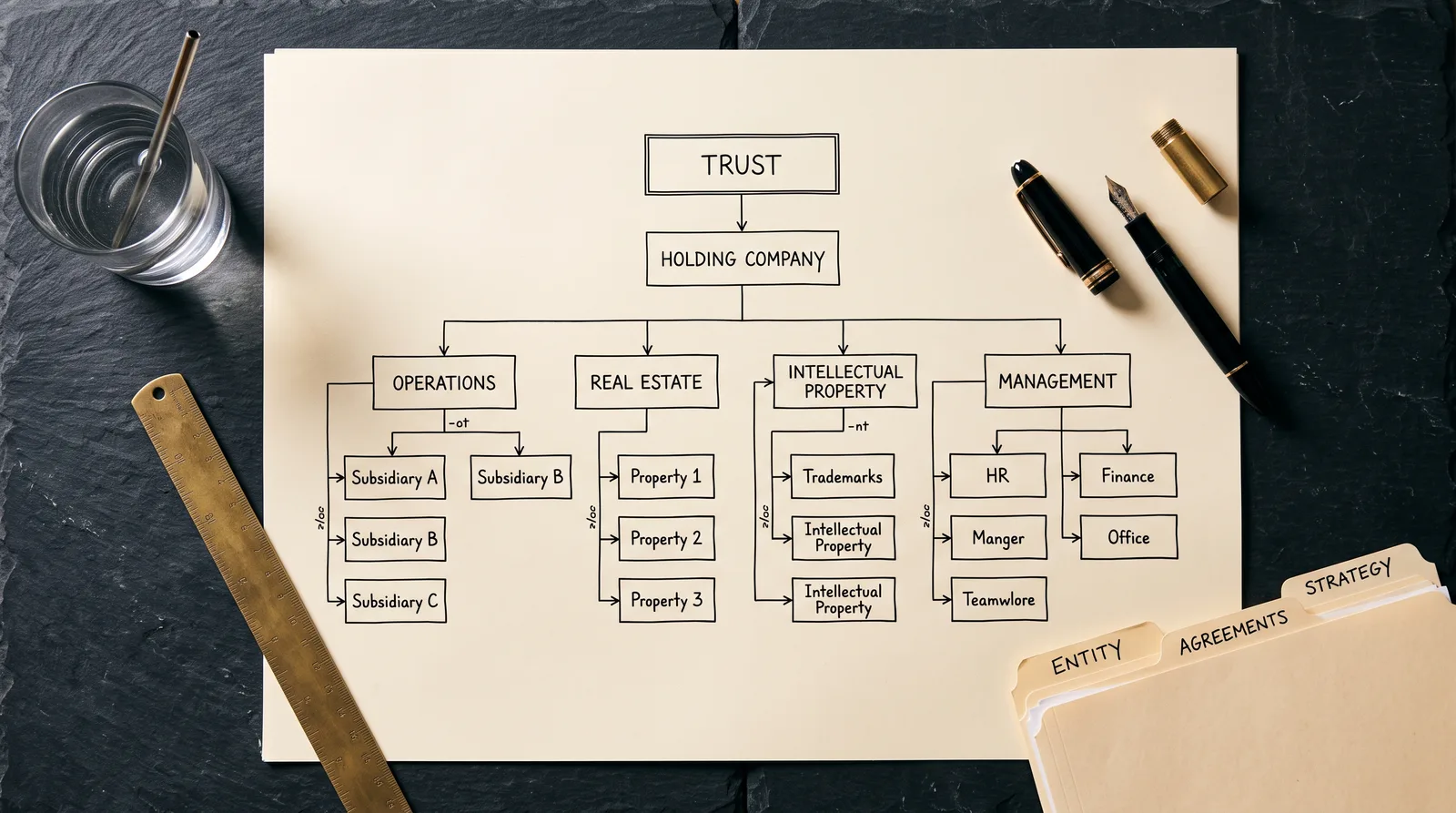
- Separate ventures, real estate, intellectual property, and higher-risk operations into a coherent multi-entity architecture that isolates liability and protects what you've built
- Structure intercompany relationships — management fees, licensing agreements, intercompany loans, and shared services — with proper documentation and clean recordkeeping
- Evaluate your existing entity stack for structural gaps, commingling risks, missing agreements, and governance failures — and build a prioritized remediation plan
- Complete a personalized Empire Architecture Blueprint that maps your current or proposed ownership structure and equips you with an organized set of questions and priorities to bring to your attorney, CPA, and estate-planning team
How it works
A school that adapts to you
This isn't a set of static videos. Every lesson is generated live and tuned to where you actually are.
We learn your level
A quick placement check tailors your starting point so you're never bored or lost.
Lessons adapt as you go
Each lesson is written for your pace and your goal, adjusting as your skills grow.
Your AI coach keeps you moving
Checkpoints, feedback, and gentle nudges turn progress into a real result.
The curriculum
What's inside your school
8 modules · 38 lessons

The Architecture of Ownership
Establishes the foundational mindset shift from operator to owner-architect, covering what ownership really means, how it differs from control, and why structure matters before you need it.
- 1.1Operator vs. Owner: The Mindset ShiftIncluded
- 1.2Ownership vs. Control: How They Separate — and WhyIncluded
- 1.3Why Structure Matters Before You Need ItIncluded
- 1.4The Simplicity Principle: Complexity Is Not SophisticationIncluded
- 1.5How Professionals Fit In: Attorneys, CPAs, and StrategistsIncluded
Entity Fundamentals: The Building Blocks
Covers the core entity types — LLCs, corporations, partnerships, holding companies, and management companies — including how they work, how they differ, and where each fits in a structure.
- 2.1LLCs: Flexibility, Liability, and How They Actually WorkIncluded
- 2.2Corporations: S-Corps, C-Corps, Governance, and OwnershipIncluded
- 2.3Partnerships and Joint Ventures: Shared Ownership StructuresIncluded
- 2.4Legal Structure vs. Tax Classification: Two Separate DecisionsIncluded
- 2.5Holding Companies, Parent Entities, and Management CompaniesIncluded
Trust Fundamentals and Their Role in Ownership
Demystifies trusts — revocable and irrevocable — and explains how they function as ownership, succession, and estate-planning tools within a broader entity architecture.
- 3.1What a Trust Is and How It Holds AssetsIncluded
- 3.2Revocable Living Trusts: Control, Probate, and Incapacity PlanningIncluded
- 3.3Irrevocable Trusts: Asset Protection, Tax Planning, and Trade-OffsIncluded
- 3.4Trusts as the Top of the Ownership StackIncluded
- 3.5Trust Pitfalls, Funding, and When to Involve an Estate AttorneyIncluded
Designing Your Entity Architecture
Teaches students to design a coherent, layered multi-entity structure — separating ventures, assets, intellectual property, real estate, and risk — organized around a central holding or parent entity.
- 4.1Reading an Ownership Map: Layers, Arrows, and Entity RelationshipsIncluded
- 4.2The Holding Company Model: How and Why It WorksIncluded
- 4.3Separating Ventures, Real Estate, and Higher-Risk ActivitiesIncluded
- 4.4Intellectual Property Entities: Ownership, Licensing, and RoyaltiesIncluded
- 4.5Building Your Structure: A Framework for Decisions, Not a Universal BlueprintIncluded
Operations, Intercompany Relationships, and Clean Recordkeeping
Covers how to organize shared services and management entities, properly document intercompany transactions, and maintain the clean records and entity separateness that make structures defensible.
- 5.1Management and Operations Companies: Centralized Services Across EntitiesIncluded
- 5.2Intercompany Transactions: Fees, Loans, Licensing, and ReimbursementsIncluded
- 5.3Contracts and Intercompany Agreements That Hold UpIncluded
- 5.4Banking, Bookkeeping, and the Commingling ProblemIncluded
- 5.5Governance, Compliance, and Maintaining Entity SeparatenessIncluded
Asset Protection, Risk Management, and Liability Separation
Teaches how to use entity structure, insurance, and operational design to isolate and minimize risk across a multi-venture enterprise.
- 6.1How Liability Protection Actually Works — and When It FailsIncluded
- 6.2Mapping Risk Across Your Entity StackIncluded
- 6.3Insurance as a Layer of Protection: What Structure Alone Can't DoIncluded
- 6.4Protecting Intellectual Property Across Your EmpireIncluded
Growth, Investment, and Bringing in Partners
Covers how to structure entities for outside investment or acquisition, bring in partners or co-owners cleanly, and build a structure that supports scale without creating future problems.
- 7.1Bringing in Partners and Co-Owners: Equity, Agreements, and RightsIncluded
- 7.2Raising Investment: How Structure Affects What You Can OfferIncluded
- 7.3Structuring for Acquisition or Sale: What Buyers Actually Look AtIncluded
- 7.4Restructuring an Existing Collection of EntitiesIncluded
Succession, Legacy, and the Empire Architecture Blueprint
Brings everything together by planning for ownership transfer, incapacity, and generational legacy — and completing the personalized Empire Architecture Blueprint students will bring to their professional team.
- 8.1Succession Planning: Who Gets Control When You Can't LeadIncluded
- 8.2Transferring Ownership: Gifting, Selling, and Inheriting Business InterestsIncluded
- 8.3Building a Legacy Structure: Trusts, Entities, and Generational WealthIncluded
- 8.4Auditing Your Current Structure: Gaps, Risks, and PrioritiesIncluded
- 8.5The Empire Architecture Blueprint: Your Personalized Ownership PlanIncluded
Who it's for
Is this you?

The multi-venture founder
You're running two or three businesses simultaneously and realizing your entity stack was assembled, not designed — this school gives you the framework to finally architect it properly.

The real estate operator
You're accumulating properties across multiple LLCs and need to understand how holding structures, liability separation, and trust ownership work together as your portfolio grows.

The established business owner
You've built real value over the years, and now succession, partner transitions, or a potential sale means the structure underneath your business actually matters — urgently.

The early empire builder
You're building your first serious venture with an eye on what comes next, and you want to set up your structure deliberately from the start rather than untangle a mess later.

The IP-driven entrepreneur
You've built brands, content, software, or systems that have real value, and you need to understand how to hold, license, and protect intellectual property across your entity stack.

The legacy-minded owner
You're thinking about what happens to everything you've built — who controls it, how it transfers, and how to structure it so the next generation inherits an asset, not a liability.
Questions
Frequently asked
Your teacher
A note from your teacher

Dr. Olga Cerafima Gabrielle
If you've built something real — a business, a portfolio, a collection of ventures — you already know the feeling I'm describing. You're busy operating, and somewhere in the background there's a structure question you keep meaning to address. An LLC you formed years ago that holds things it probably shouldn't. A partnership with no operating agreement. A trust your estate attorney mentioned once that you never funded. Assets accumulating without a clear map of how they're held or how they'd transfer.
I built this school for owners who are done letting those questions drift. Not because a crisis is imminent, but because you've worked too hard to have the architecture underneath it all be an afterthought.
What I've seen, working through these structures with founders and multi-venture owners, is that the problem is rarely a lack of intelligence or seriousness — it's a lack of a clear framework. Most owners have never had someone walk them through how a holding company actually works, what a trust does at the top of an ownership stack, how intercompany fees and loans need to be documented to hold up, or what a buyer or partner actually looks at when they evaluate your structure. That's what this curriculum does. It gives you the framework, the vocabulary, and the judgment — in plain English, without burying you in jargon or pretending this is simpler than it is.
I want to be clear about what this school is and what it isn't. It's substantive, specific, and grounded in how these structures actually function. It's not a substitute for your attorney, your CPA, or your estate-planning team — and it says so, repeatedly, because I mean it. What it will do is make you a dramatically better client. You'll walk into those conversations knowing what questions to ask, what red flags to look for, and how to evaluate the answers you get. That's worth more than most people realize.
By the time you finish, you'll have a completed Empire Architecture Blueprint — a personalized ownership map, a prioritized list of gaps and risks you've identified, and a clear agenda for your next professional consultation. That document is the point. It turns everything you've learned into a plan that actually moves forward.
If you're ready to stop operating inside your business and start thinking like the architect of everything you own, this is where that shift happens. Come build.
— Dr. Olga Cerafima Gabrielle
Start your journey today
Get instant access — learn at your own pace with an AI coach in your corner.
$97/mo
Recurring billing · cancel anytime
Secure checkout · Instant access
- 8 modules, 38 lessons
- AI-adaptive lessons tuned to your level
- Quizzes & checkpoints to lock in progress
- Your own AI learning coach
- Learn on any device, at your pace
- Full access for as long as you're subscribed