Conquer High School Math 2 — one clear step at a time
Built for California 9th–10th graders, this course walks you through every state-tested topic — from geometry proofs to quadratic equations — with worked examples, plain-English explanations, and the kind of steady "you've got this" support that turns confusion into real confidence.

I wrote every lesson for the student who's convinced they're bad at math — because I know that student just hasn't had it explained the right way yet.— Diana Bruce
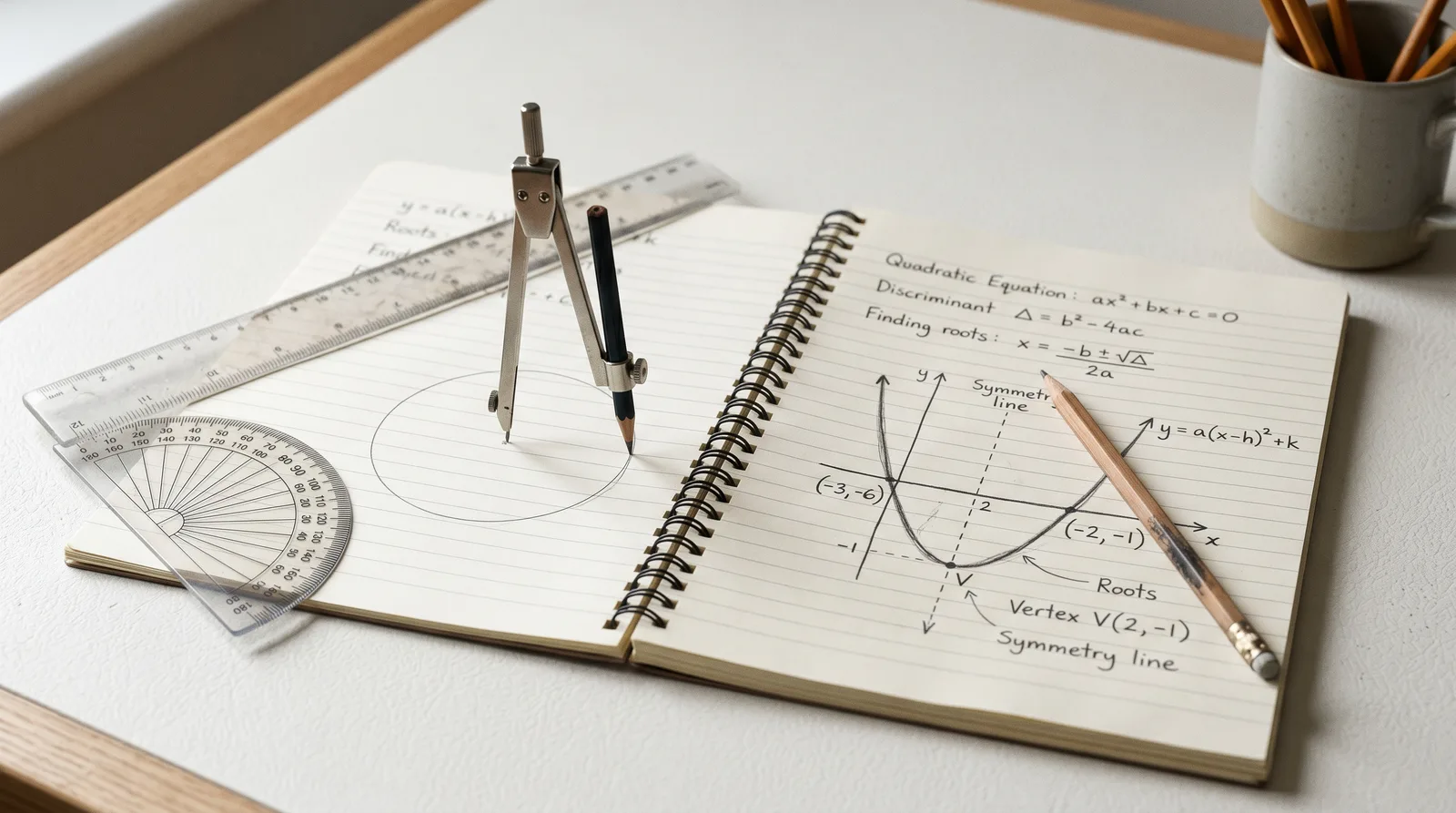
What you'll learn
What you'll be able to do
- Prove and apply theorems about triangles, parallel lines, and circles using formal two-column and paragraph proofs.
- Solve quadratic equations by factoring, completing the square, and the quadratic formula, and interpret their real-world meaning.
- Understand and perform transformations — translations, rotations, reflections, and dilations — on the coordinate plane.
- Apply the Pythagorean Theorem and trigonometric ratios (sine, cosine, tangent) to solve right-triangle problems.
- Analyze and graph quadratic, square-root, and inverse functions, identifying key features like vertex, intercepts, and domain.
- Interpret and calculate probability using conditional probability, two-way tables, and basic counting principles.
How it works
A school that adapts to you
This isn't a set of static videos. Every lesson is generated live and tuned to where you actually are.
We learn your level
A quick placement check tailors your starting point so you're never bored or lost.
Lessons adapt as you go
Each lesson is written for your pace and your goal, adjusting as your skills grow.
Your AI coach keeps you moving
Checkpoints, feedback, and gentle nudges turn progress into a real result.
The curriculum
What's inside your school
6 modules · 25 lessons

Foundations of Geometric Reasoning & Proof
Students build the logical scaffolding required for all formal proof work in the course. Starting from definitions, postulates, and logical connectives, they develop fluency with two-column and paragraph proofs before applying those skills to parallel-line and triangle theorems — ensuring every subsequent geometry module rests on solid deductive reasoning.
- 1.1Logic, Definitions, and the Language of ProofIncluded
- 1.2Parallel Lines, Transversals, and Angle RelationshipsIncluded
- 1.3Triangle Congruence Theorems (SSS, SAS, ASA, AAS, HL)Included
- 1.4Triangle Similarity and Proportionality TheoremsIncluded
Transformations on the Coordinate Plane
Students develop a precise, coordinate-based understanding of the four rigid motions and dilations. The module reinforces congruence (rigid motions preserve size and shape) and similarity (dilations change size but preserve shape), directly connecting to Module 1's congruence and similarity proofs and providing the spatial intuition needed for circle and function graphing later.
- 2.1Translations and ReflectionsIncluded
- 2.2RotationsIncluded
- 2.3Dilations and Scale FactorIncluded
- 2.4Sequences of Transformations and Congruence/SimilarityIncluded
Triangle Theorems, the Pythagorean Theorem & Right-Triangle Trigonometry
Building on the congruence and similarity work of Modules 1–2, students extend their triangle toolkit with advanced theorems, then develop the Pythagorean Theorem and its applications, and finally introduce trigonometric ratios — providing the computational tools needed for real-world measurement and laying the groundwork for the coordinate geometry embedded throughout the course.
- 3.1Advanced Triangle TheoremsIncluded
- 3.2The Pythagorean Theorem, Its Converse, and Special Right TrianglesIncluded
- 3.3Sine, Cosine, and Tangent RatiosIncluded
- 3.4Applying Trigonometric Ratios to Real-World ProblemsIncluded
Circle Theorems and Coordinate Geometry of Circles
Students prove and apply the major theorems about circles — central angles, inscribed angles, chords, tangents, and secants — and then extend to the coordinate plane by deriving and using the equation of a circle. The proof skills from Module 1 are directly applied, and the coordinate work connects to the graphing fluency built throughout the course. (Note: The original draft's Module 4 lacked a coordinate geometry lesson; it has been added here as an essential capstone lesson for this module.)
- 4.1Central Angles, Arcs, and ChordsIncluded
- 4.2Inscribed Angles and Polygon-in-Circle TheoremsIncluded
- 4.3Tangent Lines, Secants, and Their Angle RelationshipsIncluded
- 4.4Equations of Circles on the Coordinate PlaneIncluded
Quadratic Functions, Equations & Their Graphs
Students develop a complete understanding of quadratic functions — graphing in multiple forms, solving by three algebraic methods, connecting solutions to graph features, and interpreting results in context. This module ensures every target outcome related to quadratics is met and sequences from graphical intuition to algebraic skill to real-world application.
- 5.1Graphing Quadratics: Vertex Form and Standard FormIncluded
- 5.2Solving Quadratics by FactoringIncluded
- 5.3Completing the Square and the Quadratic FormulaIncluded
- 5.4Interpreting Quadratics in Real-World ContextsIncluded
Functions Beyond Quadratics & Probability
Students extend their function toolkit to square-root, cube-root, and inverse functions — graphing each, identifying key features, and understanding domain restrictions — then pivot to probability, mastering conditional probability, two-way tables, and counting principles. These two strands complete all six target outcomes for California Math 2. (Note: The original draft grouped these together; they are preserved here but enriched with a prerequisite lesson on function families and key features to ensure a smooth transition from quadratics.)
- 6.1Function Families and Key Features ReviewIncluded
- 6.2Square-Root and Cube-Root FunctionsIncluded
- 6.3Inverse FunctionsIncluded
- 6.4Introduction to Probability and Conditional ProbabilityIncluded
- 6.5Two-Way Tables and Counting PrinciplesIncluded
Who it's for
Is this you?

The Struggling 9th Grader
Falling behind in class and needs step-by-step lessons in plain English to finally get geometry proofs and quadratics to click.

The Ahead-of-the-Curve Sophomore
Wants to preview the full Math 2 curriculum before the semester hits so nothing catches them off guard.

The Supportive Parent
Needs to understand the material well enough to sit down with their teen and actually help — not just say 'ask your teacher.'

The Independent Tutor
Looks for a structured, California-standards-aligned resource to anchor sessions and target each student's exact weak spots.

The Gap-Filler
Passed Math 1 but knows some foundations are shaky, and wants to patch those holes before they snowball in Math 2.

The Test-Prep Student
Has a big unit test or semester exam coming up and needs a clear, organized review of every topic — not the night before, but now.
Questions
Frequently asked
Your teacher
A note from your teacher
Diana Bruce
Hey — I see you.
Maybe you opened your Math 2 syllabus and felt your stomach drop a little. Proofs? Trigonometry? The quadratic formula? That's a lot of words that can feel like a foreign language when you're staring at them for the first time. Or maybe you're a parent watching your teenager get more stressed by the week, wishing you could help but not knowing where to start. Either way, I built this course because that feeling — the "I don't even know what I don't know" feeling — is exactly what good teaching is supposed to fix.
Here's what I know for certain: Math 2 is not actually as chaotic as it looks from the outside. There's a real structure to it. Geometric proof logic flows naturally into triangle theorems, which connect to trig ratios, which connect to the coordinate plane — and once you can see those connections, the whole course clicks into place. Every single lesson in Master Math 2 is designed to show you that structure clearly, using plain language, worked examples you can follow step by step, and explanations that never skip the "but why does this work?" part.
I didn't write this course to impress math teachers. I wrote it for a 14-year-old sitting at a kitchen table at 9 p.m. who needs something to actually make sense. That means no intimidating notation without explanation, no "as you can clearly see" moments, and no leaving you hanging on the hard parts. If something is tricky — completing the square, inscribed angle theorems, conditional probability — we slow down, look at it from multiple angles, and work through it together until it sticks.
If you're a tutor or a parent using this alongside a student, you'll find the structure genuinely useful: units are logically sequenced to match how California Math 2 courses are typically taught, so you can jump to exactly the topic your student needs right now, or use it as a full-semester companion from start to finish.
You don't need to be a "math person" to succeed in Math 2. You just need clear explanations, enough practice to build real understanding, and someone in your corner telling you the truth: this is learnable. Come on in — let's get to work.
— Diana Bruce
Start your journey today
Join get instant access — learn at your own pace with an AI coach in your corner.
$29/mo
Recurring billing · cancel anytime
Secure checkout · Instant access
- 6 modules, 25 lessons
- AI-adaptive lessons tuned to your level
- Quizzes & checkpoints to lock in progress
- Your own AI learning coach
- Learn on any device, at your pace
- Full access for as long as you're subscribed