
Ace your Cambridge O Level History exam
Structured, exam-focused lessons take you from shaky source analysis to confident, mark-scheme-ready essays — covering every core topic, framework, and technique the Cambridge examiner is looking for.

I built this school because knowing your history and proving it to an examiner are two completely different skills — and every student deserves to be taught both.
— Renstay College
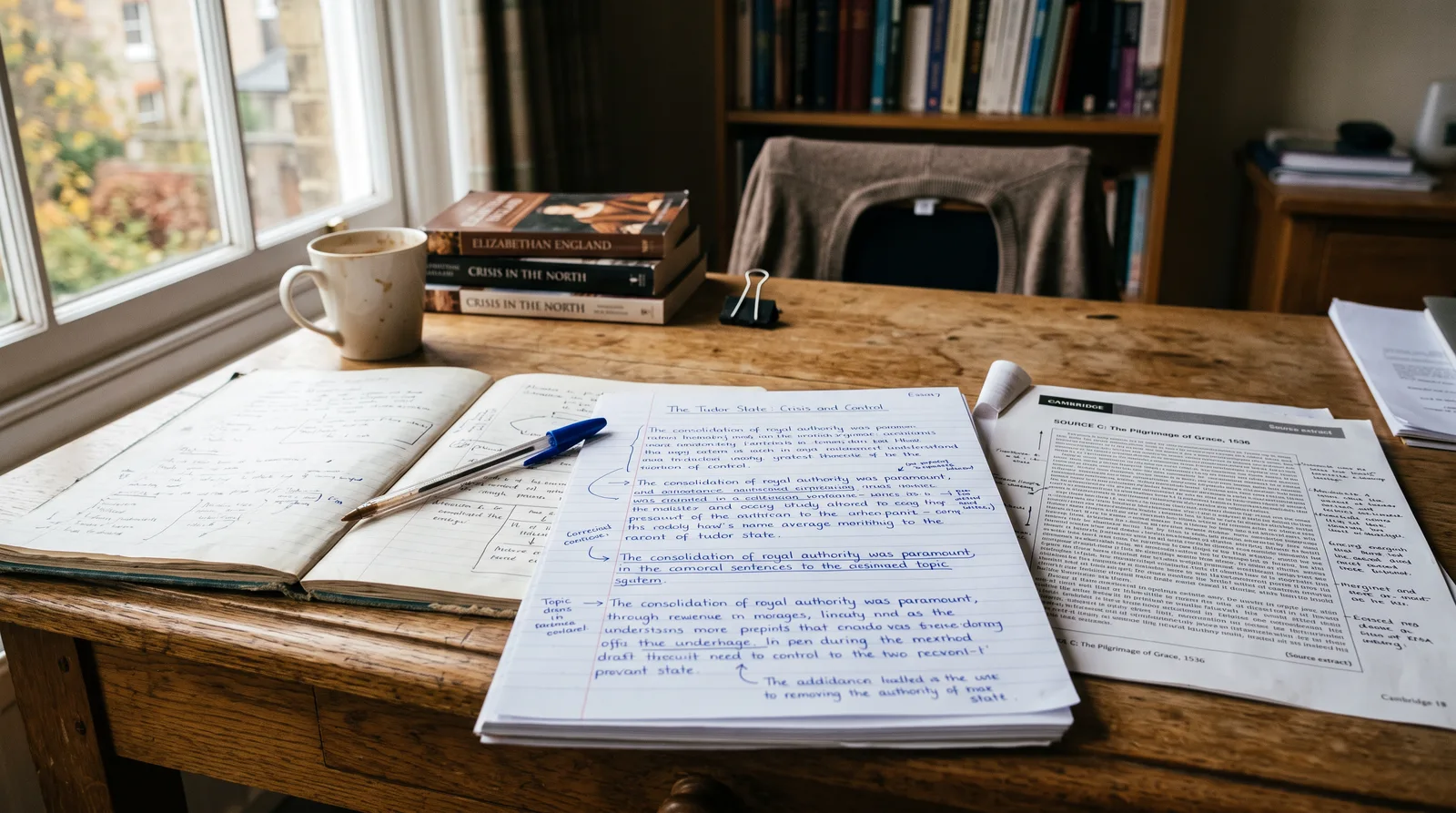
What you'll learn
What you'll be able to do
- Analyse primary and secondary sources using the Cambridge DACE/NOP frameworks with confidence
- Write structured, well-evidenced essays that meet O Level mark-scheme criteria
- Explain key causation, consequence, and change-and-continuity arguments across all core topics
- Identify and avoid the most common mistakes that cost students marks in Paper 1 and Paper 2
- Recall and apply precise historical facts, dates, and key figures across the full O Level syllabus
- Manage exam time effectively, planning and completing full answers under timed conditions
How it works
A school that adapts to you
This isn't a set of static videos. Every lesson is generated live and tuned to where you actually are.
We learn your level
A quick placement check tailors your starting point so you're never bored or lost.
Lessons adapt as you go
Each lesson is written for your pace and your goal, adjusting as your skills grow.
Your AI coach keeps you moving
Checkpoints, feedback, and gentle nudges turn progress into a real result.
The curriculum
What's inside your school
37 modules · 164 lessons

Foundations of Cambridge O Level History
Orients students to the exam structure, mark schemes, and the historical thinking skills that underpin every paper.
- 1.1Understanding the O Level ExamIncluded
- 1.2Thinking Like a HistorianIncluded
- 1.3Reading the Mark SchemeIncluded
- 1.4Building Your Revision ToolkitIncluded
Source Analysis Mastery
Develops confident, methodical source-analysis skills using the Cambridge DACE and NOP frameworks.
- 2.1Introducing the DACE FrameworkIncluded
- 2.2Using the NOP FrameworkIncluded
- 2.3Utility and Reliability QuestionsIncluded
- 2.4Cross-Referencing Multiple SourcesIncluded
- 2.5Common Source-Analysis MistakesIncluded
Essay Technique and Exam Writing
Builds the structured, evidence-rich essay writing style required to score highly on O Level extended-response questions.
- 3.1Planning an Essay in Five MinutesIncluded
- 3.2Writing a Strong Introduction and ThesisIncluded
- 3.3Building PEEL Paragraphs with Precise EvidenceIncluded
- 3.4Writing Conclusions That Clinch MarksIncluded
- 3.5Timed Essay Practice and Self-AssessmentIncluded
Core Topic 1 — The 20th-Century World
Covers the major international crises, conflicts, and turning points most commonly tested in Paper 2.
- 4.1Causes of the First World WarIncluded
- 4.2The Rise of Dictatorships in the 1930sIncluded
- 4.3Causes and Course of the Second World WarIncluded
- 4.4The Cold War: Origins and CrisesIncluded
- 4.5The End of the Cold War and Its ConsequencesIncluded
Core Topic 2 — Depth Studies and Source-Based History
Applies analytical skills to the detailed depth studies tested in Paper 1, focusing on evidence-based argument.
- 5.1Germany 1918–1945: Rise and Fall of the Nazi StateIncluded
- 5.2Russia and the Soviet Union 1905–1941Included
- 5.3The United States 1919–1941Included
- 5.4Applying Source Skills to Depth Study QuestionsIncluded
Exam Readiness and Final Preparation
Consolidates all skills through past-paper practice, targeted feedback, and exam-day strategy.
- 6.1Exam Time Management StrategyIncluded
- 6.2Paper 1 Full Mock and ReviewIncluded
- 6.3Paper 2 Full Mock and ReviewIncluded
- 6.4Top Mark-Losing Mistakes Across Both PapersIncluded
- 6.5Final Consolidation and Confidence CheckIncluded
Were the revolutions of 1848 important?
• The nature of revolutions in 1848 and the influence of liberalism and nationalism
• Causes, events and results of revolutions in: France, Italy, Germany, the Austrian Empire
• Reasons for the failure of the revolutions
- 7.1Why had liberalism and nationalism grown in influence by 1848?Included
- 7.2Why were there so many revolutions in 1848?Included
- 7.3Did the revolutions have anything in common?Included
- 7.4Why did most of the revolutions fail?Included
- 7.5Did the revolutions change anything?Included
How was Italy unified?
• Austrian influence over Italy
• Italian nationalism and the role of Mazzini
• Events of 1848–49
• Victor Emmanuel II and Cavour: the agreement of Plombières, war with Austria in 1859
• Garibaldi and the invasion of Sicily and Naples
• The creation of the Kingdom of Italy, completion of unification by 1870
- 8.1Why was Italy not unified in 1848–49?Included
- 8.2How important was Garibaldi’s contribution to unifying Italy?Included
- 8.3Did Cavour help or hinder the unification of Italy?Included
- 8.4How important for other European countries were moves towards Italian unification?Included
How was Germany unified?
• German nationalism
• The Zollverein
• The 1848 revolution in Prussia
• The setting up and eventual failure of the Frankfurt Parliament
• Re-establishment of Austrian influence in Germany by 1850
• Bismarck as Prussian Minister–President
• Bismarck’s foreign policy to 1871: Schleswig, Holstein, the Austro–Prussian War and its consequences, relations with France, the Spanish Succession and the Franco-Prussian War and the creation of the German
- 9.1Why was Germany not unified in 1848–50?Included
- 9.2How did Bismarck bring about Austria’s defeat of 1866?Included
- 9.3How did Bismarck bring about France’s defeat of 1870?Included
- 9.4How far was Bismarck responsible for the unification of Germany?Included
Why was there a civil war in the United States and what were its results?
• Causes and consequences of the American Civil War, 1820–77: differences between North and South , slavery, slave states and free states, abolitionism , the 1860 election and secession of the Southern states , reasons for the North’s victory and the South’s defeat , the role of Lincoln and reconstruction and the extent of its success
- 10.1How far did slavery cause the Civil War?Included
- 10.2What was the significance of Lincoln’s election as president?Included
- 10.3Why was the North able to win the war?Included
- 10.4Did the war change anything?Included
Why, and with what effects, did nations gain and expand their overseas empires in the nineteenth century?
• Reasons for imperialism: economic, military, geopolitical, religious and cultural motives
• Europeans in Africa: case studies of French, British and Belgian imperialism, and their impacts on
Africans:
– the French model of assimilation and direct rule; Faidherbe and Senegal
– the British model of indirect rule; Lugard and Nigeria
– the Belgians and private imperialism; Leopold II and the Congo
• The British in India: the events of 1857 and the changes they brought to British rule
• Wars of independence in the Philippines and Cuba, the Spanish–American War and the Treaty of Paris:
– the debate in the USA over US imperialism
– the Philippines; consequences of American control on the Filipinos– Ame
- 11.1What were the motives behind European and US imperialism?Included
- 11.2How varied were the impacts of European imperialism on Africans?Included
- 11.3Why, and with what effects, did Indians resist British rule?Included
- 11.4Why, and with what effects, did the United States gain former Spanish colonies?Included
What caused the First World War?
• The origins of the First World War, 1890–1914:
– the Alliance System and the European diplomatic system
– the 1902 Anglo–Japanese Alliance
– the arms race
– colonial rivalries
– developments in the Balkans
– the crisis of Ju
- 12.1Did the Alliance System and global diplomacy make war more likely or less likely?Included
- 12.2How far did colonial problems create tensions between the Great Powers?Included
- 12.3Why were problems in the Balkans so difficult for the Great Powers to solve?Included
- 12.4How did the assassination of Franz Ferdinand lead to war?Included
Was the Treaty of Versailles fair?
• The roles of Wilson, Clemenceau and Lloyd George in the peacemaking process
• The terms of the Treaty
• Social, economic and political impact of the Treaty in Germany to the end of 1923
• Contemporary opinions about the Treaty
- 13.1What were the motives and aims of the Big Three at Versailles?Included
- 13.2Why did the victors not get everything they wanted?Included
- 13.3What was the impact of the Treaty on Germany up to the end of 1923?Included
- 13.4Could the Treaty be justified at the time?Included
To what extent was the League of Nations a success?
• The structure, aims and membership of the League
• Successes and failures in peacekeeping during the 1920s:
– Vilna 1920
– Aaland Islands 1920–21
– Corfu 1923
– Bulgaria 1925
• The League’s humanitarian work:
– refugees
– health
– working conditions
– slavery
• The League in the 1930s:
– causes, events and consequences of the Manchurian crisis and of the Abyssinian crisis
- 14.1How far did weaknesses in the League’s organisation and membership make failure inevitable?Included
- 14.2How successful were the League’s attempts at peacekeeping in the 1920s?Included
- 14.3How important was the League’s humanitarian work?Included
- 14.4How far did the Depression make the work of the League more difficult in the 1930s?Included
How far was Hitler’s foreign policy to blame for the outbreak of war in Europe in 1939?
• Hitler’s foreign policy aims
• Rearmament
• The Saar
• Remilitarisation of the Rhineland
• The Rome–Berlin Axis and the Anti-Comintern Pact
• German and Italian involvement in the Spanish Civil War
• Anschluss with Austria
• The crisis over Czechoslovakia and the Munich Agreement
• The Polish crisis and the outbreak of war
- 15.1What were the long-term consequences of the Treaty of Versailles?Included
- 15.2What were the consequences of the failures of the League of Nations in the 1930s?Included
- 15.3Was the policy of appeasement justified?Included
- 15.4How important was the Nazi–Soviet Pact?Included
- 15.5Why did Britain and France declare war on Germany in September 1939?Included
Who was to blame for the Cold War?
• The origins of the Cold War:
– the 1945 summit conferences and the breakdown of the US–Soviet alliance in 1945–46
– Soviet expansion into Eastern Europe to 1948, and American reactions to it
– the occupation of Germany and the Berlin Blockade
– NATO and the Warsaw
- 16.1Why did the US–Soviet alliance begin to break down in 1945?Included
- 16.2How had the USSR gained control of Eastern Europe by 1948?Included
- 16.3How did the United States react to Soviet expansionism?Included
- 16.4What were the consequences of the Berlin Blockade?Included
- 16.5Who was more to blame for starting the Cold War: the United States or the USSR?Included
How effectively did the United States contain the spread of communism?
• Case studies of:
– American reactions to North Korea’s invasion of South Korea, the involvement of the UN, the course
of the war to 1953
– American reactions to the Cuban Revolution, including the Missile Crisis and its aftermath
– American involvement in the Vietnam War, including reasons for involvement, tactics and strategy,
reasons for withdrawal
- 17.1The United States and events in Korea, 1950–53Included
- 17.2The United States and events in Cuba, 1959–62Included
- 17.3American involvement in Vietnam, 1955–75Included
How secure was the USSR’s control over Eastern Europe, 1948–c.1989?
• Soviet power in Eastern Europe:
– resistance to Soviet power in Hungary (1956) and Czechoslovakia (1968)
– the Berlin Wall
– Solidarity in Poland
– Gorbachev and the collapse of Soviet control over Eastern Europe
- 18.1Why was there opposition to Soviet control in Hungary in 1956 and Czechoslovakia in 1968, and how did the USSR react to this opposition?Included
- 18.2How similar were events in Hungary in 1956 and in Czechoslovakia in 1968?Included
- 18.3Why was the Berlin Wall built in 1961?Included
- 18.4What was the significance of Solidarity in Poland for the decline of Soviet influence in Eastern Europe?Included
- 18.5How far was Gorbachev personally responsible for the collapse of Soviet control over Eastern Europe?Included
Why was there stalemate on the Western Front?
- 19.1Why did the Schlieffen Plan fail?Included
- 19.2Why did a defensive war emerge by the end of 1914?Included
- 19.3What was living and fighting in the trenches like?Included
- 19.4How important were new methods of warfare?Included
- 19.5What was the significance of the Battles of Verdun and the Somme?Included
To what extent was it a world war?
- 20.1How important was the role of troops from the British Empire on the Western Front?Included
- 20.2What was the contribution of Indian and South African troops in Africa?Included
- 20.3What was the contribution of Japan to the Allied victory?Included
- 20.4How important was the Arab Revolt?Included
How important were other fronts?
- 21.1Who won the war at sea?Included
- 21.2Why did the Gallipoli Campaign of 1915 fail?Included
- 21.3How important was the Eastern Front?Included
- 21.4What was the impact of war on civilian populations?Included
Why did Germany ask for an armistice in 1918?
- 22.1What was the importance of America’s entry into the war?Included
- 22.2Why was the German offensive of 1918 unsuccessful?Included
- 22.3Why did revolution break out in Germany in October 1918?Included
- 22.4Why was the Armistice signed?Included
Was the Weimar Republic doomed from the start?
- 23.1How did Germany emerge from defeat at the end of the First World War?Included
- 23.2What was the impact of the Treaty of Versailles on the Republic?Included
- 23.3To what extent did the Republic recover after 1923?Included
- 23.4What were the achievements of the Weimar period?Included
Why was Hitler able to dominate Germany by 1934?
- 24.1What did the Nazi Party stand for in the 1920s?Included
- 24.2Why did the Nazis have little success before 1930?Included
- 24.3Why was Hitler able to become Chancellor by 1933?Included
- 24.4How did Hitler consolidate his power in 1933–34?Included
The Nazi regime
- 25.1(a) How effectively did the Nazis control Germany, 1933–45?Included
- 25.2How much opposition was there to the Nazi regime?Included
- 25.3How effectively did the Nazis deal with their political opponents?Included
- 25.4How did the Nazis use culture and the mass media to control the people?Included
- 25.5Why did the Nazis persecute many groups in German society?Included
- 25.6Was Nazi Germany a totalitarian state?Included
- 25.7(b) What was it like to live in Nazi Germany?Included
- 25.8How did young people react to the Nazi regime?Included
- 25.9How successful were Nazi policies towards women and the family?Included
- 25.10Did most people in Germany benefit from Nazi rule?Included
- 25.11How did the coming of war change life in Nazi Germany?Included
Why did the Tsarist regime collapse in 1917?
- 26.1How well did the Tsarist regime deal with the difficulties of ruling Russia up to 1914?Included
- 26.2How did the Tsar survive the 1905 Revolution?Included
- 26.3How far was the Tsar weakened by the First World War?Included
- 26.4Why was the revolution of March 1917 successful?Included
How did the Bolsheviks gain power, and how did they consolidate their rule?
- 27.1How effectively did the Provisional Government rule Russia in 1917?Included
- 27.2Why were the Bolsheviks able to seize power in November 1917?Included
- 27.3Why did the Bolsheviks win the Civil War?Included
- 27.4How far was the New Economic Policy a success?Included
How did Stalin gain and hold on to power?
- 28.1Why did Stalin, and not Trotsky, emerge as Lenin’s successor?Included
- 28.2Why did Stalin launch the Purges?Included
- 28.3What methods did Stalin use to control the Soviet Union?Included
- 28.4How complete was Stalin’s control over the Soviet Union by 1941?Included
What was the impact of Stalin’s economic policies?
- 29.1Why did Stalin introduce the Five-Year Plans?Included
- 29.2Why did Stalin introduce collectivisation?Included
- 29.3How successful were Stalin’s economic changes?Included
- 29.4How were the Soviet people affected by these changes?Included
How far did the US economy boom in the 1920s?
- 30.1On what factors was the economic boom based?Included
- 30.2Why did some industries prosper while others did not?Included
- 30.3Why did agriculture not share in the prosperity?Included
- 30.4Did all Americans benefit from the boom?Included
How far did US society change in the 1920s?
- 31.1What were the ‘Roaring Twenties’?Included
- 31.2How widespread was intolerance in US society?Included
- 31.3Why was Prohibition introduced, and then later repealed?Included
- 31.4How far did the roles of women change during the 1920s?Included
What were the causes and consequences of the Wall Street Crash?
- 32.1How far was speculation responsible for the Wall Street Crash?Included
- 32.2What impact did the Crash have on the economy?Included
- 32.3What were the social consequences of the Crash?Included
- 32.4Why did Roosevelt win the election of 1932?Included
How successful was the New Deal?
- 33.1What was the New Deal as introduced in 1933?Included
- 33.2How far did the character of the New Deal change after 1933?Included
- 33.3Why did the New Deal encounter opposition?Included
- 33.4Why did unemployment persist despite the New Deal?Included
- 33.5Did the fact that the New Deal did not solve unemployment mean that it was a failure?Included
How did the Second World War in Europe develop?
- 34.1To what extent had Nazi Germany gained control of Europe in 1940?Included
- 34.2Why was Germany unable to conquer Britain?Included
- 34.3Why did Hitler invade the Soviet Union in 1941?Included
- 34.4Why was the Battle of Stalingrad a turning point?Included
How did the Second World War in the Asia–Pacific develop?
- 35.1How did US–Japanese relationships deteriorate?Included
- 35.2How successful was the Japanese attack on Pearl Harbor?Included
- 35.3Why were the Japanese successful in the initial stages of the war?Included
- 35.4Why was the Battle of Midway a turning point?Included
What was the impact of war on civilian populations in Europe and the Asia–Pacific?
- 36.1What was the impact on civilians of the bombing of Britain (1940–41) and Germany (1943–45)?Included
- 36.2How did Japanese control impact on peoples’ lives?Included
- 36.3What were the experiences of civilian populations in Nazi-occupied Europe?Included
- 36.4How effective were resistance movements in Europe and the Asia–Pacific?Included
How did the Allies achieve victory over the Axis powers?
- 37.1What was the importance of the Allied advance through Italy?Included
- 37.2Why was Nazi Germany on the point of collapse by April 1945?Included
- 37.3Why were the Allies able to achieve victory over Japan?Included
- 37.4How did the Allies consolidate their victories in Germany and Japan?Included
Who it's for
Is this you?

The Ambitious Student
Aiming for an A* and wants a structured, rigorous path through every source framework, essay technique, and core topic the Cambridge mark scheme rewards.

The Struggling Reviser
Knows the content but keeps losing marks — and needs someone to break down exactly what the examiner wants, step by step.

The Supportive Parent
Wants to understand what the O Level exam actually demands so they can guide meaningful revision at home rather than just hoping for the best.

The Private Tutor
Needs a mark-scheme-aligned resource with frameworks, essay models, and mock papers to build focused, effective sessions around.

The Late Starter
Exams are approaching fast — needs to cut to the most impactful lessons: essay technique, common mistakes, and timed mock practice, immediately.

The Depth Study Specialist
Strong on 20th-century world history but needs to master the source-based depth study questions on Nazi Germany, Soviet Russia, or 1930s America.
Questions
Frequently asked
Your teacher
A note from your teacher

Renstay College
If you've ever sat down to revise History and thought, I know the content — but I still don't know what the examiner actually wants, then you're in exactly the right place.
That feeling — of working hard but not quite translating it into marks — is the most common thing I hear from O Level History students. And it's not a knowledge problem. It's a skills problem. The Cambridge exam is testing a very specific set of analytical and writing techniques, and if no one has walked you through them clearly, you're left guessing. Cambridge History Lab exists to stop the guessing.
I've designed every lesson in this school around one question: what does a student actually need to do to move up a mark band? That means teaching the DACE and NOP frameworks until source analysis feels routine, not scary. It means breaking essay structure down into steps — five-minute planning, a thesis that takes a clear line, PEEL paragraphs that carry real evidence, conclusions that don't just summarise but actually argue. It means covering the full sweep of 20th-century history and the three depth studies with enough precision that dates, figures, and causation arguments are genuinely at your fingertips when you need them.
I also know that understanding the content in a lesson and performing under timed exam conditions are two very different things. That's why the school includes full mock papers for both Paper 1 and Paper 2, self-assessment tools, and a dedicated focus on the mistakes — the vague phrases, the unsupported assertions, the misread source questions — that quietly cost students marks they deserved to keep.
Whether you're a student sitting down to work through this yourself, a parent trying to make sense of what your child needs, or a tutor looking for a rigorous framework to build sessions around — I want this school to feel like having a brilliant teacher in your corner who knows the exam inside out and genuinely wants you to hit your potential.
The exam is learnable. The skills are teachable. Let's get to work.
— Renstay College
Start your journey today
Get instant access — learn at your own pace with an AI coach in your corner.
$10/mo
Recurring billing · cancel anytime
Enrolling a child? Sign up as a parent — you'll add your student right here after.
Secure checkout · Instant access
- 37 modules, 164 lessons
- AI-adaptive lessons tuned to your level
- Quizzes & checkpoints to lock in progress
- Your own AI learning coach
- Learn on any device, at your pace
- Full access for as long as you're subscribed