
Crack Cambridge O Level Accounts — from first principles to full marks
A complete, step-by-step programme that walks you through every syllabus topic — double-entry bookkeeping, final accounts, partnerships, ratios, and real past-paper practice — so you walk into the exam room knowing exactly what to do.

Once you understand the why behind every entry, the whole subject stops being intimidating and starts being logical — and that's the moment everything changes.
— Renstay College
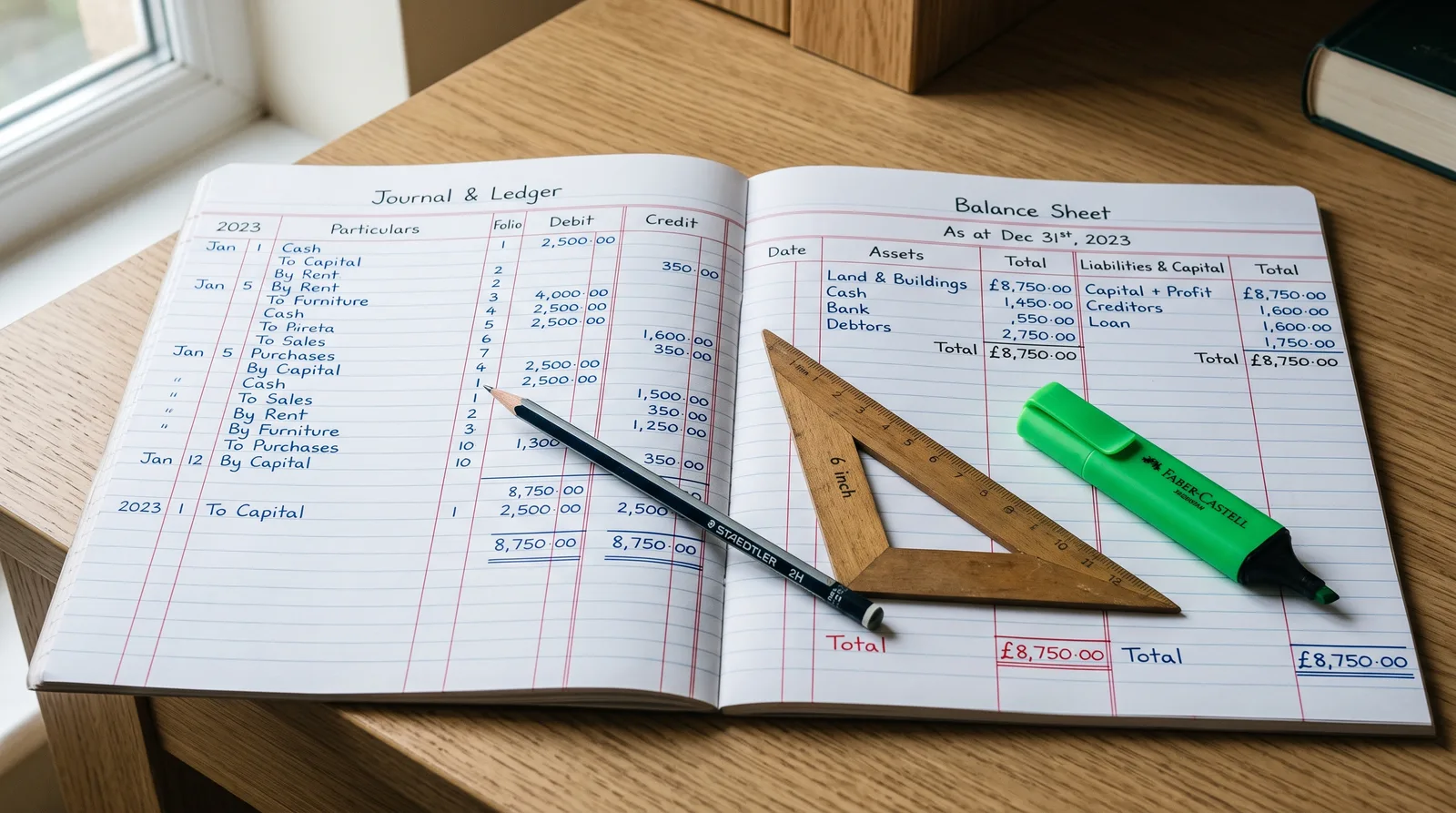
What you'll learn
What you'll be able to do
- Record business transactions accurately using double-entry bookkeeping and the rules of debit and credit
- Prepare complete sets of final accounts including Trading, Profit & Loss Accounts, and Balance Sheets for sole traders and partnerships
- Reconcile bank statements and maintain a fully balanced cash book with confidence
- Interpret and analyse financial statements using key accounting ratios and performance indicators
- Answer structured and free-response Cambridge O Level past-paper questions under timed, exam-realistic conditions
- Apply accounting concepts and conventions correctly to justify entries and adjustments in any exam scenario
How it works
A school that adapts to you
This isn't a set of static videos. Every lesson is generated live and tuned to where you actually are.
We learn your level
A quick placement check tailors your starting point so you're never bored or lost.
Lessons adapt as you go
Each lesson is written for your pace and your goal, adjusting as your skills grow.
Your AI coach keeps you moving
Checkpoints, feedback, and gentle nudges turn progress into a real result.
The curriculum
What's inside your school
13 modules · 55 lessons

Foundations of Accounting
Establishes the core language, concepts, and conventions that underpin every accounting decision students will make throughout the course.
- 1.1What is Accounting? Purpose and Users of Financial InformationIncluded
- 1.2Accounting Concepts and ConventionsIncluded
- 1.3The Accounting Equation and Business DocumentsIncluded
- 1.4Introduction to Double-Entry BookkeepingIncluded
- 1.5The Ledger and Balancing AccountsIncluded
Books of Prime Entry and the Trial Balance
Covers every book of original entry and shows how all recorded transactions flow into a trial balance ready for final accounts.
- 2.1Sales and Purchases Day BooksIncluded
- 2.2Returns Day Books and Trade DiscountIncluded
- 2.3The Cash Book as a Book of Prime EntryIncluded
- 2.4The Petty Cash Book and Imprest SystemIncluded
- 2.5The Journal and Extracting a Trial BalanceIncluded
Bank Reconciliation and Control Accounts
Develops students' ability to verify cash book accuracy and control the accuracy of personal ledgers through reconciliation techniques.
- 3.1Understanding Bank Statements and Timing DifferencesIncluded
- 3.2Preparing a Bank Reconciliation StatementIncluded
- 3.3Sales Ledger Control AccountIncluded
- 3.4Purchases Ledger Control AccountIncluded
Final Accounts — Sole Traders
Takes students from trial balance to a complete set of final accounts for a sole trader, including all common adjustments.
- 4.1The Trading Account and Calculating Gross ProfitIncluded
- 4.2The Profit and Loss AccountIncluded
- 4.3Accruals, Prepayments, and the Matching ConceptIncluded
- 4.4Depreciation of Fixed AssetsIncluded
- 4.5Bad Debts, Provisions, and the Balance SheetIncluded
Partnership Accounts and Further Financial Statements
Extends final accounts preparation to partnership businesses, including profit sharing and capital structures.
- 5.1Features of a Partnership and the Partnership AgreementIncluded
- 5.2The Profit and Loss Appropriation AccountIncluded
- 5.3Partners' Capital and Current AccountsIncluded
- 5.4Partnership Balance SheetIncluded
Interpretation of Accounts and Exam Mastery
Builds analytical and exam skills by teaching ratio analysis, financial interpretation, and timed past-paper technique.
- 6.1Accounting Ratios — ProfitabilityIncluded
- 6.2Accounting Ratios — Liquidity and EfficiencyIncluded
- 6.3Analysing and Comparing Financial PerformanceIncluded
- 6.4Errors and Their Correction — Suspense AccountsIncluded
- 6.5Exam Technique and Timed Past-Paper PracticeIncluded
The fundamentals of accounting
- 7.1The purpose of accountingIncluded
- 7.2The accounting equationIncluded
Sources and recording of data
- 8.1The double entry system of book-keepingIncluded
- 8.2Business documentsIncluded
- 8.3Books of prime entryIncluded
Verification of accounting records
- 9.1The trial balanceIncluded
- 9.2Correction of errorsIncluded
- 9.3Bank reconciliationIncluded
- 9.4Control accountsIncluded
Accounting procedures
- 10.1Capital and revenue expenditure and receiptsIncluded
- 10.2Accounting for depreciation and disposal of non-current assetsIncluded
- 10.3Other payables and other receivablesIncluded
- 10.4Irrecoverable debts and provision for doubtful debtsIncluded
- 10.5Valuation of inventoryIncluded
Preparation of financial statements
- 11.1Sole tradersIncluded
- 11.2PartnershipsIncluded
- 11.3Limited companiesIncluded
- 11.4Clubs and societiesIncluded
- 11.5Manufacturing accountsIncluded
- 11.6Incomplete recordsIncluded
Analysis and interpretation
- 12.1Calculation and understanding of accounting ratiosIncluded
- 12.2Interpretation of accounting ratiosIncluded
- 12.3Inter-firm comparisonIncluded
- 12.4Interested partiesIncluded
- 12.5Limitations of accounting statementsIncluded
Accounting principles and policies
- 13.1Accounting principlesIncluded
- 13.2Accounting policiesIncluded
Who it's for
Is this you?

O Level exam candidates
You're sitting the Cambridge O Level paper and want a complete, syllabus-aligned resource that leaves no topic uncovered.

Private candidates
You're studying without a school or teacher and need a self-contained course that guides you step by step through the entire syllabus independently.

International school students
Your school follows the Cambridge curriculum but moves quickly — this course gives you the patient, methodical explanations you need to keep up and go deeper.

Struggling bookkeeping learners
Debits and credits still don't make sense — this course starts from first principles and builds the logic until double-entry becomes second nature.

Revision-focused students
You've covered the basics in class but want worked past-paper examples and exam technique coaching to convert your knowledge into marks.

Home-educated teens
You're learning at home and need a structured, curriculum-complete programme that takes you from the accounting equation all the way to partnership balance sheets.
Questions
Frequently asked
Your teacher
A note from your teacher

Renstay College
If you've ever stared at a debit and credit entry and thought, "I have no idea why that goes there" — I want you to know that feeling is completely normal, and it's exactly the problem this course is built to solve.
Accounting at O Level isn't about being a "maths person." It's about understanding a set of logical rules, applying them consistently, and knowing how to present your answers so the examiner can follow your thinking. The students who struggle aren't struggling because they lack ability — they're struggling because nobody has shown them the why behind every entry. That's what I set out to change here.
Every lesson in Cambridge Accounts Pro is written the way I wish accounting had been explained to me: in plain, patient language, with the steps numbered out clearly, and with worked examples that don't skip the parts that actually trip people up. We start with the accounting equation and build all the way through to partnership accounts and financial ratio analysis — in the right order, with nothing assumed and nothing glossed over. You won't just be copying journal entries; you'll understand what they mean and why they balance.
I've paid particular attention to the topics that cost students marks year after year — accruals and prepayments, the treatment of depreciation, bad debt provisions, control account reconciliations, and the interpretation section that many candidates skip in revision. Each one gets its own careful treatment, with exam-style questions so you can practise in the same format the Cambridge paper uses.
Whether you're in a school that moves too fast, or you're a private candidate working entirely on your own, this course gives you a structured, complete path through the entire syllabus. You set the pace. You revisit whatever you need to. And by the time you reach the Exam Mastery section, you'll be working through past papers with the kind of confidence that only comes from genuinely understanding the material — not just memorising it.
I'm glad you're here. Let's get those accounts to balance.
— Renstay College
Start your journey today
Get instant access — learn at your own pace with an AI coach in your corner.
$10/mo
Recurring billing · cancel anytime
Enrolling a child? Sign up as a parent — you'll add your student right here after.
Secure checkout · Instant access
- 13 modules, 55 lessons
- AI-adaptive lessons tuned to your level
- Quizzes & checkpoints to lock in progress
- Your own AI learning coach
- Learn on any device, at your pace
- Full access for as long as you're subscribed