Understand money. Protect your choices. Keep cash alive.
Six practical modules — from the 5,000-year story of money to your own cash-resilience plan — give you the grounded knowledge to push back on a cashless world with confidence, not just concern.
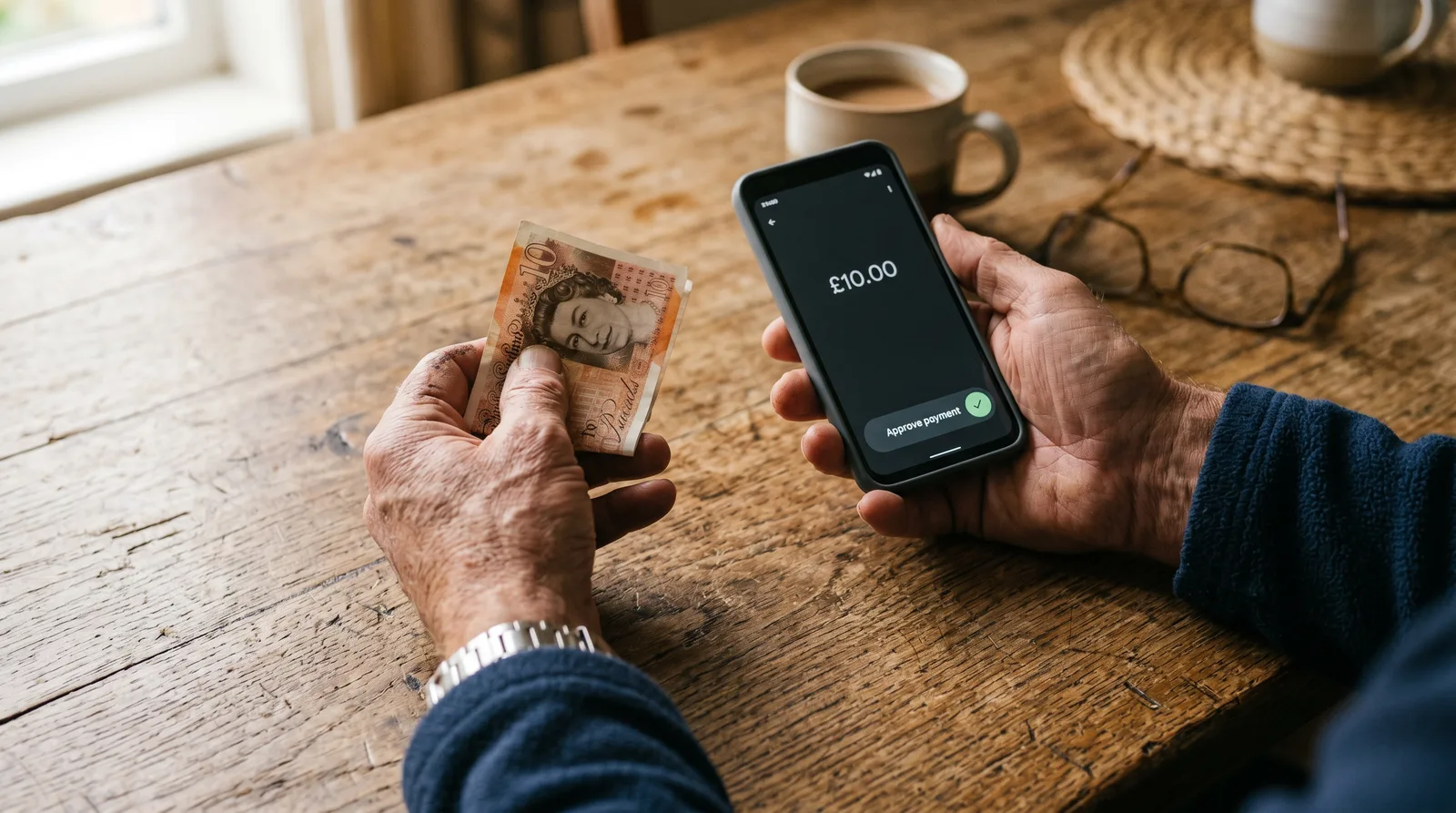
"I believe the most powerful thing an ordinary person can do is understand their money clearly — and then speak up about it without apology."— David Clilverd
What you'll learn
What you'll be able to do
- Explain clearly why physical cash remains a critical safety net alongside digital payments — and articulate this confidently to others.
- Build a practical personal cash-resilience plan, including safe home reserves and access strategies, for emergencies and infrastructure failures.
- Trace the history of money — from barter and the gold standard to fiat currency and cryptocurrency — and evaluate what truly gives money its value and trust.
- Critically assess the real risks of a fully cashless society: infrastructure vulnerability, surveillance, exclusion of vulnerable groups, and loss of financial autonomy.
- Navigate and compare today's key payment systems — bank apps, contactless, crypto, ATMs, and cash — understanding their strengths, weaknesses, and appropriate uses.
- Advocate effectively in your community for the preservation of cash access, local banking services, and decentralised financial infrastructure.
How it works
A school that adapts to you
This isn't a set of static videos. Every lesson is generated live and tuned to where you actually are.
We learn your level
A quick placement check tailors your starting point so you're never bored or lost.
Lessons adapt as you go
Each lesson is written for your pace and your goal, adjusting as your skills grow.
Your AI coach keeps you moving
Checkpoints, feedback, and gentle nudges turn progress into a real result.
The curriculum
What's inside your school
6 modules · 18 lessons

What Is Money, Really? A 5,000-Year Story
Establishes the essential historical and conceptual foundation for everything that follows. Students must understand what money is, why it is trusted, and how it has evolved before they can critically assess modern digital and physical payment systems. This module grounds all later discussion in the user's core theme: that money's value rests on trust, shared belief, and real-world anchors — and that understanding this history is the prerequisite for sound judgement today.
- 1.1From Barter to Coins — The First 4,000 YearsIncluded
- 1.2The Gold Standard, Fiat Money, and the Promise on the BanknoteIncluded
- 1.3Cryptocurrency — Digital Gold or Digital Illusion?Included
The Case for Cash — Why Physical Money Still Matters
Having established what money is and how trust works, students now build the core argument of the curriculum: physical cash is not obsolete — it is a critical safety net, a civil liberties safeguard, and a tool of inclusion. This module directly addresses the user's central concerns and equips students with the evidence and reasoning they need to articulate and defend this position. Sequenced before the payment-landscape module so students carry a clear value framework into their evaluation of digital tools.
- 2.1When the Internet Goes Down — Real Infrastructure FailuresIncluded
- 2.2Who Gets Left Behind — Cash Exclusion and Vulnerable GroupsIncluded
- 2.3Cash, Control, and Civil Liberties — The Surveillance QuestionIncluded
Navigating Today's Payment Landscape
With a solid understanding of money's history and a clear values framework around cash, students now map the practical terrain of modern payments. This module is intentionally placed third — after the critical framework is built — so students evaluate digital tools with informed judgement rather than uncritical adoption. Covers how each payment method works, what can go wrong, and how to choose the right tool for the right moment. Directly supports the outcome of navigating key payment systems confidently.
- 3.1Mapping the Payment Ecosystem — Cards, Apps, Contactless, ATMs, and CashIncluded
- 3.2Using Digital Tools Wisely — Security, Scams, and Smart HabitsIncluded
- 3.3Making Informed Choices — Right Tool, Right MomentIncluded
Your Personal Cash-Resilience Plan
Moves from understanding to action. Students now design and rehearse their own practical emergency financial resilience plan. Sequenced after the payment landscape module so students have a complete picture of all available tools and their failure modes before deciding what to stockpile and prepare. Directly delivers the target outcome of building a personal cash-resilience plan. Reflects the user's reference to government and expert advice to keep a cash reserve at home.
- 4.1How Much Cash Is Enough? — Building Your Home ReserveIncluded
- 4.2ATMs, Post Offices, and Local Access — Knowing Your Cash NetworkIncluded
- 4.3Emergency Scenarios — Rehearsing for Real DisruptionIncluded
The Bigger Picture — Infrastructure, Decentralisation, and Lessons from History
Zooms out to place the cash debate within the broader pattern the user identifies: repeated UK policy decisions that have prioritised scale, centralisation, and modernisation over resilience, community, and human connection — with lasting damage. Beeching's railway cuts, High Street bank closures, NHS centralisation, and the HS2 debate are examined as case studies in the same underlying tension: big versus small, efficient versus resilient, digital versus human. Schumacher's 'Small is Beautiful' provides the organising philosophical framework. This module deepens the advocacy skills developed in Module 6 by giving students the historical and analytical ammunition to make a persuasive systemic argument.
- 5.1Beeching, HS2, and the High Street Bank — When Thinking Big Goes WrongIncluded
- 5.2The Human Face of Finance — What We Lose When We Digitalise RelationshipsIncluded
- 5.3Alternative Energy, Diverse Provision, and the Case for RedundancyIncluded
Speak Up — Advocating for Cash, Community Banking, and Financial Freedom
The culminating module — where understanding, analysis, and personal planning are converted into confident public voice. Students learn who is driving the cashless agenda, how to construct and deliver a persuasive evidence-based argument, and how to take practical action through democratic and community channels. Placed last because advocacy requires everything learned in the previous five modules: historical grounding, risk analysis, personal resilience, and systemic understanding. Directly delivers the final target outcome.
- 6.1Who Is Driving the Cashless Agenda — and Why?Included
- 6.2Making the Case — Evidence, Arguments, and Confident ConversationIncluded
- 6.3Taking Action — Councils, MPs, Community Groups, and BeyondIncluded
Who it's for
Is this you?

Concerned retirees
You rely on cash for daily independence and want to understand — and push back on — a system being redesigned without you in mind.

Small business owners
You still accept cash and face growing pressure not to — this school gives you the knowledge and arguments to hold your ground.

Community advocates
You're already fighting to keep local banking and services alive, and you want sharper evidence and stronger arguments to back you up.

Financially anxious adults
You want to feel genuinely prepared for disruption — power cuts, outages, system failures — not just hoping your phone battery holds out.

Curious lifelong learners
You love understanding how the world really works, and the 5,000-year story of money is exactly the kind of big, grounded idea you're here for.

Carers and family supporters
You support someone — a parent, a neighbour, a person with a disability — who depends on cash access and you want to advocate effectively on their behalf.
Questions
Frequently asked
Your teacher
A note from your teacher

David Clilverd
If you've picked up this page, I'd guess you've had that quiet, nagging feeling for a while now — the sense that something important is being taken away, slowly and without much public debate. A bank branch gone. An ATM boarded up. A market stall that no longer takes a tenner. A family member who simply can't manage without physical money. You know something is wrong, but when you try to put it into words, it can feel like you're swimming against a very strong tide.
I built this school because I kept having the same conversation — at kitchen tables, in community halls, in the comments under news articles — with thoughtful, curious people who felt exactly that way. People who weren't anti-technology, weren't conspiracy theorists, weren't trying to turn the clock back. They just wanted the full picture. They wanted to understand why cash matters, who loses when it disappears, and how a system that looks like progress can quietly become a source of vulnerability for millions of people. They wanted to be able to say all of that clearly, calmly, and with confidence.
So that's what this school does. We go back to the beginning — 5,000 years of money's history — because you can't really understand today's arguments without understanding what money is, what gives it value, and how societies have made and broken the trust that makes it work. Then we get specific and practical: the infrastructure failures that leave digital-only users stranded, the surveillance questions that rarely get asked, and the real human cost of financial exclusion. And then we build your personal plan — not abstract advice, but a concrete, workable approach to cash resilience for your life and your community.
I want to be honest with you: this school won't tell you what to think. It will give you the history, the evidence, the arguments, and the tools — and then trust you to draw your own conclusions and make your own choices. What I can promise is that by the end, you'll understand this landscape far better than most people do, you'll have a practical plan in place, and you'll be ready to speak up — confidently and effectively — wherever it matters most to you.
Come and join us. The conversation at the kitchen table has room for one more.
— David Clilverd
Start your journey today
Join get instant access — learn at your own pace with an AI coach in your corner.
$29/mo
Recurring billing · cancel anytime
Secure checkout · Instant access
- 6 modules, 18 lessons
- AI-adaptive lessons tuned to your level
- Quizzes & checkpoints to lock in progress
- Your own AI learning coach
- Learn on any device, at your pace
- Full access for as long as you're subscribed