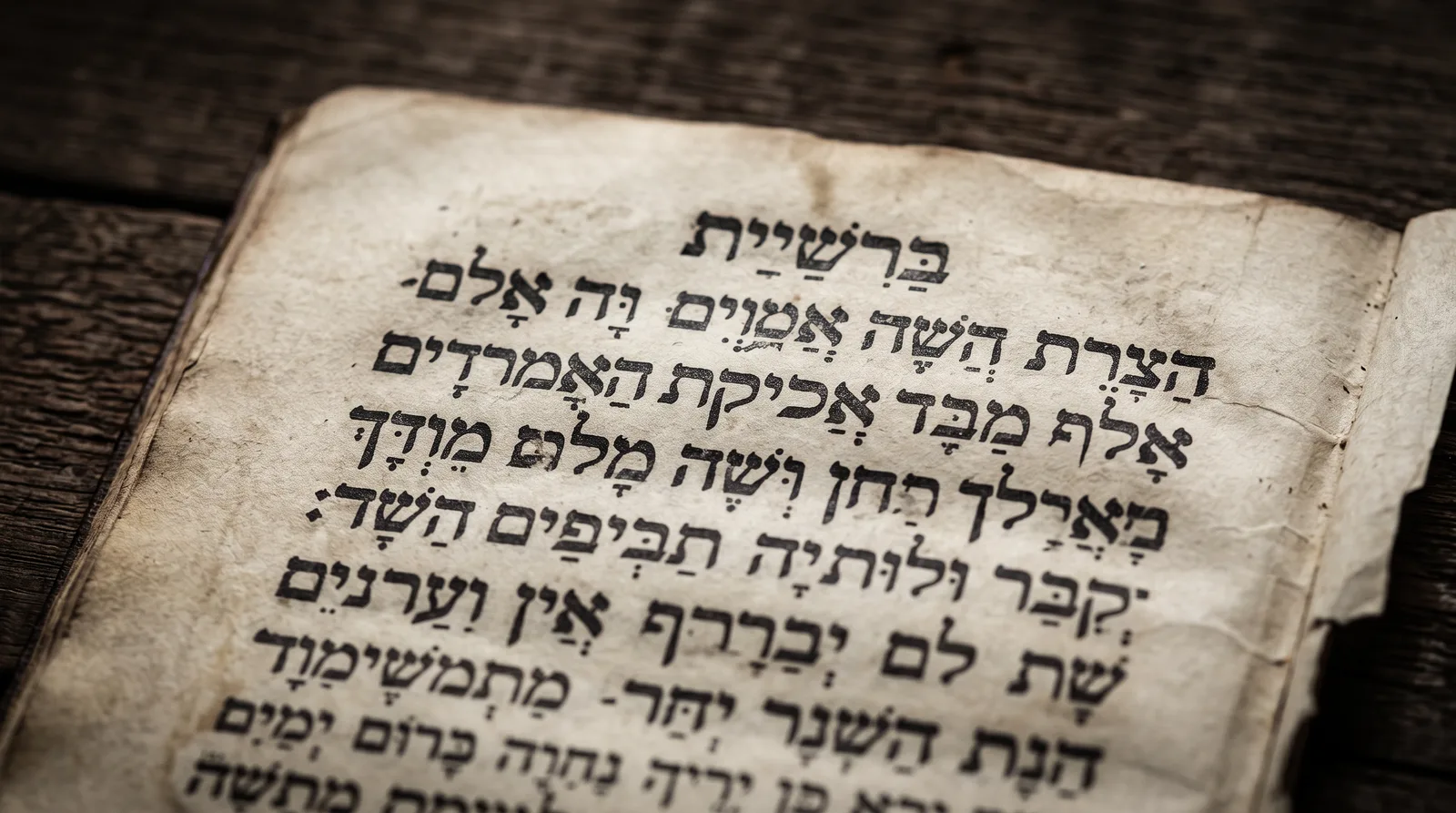
Most people who try to learn Biblical Hebrew don't fail because the language is impossibly hard. They fail because nobody handed them a map. They memorize the alphabet, pick up a textbook, stall out somewhere around verb paradigms, and quietly conclude they're not "language people." They are. They just didn't know where they were going.
Here is the map.
Stage 1: The Alphabet and Vowel System (Weeks 1–2)
Biblical Hebrew uses a 22-letter consonantal alphabet written right to left. Before you touch a single vocabulary word or grammar rule, you need to own these letters — read them automatically, without hesitation.
Don't rush this. Flashcard the letters daily until recognition is instant. Then layer in the vowel pointing system (called nikud). Biblical Hebrew was originally written with consonants only; the vowel marks were added by medieval scribes called the Masoretes to preserve pronunciation. Modern students study the pointed text, so you need to read both consonants and vowels fluently before grammar makes sense.
Practical tip: Write each letter by hand repeatedly. The muscle memory speeds recognition far more than staring at a screen.
Stage 2: Foundational Grammar — Nouns, Pronouns, and the Article (Weeks 3–6)
Once you can read the script, you build the grammatical skeleton. Hebrew nouns carry gender (masculine or feminine) and number (singular, plural, dual). The definite article (ha-) attaches directly to the noun and causes changes in the following consonant — a pattern called dagesh forte. Pronouns agree with their antecedents in gender and number.
Work through these systematically. At this stage, every paradigm you memorize is load-bearing — later material stacks on top of it. Don't skip the dual forms or the construct chain (the Hebrew way of expressing possession like "the word of the Lord"). These patterns appear on nearly every page of the Old Testament.
Stage 3: The Verb System — The Heart of Biblical Hebrew (Weeks 7–16)
This is where most beginners either commit or quit. The Hebrew verb system is genuinely different from English. Hebrew organizes verbs by aspect (completed vs. ongoing action) rather than by tense the way English does. The two primary conjugations — the Qal Perfect and the Qal Imperfect — will occupy you for weeks, and that's exactly right.
Master the Qal stem first, in both strong (regular) and weak (irregularly behaving) verb roots. Then work through the derived stems: Niphal, Piel, Pual, Hiphil, Hophal, and Hithpael. Each stem modifies the basic meaning of the root in predictable ways — passive, causative, reflexive, intensive. Learning them systematically means you can decode thousands of verb forms you've never seen before.
What to drill: Paradigm tables, yes — but always pair them with actual biblical examples. Seeing wayyiqtol in Genesis 1:3 anchors the form in a way that flashcards alone never will.
Stage 4: Vocabulary — The 500-Word Core (Ongoing from Week 1)
Start vocabulary work on Day 1 and never stop. Prioritize by frequency: words that appear 500 or more times first, then 200, then 100. By the time you've internalized the top 500 Hebrew words, you have coverage over the majority of the running words in the Hebrew Bible.
Use spaced-repetition software. Review every day, even when it's only ten minutes. Vocabulary gaps are the most common reason intermediate students stall when they finally open the text.
Stage 5: Syntax and Reading Connected Text (Months 4–6)
Grammar describes the pieces. Syntax explains how they work together across clauses, sentences, and paragraphs. This is where the language stops feeling like a puzzle and starts feeling like communication.
Study the waw-consecutive constructions that drive Hebrew narrative. Learn how subordinate clauses function. Practice identifying discourse patterns — how a biblical author signals emphasis, contrast, or summary. At this stage, start reading actual biblical prose: Genesis 1–3 is the classic entry point. The vocabulary is manageable, the grammar is representative, and the text rewards close attention.
Read slowly. Parse every verb. Look up what you don't know. This is not a sign that you're behind — it's exactly what skilled readers do.
Stage 6: From Reader to Exegete
Once you're moving through Genesis with reasonable fluency, you're ready to go deeper: text criticism, poetic syntax, and the interpretive questions that only the Hebrew text can answer. This is where a more guided course environment pays off — not because you can't read on your own, but because a trained guide can show you what to notice and why it matters theologically.
That's what my courses are built for. Biblical Hebrew Roots is where the roadmap above begins. When you're ready to move into intermediate grammar, Biblical Hebrew I and Biblical Hebrew II take you through the full grammatical curriculum with careful, text-grounded instruction. And if you want to reach the level where you're doing real scholarly exegesis — Hebrew Exegesis IV and Hebrew Syntax Mastery are where that work happens.
Pick your stage. Start today. The text has been waiting a long time, and it will reward every hour you give it.