Pass the CLEP Psychology Exam on Your First Try
24 laser-focused lessons cover every high-yield topic the exam actually tests — so you earn real college credit without sitting through a semester-long course.

"You don't need a semester — you need the right roadmap, the right tools, and someone who actually believes you can do this."— Leigh Baumann
What you'll learn
What you'll be able to do
- Diagnose your own knowledge gaps with a placement assessment and follow a personalized study roadmap that skips what you already know
- Master every high-yield CLEP Psychology content domain — from biological bases of behavior to social psychology — at the depth the exam actually tests
- Apply proven test-taking strategies to identify correct answers quickly, eliminate distractors confidently, and manage exam time under pressure
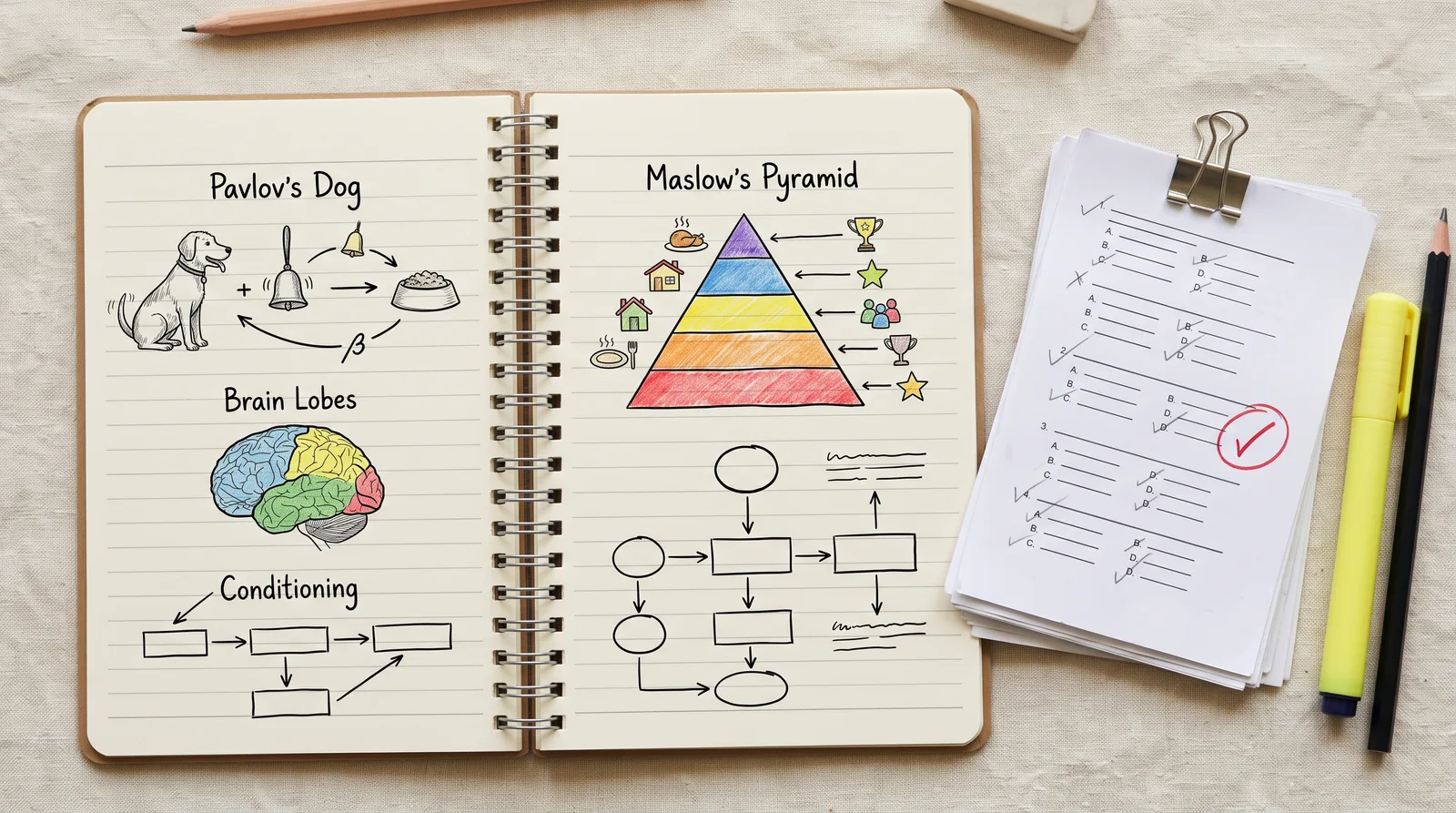
- Recall complex theories, key researchers, and psychological terminology using mnemonics, concept maps, and comparison charts built specifically for CLEP
- Score at or above the 85% proficiency threshold on full-length CLEP-style practice exams before ever sitting the real test
- Walk into exam day with demonstrated readiness, reduced test anxiety, and a clear strategy — maximizing your chance of passing on the first attempt
How it works
A school that adapts to you
This isn't a set of static videos. Every lesson is generated live and tuned to where you actually are.
We learn your level
A quick placement check tailors your starting point so you're never bored or lost.
Lessons adapt as you go
Each lesson is written for your pace and your goal, adjusting as your skills grow.
Your AI coach keeps you moving
Checkpoints, feedback, and gentle nudges turn progress into a real result.
The curriculum
What's inside your school
8 modules · 21 lessons

Diagnostic, Orientation & Your Personalized Study Roadmap
Before a single content lesson begins, students orient themselves to the CLEP Psychology exam—its structure, scoring scale, content weights, and passing thresholds—and then sit a full-length diagnostic that maps every answer to a specific content domain. The gap-analysis output generates a personalized study roadmap: high scorers skip or accelerate through familiar modules, while beginners receive a sequenced path with targeted reinforcement flags. This module is the strategic backbone of the entire course and directly serves the outcome of diagnosing knowledge gaps and skipping what students already know.
- 1.1CLEP Psychology Decoded: Exam Structure, Scoring & What Actually MattersIncluded
- 1.2Full-Length Diagnostic Assessment & Gap AnalysisIncluded
Research Methods, History & the Science of Psychology
CLEP consistently tests research methods, statistics, and historical perspectives—content that underpins every later topic. Placing this module second ensures students can read and interpret the psychological studies referenced throughout the rest of the course and in exam scenarios. Students learn how psychology became a science, the major schools of thought they must recognize by name, the research designs that appear repeatedly on CLEP, and the statistical and ethical principles the exam tests at surface and applied levels. Foundational here means every subsequent content domain lands with more depth and test-ready precision.
- 2.1How Psychology Works: History, Perspectives & Major Schools of ThoughtIncluded
- 2.2Research Methods, Statistics & Ethical GuidelinesIncluded
Biological Bases of Behavior, Sensation & Perception
Biological psychology, sensation, and perception together represent one of the largest weighted content areas on the CLEP exam. This module builds from the microscopic (neurons, neurotransmitters) up through genetics, the endocrine system, and finally into how sensory information is processed and interpreted. States of consciousness—sleep, dreams, hypnosis, and psychoactive drugs—are included here because they are biologically grounded and frequently grouped with perception content on CLEP. The progressive inside-out sequencing (cell → system → experience) mirrors how the exam clusters these topics and prevents cognitive overload.
- 3.1The Brain, Nervous System & NeurotransmittersIncluded
- 3.2Genetics, Evolutionary Psychology & the Endocrine SystemIncluded
- 3.3Sensation, Perception & States of ConsciousnessIncluded
Learning, Memory, Cognition & Intelligence
Learning and memory together account for a substantial slice of CLEP content, and cognition and intelligence round out this cluster. The sequencing within this module follows the natural information-processing chain: first, how behavior is shaped by experience (learning), then how information is encoded and retrieved (memory), then how we use stored knowledge to think and communicate (cognition), and finally how we measure mental ability (intelligence). This logical chain mirrors both CLEP's content groupings and students' intuitive understanding, making complex theories easier to retain and apply under timed conditions.
- 4.1Classical & Operant ConditioningIncluded
- 4.2Memory: Encoding, Storage, Retrieval & ForgettingIncluded
- 4.3Thinking, Language & Problem SolvingIncluded
- 4.4Intelligence: Theories, Testing & ControversiesIncluded
Lifespan Development, Motivation, Emotion & Personality
This module groups the three content areas that CLEP treats as interrelated dimensions of the developing, striving, feeling person. Lifespan development comes first because Erikson's stages, Piaget's stages, Kohlberg's moral reasoning, and attachment theory provide named frameworks that also reappear in the personality and motivation lessons. Motivation and emotion follow naturally—why we act and what we feel—before personality theory synthesizes biological, psychodynamic, behavioral, cognitive, and humanistic explanations of who we are. This sequencing prevents redundancy while reinforcing cross-cutting concepts like Maslow (who appears in both motivation and humanistic personality theory).
- 5.1Lifespan Development: Physical, Cognitive & Socioemotional ChangesIncluded
- 5.2Motivation & EmotionIncluded
- 5.3Personality: Theories, Assessment & the Big FiveIncluded
Psychological Disorders & Treatment Approaches
Psychological disorders and treatment approaches together represent the single largest content domain on the CLEP Psychology exam—making this the highest-stakes module in the course. Students learn to classify disorders using DSM-5 criteria at the recognition level, distinguish between major disorder categories by their defining symptoms, and understand the biopsychosocial and diathesis-stress explanations that the exam favors over purely medical models. Treatment approaches follow immediately so students can connect each disorder family to its evidence-based treatments—a linkage CLEP tests directly. The 'CLEP Hack' flags in every lesson target the distractor patterns that cause the most score loss in this domain.
- 6.1Defining & Classifying Psychological DisordersIncluded
- 6.2Therapeutic Approaches: Psychotherapy, Biomedical & BeyondIncluded
Social Psychology
Social psychology is a highly testable, concept-dense domain that CLEP treats as a distinct content area. Students must recognize classic experiments (Milgram, Asch, Zimbardo, Darley and Latané) by name, understand the situational vs. dispositional attribution distinction that underlies the entire field, and apply group-dynamics concepts to novel scenarios. This module is placed near the end—after students have mastered individual psychology—because social behavior is most meaningfully understood as the interaction between the individual processes covered in earlier modules and the social context covered here.
- 7.1Social Influence, Attitudes & AttributionIncluded
- 7.2Group Dynamics, Prejudice & Prosocial BehaviorIncluded
CLEP-Style Practice Exams, Score Mastery & Exam Day Readiness
The final module transforms all content knowledge into demonstrated, exam-day performance. Three full-length, timed, CLEP-style practice exams are administered under progressively stricter test conditions, each followed by deep answer-explanation review, domain-level score analysis, and adaptive remediation for any domain falling below the 85% proficiency target. Between exams, students refine their test-taking strategy, consolidate remaining weak areas, and build the psychological readiness—confidence, reduced anxiety, and a clear execution plan—needed to perform on test day. No student advances to the next exam until scoring at or above the proficiency target on the previous one.
- 8.1Full-Length Practice Exam 1 & Comprehensive ReviewIncluded
- 8.2Full-Length Practice Exam 2, Adaptive Remediation & Strategy RefinementIncluded
- 8.3Full-Length Practice Exam 3, Final Score Verification & Exam Day Execution PlanIncluded
Who it's for
Is this you?

Homeschool Achievers
Homeschooled students ready to earn accredited college credit on their own schedule without enrolling in a traditional course.

Credit-Hungry High Schoolers
High school students who want to arrive at college with credits already earned and tuition costs already slashed.

Gap-Year Go-Getters
Gap-year learners who want to stay academically sharp and bank real college credit while living life outside the classroom.
Self-Directed Adults
Adult learners returning to education who need an efficient, no-nonsense path to college credit that respects their time.

Budget-Conscious Families
Students and families determined to cut the cost of a college degree by testing out of introductory courses wherever possible.
First-Time CLEP Test-Takers
Anyone sitting a CLEP exam for the first time who wants a structured, confidence-building prep experience — not just a stack of flashcards.
Questions
Frequently asked
Your teacher
A note from your teacher
Leigh Baumann
Hey — I see you. You're smart, you're motivated, and you're not interested in sitting through a semester of college lectures just to earn credit for something you could learn on your own terms. Maybe you're a homeschooler charting your own path. Maybe you're a high schooler who wants to show up to college with credits already in the bank. Maybe you took a gap year and you're ready to prove what you know. Whatever brought you here, I want you to know: you are exactly who this course was built for.\n\nHere's the honest truth about the CLEP Psychology exam — it's very passable, but only if you study the right things. The exam tests specific content domains at a specific depth, and most students either over-prepare in areas that barely show up or blow past the topics that carry the most weight. This course fixes that from day one. We start with a diagnostic assessment that maps your personal knowledge gaps, then we build your roadmap around your starting point — not some imaginary average student's.\n\nFrom there, we move fast and we make it stick. I'm talking mnemonics that actually lodge in your brain, real-world stories that make Pavlov and Freud feel like people you know, and comparison charts that untangle the theories and researchers the exam loves to mix up. We cover every high-yield domain — neuroscience, learning, memory, cognition, development, disorders, social psychology — at exactly the depth the exam tests. No fluff. No filler. Just the stuff that gets you the credit.\n\nAnd then we test you. Three times, with full-length CLEP-style practice exams, adaptive review, and strategy refinement between each one. By the time you hit Exam Day Execution in the final lesson, you won't be hoping you pass — you'll know you're ready, because you'll have already proven it on paper.\n\nI built this course because I believe earning college credit should be about demonstrating what you know — not about how many hours you've sat in a classroom. You've got the drive. I've got the roadmap. Let's get you that credit.
— Leigh Baumann
Start your journey today
Join get instant access — learn at your own pace with an AI coach in your corner.
$39/mo
Recurring billing · cancel anytime
Secure checkout · Instant access
- 8 modules, 21 lessons
- AI-adaptive lessons tuned to your level
- Quizzes & checkpoints to lock in progress
- Your own AI learning coach
- Learn on any device, at your pace
- Full access for as long as you're subscribed