Think and treat like a seasoned clinician
A rigorous 16-week clinical deep-dive into pathomechanics, orthopedic assessment, and musculoskeletal rehabilitation — built for aspiring and practicing physical therapists who want to think and treat like seasoned clinicians. Move beyond textbook anatomy into real patient presentations, hands-on special testing, and structured rehab protocol design.
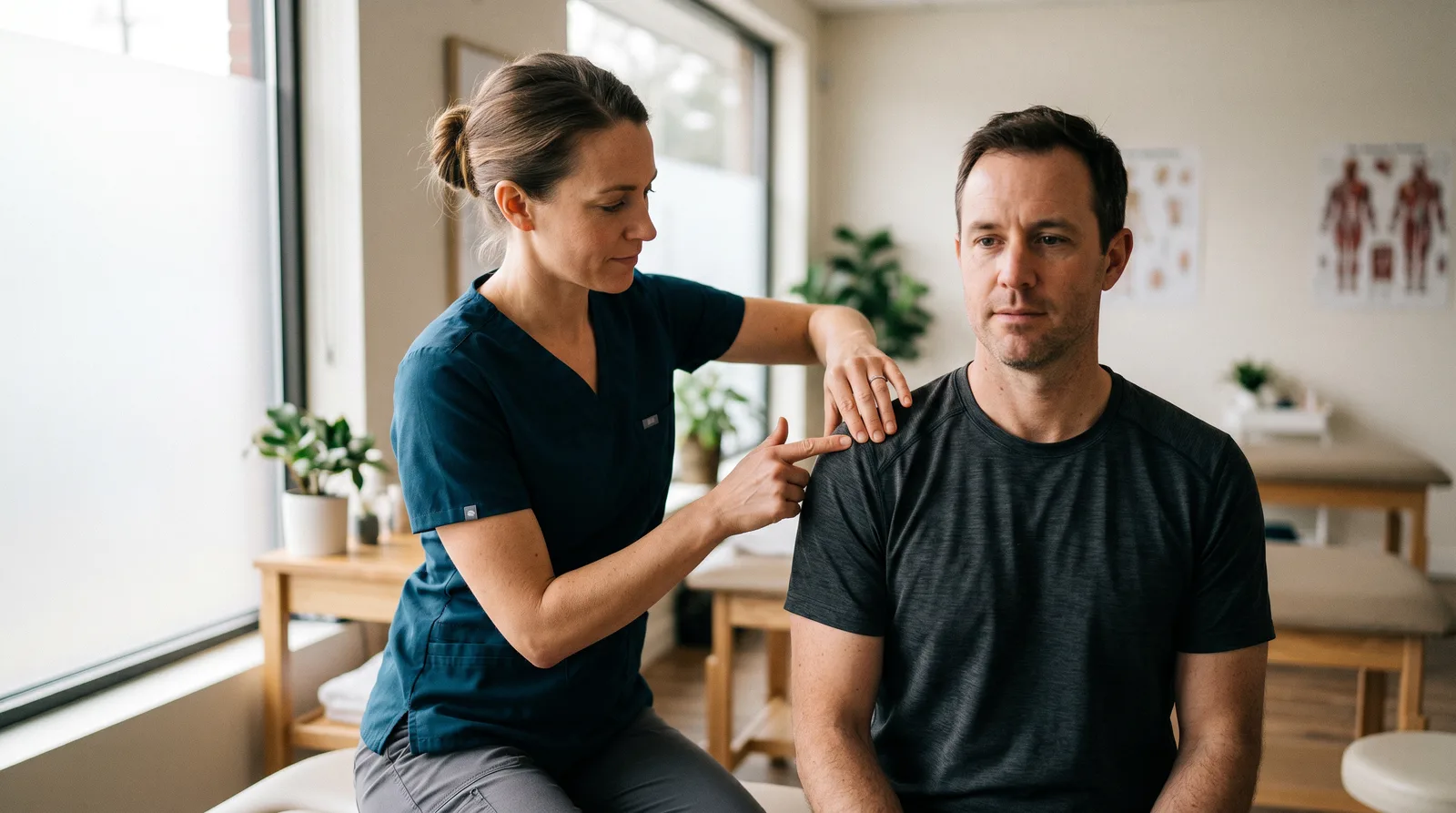
"I don't want you to remember the right answer — I want you to be able to reason your way to it in a room with a real patient."— Geoffrey Mitchell
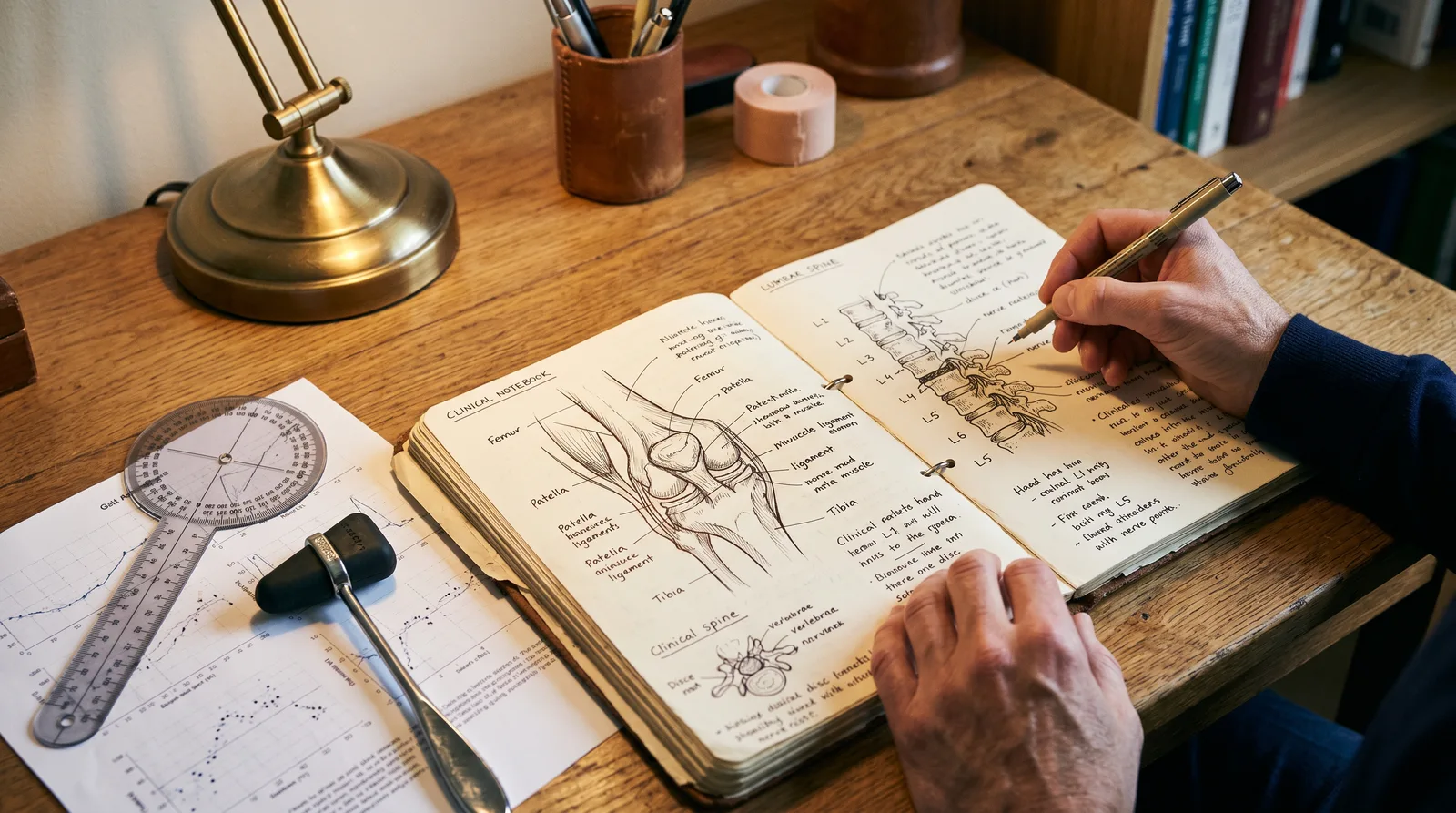
What you'll learn
What you'll be able to do
- Identify and interpret key orthopedic special tests for the spine, shoulder, knee, and hip — and articulate their sensitivity, specificity, and clinical implications.
- Analyze gait deviations and postural compensations using a systematic pathomechanical framework to pinpoint underlying structural dysfunction.
- Design a structured, 3-phase musculoskeletal rehabilitation protocol — from acute tissue protection through functional return-to-activity — for common orthopedic presentations.
- Apply manual muscle testing, passive range of motion assessment, and landmark palpation techniques accurately in a hands-on clinical lab setting.
- Reason through real patient case presentations using differential diagnosis principles, linking tissue pathology to biomechanical cause and rehabilitation strategy.
- Evaluate neuromuscular re-education and therapeutic modality selection for post-injury or post-surgical rehab, justifying clinical decisions with evidence-based rationale.
How it works
A school that adapts to you
This isn't a set of static videos. Every lesson is generated live and tuned to where you actually are.
We learn your level
A quick placement check tailors your starting point so you're never bored or lost.
Lessons adapt as you go
Each lesson is written for your pace and your goal, adjusting as your skills grow.
Your AI coach keeps you moving
Checkpoints, feedback, and gentle nudges turn progress into a real result.
The curriculum
What's inside your school
4 modules · 19 lessons

Clinical Anatomy, Tissue Mechanics, and Joint Pathology
This foundational block establishes the anatomical and physiological literacy every clinician needs before touching a patient. Students move through gross anatomy with a pathology-first lens, understand how tissues respond to load and injury, and learn the arthrokinematic principles that explain why joints fail — culminating in a structured framework for screening any joint in the body. All four weeks build sequentially: you cannot assess what you cannot name, and you cannot rehabilitate what you do not understand mechanically.
- 1.1Clinical Anatomy Through a Pathology LensIncluded
- 1.2Tissue Biomechanics and the Healing ContinuumIncluded
- 1.3Joint Mechanics, Arthrokinematics, and Capsular PatternsIncluded
- 1.4Orthopedic Evaluation Framework and Joint-by-Joint Pathology ScreeningIncluded
Pathomechanics and Biomechanical Assessment of the Axial Skeleton
Month 2 elevates the clinical gaze to the spine and postural system — the axial skeleton that governs load transfer, neurological protection, and regional movement quality for the entire body. Students systematically analyze posture, dissect gait as a clinical diagnostic tool, and drill into the specific pathomechanics of lumbar, thoracic, and cervical conditions. The block culminates in a mid-term practical where students must defend a live biomechanical assessment, integrating Month 1 foundations with the axial assessment skills developed here. Five lessons are included because the spine warrants depth that a single lesson cannot provide, and the mid-term assessment is an instructional event, not just an evaluation.
- 2.1Postural Assessment and Pathomechanical Compensation PatternsIncluded
- 2.2Gait Analysis: Deviations, Compensations, and Clinical InterpretationIncluded
- 2.3Lumbar Spine Pathomechanics: Disc, Facet, and StenosisIncluded
- 2.4Cervical Spine and Thoracic Pathomechanics: Radiculopathy, Instability, and Regional InfluenceIncluded
- 2.5Mid-Term Practical: Biomechanical Assessment DefenseIncluded
Peripheral Biomechanics and Rehabilitation Principles — Upper and Lower Extremities
With axial foundations secured, Month 3 moves systematically through every major peripheral joint region, applying the pathomechanical reasoning framework to real, high-prevalence orthopedic conditions. Five lessons cover the shoulder complex, elbow-wrist-hand, hip and pelvis, knee, and foot-ankle in that order — top-down, respecting the kinematic chain. For each region, students identify the key pathologies, master the primary special tests, understand the biomechanical drivers, and begin designing introductory rehabilitation progressions. This month directly feeds the final case study and builds the clinical vocabulary students need for Month 4's rehabilitation design and modality selection.
- 3.1Shoulder Complex Pathomechanics: Impingement, Instability, and Rotator Cuff DysfunctionIncluded
- 3.2Elbow, Wrist, and Hand: Overuse Pathomechanics and Load ManagementIncluded
- 3.3Hip and Pelvis: Pathomechanics of FAI, Gluteal Dysfunction, and Hip OAIncluded
- 3.4Knee Pathomechanics: ACL, Meniscus, and Patellofemoral SyndromeIncluded
- 3.5Foot, Ankle, and Lower Chain: Plantar Fasciitis, Ankle Instability, and Kinematic Chain EffectsIncluded
Therapeutic Modalities, Neuromuscular Re-education, and Case-Based Functional Rehab
The final block synthesizes everything that has come before into clinical action. Students learn how to select and justify therapeutic modalities with evidence-based rigor, how to retrain the neuromuscular system after injury disrupts it, and how to architect a complete 3-phase rehabilitation protocol from first contact to return-to-activity. The block culminates in a cumulative final case-study presentation — the course's highest-order assessment — where students must integrate pathomechanics, biomechanical assessment, differential reasoning, and rehabilitation protocol design into a single coherent clinical argument. A prerequisite check at the start of each lesson ensures Month 3 concepts are actively retrieved before new content is layered on top.
- 4.1Therapeutic Modalities: Evidence, Selection, and Clinical JustificationIncluded
- 4.2Neuromuscular Re-education: Motor Control, Proprioception, and Post-Injury RetrainingIncluded
- 4.3Designing 3-Phase Rehabilitation Protocols: From Acute Protection to Functional ReturnIncluded
- 4.4Advanced Clinical Reasoning: Differential Diagnosis and Complex Case ManagementIncluded
- 4.5Final Case Study Presentation: Comprehensive Rehabilitation Protocol DefenseIncluded
Who it's for
Is this you?

Pre-PT Undergraduates
Build the clinical reasoning foundation that makes your PT school application — and your first year — stand apart from peers who only studied for the GRE.

DPT Students
Translate everything you've learned in the classroom into the systematic orthopedic assessment and protocol design skills that clinical rotations will demand of you.

Physical Therapy Assistants
Deepen your understanding of the pathomechanical rationale behind every intervention you carry out, and sharpen the clinical judgment that elevates your practice.

Athletic Trainers
Add a structured orthopedic rehabilitation framework — from acute tissue protection to functional return — to the assessment skills you already bring to the field and clinic.

Kinesiology Majors
Move beyond exercise science theory into real pathomechanics, special testing, and rehab protocol design that opens doors to graduate-level clinical programs.

Early-Career Rehab Clinicians
Systematize the clinical reasoning you've been developing on the job — and gain the differential diagnosis and complex case management skills that experience alone doesn't always build.
Questions
Frequently asked
Your teacher
A note from your teacher
Geoffrey Mitchell
If you're reading this, there's a good chance you already know anatomy. You can name the structures, recite the special tests, and describe what a rotator cuff tear looks like on paper. And yet — when a real patient walks in, loads the joint, or compensates in a way your textbook never illustrated — you're not as certain as you want to be. That gap between knowledge and clinical confidence is exactly what this lab is built to close.
I designed Clinical Kinesiology Lab because I kept seeing the same problem in students and early-career clinicians: tremendous foundational knowledge paired with underdeveloped clinical reasoning. They could identify a positive Hawkins-Kennedy test. They couldn't tell you why that finding connected to the patient's scapular dyskinesis, or what that meant for their phase-one rehabilitation priorities. Memorization and reasoning are not the same skill — and only one of them will make you an exceptional clinician.
This is a 16-week curriculum that takes you through every major orthopedic region — spine, shoulder, hip, knee, foot — not as a checklist of structures, but as a system of interacting biomechanical forces, tissue vulnerabilities, and compensation patterns. You will learn to read a gait deviation and trace it upstream. You will learn to interpret special test clusters, not just individual tests. You will learn to build a rehabilitation protocol that accounts for tissue healing timelines, neuromuscular retraining, and functional return criteria — and to defend every decision you make.
The two practical assessments in this course are non-negotiable. The Biomechanical Assessment Defense at midterm asks you to analyze and argue a clinical presentation on its merits. The Final Case Study Presentation asks you to build and defend a comprehensive orthopedic rehabilitation protocol from the ground up. These are not easy. They are not meant to be. They are the kind of thinking your patients will depend on.
I don't reward rote answers in this lab. I reward the student who can look at a complex knee presentation, account for the lumbar and hip biomechanics influencing it, and propose a phased rehab plan with a clear rationale. That student becomes the clinician who other people send their difficult cases to. Come ready to be challenged — and to rise to it.
Whether this lab is your first real clinical reasoning experience or a systematic sharpening of skills you've been developing for years in practice, I'm glad you're here. Let's get to work.
— Geoffrey Mitchell
Start your journey today
Join get instant access — learn at your own pace with an AI coach in your corner.
$60/mo
Recurring billing · cancel anytime
Secure checkout · Instant access
- 4 modules, 19 lessons
- AI-adaptive lessons tuned to your level
- Quizzes & checkpoints to lock in progress
- Your own AI learning coach
- Learn on any device, at your pace
- Full access for as long as you're subscribed