Master compliant, evidence-based cognitive disability care from assessment to auditable record
The definitive professional training platform for Board Certified Cognitive Specialists, psychologists, and allied clinicians mastering compliant, evidence-based cognitive disability assessment, diagnosis, and coordinated care delivery—from screening tools to telehealth workflows and auditable records.

"You bring the clinical expertise; I'll give you the integrated systems, regulatory precision, and procedural frameworks that make every layer of your practice as defensible as your clinical judgment."— Pauline Smith EdD
What you'll learn
What you'll be able to do
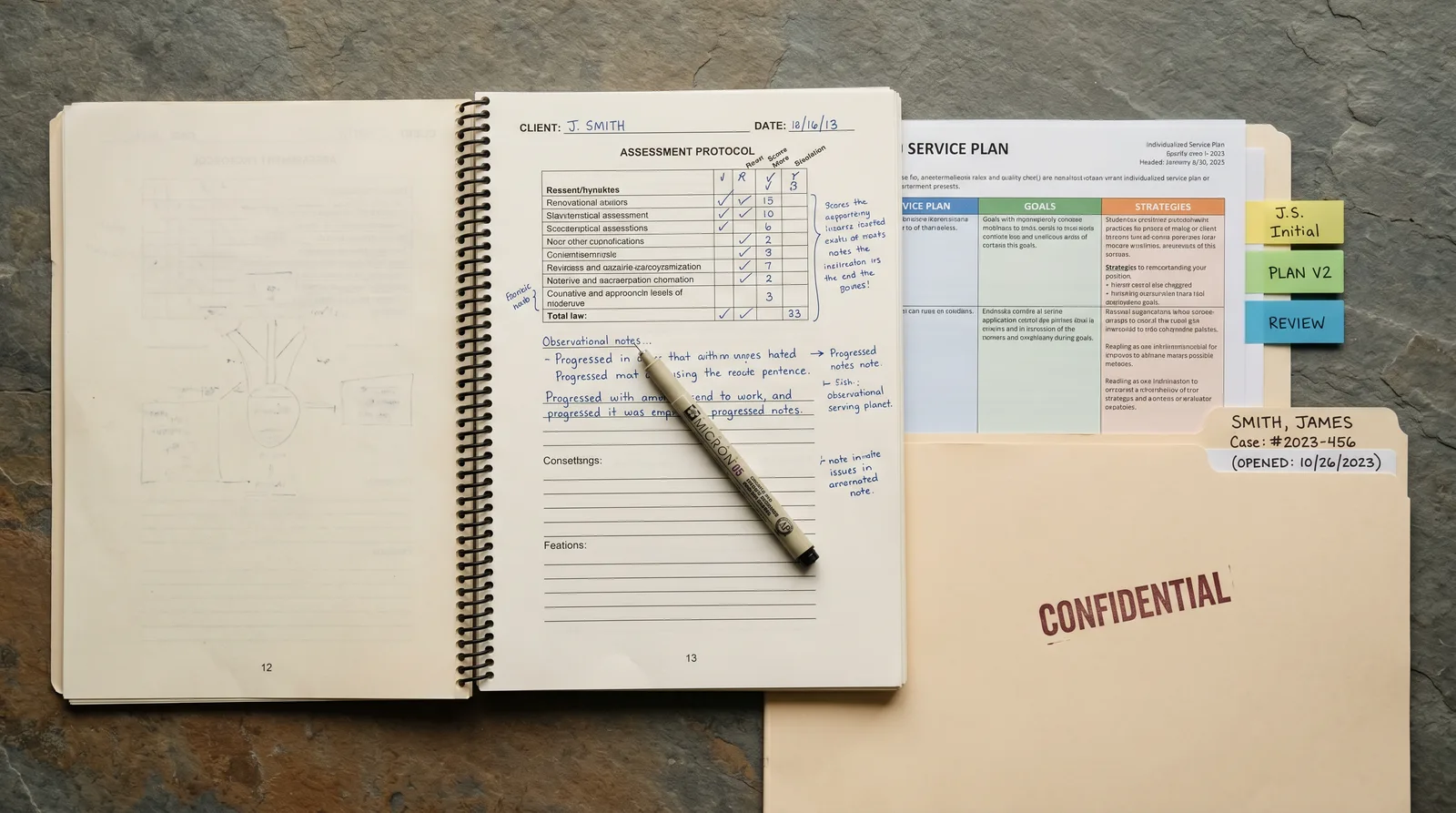
- Select, administer, and score validated evidence-based cognitive screening and assessment instruments appropriate to client age, presentation, and diagnostic question
- Accurately document diagnostic impressions and differential diagnoses within licensed scope of practice, generating defensible, clear findings reports for clients, families, and multidisciplinary teams
- Design individualized treatment and service plans that integrate evidence-based interventions, measurable goals, and coordinated referral pathways across educational, clinical, and community settings
- Architect and execute HIPAA- and FERPA-compliant telehealth and in-person care workflows, including informed consent, session documentation, and secure data handling
- Maintain fully auditable clinical records—covering assessments, progress monitoring notes, referrals, and resource libraries—that satisfy regulatory review and care-team accountability standards
- Lead and coordinate family, school, and care-team communication using structured reporting frameworks that translate complex cognitive findings into actionable, plain-language guidance
How it works
A school that adapts to you
This isn't a set of static videos. Every lesson is generated live and tuned to where you actually are.
We learn your level
A quick placement check tailors your starting point so you're never bored or lost.
Lessons adapt as you go
Each lesson is written for your pace and your goal, adjusting as your skills grow.
Your AI coach keeps you moving
Checkpoints, feedback, and gentle nudges turn progress into a real result.
The curriculum
What's inside your school
6 modules · 25 lessons

Foundations of Cognitive Disability Assessment & Scope of Practice
Establishes the conceptual, ethical, and regulatory bedrock that all subsequent clinical work depends on. Learners ground themselves in how cognitive disabilities are classified, what legal frameworks govern data and privacy, and what professional accountability looks like before touching any assessment instrument or client record. This module is intentionally first — no clinical skill is safe without this foundation.
- 1.1Cognitive Disability Taxonomy & Diagnostic FrameworksIncluded
- 1.2Lifespan Considerations & Developmental ContextIncluded
- 1.3HIPAA & FERPA Compliance for Cognitive Disability CliniciansIncluded
- 1.4Ethics, Scope, and Professional Accountability in Cognitive PracticeIncluded
Evidence-Based Screening & Cognitive Assessment Instruments
Develops the core clinical assessment competency: knowing which validated instrument to choose, how to administer and score it with fidelity, and how to interpret results in context. Coverage spans the full range of cognitive, intellectual, autism, adaptive behavior, neuropsychological, memory, and attention instruments. Cultural, linguistic, and sensory accommodation considerations are embedded throughout rather than treated as an afterthought.
- 2.1Assessment Selection: Matching Instruments to Referral QuestionsIncluded
- 2.2Cognitive & Intellectual Assessment: Administration & ScoringIncluded
- 2.3Autism, Adaptive Behavior, and Neurodevelopmental Screening & AssessmentIncluded
- 2.4Neuropsychological, Memory & Attention AssessmentIncluded
- 2.5Culturally Responsive & Trauma-Informed Assessment PracticeIncluded
Diagnostic Documentation, Differential Diagnosis & Findings Reporting
Translates assessment data into clinically sound, legally defensible, and clearly written diagnostic documentation. Learners move from raw scores through clinical formulation and differential reasoning to fully structured written reports and verbal communication with non-specialist audiences. This module directly addresses the target outcome of generating defensible findings reports and communicating complex findings in plain language.
- 3.1Differential Diagnosis Reasoning & Clinical FormulationIncluded
- 3.2Writing Defensible, Clear Cognitive Assessment ReportsIncluded
- 3.3Communicating Findings to Families, Schools & Care TeamsIncluded
Individualized Treatment & Service Plan Design
Bridges assessment findings to actionable, coordinated care. Learners select evidence-based interventions matched to specific cognitive disability profiles, write SMART goals tied to measurable outcomes, and design referral and care coordination pathways across educational, clinical, and community contexts. A newly added lesson on family and school involvement ensures that plans are not clinician-only documents but living tools co-constructed with the people who implement them daily.
- 4.1Evidence-Based Intervention Selection for Cognitive DisabilitiesIncluded
- 4.2Writing SMART Goals & Measurable Outcomes for Cognitive PlansIncluded
- 4.3Coordinated Referral Pathways & Care Team IntegrationIncluded
- 4.4Family & School Involvement in Treatment PlanningIncluded
HIPAA/FERPA-Compliant Telehealth & In-Person Care Workflows
Operationalizes compliance across the full care delivery lifecycle — from platform selection and informed consent through session documentation and cross-setting coordination. Learners design, test, and critique complete clinical workflows for both telehealth and in-person modalities, ensuring every step is defensible under HIPAA, FERPA, and applicable state telehealth laws. A new lesson on crisis and safety protocols addresses a gap the original draft left unresolved for this high-vulnerability population.
- 5.1Telehealth Platform Selection & Technical ComplianceIncluded
- 5.2Informed Consent, Client Onboarding & Session DocumentationIncluded
- 5.3In-Person Assessment & Clinical Workflow Safety ProtocolsIncluded
- 5.4Crisis Intervention & Safety Planning for Cognitive Disability ClientsIncluded
- 5.5Cross-Setting Care Coordination & Workflow IntegrationIncluded
Auditable Records, Progress Monitoring & Resource Systems
Builds the infrastructure layer of clinical practice: the record systems, data workflows, consent chains, and resource libraries that make everything else reviewable, reproducible, and regulatorily defensible. This module also closes the loop between assessment and ongoing care by teaching systematic progress monitoring that informs real-time clinical decision-making. The original draft structure is retained and strengthened with a new lesson dedicated to data-informed clinical decision-making.
- 6.1Clinical Record Architecture & Audit-ReadinessIncluded
- 6.2Progress Monitoring: Data Systems & Clinical Decision-MakingIncluded
- 6.3Referral Tracking, Consent Chains & Compliance LoggingIncluded
- 6.4Resource Libraries, Family Psychoeducation & Care-Team Knowledge SharingIncluded
Who it's for
Is this you?

Board Certified Cognitive Specialists
BCCSs seeking the integrated assessment, documentation, and compliance systems that match the full scope and rigor their credential demands across every care setting.

Licensed Psychologists
Psychologists who conduct cognitive and neuropsychological assessments and need procedurally current, audit-ready documentation frameworks and coordinated care workflows.

Certified Autism Specialists
CASs delivering neurodevelopmental assessment and intervention who need structured guidance on instrument selection, diagnostic formulation, and HIPAA/FERPA-compliant record systems.

School-Based Diagnosticians
Educational diagnosticians operating at the clinic-school interface who must navigate FERPA compliance, IEP-aligned reporting, and cross-setting care coordination simultaneously.

Telehealth Clinicians
Practitioners who have expanded into remote cognitive disability services and need technically compliant telehealth workflows, informed consent protocols, and secure documentation standards.

Psychiatrists in Cognitive Care
Psychiatrists coordinating cognitive disability services within multidisciplinary teams who need rigorous differential diagnosis frameworks and defensible findings reporting at a clinical leadership level.
Questions
Frequently asked
Your teacher
A note from your teacher

Pauline Smith EdD
If you are reading this, you almost certainly did not arrive at your credential without rigorous training, supervised hours, and hard-won clinical judgment. You know how to assess. You know how to think diagnostically. What brings experienced practitioners to CogCare Clinical Academy is rarely a gap in foundational clinical knowledge—it is the growing complexity of everything surrounding the clinical encounter itself.
The regulatory environment for cognitive disability practice has become more demanding, not less. HIPAA and FERPA intersect in ways that are genuinely complicated for practitioners who work across clinic and school settings. Telehealth introduced an entirely new layer of technical compliance requirements alongside the clinical ones. Multidisciplinary teams—educators, pediatricians, behavioral specialists, family advocates—expect reports and communications that are simultaneously defensible to a regulatory reviewer and comprehensible to a parent sitting at an IEP table. And the records that underpin all of it must be constructed to survive audit. This is the operational reality of modern cognitive disability practice, and it deserves training that addresses it at full professional depth.
CogCare Clinical Academy was built to meet that standard. The curriculum is written for practitioners who are already credentialed and want procedurally specific, evidence-grounded guidance they can apply immediately—not a survey of concepts they encountered in graduate school. Every module is organized around what you actually do in practice: select the right instrument for this referral question, write a findings report that holds up under scrutiny, design a service plan with measurable goals and coordinated referral pathways, document informed consent for a telehealth session in a HIPAA-compliant workflow, and build a record system that a payor or regulatory reviewer can navigate without ambiguity.
I want to address the objection I hear most often from experienced clinicians: "I already know how to do this." Perhaps you do—in the domains where your training was deepest. But I have found, consistently, that even highly skilled practitioners carry unexamined gaps in the surrounding infrastructure: the documentation frameworks, the compliance architecture, the structured communication protocols that translate sophisticated clinical work into coordinated, accountable care. Those gaps are not failures of competence; they are the predictable result of training systems that historically prioritized clinical skill over practice operations. This curriculum closes them.
You bring the clinical expertise. CogCare Clinical Academy provides the integrated systems, regulatory precision, and procedural frameworks to practice with the confidence that every layer of your work—from the assessment protocol to the audit-ready record—reflects the standard your credential demands. I invite you to join a community of practitioners who hold that standard as a shared professional commitment.
— Pauline Smith EdD
Start your journey today
Join get instant access — learn at your own pace with an AI coach in your corner.
$150/mo
Recurring billing · cancel anytime
Secure checkout · Instant access
- 6 modules, 25 lessons
- AI-adaptive lessons tuned to your level
- Quizzes & checkpoints to lock in progress
- Your own AI learning coach
- Learn on any device, at your pace
- Full access for as long as you're subscribed