Master the tools that make cross-team work actually work
Master the practical tools, language, and frameworks needed to align priorities, clarify ownership, and move shared work forward—across any team, function, or work style. Built for the modern hybrid workplace, where collaboration is rarely simple.

"I don't teach collaboration as a soft skill—I teach it as a set of precise tools for the specific moments where cross-team work breaks down."— Shani Roberts
What you'll learn
What you'll be able to do
- Recognize how differences in work styles, priorities, and communication preferences create collaboration friction—and how to work with those differences productively.
- Clarify shared goals, roles, decision rights, timelines, and success measures before a project begins to prevent costly misalignment.
- Build stronger, trust-based relationships with cross-functional partners and stakeholders across organizational boundaries.
- Spot collaboration breakdowns—unclear ownership, missed handoffs, shifting requirements—early enough to restore alignment before they escalate.
- Navigate competing priorities and ambiguous ownership using concrete language and decision-making frameworks suited to real workplace dynamics.
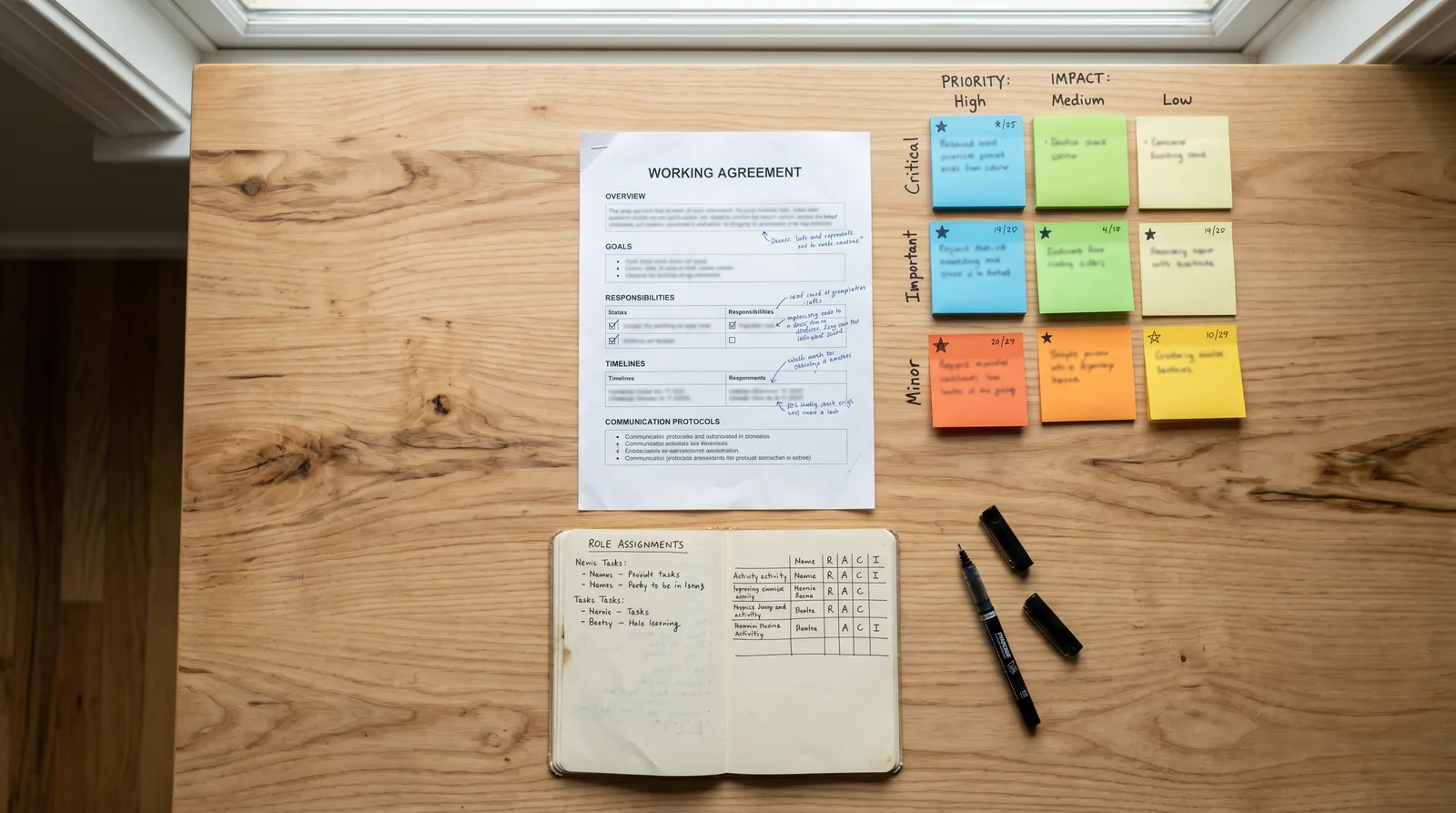
- Co-create durable working agreements that establish clear communication rhythms, meeting norms, escalation paths, and follow-through habits across teams.
How it works
A school that adapts to you
This isn't a set of static videos. Every lesson is generated live and tuned to where you actually are.
We learn your level
A quick placement check tailors your starting point so you're never bored or lost.
Lessons adapt as you go
Each lesson is written for your pace and your goal, adjusting as your skills grow.
Your AI coach keeps you moving
Checkpoints, feedback, and gentle nudges turn progress into a real result.
The curriculum
What's inside your school
5 modules · 18 lessons

Understand Work Styles and Collaboration Preferences
Before collaborating effectively, individuals must understand how people differ—in communication style, pace, planning preferences, decision-making approaches, and detail orientation. This module helps learners recognize that differences are not deficiencies, but unmanaged differences create friction. Learners build awareness of their own collaboration style and develop the vocabulary to work productively across those differences. This module serves as the foundation for everything that follows.
- 1.1How Work Styles Shape CollaborationIncluded
- 1.2Reading the Room Across Roles and FunctionsIncluded
- 1.3Differences as Data, Not ProblemsIncluded
Create Alignment Before Work Begins
Most collaboration problems are alignment problems—and most alignment problems are preventable. This module equips learners with concrete tools, conversations, and frameworks to establish shared understanding before a project or collaboration kicks off. Learners practice clarifying goals, outcomes, roles, decision rights, success measures, and expectations in a way that prevents costly misalignment downstream. This module directly addresses the conditions that make Modules 4 and 5 necessary—and dramatically reduces how often teams end up there.
- 2.1The Alignment Conversation Most Teams SkipIncluded
- 2.2Clarifying Roles, Responsibilities, and Decision RightsIncluded
- 2.3Setting Success Measures and Shared ExpectationsIncluded
Work Across Teams and Functions
Cross-functional collaboration requires more than goodwill—it requires the ability to understand how other teams operate, translate information across audiences, build relationships that span organizational boundaries, and work within systems that were not designed with collaboration in mind. This module gives learners practical tools and strategies for navigating organizational complexity, building cross-functional credibility, and reducing the friction that comes from silos, competing incentives, and mismatched mental models.
- 3.1Understanding How Other Teams OperateIncluded
- 3.2Translating Information Across AudiencesIncluded
- 3.3Building Stakeholder Relationships Across BoundariesIncluded
- 3.4Navigating Silos and Organizational BoundariesIncluded
Address Collaboration Breakdowns Early
Even well-aligned teams encounter breakdowns. This module helps learners recognize the early warning signs of collaboration friction—before a small problem becomes a significant one—and respond with practical, process-focused strategies. The emphasis is on restoring alignment and improving the system, not assigning blame or escalating prematurely. Learners develop a toolkit for handling the most common collaboration failure modes: unclear ownership, missed handoffs, competing priorities, shifting requirements, and delayed responses.
- 4.1Recognizing the Early Warning SignsIncluded
- 4.2Handling Unclear Ownership and Missed HandoffsIncluded
- 4.3Managing Shifting Requirements and Changing ExpectationsIncluded
- 4.4Addressing Competing Priorities and Delayed ResponsesIncluded
Build Working Agreements That Last
Working agreements are the structural backbone of durable collaboration—explicit, shared commitments about how a team will communicate, make decisions, handle conflict, follow through, and hold each other accountable. This module helps learners move from good intentions to practical, maintained agreements that make collaboration easier over time. Lessons build on everything from earlier modules—work styles, alignment tools, stakeholder relationships, breakdown recovery—and help learners codify those insights into sustainable team practices.
- 5.1What Working Agreements Are—and Why Teams Skip ThemIncluded
- 5.2Establishing Communication Rhythms and Meeting NormsIncluded
- 5.3Documentation, Follow-Through, and Accountability HabitsIncluded
- 5.4Escalation Paths and Knowing When to Use ThemIncluded
Who it's for
Is this you?

The cross-functional project lead
You're driving work across multiple teams without direct authority, and you need frameworks for alignment, ownership, and accountability that actually hold.
The emerging people manager
You're stepping into a leadership role and want to build the cross-team collaboration habits—working agreements, escalation paths, stakeholder relationships—that set your team up to succeed.

The remote or hybrid contributor
You collaborate primarily across distance and async channels, and you need tools that work when you can't just walk over to someone's desk to get alignment.

The business or functional partner
You sit at the intersection of multiple teams—HR, Finance, Operations, Legal—and spend your days translating priorities and managing expectations across organizational boundaries.

The individual contributor in a matrixed org
You report to one manager but take direction from several stakeholders, and you want concrete language for navigating competing priorities without burning relationships.

The team rebuilding after a breakdown
Your team has been through a rough project—missed handoffs, unclear ownership, trust erosion—and you want a structured way to reset and build more durable working norms.
Questions
Frequently asked
Your teacher
A note from your teacher
Shani Roberts
If you've ever sat in a cross-functional meeting and thought, "How did we get this misaligned?"—I built this school for that moment.
You came in prepared. You've been doing your part. But somewhere between the kickoff and today, ownership got blurry, priorities shifted on the other team's side, and now you're spending more energy on coordination than on the actual work. That's not a personal failure. It's what happens when organizations assume collaboration is intuitive and never give people the tools to do it well.
The truth is, working across teams and functions is one of the hardest skills in modern organizational life—and it's almost never taught directly. You're expected to build trust across boundaries, translate your work for stakeholders who don't share your context, navigate silos you didn't create, and drive shared outcomes without the authority to enforce anything. This school is my answer to that gap. Every module covers a specific, recurring moment where cross-team collaboration breaks down—and gives you the exact framework, language, or conversation structure you need to handle it.
We start where most collaboration problems actually begin: with differences in work styles, communication preferences, and priorities that teams treat as friction instead of data. From there, we move into the alignment conversations that most teams skip (and later regret), the mechanics of building real stakeholder relationships across organizational boundaries, and the early warning signs that a collaboration is heading off-track before it's too late to correct. We close by building the kind of working agreements that keep teams aligned not just at kickoff, but over the full life of a project.
Everything here is designed for the workplace as it actually exists—hybrid, matrixed, fast-moving, and full of competing roadmaps. No abstract theory. No advice that only works when everyone's in the same building. Just polished, practical tools you can bring into your next meeting, your next project launch, or your next difficult stakeholder conversation.
You already show up to this work with good intentions. Let me give you the frameworks to match them.
— Shani Roberts
Start your journey today
Join get instant access — learn at your own pace with an AI coach in your corner.
$150/mo
Recurring billing · cancel anytime
Secure checkout · Instant access
- 5 modules, 18 lessons
- AI-adaptive lessons tuned to your level
- Quizzes & checkpoints to lock in progress
- Your own AI learning coach
- Learn on any device, at your pace
- Full access for as long as you're subscribed