Master credentialing from application to approval
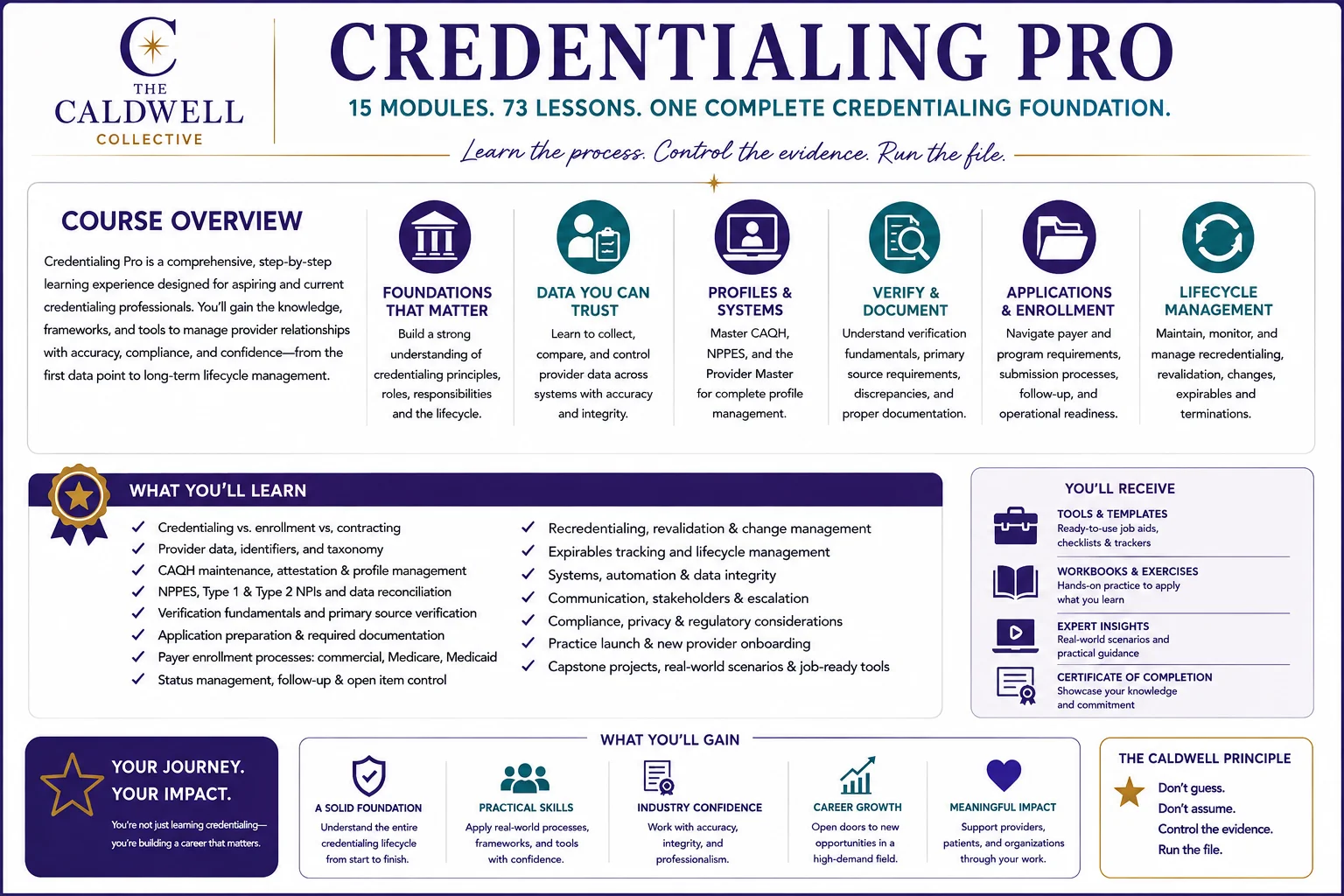
A step-by-step, process-driven program for healthcare administrators and billing professionals who need to credential providers faster, with fewer errors — and protect every dollar in the revenue cycle.
"Credentialing done right isn't just compliance — it's how you protect your providers, your organization, and every dollar you've earned."
— The Caldwell Collective

What you'll learn
What you'll be able to do
- Navigate the full provider credentialing lifecycle from initial application to approval without missing critical deadlines
- Conduct accurate primary source verification for licenses, education, and malpractice history
- Complete payer enrollment applications for commercial insurers and government programs (Medicare/Medicaid)
- Build and maintain a compliant provider credentials file that passes audits and re-credentialing reviews
- Identify and resolve the most common credentialing errors that delay provider start dates and insurance payments
- Track expirables — licenses, DEA certificates, board certifications — using a proactive monitoring system
How it works
A school that adapts to you
This isn't a set of static videos. Every lesson is generated live and tuned to where you actually are.
We learn your level
A quick placement check tailors your starting point so you're never bored or lost.
Lessons adapt as you go
Each lesson is written for your pace and your goal, adjusting as your skills grow.
Your AI coach keeps you moving
Checkpoints, feedback, and gentle nudges turn progress into a real result.
The curriculum
What's inside your school
15 modules · 72 lessons
Credentialing Foundations
Establishes the vocabulary, regulatory landscape, and key stakeholders every credentialing professional must know before touching an application.
- 1.1What Credentialing Is and Why It MattersIncluded
- 1.2Credentialing vs. Enrollment: Understanding the DifferenceIncluded
- 1.3Key Players and Governing BodiesIncluded
- 1.4The Provider Credentialing Lifecycle at a GlanceIncluded
- 1.5Credentialing Foundations Capstone: Putting It All TogetherIncluded
Building the Credentials File
Covers exactly what goes into a compliant provider credentials file, how to collect it efficiently, and how to organize it for audits and re-credentialing.
- 2.1Provider Data vs Organization DataIncluded
- 2.2NPI, TIN & Core IdentifiersIncluded
- 2.3Specialty, Taxonomy, & Practice LocationsIncluded
- 2.4Building the Provider MasterIncluded
- 2.5Organizing and Storing the Credentials FileIncluded
- 2.6Expirables Tracking SystemIncluded
Primary Source Verification
Trains learners to verify every credential directly at the source, correctly document results, and know what to do when something doesn't check out.
- 3.1CAQH ProView EssentialsIncluded
- 3.2Verifying Licenses, Education, and TrainingIncluded
- 3.3Verifying Malpractice History and Work HistoryIncluded
- 3.4Documenting PSV Results and Handling DiscrepanciesIncluded
- 3.5Understanding NPPESIncluded
- 3.6Reconciling CAQH, NPPES & The Provider MasterIncluded
- 3.7CAQH Maintenance & AttestationIncluded
Primary Source Verification & Credential Review
Break down every major credential type — licenses, DEA certificates, board certifications, education, training, work history, malpractice, and disclosures — so you know exactly what "verified" means for each one, where to get it, and what to do when something doesn't add up. This module draws a hard line between collected documents and confirmed facts, and gives you a clear escalation path when sanctions, exclusions, or adverse history surface.
- 4.1Collected vs. Verified — Understanding the Critical DifferenceIncluded
- 4.2Verifying Licenses, DEA Certificates, and Board CertificationsIncluded
- 4.3Education, Training, and Work History VerificationIncluded
- 4.4Malpractice History and Disclosure VerificationIncluded
- 4.5Sanctions, Exclusions, and Escalation ProtocolsIncluded
Payer Enrollment — Commercial Insurers
Guides learners through completing, submitting, and following up on enrollment applications with commercial insurance plans.
- 5.1How Commercial Payer Enrollment WorksIncluded
- 5.2Completing the Commercial Enrollment ApplicationIncluded
- 5.3Submitting Applications and Managing the Follow-Up QueueIncluded
- 5.4Effective Dates, Retroactive Billing, and Participation AgreementsIncluded
Payer Enrollment — Medicare and Medicaid
Covers the distinct rules, portals, and compliance requirements for enrolling providers in federal government programs.
- 6.1Medicare Enrollment Overview and PECOSIncluded
- 6.2Individual, Group, & Reassignment RelationshipsIncluded
- 6.3Initial Enrollment, Changes & RevalidationIncluded
- 6.4Completing a Medicare Enrollment Application in PECOSIncluded
Medicaid, Managed Care & Program-Specific Enrollments
Cut through Medicaid's layered complexity by learning how the program is structured, how providers, groups, and locations are linked in state systems, and how Managed Care Organization enrollment fits into — and depends on — your base Medicaid approval. You'll leave with a sequenced enrollment roadmap you can apply immediately to any state or MCO relationship.
- 7.1Medicaid Program FoundationsIncluded
- 7.2Provider, Group, and Location Relationships in State SystemsIncluded
- 7.3Managed Care Organizations and Your Medicaid Enrollment StrategyIncluded
- 7.4Dependencies and Enrollment SequencingIncluded
- 7.5Medicaid and MCO Enrollment CapstoneIncluded
Error Prevention, Audits, and Re-Credentialing
Equips learners to spot and fix the most damaging credentialing errors, pass audits confidently, and run a smooth re-credentialing cycle.
- 8.1The Most Common Credentialing Errors and How to Prevent ThemIncluded
- 8.2Auditing Your Own Credentials FilesIncluded
- 8.3Surviving a Payer or Accreditation AuditIncluded
- 8.4Running the Re-Credentialing CycleIncluded
- 8.5Building a Credentialing Policies and Procedures ManualIncluded
Credentialing Tracking, Follow-Up & Payer Communication
Once applications are submitted, the real work begins — monitoring status, chasing payers, responding to information requests, and documenting every move. This module gives you a complete system for staying in control of every active credentialing file from submission through approval, so nothing falls through the cracks and no deadline catches you off guard.
- 9.1Building Your Credentialing TrackerIncluded
- 9.2Credentialing Status ManagementIncluded
- 9.3Effective Payer Follow-UpIncluded
- 9.4Handling RFIs and Additional Information RequestsIncluded
- 9.5Professional Credentialing Notes and CommunicationIncluded
- 9.6Tracking and Follow-Up CapstoneIncluded
Provider Start Dates, Activation & Revenue-Cycle Readiness
Credentialing approval and billing readiness are not the same finish line — and confusing them is one of the most expensive mistakes a credentialing team can make. This module walks you through every step between receiving an approval and the moment a provider can legally see patients and generate a paid claim: decoding approval data, confirming true payer activation, managing partial and location-specific enrollment gaps, executing clean handoffs to billing and scheduling, and completing a capstone readiness check before day one.
- 10.1Approval Dates, Effective Dates, and What They Actually MeanIncluded
- 10.2Confirming True Payer ActivationIncluded
- 10.3Partial Activation and Location-Specific ReadinessIncluded
- 10.4Billing and Scheduling Handoffs That Protect RevenueIncluded
- 10.5Day-One Readiness CapstoneIncluded
Credentialing Exceptions, Risk & Escalation
Not every credentialing file is clean — and how you handle the ones that aren't defines the integrity of your organization's process. This module walks you through the high-stakes judgment calls: spotting red flags in provider histories, resolving conflicting source data, navigating denials and conditional approvals, and knowing exactly when and how to escalate beyond your role.
- 11.1Recognizing Adverse Information and High-Risk FindingsIncluded
- 11.2Navigating Conflicting Sources and Uncertain Provider StatusIncluded
- 11.3Role Boundaries and Escalation PathwaysIncluded
- 11.4Denials, Conditional Approvals, and Payer Adverse OutcomesIncluded
- 11.5Exceptions Capstone: Full-File AdjudicationIncluded
Credentialing Technology, Automation, Ai & Workflow Optimization
Move beyond manual spreadsheets and siloed inboxes by building a technology-powered credentialing operation. This module walks you through selecting and configuring credentialing software, mapping automated workflows, leveraging AI-assisted verification, and using dashboards and roster tools to keep provider data accurate, audit-ready, and always current.
- 12.1Credentialing Technology Foundations & Workflow MappingIncluded
- 12.2Master Provider Data, Automation Triggers & Exception QueuesIncluded
- 12.3AI-Assisted Credentialing & Human ReviewIncluded
- 12.4Credentialing Dashboards, KPIs & Automated ReportingIncluded
- 12.5Roster Automation, Bulk Data QA & Expirables Lifecycle ManagementIncluded
Provider Changes, Terminations, Offboarding & Practice Transitions
Every credentialing professional eventually faces the harder side of enrollment: something changes after activation. This module walks you through every category of mid-cycle change — from a provider's legal name update to a full practice closure — so you can execute each transition cleanly, protect active enrollments, and keep payers, regulators, and your revenue cycle in sync.
- 13.1Provider Demographic, Name & Professional Information ChangesIncluded
- 13.2Adding, Moving & Closing Practice LocationsIncluded
- 13.3Group, TIN, Organizational & Ownership ChangesIncluded
- 13.4Provider Terminations, Offboarding & Payer Relationship ClosureIncluded
- 13.5Credentialing Changes & Transitions CapstoneIncluded
Credentialing Quality Control, Audits & File Readiness
Walk through every quality control checkpoint that stands between a credentialing file and final approval — from your first self-audit and error correction workflow to QA sampling, documentation standards, and the definitive close-out review. By the end of this module you will be able to catch your own mistakes before a payer or auditor does, fix them fast, and hand off a file you'd stake your organization's revenue cycle on.
- 14.1Audit a Credentialing File Before You Call It CompleteIncluded
- 14.2Credentialing Errors, Corrections & When to EscalateIncluded
- 14.3File Organization, Naming Conventions & Documentation StandardsIncluded
- 14.4Credentialing QA Checklist, Second-Level Review & First-Pass AccuracyIncluded
- 14.5QA Sampling, Error Trending & Final File ReadinessIncluded
Course Summary
From Credentialing Foundations to Running the File
Congratulations—you've reached the end of Credentialing Pro.
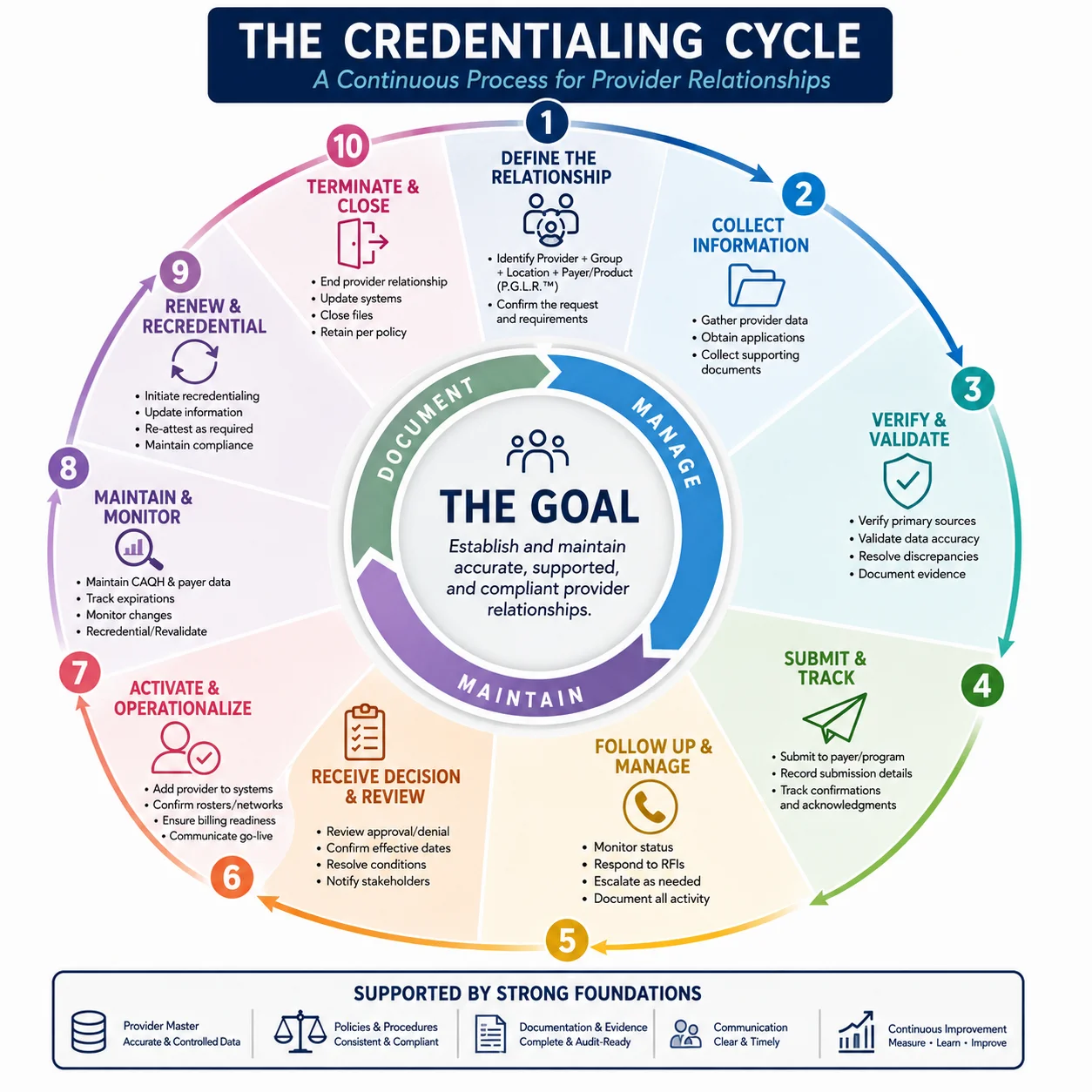
When you started this course, credentialing may have looked like a collection of applications, portals, documents, acronyms, payer rules, and deadlines.
But credentialing is much more than completing forms.
It is the process of building, supporting, monitoring, and maintaining provider relationships through accurate data, evidence, documentation, follow-up, and lifecycle management.
And throughout this course, you've learned how those pieces connect.
Think Back to Where We Started
We began with the foundations.
You learned the difference between:
Credentialing. Enrollment. Contracting.
You learned that although these functions interact, they are not interchangeable.
You also learned one of the most important principles in this entire course:
A provider can be credentialed without being enrolled, enrolled without being ready to bill, and contracted without every provider, location, or product relationship being operational.
That distinction changes how you approach the entire credentialing process.
You Learned to Understand the Relationship
Credentialing work is rarely about one provider in isolation.
You learned to think in terms of:
P.G.L.R.™
Provider. Group. Location. Relationship.
Instead of asking:
“Is this provider enrolled?”
you now know to ask:
“What exact provider + group + location + payer/product relationship are we talking about?”
That one question can prevent countless credentialing errors.
You Learned to Control Provider Data
You learned how to work with:
Type 1 and Type 2 NPIs
TINs and EINs
Taxonomy
Specialty
Practice locations
Provider and organization information
CAQH
NPPES
Provider Master data
More importantly, you learned not to blindly copy information from one system into another.
When information conflicts, you know to research it.
You learned:
Different does not automatically mean wrong.
And you learned to use S.O.U.R.C.E.™ thinking to determine what the evidence actually supports.
You Learned the Difference Between Collection and Verification
One of the most important distinctions in credentialing is:
Collected ≠ Verified.
Having a copy of a document doesn't automatically mean the information has been appropriately verified.
You learned to recognize when primary-source or other required verification is necessary, how to document the source and date, and how to handle discrepancies.
And you learned something equally important:
Credentialing professionals should not make decisions outside their authority.
When something requires escalation, review, or a formal decision, your responsibility is to document it accurately and route it appropriately.
You Learned to Work With Payers and Programs
You learned that every payer relationship can have its own requirements.
You worked through concepts involving:
Commercial payers
Medicare
Medicaid
Enrollment applications
Rosters
Supporting documentation
Requests for additional information
Follow-up
Effective dates
Recredentialing
Revalidation
Provider changes
And you learned not to assume that one payer's process automatically applies to another.
Research first. Document what you find. Then work the requirement.
You Learned to Manage Status Correctly
Words matter in credentialing.
You learned the differences between:
Not Started
In Progress
Submitted
Pending
RFI
Approved
Future Effective
Active
Closed
And you learned not to overstate a status.
Submitted ≠ Approved.
Approved ≠ Active.
Provider start date ≠ Payer effective date.
Active at one location ≠ Active everywhere.
The evidence determines the status—not what we hope the status will be.
You Learned That Follow-Up Is Part of the Work
Submitting an application isn't the end of credentialing.
You learned to control the file after submission through:
Evidence → Status → Open Item → Next Action → Owner → Follow-Up Date
That means when you open a credentialing file, you should be able to determine:
Where are we?
What are we waiting for?
Who owns the next action?
When are we following up?
What evidence supports the status?
If you can answer those questions, you're controlling the file.
You Learned That Credentialing Is a Lifecycle
A provider doesn't simply become credentialed and disappear from the workload.
Credentials expire.
CAQH requires maintenance.
Licenses renew.
Malpractice coverage changes.
Providers move.
Groups change.
Locations open and close.
Payers recredential.
Government programs may require revalidation.
Providers eventually terminate.
That's why we introduced lifecycle management and tools such as your Expirables & Lifecycle Tracking System.
Good credentialing isn't only about getting a provider through the front door.
It's about managing the relationship throughout its lifecycle.
Who it's for
Is this you?

New credentialing specialists
Just stepped into a credentialing role and needs a clear, structured foundation before the first application deadline hits.

Practice managers
Oversees a clinical team and needs to understand the credentialing process end-to-end to keep provider start dates on track.

Healthcare billing professionals
Works the revenue cycle and wants to eliminate the enrollment gaps and credentialing errors that freeze payments.

Experienced admins filling gaps
Has years of on-the-job experience but never had formal training — and wants to shore up the areas where things keep going wrong.

Multi-site office administrators
Manages credentialing across several providers or locations and needs repeatable systems, audit-ready files, and a P&P manual that holds up.

Career changers entering healthcare admin
Transitioning into a medical office role and wants job-ready credentialing skills before day one on the floor.
Questions
Frequently asked
Your teacher
A note from your teacher

The Caldwell Collective
If you work in medical credentialing, you already know the pressure. A provider can't see patients or bill insurance until they're credentialed and enrolled — and if something in that file is wrong, missing, or expired, the clock stops and the revenue stops with it. Most people in this field were handed a stack of folders on their first day and told to figure it out. There was no roadmap. There was no training that matched the reality of the job.
I built The Credentialing Pro because that gap is real, and the stakes are too high for on-the-fly learning to be the standard. Credentialing isn't just paperwork — it's a complex, deadline-driven process that touches licensing, verification, federal enrollment systems, payer contracts, and compliance. When it goes wrong, providers are delayed, payments are denied, and organizations get flagged in audits. When it goes right, the entire revenue cycle runs cleaner.
What you'll find in this program is structure. Not theory for theory's sake — structure you can actually use. We start with how the credentialing lifecycle works from end to end, so you understand not just what to do but why each step exists. From there, we get into the work: building credentials files that hold up under scrutiny, conducting primary source verification the right way, completing commercial and government enrollment applications, tracking expirables before they become emergencies, and auditing your own files before someone else does.
I've been deliberate about including the things most training glosses over — handling discrepancies in PSV, navigating PECOS for Medicare enrollment, understanding retroactive billing and effective dates, surviving a payer or accreditation audit, and actually writing a policies and procedures manual your team will use. These aren't edge cases. They're the parts of the job where people get stuck.
I respect that you're busy. Every lesson in this program is built to be direct, practical, and immediately applicable. Checklists, step-by-step walkthroughs, real-world scenarios — not slides full of definitions. If you're ready to turn a stressful, reactive process into a controlled, repeatable one, this is where we start. I'm glad you're here.
— The Caldwell Collective
Start your journey today
Get instant access — learn at your own pace with an AI coach in your corner.
$197/yr
Recurring billing · cancel anytime
Secure checkout · Instant access
- 15 modules, 72 lessons
- AI-adaptive lessons tuned to your level
- Quizzes & checkpoints to lock in progress
- Your own AI learning coach
- Learn on any device, at your pace
- Full access for as long as you're subscribed