Lead the Crisis. Control the Narrative. Protect What Matters.
Crisis Command PR gives PR professionals and organizational leaders a battle-tested system — the C.A.R.E. method and a fully built Media Action Plan — so when a crisis hits, you're already ready to act with confidence, speed, and stakeholder-first precision.

"A crisis doesn't wait for you to get organized — so we build the system before you ever need it."— Tonya McCleary
What you'll learn
What you'll be able to do
- Apply the C.A.R.E. method to triage and respond to any organizational crisis with speed and stakeholder-first precision
- Assemble and activate a cross-functional Crisis Team — spanning legal, IT, PR, and leadership — before an incident occurs
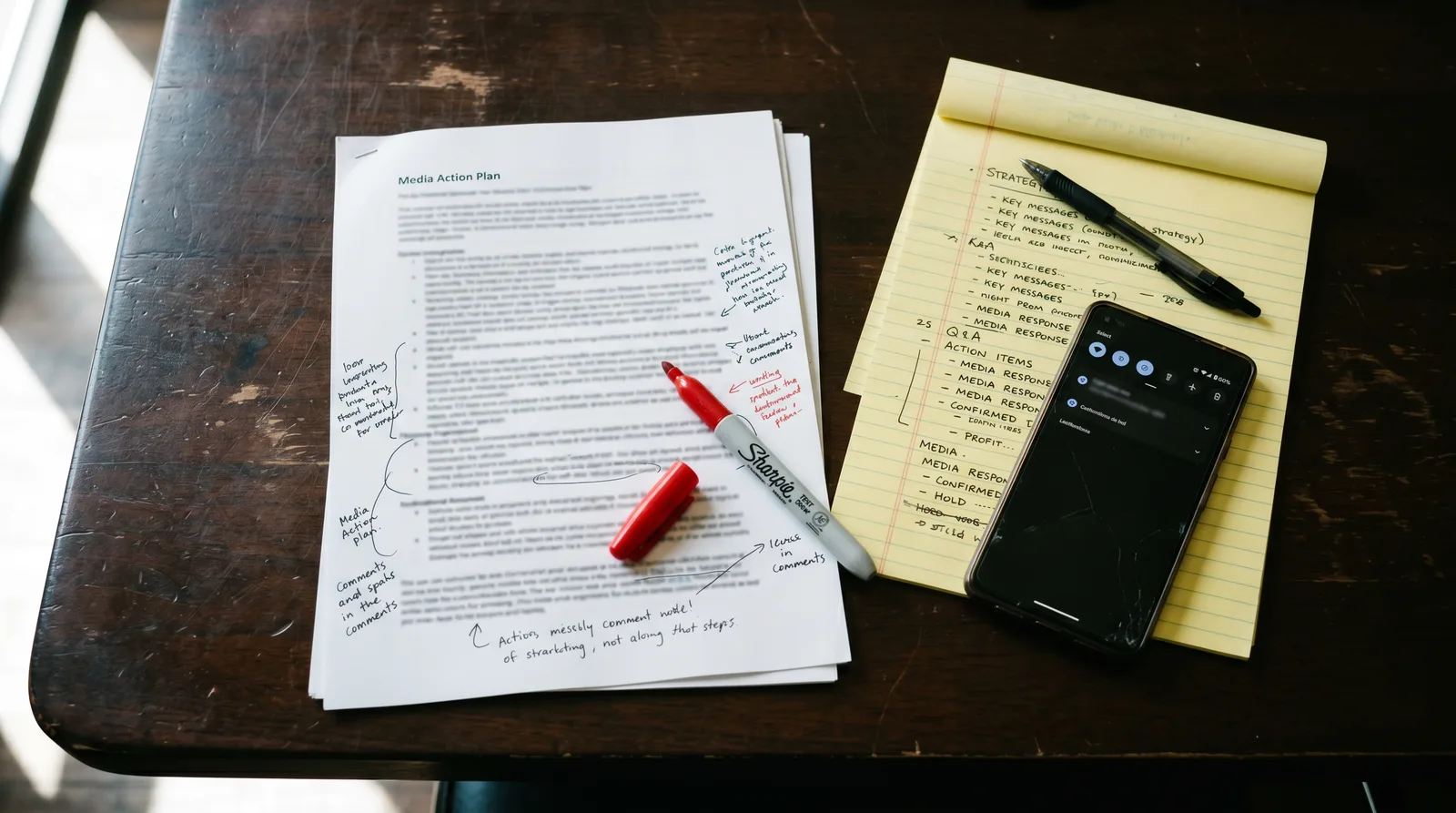
- Build a fully customized Media Action Plan (M.A.P.) that dictates messaging, channels, timing, and spokesperson roles
- Draft and disseminate professional news releases and organize credible news conferences under real deadline pressure
- Manage stakeholder expectations through clear, consistent, high-frequency communication that prevents rumor and litigation risk
- Collaborate on a team M.A.P. exercise using a live scenario, simulating the exact decision-making environment of a real crisis response
How it works
A school that adapts to you
This isn't a set of static videos. Every lesson is generated live and tuned to where you actually are.
We learn your level
A quick placement check tailors your starting point so you're never bored or lost.
Lessons adapt as you go
Each lesson is written for your pace and your goal, adjusting as your skills grow.
Your AI coach keeps you moving
Checkpoints, feedback, and gentle nudges turn progress into a real result.
The curriculum
What's inside your school
5 modules · 23 lessons

Crisis Foundations & the C.A.R.E. Method
Establishes the mindset, vocabulary, and step-by-step C.A.R.E. framework that underpins every crisis response action in this course.
- 1.1What Is a Crisis? Defining the Organizational Threat LandscapeIncluded
- 1.2Introducing C.A.R.E.: A Four-Stage Response FrameworkIncluded
- 1.3Stakeholder-First Thinking: Identifying and Prioritizing Who Matters MostIncluded
- 1.4Proactive Crisis Preparedness: Acting Before the Incident OccursIncluded
- 1.5Knowledge Check: C.A.R.E. Method QuizIncluded
Assembling & Activating Your Crisis Team
Guides students through designing, staffing, and mobilizing a cross-functional Crisis Team so every role is clear before a breach happens.
- 2.1Who Belongs in the Room: Crisis Team Roles and ResponsibilitiesIncluded
- 2.2Internal Acknowledgment: Declaring the Breach and Triggering ProtocolIncluded
- 2.3Chain of Command: Decision-Making Under PressureIncluded
- 2.4Legal and Ethical Guardrails Every Crisis Team Must KnowIncluded
Building the Media Action Plan (M.A.P.)
Takes students from blank page to a fully structured, customized M.A.P. covering messaging, channels, timing, and spokesperson strategy.
- 3.1Anatomy of a M.A.P.: Components, Structure, and PurposeIncluded
- 3.2Crafting Core Messages: Clear, Concise, and Stakeholder-Centered LanguageIncluded
- 3.3Channel Strategy: Choosing the Right Medium for the Right AudienceIncluded
- 3.4Spokesperson Selection and Media Training EssentialsIncluded
- 3.5Timing and Cadence: High-Frequency Communication That Prevents RumorIncluded
Applying C.A.R.E. & M.A.P. to a Real Crisis Scenario
Immerses students in a live, high-stakes scenario — the hospital nursery incident — to practice every framework skill under simulated deadline pressure.
- 4.1Scenario Briefing: The Hospital Nursery IncidentIncluded
- 4.2Executing C.A.R.E.: Walking the Scenario Through Every StageIncluded
- 4.3Individual M.A.P. Assignment: Build Your Crisis Response PlanIncluded
- 4.4Scenario Quiz: Testing C.A.R.E. Decision-Making Under PressureIncluded
Creating & Disseminating the Team M.A.P.
Replicates a real crisis communications room as student teams merge individual plans, receive expert feedback, and produce a unified M.A.P.
- 5.1M.A.P. Peer Review: Giving and Receiving Constructive FeedbackIncluded
- 5.2Team Collaboration: Merging Individual Plans into One Unified M.A.P.Included
- 5.3Writing the News Release: Drafting Under Real Deadline PressureIncluded
- 5.4Organizing a News Conference: Logistics, Roles, and Message ControlIncluded
- 5.5Final Presentation: Delivering and Defending the Team M.A.P.Included
Who it's for
Is this you?

PR Professionals
They handle communications daily but need a structured, repeatable crisis framework they can activate — not reinvent — the moment an incident escalates.

Communications Managers
Responsible for organizational voice, they need to move from reactive messaging to a proactive M.A.P. that aligns stakeholders, channels, and timing before a crisis hits.

Healthcare Administrators
Operating in a high-stakes, high-scrutiny environment, they need a crisis system that addresses patient safety incidents, regulatory exposure, and public trust simultaneously.

Corporate Spokespersons
They're the face of the organization in a crisis and need the spokesperson training, message discipline, and media protocol to perform credibly under real pressure.

Senior Organizational Leaders
CEOs, COOs, and department heads who will be in the command room during a crisis need to understand the C.A.R.E. chain of command and their role in it.

Legal & Compliance Staff
They set the guardrails — and this curriculum shows them exactly how legal considerations integrate with PR decisions so the whole crisis team moves in one direction.
Questions
Frequently asked
Your teacher
A note from your teacher

Tonya McCleary
If you've ever been the person in the room when something went wrong — the one the executives looked to, the one the lawyers were calling, the one expected to have answers before you'd had time to process the question — then you already know what this school is for.
Most crisis communication training teaches you concepts. It walks you through theory, gives you a checklist, and sends you back to work hoping you'll figure out the rest when the moment arrives. I built Crisis Command PR because that approach isn't good enough. When a crisis breaks — a data breach, a patient safety incident, a leadership failure — you don't have time to improvise a framework. You need a system that's already built, already tested, and already understood by every person on your team.
That system is the C.A.R.E. method, and the tool it produces is your Media Action Plan. Together, they give you something most organizations don't have: a repeatable, stakeholder-first process for moving from incident to resolution with credibility and control. We go deep into both — not as abstract concepts, but as working documents you build, apply to a real scenario, stress-test with peers, and walk away ready to deploy.
I want to be honest with you about what this school is. It is not a passive experience. You will map stakeholders, draft messages under deadline pressure, assemble a cross-functional team structure, write a news release, and defend a completed M.A.P. in a team setting. You will be challenged, and you will be better for it — because that's exactly what a real crisis demands of you.
The people and organizations you represent deserve a communicator who is prepared before the crisis arrives, not one who's learning on the way to the podium. If you're ready to become that communicator, you're in the right place. Let's get to work.
— Tonya McCleary
Start your journey today
Join get instant access — learn at your own pace with an AI coach in your corner.
$150/mo
Recurring billing · cancel anytime
Secure checkout · Instant access
- 5 modules, 23 lessons
- AI-adaptive lessons tuned to your level
- Quizzes & checkpoints to lock in progress
- Your own AI learning coach
- Learn on any device, at your pace
- Full access for as long as you're subscribed