
Lead your organization through any crisis — without improvising
Master the frameworks, decision-making disciplines, and contingency architectures that keep organizations operational when everything goes wrong. Built for leaders who can't afford to improvise under pressure.
"Resilience isn't what you do when the crisis hits — it's the architecture you built before it did."— Dr. J Sebaaly
What you'll learn
What you'll be able to do
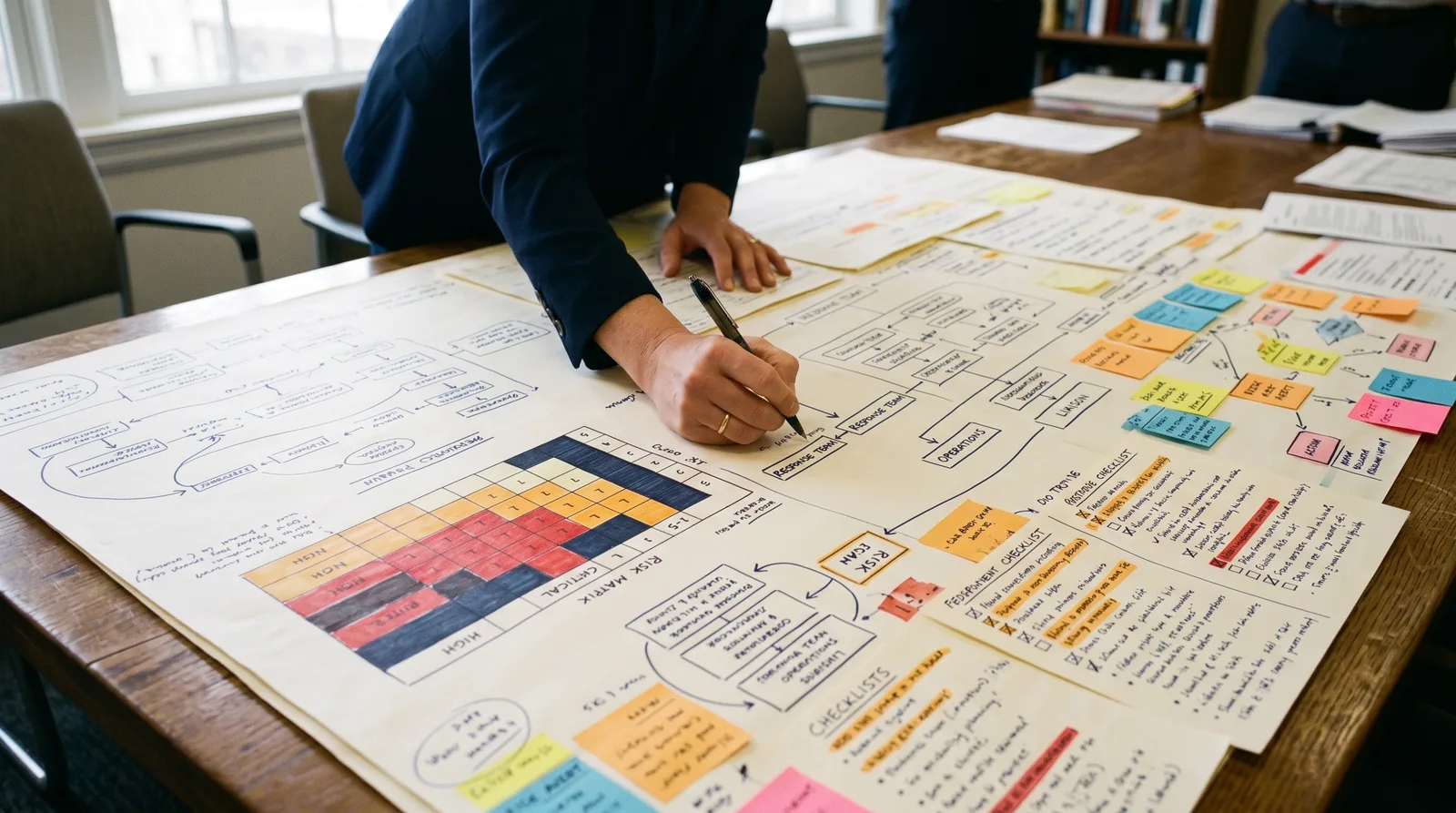
- Build a fully documented contingency plan with risk-tiered response protocols for your organization
- Apply structured decision-making models that hold up under cognitive stress and time pressure
- Design and run tabletop exercises that expose critical gaps before a real crisis does
- Establish a crisis command structure with clear roles, communication chains, and escalation triggers
- Develop operational continuity playbooks that keep core functions running through disruption
- Conduct post-incident reviews that translate crisis data into lasting organizational resilience
How it works
A school that adapts to you
This isn't a set of static videos. Every lesson is generated live and tuned to where you actually are.
We learn your level
A quick placement check tailors your starting point so you're never bored or lost.
Lessons adapt as you go
Each lesson is written for your pace and your goal, adjusting as your skills grow.
Your AI coach keeps you moving
Checkpoints, feedback, and gentle nudges turn progress into a real result.
The curriculum
What's inside your school
6 modules · 18 lessons

Crisis Anatomy and Risk Intelligence
Establishes the foundational knowledge every practitioner needs before designing any plan or structure. Learners study how crises develop and cascade, build a living threat register tiered by risk severity, and conduct an honest organizational vulnerability assessment — creating the evidence base that every downstream module draws on.
- 1.1How Crises Actually UnfoldIncluded
- 1.2Building a Risk-Tiered Threat RegisterIncluded
- 1.3Organizational Vulnerability AssessmentIncluded
Contingency Architecture and Continuity Playbooks
Translates the risk intelligence built in Module 1 directly into documented, actionable plans. Learners design response protocols calibrated to each risk tier, build operational continuity playbooks that keep core functions running through disruption, and assemble everything into a fully documented contingency plan — the primary deliverable of the entire course.
- 2.1Designing Risk-Tiered Response ProtocolsIncluded
- 2.2Operational Continuity PlaybooksIncluded
- 2.3Documenting the Full Contingency PlanIncluded
Crisis Command Structure and Communication
Defines who is in charge of what, under what conditions, and how information flows. Without this module's outputs, even the best-designed plans fail in execution. Learners build a command structure tailored to their organization, define escalation triggers and decision authorities, and design communication chains that hold up under the chaos and information overload of a real crisis.
- 3.1Building Your Crisis Command StructureIncluded
- 3.2Escalation Triggers and Decision AuthoritiesIncluded
- 3.3Crisis Communication Chains and Stakeholder ProtocolsIncluded
Decision-Making Under Pressure
Directly addresses the human performance layer that determines whether well-designed plans are actually executed well. Learners understand how cognitive stress degrades decision quality, master structured decision models proven to hold up under time pressure and uncertainty, and establish documentation practices that preserve command integrity and accountability throughout a crisis.
- 4.1How Stress Degrades Decisions — and How to Counter ItIncluded
- 4.2Structured Decision Models for Crisis ConditionsIncluded
- 4.3Decision Documentation and Command IntegrityIncluded
Tabletop Exercises and Gap Exposure
Transforms plans, structures, and decision models into tested — not assumed — capabilities. Learners design exercises that are realistic enough to expose genuine gaps, facilitate them with the discipline to let failures surface rather than coaching teams to success, and run structured debriefs that convert exercise findings into actionable plan revisions. Placed after Modules 1–4 so exercises test real, developed plans.
- 5.1Designing High-Impact Tabletop ExercisesIncluded
- 5.2Facilitating and Observing ExercisesIncluded
- 5.3Debriefing Exercises and Closing the GapIncluded
Post-Incident Reviews and Building Lasting Resilience
Closes the learning loop after real events — not just exercises. Learners conduct rigorous post-incident reviews that go beyond blame assignment to surface systemic causes, translate crisis data into documented organizational improvements, and build the cultural and structural conditions for resilience to compound over time. This module transforms crisis experience into institutional capability.
- 6.1Conducting Rigorous Post-Incident ReviewsIncluded
- 6.2Translating Crisis Data into Systemic ImprovementsIncluded
- 6.3Building an Organizational Resilience CultureIncluded
Who it's for
Is this you?

Operations Directors
Responsible for keeping complex systems running, they need contingency architectures and continuity playbooks that hold up when the operational environment goes sideways.

Risk & Compliance Officers
They own the threat register and need a structured, defensible methodology to assess organizational vulnerabilities and build risk-tiered response protocols.

Business Continuity Planners
Tasked with producing plans that actually function under pressure, they'll gain the frameworks to design, test, and continuously improve their organization's continuity program.

Government & Public Sector Leaders
Operating in high-accountability environments where disruption has public consequences, they need command structures and communication chains built to withstand scrutiny and stress.

Healthcare Operations Managers
In a sector where operational failure directly affects patient outcomes, they need decision-making discipline and escalation protocols that perform when stakes are at their highest.

Senior Leaders Entering Crisis Roles
Newly appointed to a leadership position with crisis accountability, they need to rapidly build the doctrine, language, and structured thinking to lead a prepared organization.
Questions
Frequently asked
Your teacher
A note from your teacher

Dr. J Sebaaly
If you're here, you already know the uncomfortable truth: most organizations don't find out their crisis plan doesn't work until they need it. The plan exists — it might even be well-documented — but when pressure hits and the situation gets ambiguous and the clock starts running, the seams show. The command structure is unclear. The escalation triggers aren't defined. The decision authority is assumed, not assigned. And the people who are supposed to execute have never actually practiced together.
That's not a failure of effort. It's a failure of architecture.
I built Crisis Ready because the gap between "we have a plan" and "we are genuinely prepared" is where organizations get hurt — and it's a gap that closes through rigorous, structured work, not good intentions. This program is built on the doctrine that crisis preparedness is an operational discipline, not a compliance exercise. Every module delivers a framework you can use, a deliverable you can act on, and a discipline you can embed into how your organization actually operates.
What this course will do is take you through the full cycle of crisis readiness: from mapping your real threat landscape and building a contingency architecture that's actually tiered to your risk profile, through designing the command structure and communication chains that hold under pressure, to the decision-making models that keep judgment sharp when stress is high. Then we go further — into the tabletop exercises that expose your gaps before a real event does, and the post-incident reviews that translate hard experience into lasting improvements. Most programs stop before that last step. We don't.
I won't tell you this is easy work. Building genuine organizational resilience requires honest vulnerability assessment, uncomfortable gap exposure, and the discipline to document, test, and iterate. What I will tell you is that it is entirely learnable — and that the leaders who do this work are the ones their organizations can count on when it matters. If you're ready to build something that actually holds, I'm ready to show you how.
— Dr. J Sebaaly
Start learning today
Join get instant access — learn at your own pace with an AI coach in your corner.
$59.99/yr
Recurring billing · cancel anytime
Secure checkout · Instant access
- 6 modules, 18 lessons
- AI-adaptive lessons tuned to your level
- Quizzes & checkpoints to lock in progress
- Your own AI learning coach
- Learn on any device, at your pace
- Full access for as long as you're subscribed